
Class 5: Maths Chapter 6 solutions. Complete Class 5 Maths Chapter 6 Notes.
Maharashtra Board Solutions Class 5-Maths (Problem Set 27) - Part 1: Chapter 6- Angles
Maharashtra Board 5th Maths Chapter 6, Class 5 Maths Chapter 6 solutions
Important Questions and Answers.
Question 1.
Give two examples of parallel lines you can see in your environment.
Answer:
(i) Bars on the window.
(ii) Horizontal lines in the notebook are the examples of parallel lines.
Question 2.
Give two examples of perpendicular lines you can see in your environment.
Answer:
(i) The angles formed by a pole and its shadow on the ground.
(ii) The adjacent sides of a notebook.
Question 3.
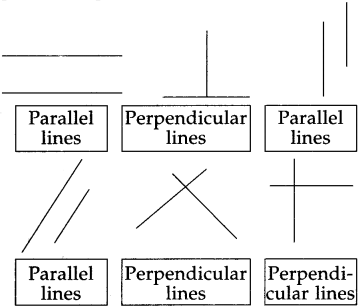
Look at the pictures given below. Decide whether the lines given in each picture are parallel or perpendicular to each other and write the answer in the box.
Answer:
Angles Problem Set 27 Additional Important Questions and Answers
Question 1.
Give some examples of perpendicular lines from capital letters of the English alphabet.
Answer:
Question 2.
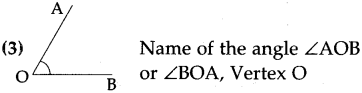
Complete the following: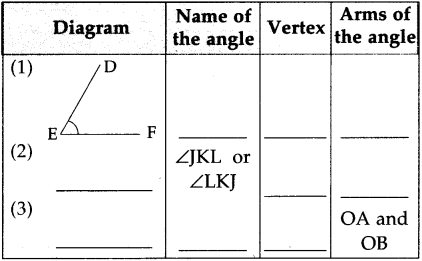
Answer:
(1) ZDEF or ZFED, Vertex E, arms are ED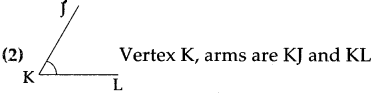
Question 3.
Which of the following figures show angle?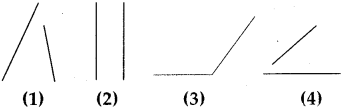
Answer:
Figure 3
Question 4.
(A) Measure the angles given below and write the measure in the given boxes: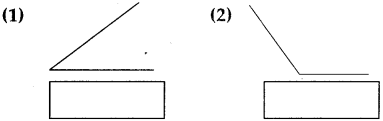
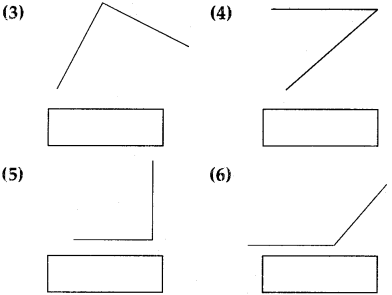
Answer:
(1) 30°
(2) 135°
(3) 90°
(4) 50°
(5) 90°
(6) 150°
B) Classify the above figures according to types of the angles.
Answer:
Acute angles: (1) and (4),
Right angles: (3) and (5),
Obtuse angles: (2) and (6)
Question 5.
Draw and name the following angles with the help of a protractor: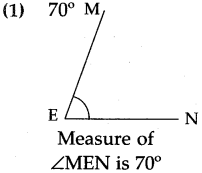
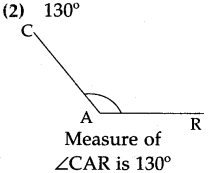
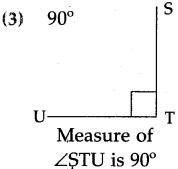
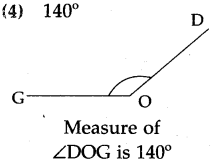
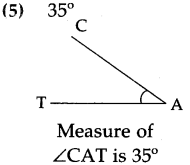
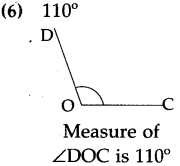
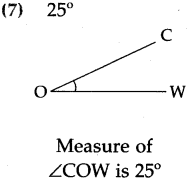
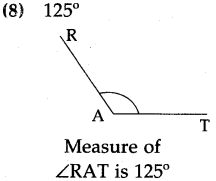
Answer:
Students to draw angles.
Question 6.
Look at the pictures given below. Decide whether the lines given in each picture are parallel or perpendicular to each other and write the answer in the box: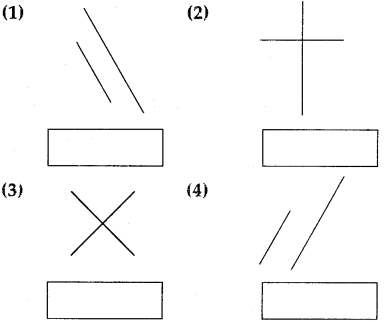
Answer:
(1) Parallel lines
(2) Perpendicular lines
(3) Perpendicular lines
(4) Parallel lines
Question 7.
Say, true or false of the following:
(1) Parallel lines do not intersect each other.
(2) Pole and its shadow on the ground makes a cute angle.
(3) Angle between two parallel lines is 90°.
(4) Angle between two intersecting lines may or may not be 90°.
Answer:
(1) True
(2) False
(3) False
(4) True
Download PDF
Maharashtra Board Solutions Class 5-Maths (Problem Set 27) - Part 1: Chapter 6- Angles
Chapterwise Maharashtra Board Solutions Class 5 Maths :
Part 1
- Chapter 1- Roman Numerals (Problem Set 1)
- Chapter 2- Number Work (Problem Set 2)
- Chapter 2- Number Work (Problem Set 3)
- Chapter 2- Number Work (Problem Set 4)
- Chapter 2- Number Work (Problem Set 5)
- Chapter 2- Number Work (Problem Set 6)
- Chapter 3- Addition and Subtraction (Problem Set 7)
- Chapter 3- Addition and Subtraction (Problem Set 8)
- Chapter 3- Addition and Subtraction (Problem Set 9)
- Chapter 3- Addition and Subtraction (Problem Set 10)
- Chapter 3- Addition and Subtraction (Problem Set 11)
- Chapter 3- Addition and Subtraction (Problem Set 12)
- Chapter 3- Addition and Subtraction (Problem Set 13)
- Chapter 4- Multiplication and Division (Problem Set 14)
- Chapter 4- Multiplication and Division (Problem Set 15)
- Chapter 4- Multiplication and Division (Problem Set 16)
- Chapter 5- Fractions (Problem Set 17)
- Chapter 5- Fractions (Problem Set 18)
- Chapter 5- Fractions (Problem Set 19)
- Chapter 5- Fractions (Problem Set 20)
- Chapter 5- Fractions (Problem Set 21)
- Chapter 5- Fractions (Problem Set 22)
- Chapter 5- Fractions (Problem Set 23)
- Chapter 6- Angles (Problem Set 24)
- Chapter 6- Angles (Problem Set 25)
- Chapter 6- Angles (Problem Set 26)
- Chapter 6- Angles (Problem Set 27)
- Chapter 7- Circles (Problem Set 28)
- Chapter 7- Circles (Problem Set 29)
- Chapter 7- Circles (Problem Set 30)
- Chapter 7- Circles (Problem Set 31)
Part 2.
- Chapter 8- Multiples and Factors (Problem Set 32)
- Chapter 8- Multiples and Factors (Problem Set 33)
- Chapter 8- Multiples and Factors (Problem Set 34)
- Chapter 8- Multiples and Factors (Problem Set 35)
- Chapter 9- Decimal Fractions (Problem Set 36)
- Chapter 9- Decimal Fractions (Problem Set 37)
- Chapter 9- Decimal Fractions (Problem Set 38)
- Chapter 9- Decimal Fractions (Problem Set 39)
- Chapter 9- Decimal Fractions (Problem Set 40)
- Chapter 9- Decimal Fractions (Problem Set 41)
- Chapter 9- Decimal Fractions (Problem Set 42)
- Chapter 10- Measuring Time (Problem Set 43)
- Chapter 10- Measuring Time (Problem Set 44)
- Chapter 10- Measuring Time (Problem Set 45)
- Chapter 11- Problems on Measurement (Problem Set 46)
- Chapter 11- Problems on Measurement (Problem Set 47)
- Chapter 12- Perimeter and Area (Problem Set 48)
- Chapter 12- Perimeter and Area (Problem Set 49)
- Chapter 12- Perimeter and Area (Problem Set 50)
- Chapter 13- Three Dimensional Objects and Nets (Problem Set 51)
- Chapter 14- Pictographs (Problem Set 52)
- Chapter 15- Patterns (Problem Set 53)
- Chapter 16- Preparation for Algebra (Problem Set 54)
- Chapter 16- Preparation for Algebra (Problem Set 55)
- Chapter 16- Preparation for Algebra (Problem Set 56)