
Class 5: Maths Chapter 8 solutions. Complete Class 5 Maths Chapter 8 Notes.
Maharashtra Board Solutions Class 5-Maths (Problem Set 33) - Part 2: Chapter 8- Multiples and Factors
Maharashtra Board 5th Maths Chapter 8, Class 5 Maths Chapter 8 solutions
Important Questions and Answers.
Question 1.
(1) Write five three-digit numbers that are multiples of 2.
Answer:
100, 102, 104, 106, 108.
(2) Write five three-digit numbers that are multiples of 5.
Answer:
100, 105, 110, 115, 120.
(3) Write five three-digit numbers that are multiples of 10.
Answer:
100, 110, 120, 130, 140.
Question 2.
Write 5 numbers that are multiples of 2 as well as of 3.
Answer:
2 as well as of 3 means 2 and 3 that is multiples of 6.
They are 6, 12, 18, 24, 30.
Question 3.
A ribbon is 3 metres long. Can we cut it into 50 cm pieces and have nothing left over? Write the reason why or why not.
Answer:
3 metres = 300 cm.
We can cut it into 50 cm pieces.
Since 300 is exactly divisible 50.
That is 300 is multiples of 50.
300 ÷ 50 = 6
We will get 6 pieces, nothing is left over.
Question 4.
A ribbon is 3 metres long. I need 8 pieces of ribbon each 40 cm long. How many centimetres shorter is the ribbon than the length I need?
Answer:
1 piece of 40 cm, so for 8 pieces ribbon needed is 40 x 8 = 320 cm.
But ribbon is 3 metre = 300 cm long.
So ribbon is shorter by 320 – 300 = 20 cm.
Question 5.
If the number given in the table is divisible by the given divisor, put ✓ in the box. If it is not divisible by the divisor, put ✗ in the box.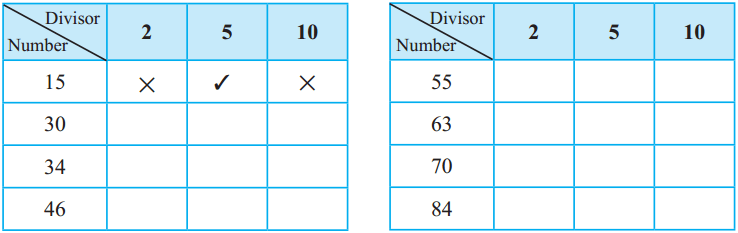
Answer: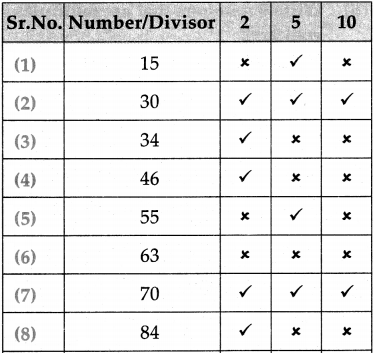
Prime and composite numbers
Some numbers are given in the tables below. Write all of their factors.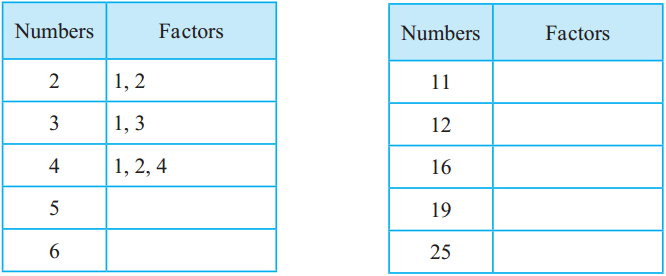
Dada : What do you notice on studying the table?
Ajay : The number 1 is a factor of every number. Some numbers have only 1 and the number itself as factors. For example, the only factors of 3 are 1 and 3. Similarly, the factors of 2 are only 1 and 2 and the factors of 19 are only 1 and 19. Some numbers have more than two factors.
Dada : Numbers like 2, 3, 19 which have only two factors are called prime numbers.
A number which has only two factors, 1 and the number itself, is called a prime number.
Ajay : What do we call numbers like 4, 6 and 16 which have more than two factors?
Dada : Numbers like 4, 6 and 16 are called composite numbers.
A number which has more than two factors is called a composite number.
Dada : Think carefully and tell me whether 1 is a prime or composite number.
Ajay : The number 1 has only one factor, 1 itself, so I can’t answer your question.
Dada : You’re right. 1 is considered neither a prime number nor a composite number.
1 is a number which is neither prime nor composite.
Additional Important Questions and Answers
Question 1.
Write five three-digit numbers that are multiples of 3.
Answer:
102, 105, 108, 111, 114.
Question 2.
Write five two-digit numbers that are multiples of 7.
Answer:
14, 21, 28, 35, 42
Question 3.
Write five three-digit numbers that are multiples of 4.
Answer:
112, 116, 120, 124, 128.
Question 4.
Write 5 numbers that are multiples of 3 as well as 5.
Answer:
3 as well as 5 means 3 and 5. i.e. multiples of 15.
They are 15, 30, 45, 60, 75.
Question 5.
A string is 4 metres long. Can we cut it into 50 cm pieces and have nothing left over?
Answer:
4 metres = 400 cm.
We can cut it into 50 cm pieces.
Since 400 is exactly divisible by 50.
That is 400 is multiple of 50 400 + 50 = 8
We will get 8 pieces. Nothing is left over.
Question 6.
A paper Is 2 metres long. I need 8 pieces of paper each 30 cm long. How many centimetres shorter is the paper than the length I need?
Answer:
A piece of 30 cm, so for 8 pieces paper needed is 30 x 8 = 240 cm.
But paper is 2 metre = 2 x 100 = 200 cm long.
So paper is shorter by 240 – 200 = 40 cm
Question 7.
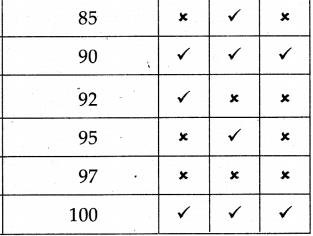
If the number given in the table is divisible by the given divisor, put P in the box. If it is not divisible by the divisor, put in the box.
Answer:
Download PDF
Maharashtra Board Solutions Class 5-Maths (Problem Set 33) - Part 2: Chapter 8- Multiples and Factors
Chapterwise Maharashtra Board Solutions Class 5 Maths :
Part 1
- Chapter 1- Roman Numerals (Problem Set 1)
- Chapter 2- Number Work (Problem Set 2)
- Chapter 2- Number Work (Problem Set 3)
- Chapter 2- Number Work (Problem Set 4)
- Chapter 2- Number Work (Problem Set 5)
- Chapter 2- Number Work (Problem Set 6)
- Chapter 3- Addition and Subtraction (Problem Set 7)
- Chapter 3- Addition and Subtraction (Problem Set 8)
- Chapter 3- Addition and Subtraction (Problem Set 9)
- Chapter 3- Addition and Subtraction (Problem Set 10)
- Chapter 3- Addition and Subtraction (Problem Set 11)
- Chapter 3- Addition and Subtraction (Problem Set 12)
- Chapter 3- Addition and Subtraction (Problem Set 13)
- Chapter 4- Multiplication and Division (Problem Set 14)
- Chapter 4- Multiplication and Division (Problem Set 15)
- Chapter 4- Multiplication and Division (Problem Set 16)
- Chapter 5- Fractions (Problem Set 17)
- Chapter 5- Fractions (Problem Set 18)
- Chapter 5- Fractions (Problem Set 19)
- Chapter 5- Fractions (Problem Set 20)
- Chapter 5- Fractions (Problem Set 21)
- Chapter 5- Fractions (Problem Set 22)
- Chapter 5- Fractions (Problem Set 23)
- Chapter 6- Angles (Problem Set 24)
- Chapter 6- Angles (Problem Set 25)
- Chapter 6- Angles (Problem Set 26)
- Chapter 6- Angles (Problem Set 27)
- Chapter 7- Circles (Problem Set 28)
- Chapter 7- Circles (Problem Set 29)
- Chapter 7- Circles (Problem Set 30)
- Chapter 7- Circles (Problem Set 31)
Part 2.
- Chapter 8- Multiples and Factors (Problem Set 32)
- Chapter 8- Multiples and Factors (Problem Set 33)
- Chapter 8- Multiples and Factors (Problem Set 34)
- Chapter 8- Multiples and Factors (Problem Set 35)
- Chapter 9- Decimal Fractions (Problem Set 36)
- Chapter 9- Decimal Fractions (Problem Set 37)
- Chapter 9- Decimal Fractions (Problem Set 38)
- Chapter 9- Decimal Fractions (Problem Set 39)
- Chapter 9- Decimal Fractions (Problem Set 40)
- Chapter 9- Decimal Fractions (Problem Set 41)
- Chapter 9- Decimal Fractions (Problem Set 42)
- Chapter 10- Measuring Time (Problem Set 43)
- Chapter 10- Measuring Time (Problem Set 44)
- Chapter 10- Measuring Time (Problem Set 45)
- Chapter 11- Problems on Measurement (Problem Set 46)
- Chapter 11- Problems on Measurement (Problem Set 47)
- Chapter 12- Perimeter and Area (Problem Set 48)
- Chapter 12- Perimeter and Area (Problem Set 49)
- Chapter 12- Perimeter and Area (Problem Set 50)
- Chapter 13- Three Dimensional Objects and Nets (Problem Set 51)
- Chapter 14- Pictographs (Problem Set 52)
- Chapter 15- Patterns (Problem Set 53)
- Chapter 16- Preparation for Algebra (Problem Set 54)
- Chapter 16- Preparation for Algebra (Problem Set 55)
- Chapter 16- Preparation for Algebra (Problem Set 56)