
Class 5: Maths Chapter 14 solutions. Complete Class 5 Maths Chapter 14 Notes.
Maharashtra Board Solutions Class 5-Maths (Problem Set 52) - Part 2: Chapter 14- Pictographs
Maharashtra Board 5th Maths Chapter 14, Class 5 Maths Chapter 14 solutions
Important Questions and Answers.
Question 1.
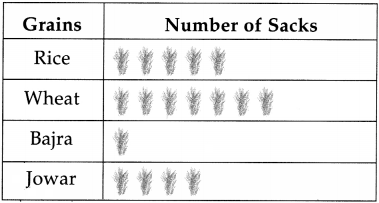
Stocks of various types of grains stored in a warehouse are as given below. Make a pictograph based on the information given.
| Grain | Sacks |
| Rice | 40 |
| Wheat | 56 |
| Bajra | 8 |
| Jowar | 32 |
Answer:
Scale :1 picture = 8 sacks
Question 2.
Information about the various types of vehicles in Wadgaon is given below. Make a pictograph for this data.
| Types of vehicles | Number |
| Bicycles | 84 |
| Automatic two-wheelers | 60 |
| Four-wheelers (cars/jeeps) | 24 |
| Heavy vehicles (truck, bus, etc.) | 12 |
| Tractors | 24 |
Answer: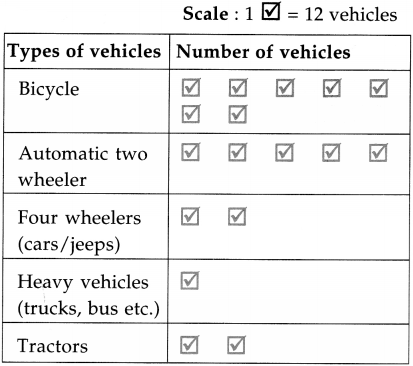
Question 3.
The numbers of the various books kept in a cupboard in the school library are given below. Make a pictograph showing the information given.
| Type of book | Number |
| Science | 28 |
| Sports | 14 |
| Poetry | 21 |
| Literature | 35 |
| History | 7 |
Answer: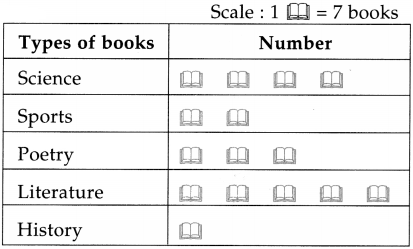
Activity
Collect information based on the points given below and make a pictograph for each.
- Which crops are grown on the farms owned by students in your class? (Vegetables, grains, pulses, fruits, etc.)
- Which storybooks do your classmates like? (fairytales, stories about kings and queens, historical stories, stories about saints, picture stories, etc.)
- What do your classmates want to be when they grow up ? (doctor, teacher, farmer, engineer, officer, etc.)
Additional Important Questions and Answers
Solve the following
Question 1.
Information regarding the number of pages of novel book read in different days by Rosi are as follows. Make a pictograph showing the information given.
| Days | 1st day | 2nd day | 3rd day | 4th day |
| Pages | 60 | 40 | 30 | 20 |
Question 2.
Different types of currency notes had with Shamin are as follows. Make a pictograph showing the information given.
| Types of Notes | ₹ 500 | ₹ 100 | ₹ 50 | ₹ 10 |
| Number of Notes | 8 | 10 | 6 | 4 |
Question 3.
Different types of colour of scooters sold by a merchant are as follows. Make a pictograph showing the data given.
| Colour | White | Red | Black | Yellow |
| No, of scooters sold | 6 | 9 | 12 | 3 |
Question 4.
Ajhount of sales of goods in rupees for the first four days of a week are as follows. Make a pictograph from the information given below.
| Days | Marks |
| Monday | ₹ 150 |
| Tuesday | ₹ 200 |
| Wednesday | ₹ 250 |
| Thursday | ₹ 100 |
Answer:
(1) All the given numbers can be divided by 2, 5, and 10. 1 picture of 10 pages will be convenient scale so 6 pictures for 60 pages. 4 pictures for 40, 3 for 30 and 2 for 20.
(2) All the given numbers can divided by 2 only, so 1 picture for 2 notes will be the scale. So, 4 pictures for notes of ? 500, 5 for ? 100 notes, 3 for ? 50 and 2 for ? 10.
(3) All given numbers are divisible by 3, so 1 picture for 3 scooters will be the scale. So, 2 pictures for white, 3 for Red, 4 for Black and 1 pictures for Yellow.
(4) All the given numbers can be divided by 2, 5,10, 25 and 50. So, 1 picture for 50 rupees will be convenient scale. So, draw 3 pictures for Monday, 4 for Tuesday, 5 for Wednesday and 2 for Thursday.
(5) Number of books are multiples of 50. Therefore Take number of pictures = 5,4,2, 1, 3 respectively.
Download PDF
Maharashtra Board Solutions Class 5-Maths (Problem Set 52) - Part 2: Chapter 14- Pictographs
Chapterwise Maharashtra Board Solutions Class 5 Maths :
Part 1
- Chapter 1- Roman Numerals (Problem Set 1)
- Chapter 2- Number Work (Problem Set 2)
- Chapter 2- Number Work (Problem Set 3)
- Chapter 2- Number Work (Problem Set 4)
- Chapter 2- Number Work (Problem Set 5)
- Chapter 2- Number Work (Problem Set 6)
- Chapter 3- Addition and Subtraction (Problem Set 7)
- Chapter 3- Addition and Subtraction (Problem Set 8)
- Chapter 3- Addition and Subtraction (Problem Set 9)
- Chapter 3- Addition and Subtraction (Problem Set 10)
- Chapter 3- Addition and Subtraction (Problem Set 11)
- Chapter 3- Addition and Subtraction (Problem Set 12)
- Chapter 3- Addition and Subtraction (Problem Set 13)
- Chapter 4- Multiplication and Division (Problem Set 14)
- Chapter 4- Multiplication and Division (Problem Set 15)
- Chapter 4- Multiplication and Division (Problem Set 16)
- Chapter 5- Fractions (Problem Set 17)
- Chapter 5- Fractions (Problem Set 18)
- Chapter 5- Fractions (Problem Set 19)
- Chapter 5- Fractions (Problem Set 20)
- Chapter 5- Fractions (Problem Set 21)
- Chapter 5- Fractions (Problem Set 22)
- Chapter 5- Fractions (Problem Set 23)
- Chapter 6- Angles (Problem Set 24)
- Chapter 6- Angles (Problem Set 25)
- Chapter 6- Angles (Problem Set 26)
- Chapter 6- Angles (Problem Set 27)
- Chapter 7- Circles (Problem Set 28)
- Chapter 7- Circles (Problem Set 29)
- Chapter 7- Circles (Problem Set 30)
- Chapter 7- Circles (Problem Set 31)
Part 2.
- Chapter 8- Multiples and Factors (Problem Set 32)
- Chapter 8- Multiples and Factors (Problem Set 33)
- Chapter 8- Multiples and Factors (Problem Set 34)
- Chapter 8- Multiples and Factors (Problem Set 35)
- Chapter 9- Decimal Fractions (Problem Set 36)
- Chapter 9- Decimal Fractions (Problem Set 37)
- Chapter 9- Decimal Fractions (Problem Set 38)
- Chapter 9- Decimal Fractions (Problem Set 39)
- Chapter 9- Decimal Fractions (Problem Set 40)
- Chapter 9- Decimal Fractions (Problem Set 41)
- Chapter 9- Decimal Fractions (Problem Set 42)
- Chapter 10- Measuring Time (Problem Set 43)
- Chapter 10- Measuring Time (Problem Set 44)
- Chapter 10- Measuring Time (Problem Set 45)
- Chapter 11- Problems on Measurement (Problem Set 46)
- Chapter 11- Problems on Measurement (Problem Set 47)
- Chapter 12- Perimeter and Area (Problem Set 48)
- Chapter 12- Perimeter and Area (Problem Set 49)
- Chapter 12- Perimeter and Area (Problem Set 50)
- Chapter 13- Three Dimensional Objects and Nets (Problem Set 51)
- Chapter 14- Pictographs (Problem Set 52)
- Chapter 15- Patterns (Problem Set 53)
- Chapter 16- Preparation for Algebra (Problem Set 54)
- Chapter 16- Preparation for Algebra (Problem Set 55)
- Chapter 16- Preparation for Algebra (Problem Set 56)