
Class 10: Maths Chapter 16 solutions. Complete Class 10 Maths Chapter 16 Notes.
RS Aggarwal Solutions for Class 10 Maths Chapter 16–Areas of Circle, Sector and Segment
RS Aggarwal 10th Maths Chapter 16, Class 10 Maths Chapter 16 solutions
Question 1:
Radius = Diameter2=352cm
Circumference of circle = 2πr = (2×227×352)cm = 110 cm
∴ Area of circle = πr2 = (227×352×352) cm2
= 962.5 cm2
Question 2:
Circumference of circle = 2πr = 39.6 cm
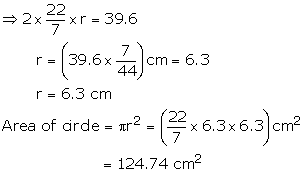
Question 3:
Area of circle = πr2 = 301.84
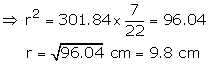
Circumference of circle = 2πr = (2×227×9.8) = 61.6 cm
Question 4:
Let radius of circle be r
Then, diameter = 2 r
circumference – Diameter = 16.8
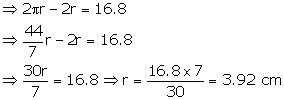
Circumference of circle = 2πr = (2×227×3.92) cm = 24.64 cm
Question 5:
Let the radius of circle be r cm
Then, circumference – radius = 37 cm
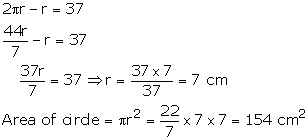
Question 6:
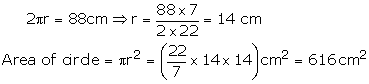
Area of square = (side)2 = 484 cm2
⇒ side = 484−−−√cm = 22 cm
Perimeter of square = 4 × side = 4 × 22 = 88 cm
Circumference of circle = Perimeter of square
Question 7:
Area of equilateral = 3√4a2 = 121√3
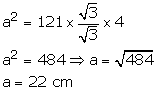
Perimeter of equilateral triangle = 3a = (3 × 22) cm
= 66 cm
Circumference of circle = Perimeter of circle
2πr = 66
⇒ (2×227×r) cm = 66
⇒ r = 10.5 cm
Area of circle = πr2 = (227×10.5×10.5) cm2
= 346.5 cm2
Question 8:
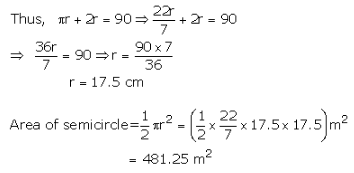
Let the radius of park be r meter
Question 9:
Let the radii of circles be x cm and (7 – x) cm
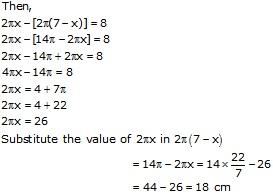
Circumference of the circles are 26 cm and 18 cm
Question 10:
Area of first circle = πr2 = 962.5 cm2
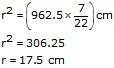
Area of second circle = πR2 = 1386 cm2
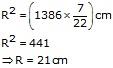
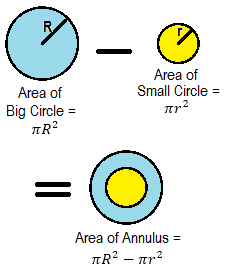
Width of ring R – r = (21 – 17.5) cm = 3.5 cm
Question 11:
Area of outer circle = πr21 = (227×23×23) cm2
= 1662.5
Area of inner circle = πr22 = (227×12×12) cm2
= 452.2 cm2
Area of ring = Outer area – inner area
= (1662.5 – 452.5) cm2 = 1210 cm2
Question 12:
Inner radius of the circular park = 17 m
Width of the path = 8 m
Outer radius of the circular park = (17 + 8)m = 25 m
Area of path = π[(25)2-(17)2] = cm2
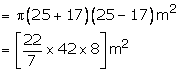
Area = 1056 m2
Question 13:
Let the inner and outer radii of the circular tacks be r meter and R meter respectively. Then
Inner circumference = 440 meter
Since the track is 14 m wide every where.
Therefore,
Outer radius R = r + 14m = (70 + 14) m = 84 m
Outer circumference = 2πR
= (2×227×84)m = 528 m
Rate of fencing = Rs. 5 per meter
Total cost of fencing = Rs. (528 × 5) = Rs. 2640
Area of circular ring = πR2 – πr2

Cost of levelling = Rs 0.25 per m2
Cost of levelling the track = Rs(6776 × 0.25) = Rs. 1694
Question 14:
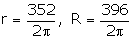
Let r m and R m be the radii of inner circle and outer boundaries respectively.
Then, 2r = 352 and 2R = 396
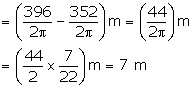
Width of the track = (R – r) m
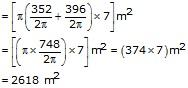
Area the track = π(R2 – r2 ) = π (R+r)(R-r)
Question 15:
Area of rectangle = (120 × 90)
= 10800 m2
Area of circular lawn = [Area of rectangle – Area of park excluding circular lawn]
= [10800 – 2950] m2 = 7850 m2
Area of circular lawn = 7850 m2
⇒ πr2 = 7850 m2
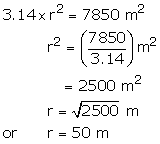
Hence, radius of the circular lawn = 50 m
Question 16:
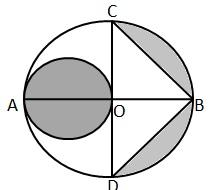
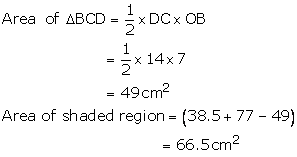
Area of the shaded region = (area of circle with OA as diameter) + (area of semicircle ∆DBC) – (area of ∆BCD)
Area of circle with OA as diameter = πr2
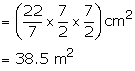
OB = 7 cm, CD = AB = 14 cm
Area of semicircle ∆DBC =
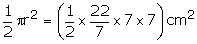
= 72
Question 17:
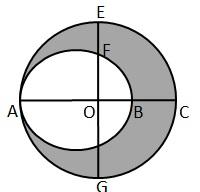
Diameter of bigger circle = AC = 54 cm
Radius of bigger circle = AC2
= (542) cm = 27 cm
Diameter AB of smaller circle = AC – BC = 54-10 = 44 cm
Radius of smaller circle = 442 cm = 22 cm
Area of bigger circle = πR2 = (227×27×27) cm2
= 2291. 14 cm2
Area of smaller circle = πr2 = (227×22×22) cm2
= 1521. 11 cm2
Area of shaded region = area of bigger circle – area of smaller circle
= (2291. 14 – 1521. 11) cm2 = 770 cm2
Question 18:
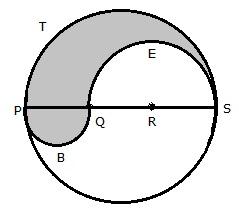
PS = 12 cm
PQ = QR = RS = 4 cm, QS = 8 cm
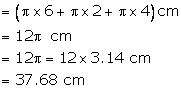
Perimeter = arc PTS + arc PBQ + arc QES
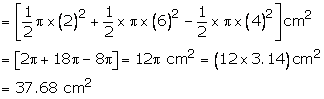
Area of shaded region = (area of the semicircle PBQ) + (area of semicircle PTS)-(Area of semicircle QES)
Question 19:
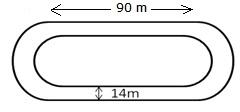
Length of the inner curved portion
= (400 – 2 × 90) m
= 220 m
Let the radius of each inner curved part be r
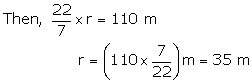
Inner radius = 35 m, outer radius = (35 + 14) = 49 m
Area of the track = (area of 2 rectangles each 90 m × 14 m) + (area of circular ring with R = 49 m, r = 35 m
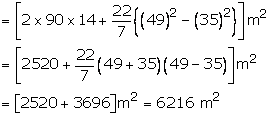
Length of outer boundary of the track

Question 20:
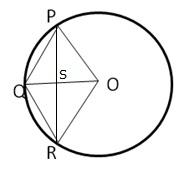
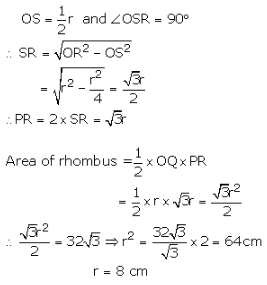
OP = OR = OQ = r
Let OQ and PR intersect at S
We know the diagonals of a rhombus bisect each other at right angle.
Therefore we have
Question 21:
Diameter of the inscribed circle = Side of the square = 10 cm
Radius of the inscribed circle = 5 cm
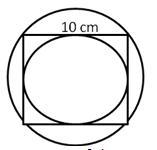
Diameter of the circumscribed circle
= Diagonal of the square
= (√2×10) cm
Radius of circumscribed circle = 5√2 cm
(i) Area of inscribed circle = (227×5×5) = 78.57 cm2
(ii) Area of the circumscribed circle

Question 22:
Let the radius of circle be r cm
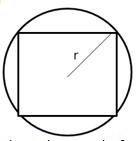
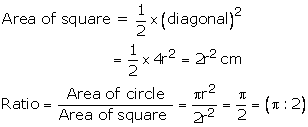
Then diagonal of square = diameter of circle = 2r cm
Area of the circle = πr2 cm2
Question 23:
Let the radius of circle be r cm
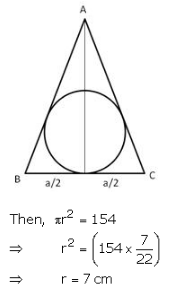
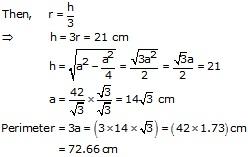
Let each side of the triangle be a cm
And height be h cm
Question 24:
Radius of the wheel = 42 cm
Circumference of wheel = 2πr = (2×227×42) = 264 cm
Distance travelled = 19.8 km = 1980000 cm
Number of revolutions = 1980000264 = 7500
Question 25:
Radius of wheel = 2.1 m
Circumference of wheel = 2πr = (2×227×2.1) = 13.2 m
Distance covered in one revolution = 13.2 m
Distance covered in 75 revolutions = (13.2 × 75) m = 990 m
= 9901000 km
Distance a covered in 1 minute = 99100 km
Distance covered in 1 hour = 99100×60 km = 59.4 km
Question 26:
Distance covered by the wheel in 1 revolution

The circumference of the wheel = 198 cm
Let the diameter of the wheel be d cm
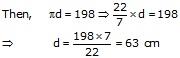
Hence diameter of the wheel is 63 cm
Question 27:
Radius of the wheel = r = 602 = 30 cm
Circumference of the wheel = 2πr = (2×227×30) = 13207 cm
Distance covered in 140 revolution
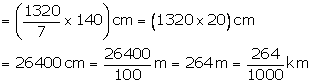
Distance covered in one hour = 2641000×60 = 15.84 km
Question 28:
Distance covered by a wheel in 1minute

Circumference of a wheel = 2πr = (2×227×70) = 440 cm
Number of revolution in 1 min = 121000440 = 275
Question 29:
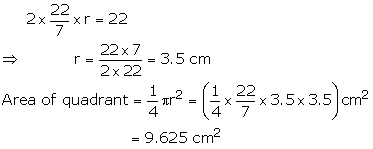
Area of quadrant = 14 πr2
Circumference of circle = 2πr = 22
Question 30:
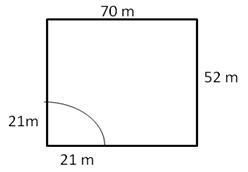
Area which the horse can graze = Area of the quadrant of radius 21 m
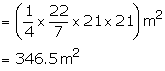
Area ungrazed = [(70×52) – 346.5] m2
= 3293.5 m2
Question 31:
Each angle of equilateral triangle is 60°
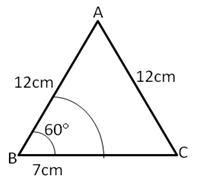
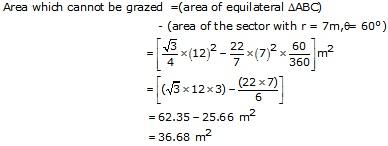
Area that the horse cannot graze is 36.68 m2
Question 32:
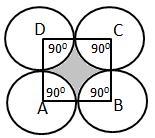
Each side of the square is 14 cm
Then, area of square = (14 × 14) cm2
= 196 cm2
Thus, radius of each circle 7 cm
Required area = area of square ABCD – 4 (area of sector with r = 7 cm, θ= 90°)
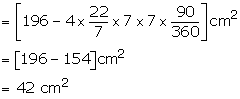
Area of the shaded region = 42 cm2
Question 33:
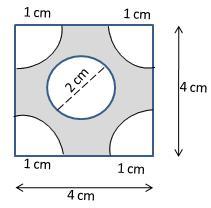
Area of square = (4 × 4) cm2
= 16 cm2
Area of four quadrant corners
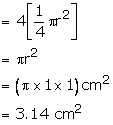
Radius of inner circle = 2/2 = 1 cm
Area of circle at the center = πr2 = (3.14 × 1 × 1) cm2
= 3.14 cm2
Area of shaded region = [area of square – area of four corner quadrants – area of circle at the centre]
= [16 – 3.14 – 3.14] cm2 = 9.72 cm2
Question 34:
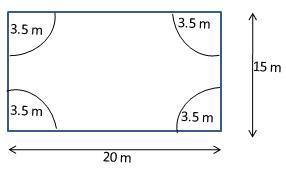
Area of rectangle = (20 × 15) m2 = 300 m2
Area of 4 corners as quadrants of circle
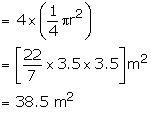
Area of remaining part = (area of rectangle – area of four quadrants of circles)
= (300 – 38.5) m2 = 261.5 m2
Question 35:
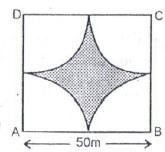
Ungrazed area
Question 36:
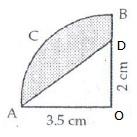
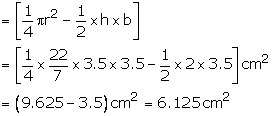
Shaded area = (area of quadrant) – (area of DAOD)
Question 37:
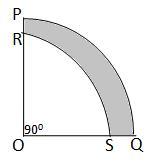
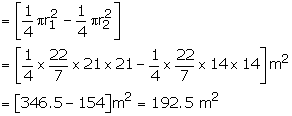
Area of flower bed = (area of quadrant OPQ) – (area of the quadrant ORS)
Question 38:
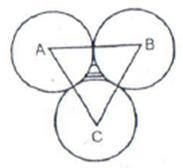
Let A, B, C be the centres of these circles. Joint AB, BC, CA
Required area=(area of ∆ABC with each side a = 12 cm) – 3(area of sector with r = 6, θ = 60°)
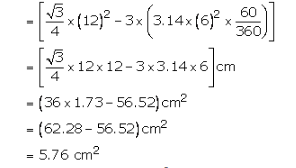
The area enclosed = 5.76 cm2
Question 39:
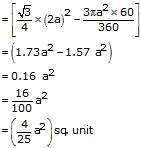
Let A, B, C be the centers of these circles. Join AB, BC, CA
Required area= (area of ∆ABC with each side 2) – 3[area of sector with r = a cm, θ = 60°]
Question 40:
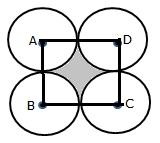
Let A, B, C, D be the centres of these circles
Join AB, BC, CD and DA
Side of square = 10 cm
Area of square ABCD
= (10 × 10) cm2
= 100 cm2
Area of each sector =
= 19.625 cm2
Required area = [area of sq. ABCD – 4(area of each sector)]
= (100 – 4 × 19.625) cm2
= (100 – 78.5) = 21.5 cm2
Question 41:
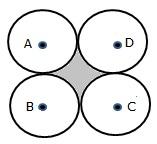
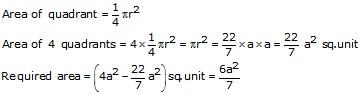
Required area = [area of square – areas of quadrants of circles]
Let the side = 2a unit and radius = a units
Area of square = (side × side) = (2a × 2a) sq. units = 4a2 sq.units
Question 42:
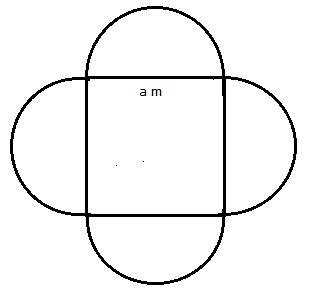
Let the side of square = a m
Area of square = (a × a) cm = a2m2
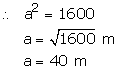
Side of square = 40 m
Therefore, radius of semi circle = 20 m
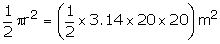
Area of semi circle =
= 628 m2
Area of four semi circles = (4 × 628) m2 = 2512 m2
Cost of turfing the plot of of area 1 m2 = Rs. 1.25
Cost of turfing the plot of area 2512 m2 = Rs. (1.25 × 2512)
= Rs. 3140
Question 43:
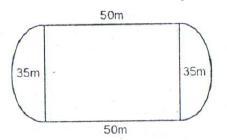
Area of rectangular lawn in the middle
= (50 × 35) = 1750 m2
Radius of semi circles = 352 = 17.5 m
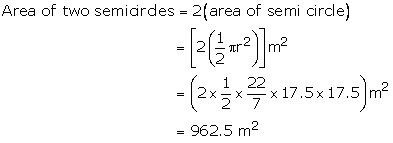
Area of lawn = (area of rectangle + area of semi circle)
= (1750 + 962.5) m2 = 2712.5 m2
Question 44:
Area of plot which cow can graze when r = 16 m is πr2
= (227×10.5×10.5)
= 804.5 m2
Area of plot which cow can graze when radius is increased to 23 m
= (227×10.5×10.5)
= 1662.57 m2
Additional ground = Area covered by increased rope – old area
= (1662.57 – 804.5)m2 = 858 m2
Question 45:
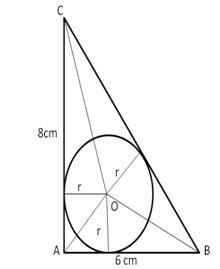
Given: ABC is right angled at A with AB = 6 cm and AC = 8 cm
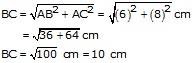
Let us join OA, OB and OC
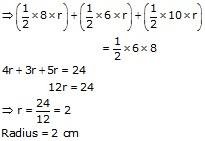
ar(∆AOC) + ar(∆OAB) + ar(∆BOC) = ar(∆ABC)
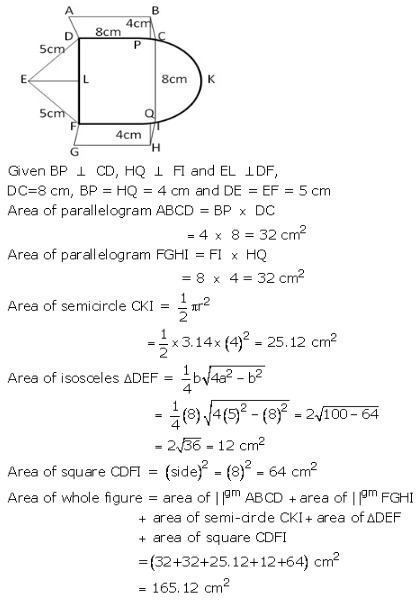
Question 46:
Question 47:
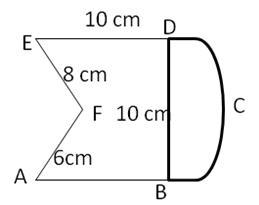
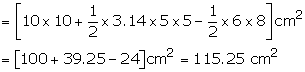
Area of region ABCDEFA = area of square ABDE + area of semi circle BCD – area of ∆AFE
Question 48:
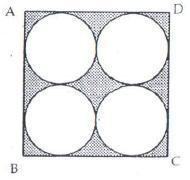
Side of the square ABCD = 14 cm
Area of square ABCD = 14 × 14 = 196 cm2
Radius of each circle = 144 = 3.5 cm
Area of the circles = 4 × area of one circle
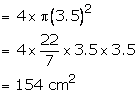
Area of shaded region = Area of square – area of 4 circles
= 196 – 154 = 42 cm2
Question 49:
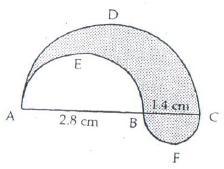
Diameter AC = 2.8 + 1.4
= 4.2 cm
Radius r1 = 4.22 = 2.1 cm
Length of semi-circle ADC = πr1 = π × 2.1 = 2.1 π cm
Diameter AB = 2.8 cm
Radius r2 = 1.4 cm
Length of semi- circle AEB = πr2 = π × 1.4 = 1.4 π cm
Diameter BC = 1.4 cm
Radius r3 = 1.42 = 0.7 cm
Length of semi – circle BFC = π × 0.7 = 0.7 π cm
Perimeter of shaded region = 2.1 + 1.4 + 0.7 = 4.2 π cm
= 4.2 × 227 = 13.2 cm
Question 50:
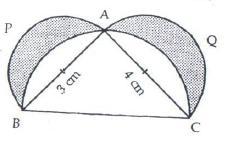
Area of shaded region = Area of ∆ABC + Area of semi-circle APB + Area of semi circle AQC – Area of semicircle BAC
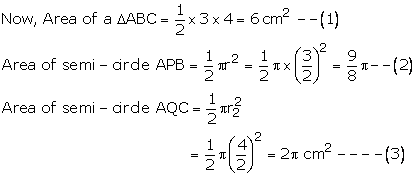
Further in ∆ABC, ∠A = 90°
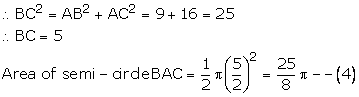
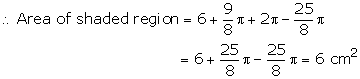
Adding (1), (2), (3) and subtracting (4)
Question 51:
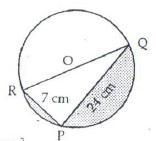
In ∆PQR, ∠P = 90°, PQ = 24 cm, PR = 7 cm
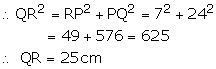
Area of semicircle
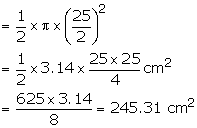
Area of ∆PQR = 12 × 7 × 24 cm2 = 84 cm2
Shaded area = 245.31 – 84 = 161.31 cm2
Question 52:
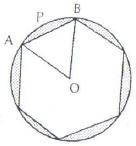
ABCDEF is a hexagon.
∠AOB = 60°, Radius = 35 cm
Area of sector AOB
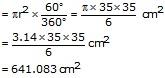
Area of ∆AOB =
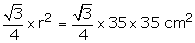
= 530.425 cm2
Area of segment APB = (641.083 – 530.425) cm2 = 110.658 cm2
Area of design (shaded area) = 6 × 110.658 cm2 = 663.948 cm2
= 663.95 cm2
Question 53:
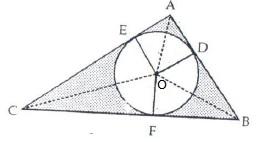
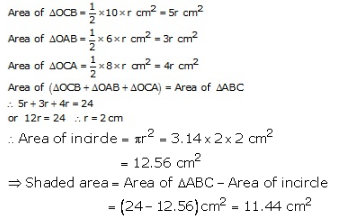
In ∆ABC, ∠A = 90°, AB = 6cm, BC = 10 cm
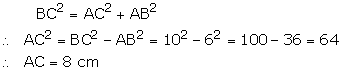
Area of ∆ABC =

Let r be the radius of circle of centre O
Question 54:
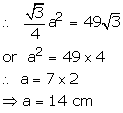
Area of equilateral triangle ABC = 49√3 cm2
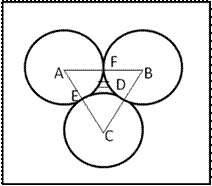
Let a be its side
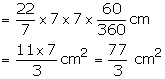
Area of sector BDF =

Area of sector BDF = Area of sector CDE = Area of sector AEF
Sum of area of all the sectors
= 773 × 3 cm2 = 77 cm2
Shaded area = Area of ∆ABC – sum of area of all sectors
= 49√3 – 77 = (84.77 – 77.00) cm2
= 77.7 cm2
Question 55:
In ∆ABC, ∠B = 90°, AB = 48 cm, BC = 14 cm
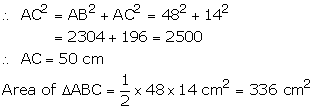
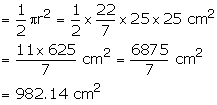
Area of semi-circle APC
Area of quadrant BDC with radius 14 cm

Shaded area = Area of ∆ABC + Area of semi-circle APC – Area of quadrant BDC
= ( 336+982.14-154 ) cm2
= ( 1318.14-154 ) cm2 = 1164.14 cm2
Question 56:
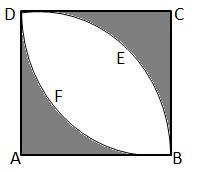
Radius of quadrant ABED = 16 cm
Its area =
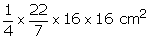
Area of ∆ABD = (12×16×16) cm2
= 128 cm2
Area of segment DEB
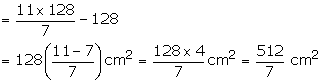
Area of segment DFB = 5127 cm2
Total area of segments = 2 × 5127 cm2 = 10247 cm2
Shaded area = Area of square ABCD – Total area of segments
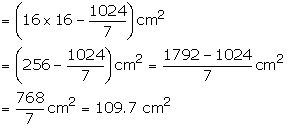
Question 57:
Radius of circular table cover = 70 cm
Area of the circular cover =

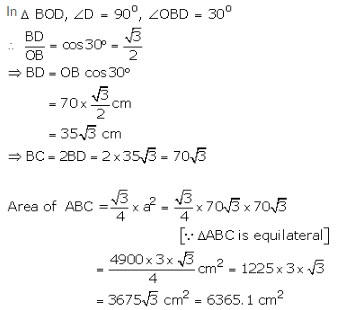
Shaded area = Area of circle – Area of ∆ABC
= (15400 – 6365.1)
Question 58:
Area of the sector of circle =

r = 14 cm and θ = 45°
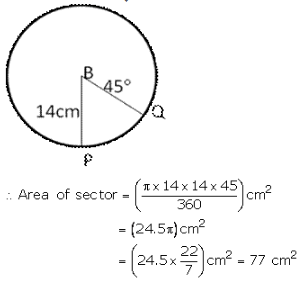
Question 59:
Length of the arc


Length of arc = ( 17.5 × 227 ) cm = 55 cm
Area of the sector =
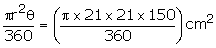
= ( 227 × 183.75 ) cm2 = 577.5 cm2
Question 60:
Length of arc of circle = 44 cm
Radius of circle = 17.5 cm
Area of sector =
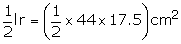
= ( 22 × 17.5) cm2 = 385 cm2
Question 61:
Let sector of circle is OAB
Perimeter of a sector of circle =31 cm
OA + OB + length of arc AB = 31 cm
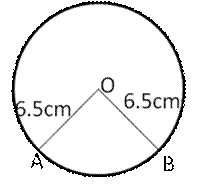
6.5 + 6.5 + arc AB = 31 cm
arc AB = 31 – 13
= 18 cm
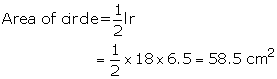
Question 62:
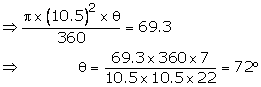
Area of the sector of circle =

Radius = 10.5 cm
Question 63:
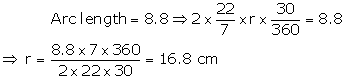
Length of the pendulum = radius of sector = r cm
Question 64:
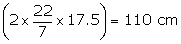
Length of arc =
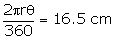
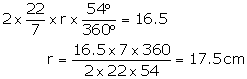
Circumference of circle = 2πr
Area of circle =
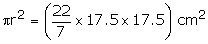
= 962.5 cm2
Question 65:
Circumference of circle = 2πr
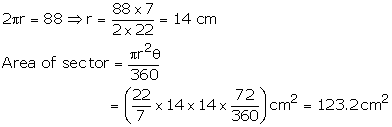
Question 66:
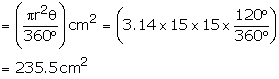
Angle described by the minute hand in 60 minutes θ = 360°
Angle described by minute hand in 20 minutes
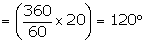
Required area swept by the minute hand in 20 minutes
= Area of the sector(with r = 15 cm and θ = 120°)
Question 67:
θ = 56° and let radius is r cm
Area of sector =
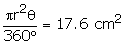
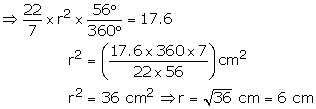
Hence radius = 6cm
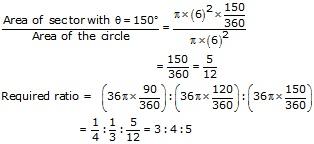
Question 68:
Question 69:
In 2 days, the short hand will complete 4 rounds
∴ Distance travelled by its tip in 2 days
=4(circumference of the circle with r = 4 cm)
= (4 × 2 × 4) cm = 32 cm
In 2 days, the long hand will complete 48 rounds
∴ length moved by its tip
= 48(circumference of the circle with r = 6cm)
= (48 × 2 × 6) cm = 576 cm
∴ Sum of the lengths moved
= (32 + 576) = 608 cm
= (608 × 3.14) cm = 1909.12 cm
Question 70:
∆OAB is equilateral.
So, ∠AOB = 60°
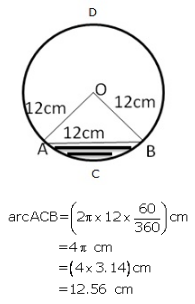
Length of arc BDA = (2π × 12 – arc ACB) cm
= (24π – 4π) cm = (20π) cm
= (20 × 3.14) cm = 62.8 cm
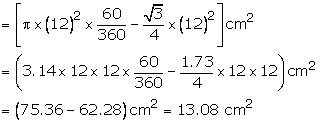
Area of the minor segment ACBA
Question 71:
Let AB be the chord of circle of centre O and radius = 6 cm such that ∠AOB = 90°
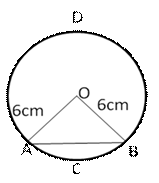
Area of sector = OACBO
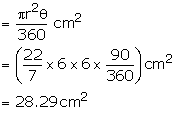
Area of ∆AOB =
Area of minor segment ACBA
= (area of sector OACBO) – (area of ∆OAB)
= (28.29 – 18) cm2 = 10.29 cm2
Area of major segment BDAB
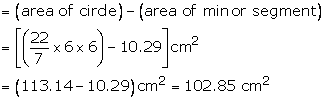
Question 72:
Let OA = 5√2 cm , OB = 5√2 cm
And AB = 10 cm
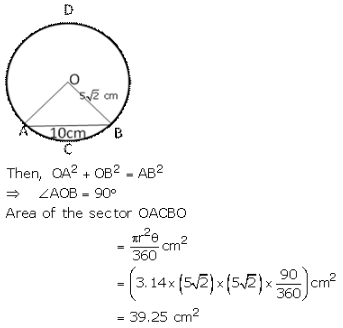
Area of ∆AOB =

= 25 cm2
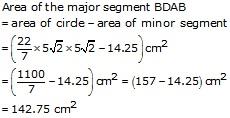
Area of minor segment = (area of sector OACBO) – (area of ∆OAB)
= ( 39.25 – 25 ) cm2 = 14.25 cm2
Question 73:
Area of sector OACBO
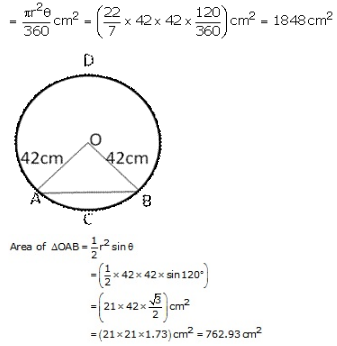
Area of minor segment ACBA

Area of major segment BADB
Question 74:
Let AB be the chord of circle of centre O and radius = 30 cm such that AOB = 60°
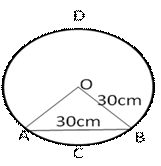
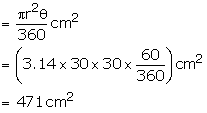
Area of the sector OACBO
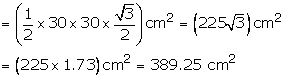
Area of ∆OAB =

Area of the minor segment ACBA
= (area of the sector OACBO) – (area of the ∆OAB)
=(471 – 389.25) cm2 = 81.75 cm2
Area of the major segment BADB
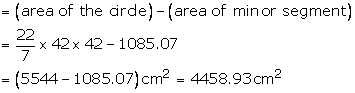
= (area of circle) – (area of the minor segment)
= [(3.14 × 30 × 30) – 81.75)] cm2 = 2744.25 cm2
Question 75:
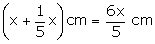
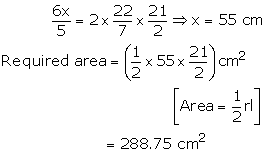
Let the major arc be x cm long
Then, length of the minor arc = 15 x cm
Circumference =
Question 76:
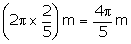
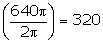
Radius of the front wheel = 40 cm = 25 m
Circumference of the front wheel =
Distance moved by it in 800 revolution
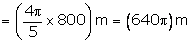
Circumference of rear wheel = (2π × 1)m = (2π) m
Required number of revolutions =
RS Aggarwal Solutions for Class 10 Maths Chapter 16: Download PDF
RS Aggarwal Solutions for Class 10 Maths Chapter 16–Areas of Circle, Sector and Segment
Chapterwise RS Aggarwal Solutions for Class 10 Maths :
- Chapter 1–Real Numbers
- Chapter 2–Polynomials
- Chapter 3–Linear Equations In Two Variables
- Chapter 4–Quadratic Equations
- Chapter 5–Arithmetic Progression
- Chapter 6–Coordinate Geometry
- Chapter 7–Triangles
- Chapter 8–Circles
- Chapter 9–Constructions
- Chapter 10–Trigonometric Ratios
- Chapter 11–T Ratios Of Some Particular Angles
- Chapter 12–Trigonometric Ratios Of Some Complementary Angles
- Chapter 13–Trigonometric Identities
- Chapter 14–Height and Distance
- Chapter 15–Perimeter and Areas of Plane Figures
- Chapter 16–Areas of Circle, Sector and Segment
- Chapter 17–Volume and Surface Areas of Solids
- Chapter 18–Mean, Median, Mode of Grouped Data
- Chapter 19–Probability
About RS Aggarwal Class 10 Book
Investing in an R.S. Aggarwal book will never be of waste since you can use the book to prepare for various competitive exams as well. RS Aggarwal is one of the most prominent books with an endless number of problems. R.S. Aggarwal's book very neatly explains every derivation, formula, and question in a very consolidated manner. It has tonnes of examples, practice questions, and solutions even for the NCERT questions.
He was born on January 2, 1946 in a village of Delhi. He graduated from Kirori Mal College, University of Delhi. After completing his M.Sc. in Mathematics in 1969, he joined N.A.S. College, Meerut, as a lecturer. In 1976, he was awarded a fellowship for 3 years and joined the University of Delhi for his Ph.D. Thereafter, he was promoted as a reader in N.A.S. College, Meerut. In 1999, he joined M.M.H. College, Ghaziabad, as a reader and took voluntary retirement in 2003. He has authored more than 75 titles ranging from Nursery to M. Sc. He has also written books for competitive examinations right from the clerical grade to the I.A.S. level.
FAQs
Why must I refer to the RS Aggarwal textbook?
RS Aggarwal is one of the most important reference books for high school grades and is recommended to every high school student. The book covers every single topic in detail. It goes in-depth and covers every single aspect of all the mathematics topics and covers both theory and problem-solving. The book is true of great help for every high school student. Solving a majority of the questions from the book can help a lot in understanding topics in detail and in a manner that is very simple to understand. Hence, as a high school student, you must definitely dwell your hands on RS Aggarwal!
Why should you refer to RS Aggarwal textbook solutions on Indcareer?
RS Aggarwal is a book that contains a few of the hardest questions of high school mathematics. Solving them and teaching students how to solve questions of such high difficulty is not the job of any neophyte. For solving such difficult questions and more importantly, teaching the problem-solving methodology to students, an expert teacher is mandatory!
Does IndCareer cover RS Aggarwal Textbook solutions for Class 6-12?
RS Aggarwal is available for grades 6 to 12 and hence our expert teachers have formulated detailed solutions for all the questions of each edition of the textbook. On our website, you'll be able to find solutions to the RS Aggarwal textbook right from Class 6 to Class 12. You can head to the website and download these solutions for free. All the solutions are available in PDF format and are free to download!