
Class 9: Maths Chapter 17 solutions. Complete Class 9 Maths Chapter 17 Notes.
RD Sharma Solutions for Class 9 Maths Chapter 17–Construction
RD Sharma 9th Maths Chapter 17, Class 9 Maths Chapter 17 solutions
Exercise 17.1 Page No: 17.3
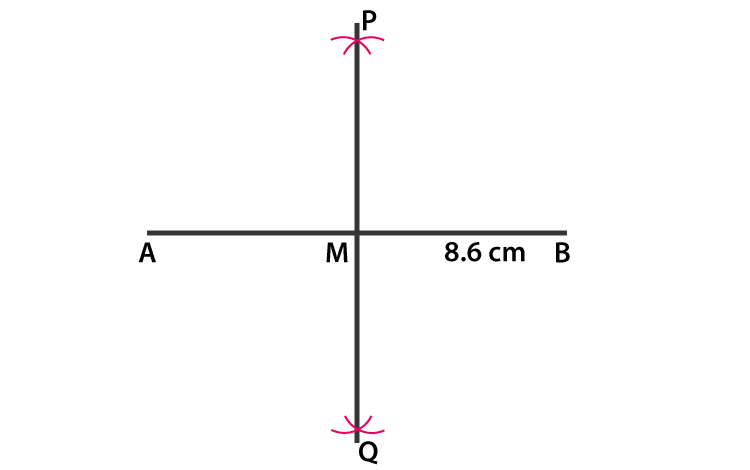
Question 1: Draw a line segment of length 8.6 cm. Bisect it and measure the length of each part.
Solution:
Step 1: Draw a line segment AB = 8.6 cm.
Step 2: Draw arcs on each side of AB using A as a center at any radius more than half of 8.6.
Step 3: Repeat Step 2 using B as a center and make sure these arcs cut the previous arcs.
Step 4: Join the points P and Q which intersects AB at M.
Therefore AM= MB = 4.3 cm
Question 2: Draw a line segment AB of length 5.8cm. Draw the perpendicular bisector of this line segment.
Solution:
Step 1: Draw a line segment AB = 5.8 cm.
Step 2: Draw arcs on each side of AB using A as a center at any radius more than half of 5.8.
Step 3: Repeat Step 2 using B as a center and make sure these arcs cut the previous arcs.
Step 4: Join the points P and Q.

Here, PQ is the perpendicular bisector of AB.
Question 3: Draw a circle with center at point O and radius 5cm. Draw its chord AB, the perpendicular bisector of line segment AB. Does it pass through the center of the circle?
Solution:
Step 1: Draw a circle choosing radius 5 cm and point O as center.
Step 2: Draw a chord AB using scale.
Step 3: Draw arcs one on each side of chord chossing A as center and radius more than half of 5 cm.
Step 4: Repeat step 3 using B as a centre and make sure these arcs cut the previous arcs.
Step 5: Join P and Q.
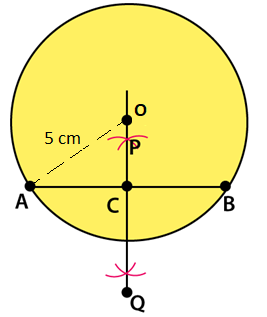
Therefore PQ is a perpendicular bisector of chord AB passes through the center of the circle.
Exercise 17.2 Page No: 17.7
Question 1: Draw an angle and label it as ∠BAC. Construct another angle, equal to ∠BAC.
Solution:
Steps of construction:
Step 1: Draw any angle ABC.
Now will construct an angle equal to ∠BAC
Step 2: Draw a line segment QR.
Step 3: Draw an arc which intersects ∠BAC at E and D using A as center and choose any radius.
Step 4: With same measurements (set in step 2), Draw an arc from point Q.
Step 5: With S as center and radius equal to DE, draw an arc which intersects the previous arc at T.
Step 6: Join Q and T.
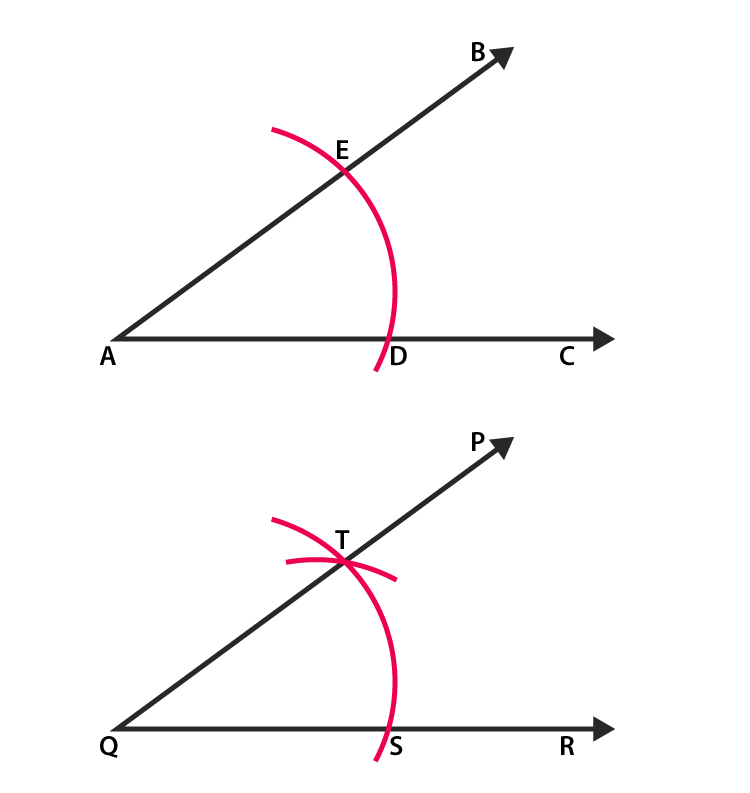
Therefore ∠PQR= ∠BAC
Question 2: Draw an obtuse angle. Bisect it. Measure each of the angles so formed.
Solution:
Steps of construction:
Step 1: Draw an obtuse angle. We choose ∠ABC = 1200.
Step 2: Draw an arc which intersects AB at P and BC at Q, from center B and choose any radius.
Step 3: Draw an arc from point P by setting radius more than half of PQ.
Step 4: Repeat step 3 using Q as center and cut the previous arc at R.
Step 5: Join BR.
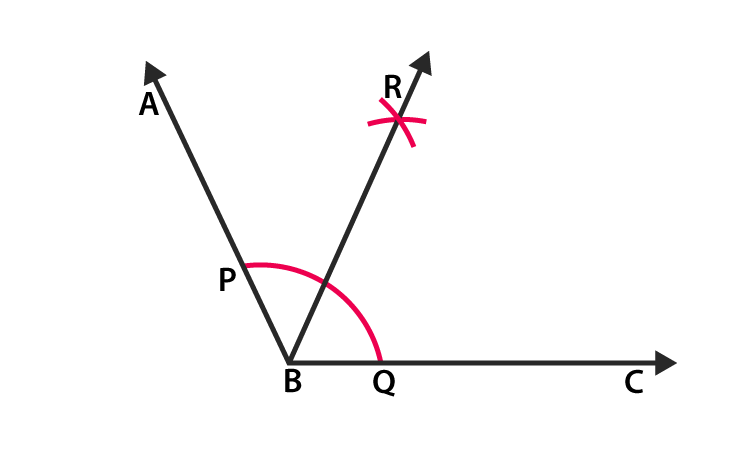
Therefore ∠ABR= ∠RBC = 600
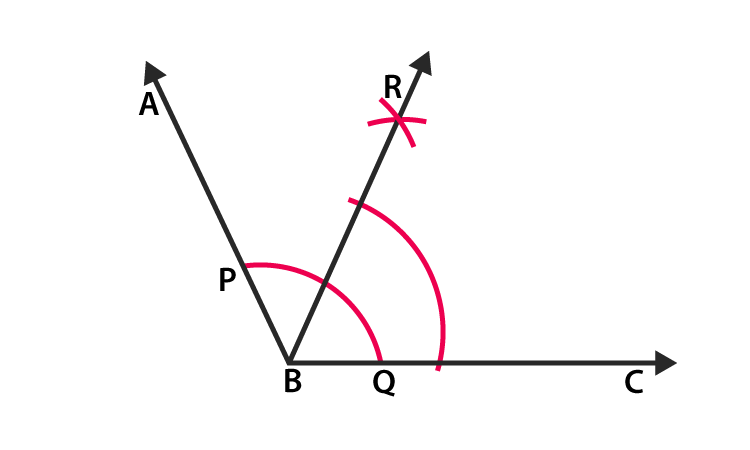
Question 3: Using your protractor, draw an angle of 1080. With this given angle as given, draw an angle of 540.
Solution:
Steps of construction:
Step 1: Draw ∠ABC = 1080.
Step 2: Draw an arc which intersects AB at P and BC at Q from point B. (Choose any radius)
Step 3: Draw an arc from point P by setting radius more than half of PQ.
Step 4: Repeat Step 3 using Q as the centre and intersect the previous arc at R.
Step 5: Join BR.
Therefore ∠RBC = 540
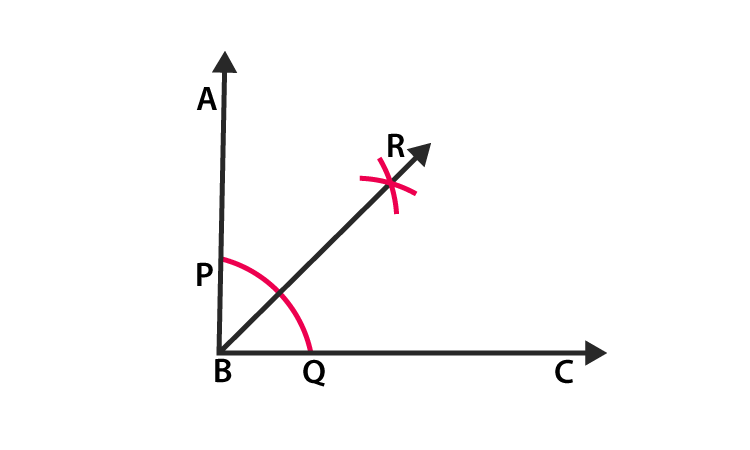
Question 4: Using the protractor, draw a right angle. Bisect it to get an angle of measure 450.
Solution:
Steps of construction:
Step 1: Draw ∠ABC = 900.
Step 2: Draw an arc which intersects AB at P and BC at Q from point B. (Choose any radius)
Step 3: Draw an arc from point P by setting radius more than half of PQ.
Step 4: Repeat step 3 using Q as a centre and intersect the previous arc at R.
Step 5: Join RB.
Therefore ∠RBC= 450
Exercise 17.3 Page No: 17.15
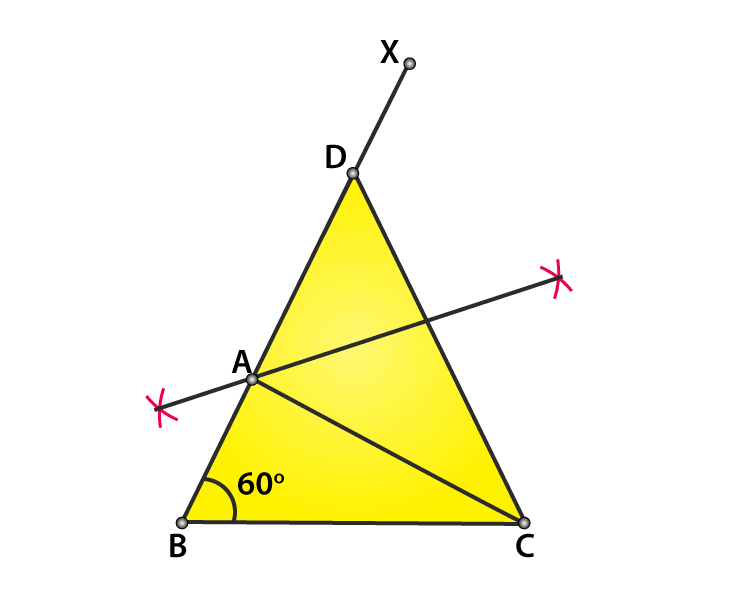
Question 1: Construct a △ABC in which BC = 3.6 cm, AB + AC = 4.8 cm and ∠B = 600.
Solution:
Steps of Construction:
Step 1: Draw a line segment BC = 3.6 cm.
Step 2: At the point B, draw ∠XBC = 600.
Step 3: Draw an arc which intersects XB at point D form point B and with radius 4.8 cm
Step 4: Join DC.
Step 5: Draw a perpendicular bisector of DC which intersects DB at A.
Step 6: Join AC.
Hence, △ABC is the required triangle.
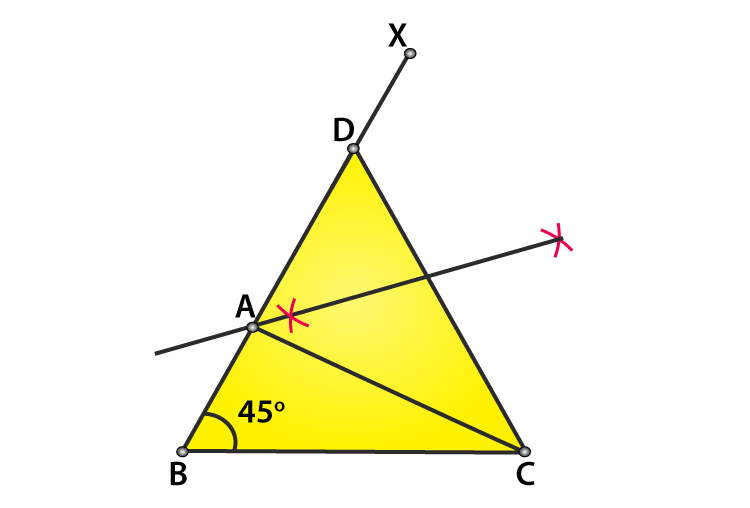
Question 2: Construct a △ABC in which AB + AC = 5.6 cm, BC = 4.5 cm and ∠B=450.
Solution:
Steps of Construction:
Step 1: Draw a line segment BC = 4.5 cm.
Step 2: At the point B, draw ∠XBC = 450.
Step 3: Draw an arc which intersects XB at point D form point B and with radius 5.6 cm
Step 4: Join DC.
Step 5: Draw a perpendicular bisector of DC which intersects DB at A.
Step 6: Join AC.
Hence, △ABC is the required triangle.
Question 3: Construct a △ABC in which BC = 3.4 cm, AB – AC = 1.5 cm and ∠B = 450.
Solution:
Steps of Construction:
Step 1: Draw a line segment BC = 3.4 cm.
Step 2: Draw ∠XBC = 450.
Step 3: Draw an arc which intersects XB at point D form point B and with radius 1.5 cm. So, BD = 1.5 cm.
Step 4: Join line segment DC.
Step 5: Draw a perpendicular bisector of DC which intersects BX at A.
Step 6: Join line segment AC.
Hence, △ABC is the required triangle.

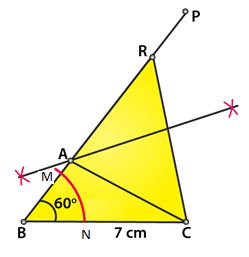
Question 4: Using rulers and compasses only, construct a △ABC, given base BC = 7 cm, ∠ABC = 600 and AB + AC = 12 cm.
Solution:
Step 1: Draw a line segment BC = 7 cm.
Step 2: Draw an arc from point B cutting BC at N. (Choose any radius.)
Step 3: Keep compass at point N with same radius selected in step 2, cut the previous arc at M.
Step 4: Join line segment BM.
Step 5: Produce BM to any point P
Step 6: Cut BR = 12 cm, from BP.
Step 7: Join CR.
Step 8: Draw a perpendicular bisector of RC which intersects BR at A.
Step 9: Join line segment AC.
Hence, △ABC is the required triangle.
RD Sharma Solutions for Class 9 Maths Chapter 17: Download PDF
RD Sharma Solutions for Class 9 Maths Chapter 17–Construction
Download PDF: RD Sharma Solutions for Class 9 Maths Chapter 17–Construction PDF
Chapterwise RD Sharma Solutions for Class 9 Maths :
- Chapter 1–Number System
- Chapter 2–Exponents of Real Numbers
- Chapter 3–Rationalisation
- Chapter 4–Algebraic Identities
- Chapter 5–Factorization of Algebraic Expressions
- Chapter 6–Factorization Of Polynomials
- Chapter 7–Introduction to Euclid’s Geometry
- Chapter 8–Lines and Angles
- Chapter 9–Triangle and its Angles
- Chapter 10–Congruent Triangles
- Chapter 11–Coordinate Geometry
- Chapter 12–Heron’s Formula
- Chapter 13–Linear Equations in Two Variables
- Chapter 14–Quadrilaterals
- Chapter 15–Area of Parallelograms and Triangles
- Chapter 16–Circles
- Chapter 17–Construction
- Chapter 18–Surface Area and Volume of Cuboid and Cube
- Chapter 19–Surface Area and Volume of A Right Circular Cylinder
- Chapter 20–Surface Area and Volume of A Right Circular Cone
- Chapter 21–Surface Area And Volume Of Sphere
- Chapter 22–Tabular Representation of Statistical Data
- Chapter 23–Graphical Representation of Statistical Data
- Chapter 24–Measure of Central Tendency
- Chapter 25–Probability
About RD Sharma
RD Sharma isn't the kind of author you'd bump into at lit fests. But his bestselling books have helped many CBSE students lose their dread of maths. Sunday Times profiles the tutor turned internet star
He dreams of algorithms that would give most people nightmares. And, spends every waking hour thinking of ways to explain concepts like 'series solution of linear differential equations'. Meet Dr Ravi Dutt Sharma — mathematics teacher and author of 25 reference books — whose name evokes as much awe as the subject he teaches. And though students have used his thick tomes for the last 31 years to ace the dreaded maths exam, it's only recently that a spoof video turned the tutor into a YouTube star.
R D Sharma had a good laugh but said he shared little with his on-screen persona except for the love for maths. "I like to spend all my time thinking and writing about maths problems. I find it relaxing," he says. When he is not writing books explaining mathematical concepts for classes 6 to 12 and engineering students, Sharma is busy dispensing his duty as vice-principal and head of department of science and humanities at Delhi government's Guru Nanak Dev Institute of Technology.