
Class 9: Maths Chapter 25 solutions. Complete Class 9 Maths Chapter 25 Notes.
RD Sharma Solutions for Class 9 Maths Chapter 25–Probability
RD Sharma 9th Maths Chapter 25, Class 9 Maths Chapter 25 solutions
Exercise 25.1 Page No: 25.13
Question 1: A coin is tossed 1000 times with the following sequence:
Head: 455, Tail: 545
Compute the probability of each event.
Solution:
Coin is tossed 1000 times, which means, number of trials are 1000.
Let us consider, event of getting head and event of getting tail be E and F respectively.
Number of favorable outcome = Number of trials in which the E happens = 455
So, Probability of E = (Number of favorable outcome) / (Total number of trials)
P(E) = 455/1000 = 0.455
Similarly,
Number of favorable outcome = Number of trials in which the F happens = 545
Probability of the event getting a tail, P(F) = 545/1000 = 0.545
Question 2: Two coins are tossed simultaneously 500 times with the following frequencies of different outcomes:
Two heads: 95 times
One tail: 290 times
No head : 115 times
Find the probability of occurrence of each of these events.
Solution:
We know that, Probability of any event = (Number of favorable outcome) / (Total number of trials)
Total number of trials = 95 + 290 + 115 = 500
Now,
P(Getting two heads) = 95/500 = 0.19
P(Getting one tail) = 290/500 = 0.58
P(Getting no head) = 115/500 = 0.23
Question 3: Three coins are tossed simultaneously 100 times with the following frequencies of different outcomes:
| Outcome | No head | One head | Two heads | Three heads |
| Frequency | 14 | 38 | 36 | 12 |
If the three coins are simultaneously tossed again, compute the probability of:
(i) 2 heads coming up
(ii) 3 heads coming up
(iii) At least one head coming up
(iv) Getting more heads than tails
(v) Getting more tails than heads
Solution:
We know, Probability of an event = (Number of Favorable outcomes) / (Total Numbers of outcomes)
In this case, total numbers of outcomes = 100.
(i) Probability of 2 Heads coming up = 36/100 = 0.36
(ii) Probability of 3 Heads coming up = 12/100 = 0.12
(iii) Probability of at least one head coming up = (38+36+12) / 100 = 86/100 = 0.86
(iv) Probability of getting more Heads than Tails = (36+12)/100 = 48/100 = 0.48
(v) Probability of getting more tails than heads = (14+38) / 100 = 52/100 = 0.52
Question 4: 1500 families with 2 children were selected randomly, and the following data were recorded:

If a family is chosen at random, compute the probability that it has:
(i) No girl (ii) 1 girl (iii) 2 girls (iv) At most one girl (v) More girls than boys
Solution:
We know, Probability of an event = (Number of Favorable outcomes) / (Total Numbers of outcomes)
In this case, total numbers of outcomes = 211 + 814 + 475 = 1500.
(Here, total numbers of outcomes = total number of families)
(i) Probability of having no girl = 211/1500 = 0.1406
(ii) Probability of having 1 girl = 814/1500 = 0.5426
(iii) Probability of having 2 girls = 475/1500 = 0.3166
(iv) Probability of having at the most one girl = (211+814) /1500 = 1025/1500 = 0.6833
(v) Probability of having more girls than boys = 475/1500 = 0.31
Question 5: In a cricket match, a batsman hits a boundary 6 times out of 30 balls he plays. Find the probability that on a ball played:
(i) He hits boundary (ii) He does not hit a boundary.
Solution:
Total number of balls played by a player = 30
Number of times he hits a boundary = 6
Number of times he does not hit a boundary = 30 – 6 = 24
We know, Probability of an event = (Number of Favorable outcomes) / (Total Numbers of outcomes)
Now,
(i) Probability (he hits boundary) = (Number of times he hit a boundary) / (Total number of balls he played)
= 6/30 = 1/5
(ii) Probability that the batsman does not hit a boundary = 24/30 = 4/5
Question 6: The percentage of marks obtained by a student in monthly unit tests are given below:
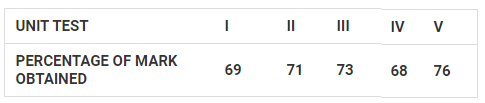
Find the probability that the student gets
(i) More than 70% marks
(ii) Less than 70% marks
(iii) A distinction
Solution:
Total number of unit tests taken = 5
We know, Probability of an event = (Number of Favorable outcomes) / (Total Numbers of outcomes)
(i) Number of times student got more than 70% = 3
Probability (Getting more than 70%) = 3/5 = 0.6
(ii) Number of times student got less than 70% = 2
Probability (Getting less than 70%) = 2/5 = 0.4
(iii) Number of times student got a distinction = 1[Marks more than 75%]
Probability (Getting a distinction) = 1/5 = 0.2
Question 7: To know the opinion of the students about Mathematics, a survey of 200 students were conducted. The data was recorded in the following table:
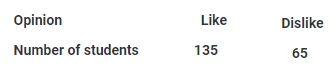
Find the probability that student chosen at random:
(i) Likes Mathematics (ii) Does not like it.
Solution:
Total number of students = 200
Students like mathematics = 135
Students dislike Mathematics = 65
We know, Probability of an event = (Number of Favorable outcomes) / (Total Numbers of outcomes)
(i) Probability (Student likes mathematics) = 135/200 = 0.675
(ii) Probability (Student does not like mathematics) = 65/200 = 0.325
Exercise VSAQs Page No: 25.16
Question 1: Define a trial.
Solution: When we perform an experiment it is called a trial of the experiment. Whereas, an operation which can produce some well-defined outcomes is called an experiment.
For example, we have 6 possible outcomes while rolling a die.
Question 2: Define an elementary event.
Solution: An outcome of a trial of an experiment is an elementary event.
Question 3: Define an event.
Solution: A subset of the sample space is called an event.
For Example: In the experiment of tossing a coin:
Event E = the event of getting a head
Event F = the event of getting a tail
Question 4: Define Probability of an Event.
Solution: Suppose an event E can happen in m ways out of a total of n possible equally likely ways.
Then, the probability of occurrence of the event = P(E) = m/n.
RD Sharma Solutions for Class 9 Maths Chapter 25: Download PDF
RD Sharma Solutions for Class 9 Maths Chapter 25–Probability
Download PDF: RD Sharma Solutions for Class 9 Maths Chapter 25–Probability PDF
Chapterwise RD Sharma Solutions for Class 9 Maths :
- Chapter 1–Number System
- Chapter 2–Exponents of Real Numbers
- Chapter 3–Rationalisation
- Chapter 4–Algebraic Identities
- Chapter 5–Factorization of Algebraic Expressions
- Chapter 6–Factorization Of Polynomials
- Chapter 7–Introduction to Euclid’s Geometry
- Chapter 8–Lines and Angles
- Chapter 9–Triangle and its Angles
- Chapter 10–Congruent Triangles
- Chapter 11–Coordinate Geometry
- Chapter 12–Heron’s Formula
- Chapter 13–Linear Equations in Two Variables
- Chapter 14–Quadrilaterals
- Chapter 15–Area of Parallelograms and Triangles
- Chapter 16–Circles
- Chapter 17–Construction
- Chapter 18–Surface Area and Volume of Cuboid and Cube
- Chapter 19–Surface Area and Volume of A Right Circular Cylinder
- Chapter 20–Surface Area and Volume of A Right Circular Cone
- Chapter 21–Surface Area And Volume Of Sphere
- Chapter 22–Tabular Representation of Statistical Data
- Chapter 23–Graphical Representation of Statistical Data
- Chapter 24–Measure of Central Tendency
- Chapter 25–Probability
About RD Sharma
RD Sharma isn't the kind of author you'd bump into at lit fests. But his bestselling books have helped many CBSE students lose their dread of maths. Sunday Times profiles the tutor turned internet star
He dreams of algorithms that would give most people nightmares. And, spends every waking hour thinking of ways to explain concepts like 'series solution of linear differential equations'. Meet Dr Ravi Dutt Sharma — mathematics teacher and author of 25 reference books — whose name evokes as much awe as the subject he teaches. And though students have used his thick tomes for the last 31 years to ace the dreaded maths exam, it's only recently that a spoof video turned the tutor into a YouTube star.
R D Sharma had a good laugh but said he shared little with his on-screen persona except for the love for maths. "I like to spend all my time thinking and writing about maths problems. I find it relaxing," he says. When he is not writing books explaining mathematical concepts for classes 6 to 12 and engineering students, Sharma is busy dispensing his duty as vice-principal and head of department of science and humanities at Delhi government's Guru Nanak Dev Institute of Technology.