
Class 9: Maths Chapter 7 solutions. Complete Class 9 Maths Chapter 7 Notes.
RD Sharma Solutions for Class 9 Maths Chapter 7–Introduction to Euclid’s Geometry
RD Sharma 9th Maths Chapter 7, Class 9 Maths Chapter 7 solutions
Exercise 7.1 Page No: 7.8
Question 1: Define the following terms.
(i) Line segment
(ii) Collinear points
(iii) Parallel lines
(iv) Intersecting lines
(v) Concurrent lines
(vi) Ray
(vii) Half-line
Solution:
(i) Line segment: The part of a line that connects two points or we can say that a shortest distance between the two points. A line segment is one-dimensional.

Here AB is a line segment.
(ii) Collinear points: Two or more points are said to be collinear if all the points lie on same line.
(iii) Parallel lines : Two lines in a plane are said to be parallel lines if they do not intersect each other.

Here l and m are parallel lines.
(iv) Intersecting lines: Two lines are intersecting if they have a common point. The common point is known as point of intersection.
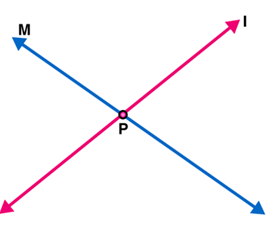
Here l and M are intersecting lines. And P is point of intersection.
(v) Concurrent lines: Two or more lines are said to be concurrent if there is a point which lies on all of them.
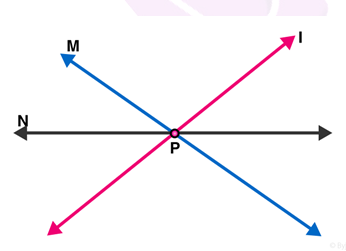
Here l, m and n are concurrent lines.
(vi) Ray: A straight line extending from a point indefinitely in one direction only.

Here OA is a ray.
(vii) Half-line: If A, B. C be the points on a line l, such that A lies between B and C, and we delete the point A from line l, the two parts of l that remain are each called a half-line.

Question 2:
(i) How many lines can pass through a given point?
(ii) In how many points can two distinct lines at the most intersect?
Solution:
(i) Infinitely many
(ii) One
Question 3:
(i) Given two points P and Q. Find how many line segments do they determine.
(ii) Name the line segments determined by the three collinear points P, Q and R.
Solution:
(i) One
(ii) PQ, QR, PR
Question 4: Write the truth value (T/F) of each of the following statements:
(i) Two lines intersect in a point.
(ii) Two lines may intersect in two points.
(iii) A segment has no length.
(iv) Two distinct points always determine a line.
(v) Every ray has a finite length.
(vi) A ray has one end-point only.
(vii) A segment has one end-point only.
(viii) The ray AB is same as ray BA.
(ix) Only a single line may pass through a given point.
(x) Two lines are coincident if they have only one point in common
Solution:
(i) False
(ii) False
(iii) False
(iv) True
(v) False
(vi) True
(vii) False
(viii) False
(ix) False
(x) False
Question 5: In the below figure, name the following:
(i) Five line segments
(ii) Five rays
(iii) Four collinear points
(iv) Two pairs of non–intersecting line segments

Solution:
(i) Five line segments AB, CD, AC, PQ. DS
(ii) Five rays :
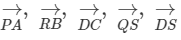
(iii) Four collinear points. C, D, Q, S
(iv) Two pairs of non–intersecting line segments AB and CD, PB and LS.
Question 6: Fill in the blanks so as to make the following statements true:
(i) Two distinct points in a plane determine a _____________ line.
(ii) Two distinct ___________ in a plane cannot have more than one point in common.
(iii) Given a line and a point, not on the line, there is one and only _____________ line which passes through the given point and is _______________ to the given line.
(iv) A line separates a plane into _________ parts namely the __________ and the _____ itself.
Solution:
(i) unique
(ii) lines
(iii) perpendicular, perpendicular
(iv) three, two half planes, line.
Exercise VSAQs Page No: 7.9
Question 1: How many least number of distinct points determine a unique line?
Solution: Two
Question 2: How many lines can be drawn through both the given points?
Solution: One
Question 3: How many lines can be drawn through a given point?
Solution: Infinite
Question 4: In how many points two distinct lines can intersect?
Solution: One
Question 5: In how many points a line, not in a plane, can intersect the plane?
Solution: One
Question 6: In how many points two distinct planes can intersect?
Solution: Infinite
Exercise 7.1 Page No: 7.8
Question 1: Define the following terms.
(i) Line segment
(ii) Collinear points
(iii) Parallel lines
(iv) Intersecting lines
(v) Concurrent lines
(vi) Ray
(vii) Half-line
Solution:
(i) Line segment: The part of a line that connects two points or we can say that a shortest distance between the two points. A line segment is one-dimensional.

Here AB is a line segment.
(ii) Collinear points: Two or more points are said to be collinear if all the points lie on same line.
(iii) Parallel lines : Two lines in a plane are said to be parallel lines if they do not intersect each other.
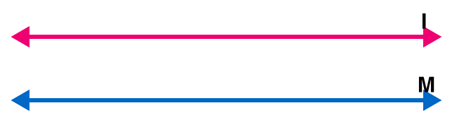
Here l and m are parallel lines.
(iv) Intersecting lines: Two lines are intersecting if they have a common point. The common point is known as point of intersection.
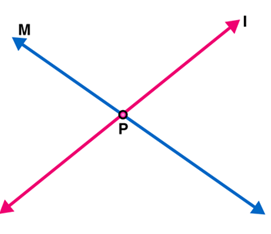
Here l and M are intersecting lines. And P is point of intersection.
(v) Concurrent lines: Two or more lines are said to be concurrent if there is a point which lies on all of them.
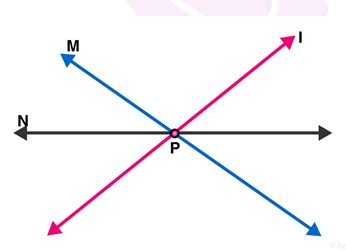
Here l, m and n are concurrent lines.
(vi) Ray: A straight line extending from a point indefinitely in one direction only.

Here OA is a ray.
(vii) Half-line: If A, B. C be the points on a line l, such that A lies between B and C, and we delete the point A from line l, the two parts of l that remain are each called a half-line.

Question 2:
(i) How many lines can pass through a given point?
(ii) In how many points can two distinct lines at the most intersect?
Solution:
(i) Infinitely many
(ii) One
Question 3:
(i) Given two points P and Q. Find how many line segments do they determine.
(ii) Name the line segments determined by the three collinear points P, Q and R.
Solution:
(i) One
(ii) PQ, QR, PR
Question 4: Write the truth value (T/F) of each of the following statements:
(i) Two lines intersect in a point.
(ii) Two lines may intersect in two points.
(iii) A segment has no length.
(iv) Two distinct points always determine a line.
(v) Every ray has a finite length.
(vi) A ray has one end-point only.
(vii) A segment has one end-point only.
(viii) The ray AB is same as ray BA.
(ix) Only a single line may pass through a given point.
(x) Two lines are coincident if they have only one point in common
Solution:
(i) False
(ii) False
(iii) False
(iv) True
(v) False
(vi) True
(vii) False
(viii) False
(ix) False
(x) False
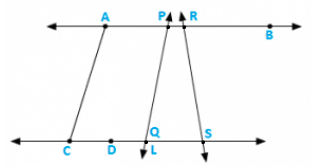
Question 5: In the below figure, name the following:
(i) Five line segments
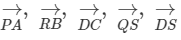
(ii) Five rays
(iii) Four collinear points
(iv) Two pairs of non–intersecting line segments
Solution:
(i) Five line segments AB, CD, AC, PQ. DS
(ii) Five rays :
(iii) Four collinear points. C, D, Q, S
(iv) Two pairs of non–intersecting line segments AB and CD, PB and LS.
Question 6: Fill in the blanks so as to make the following statements true:
(i) Two distinct points in a plane determine a _____________ line.
(ii) Two distinct ___________ in a plane cannot have more than one point in common.
(iii) Given a line and a point, not on the line, there is one and only _____________ line which passes through the given point and is _______________ to the given line.
(iv) A line separates a plane into _________ parts namely the __________ and the _____ itself.
Solution:
(i) unique
(ii) lines
(iii) perpendicular, perpendicular
(iv) three, two half planes, line.
Exercise VSAQs Page No: 7.9
Question 1: How many least number of distinct points determine a unique line?
Solution: Two
Question 2: How many lines can be drawn through both the given points?
Solution: One
Question 3: How many lines can be drawn through a given point?
Solution: Infinite
Question 4: In how many points two distinct lines can intersect?
Solution: One
Question 5: In how many points a line, not in a plane, can intersect the plane?
Solution: One
Question 6: In how many points two distinct planes can intersect?
Solution: Infinite
RD Sharma Solutions for Class 9 Maths Chapter 7: Download PDF
RD Sharma Solutions for Class 9 Maths Chapter 7–Introduction to Euclid’s Geometry
Download PDF: RD Sharma Solutions for Class 9 Maths Chapter 7–Introduction to Euclid’s Geometry PDF
Chapterwise RD Sharma Solutions for Class 9 Maths :
- Chapter 1–Number System
- Chapter 2–Exponents of Real Numbers
- Chapter 3–Rationalisation
- Chapter 4–Algebraic Identities
- Chapter 5–Factorization of Algebraic Expressions
- Chapter 6–Factorization Of Polynomials
- Chapter 7–Introduction to Euclid’s Geometry
- Chapter 8–Lines and Angles
- Chapter 9–Triangle and its Angles
- Chapter 10–Congruent Triangles
- Chapter 11–Coordinate Geometry
- Chapter 12–Heron’s Formula
- Chapter 13–Linear Equations in Two Variables
- Chapter 14–Quadrilaterals
- Chapter 15–Area of Parallelograms and Triangles
- Chapter 16–Circles
- Chapter 17–Construction
- Chapter 18–Surface Area and Volume of Cuboid and Cube
- Chapter 19–Surface Area and Volume of A Right Circular Cylinder
- Chapter 20–Surface Area and Volume of A Right Circular Cone
- Chapter 21–Surface Area And Volume Of Sphere
- Chapter 22–Tabular Representation of Statistical Data
- Chapter 23–Graphical Representation of Statistical Data
- Chapter 24–Measure of Central Tendency
- Chapter 25–Probability
About RD Sharma
RD Sharma isn't the kind of author you'd bump into at lit fests. But his bestselling books have helped many CBSE students lose their dread of maths. Sunday Times profiles the tutor turned internet star
He dreams of algorithms that would give most people nightmares. And, spends every waking hour thinking of ways to explain concepts like 'series solution of linear differential equations'. Meet Dr Ravi Dutt Sharma — mathematics teacher and author of 25 reference books — whose name evokes as much awe as the subject he teaches. And though students have used his thick tomes for the last 31 years to ace the dreaded maths exam, it's only recently that a spoof video turned the tutor into a YouTube star.
R D Sharma had a good laugh but said he shared little with his on-screen persona except for the love for maths. "I like to spend all my time thinking and writing about maths problems. I find it relaxing," he says. When he is not writing books explaining mathematical concepts for classes 6 to 12 and engineering students, Sharma is busy dispensing his duty as vice-principal and head of department of science and humanities at Delhi government's Guru Nanak Dev Institute of Technology.