
Class 9: Maths Chapter 12 solutions. Complete Class 9 Maths Chapter 12 Notes.
RD Sharma Solutions for Class 9 Maths Chapter 12–Heron's Formula
RD Sharma 9th Maths Chapter 12, Class 9 Maths Chapter 12 solutions
Exercise 12.1 Page No: 12.8
Question 1: Find the area of a triangle whose sides are respectively 150 cm, 120 cm and 200 cm.
Solution:
We know, Heron’s Formula
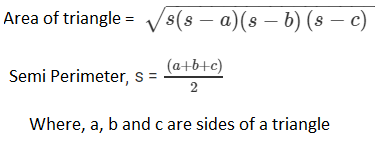
Here, a = 150 cm
b = 120 cm
c = 200 cm
Step 1: Find s
s = (a+b+c)/2
s = (150+200+120)/2
s = 235 cm
Step 2: Find Area of a triangle
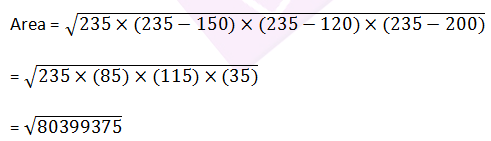
= 8966.56
Area of triangle is 8966.56 sq.cm.
Question 2: Find the area of a triangle whose sides are respectively 9 cm, 12 cm and 15 cm.
Solution:
We know, Heron’s Formula
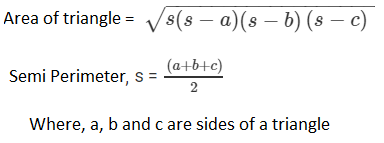
Here, a = 9 cm
b = 12 cm
c = 15 cm
Step 1: Find s
s = (a+b+c)/2
s = (9 + 12 + 15)/2
s = 18 cm
Step 2: Find Area of a triangle
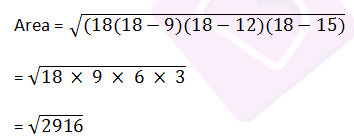
= 54
Area of triangle is 54 sq.cm.
Question 3: Find the area of a triangle two sides of which are 18 cm and 10 cm and the perimeter is 42 cm.
Solution:
Given:
a = 18 cm, b = 10 cm, and perimeter = 42 cm
Let c be the third side of the triangle.
Step 1: Find third side of the triangle, that is c
We know, perimeter = 2s,
2s = 42
s = 21
Again, s = (a+b+c)/2
Put the value of s, we get
21 = (18+10+c)/2
42 = 28 + c
c = 14 cm
Step 2: Find area of triangle
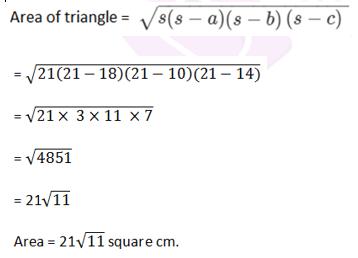
Question 4: In a triangle ABC, AB = 15cm, BC = 13cm and AC = 14cm. Find the area of triangle ABC and hence its altitude on AC.
Solution:
Let the sides of the given triangle be AB = a, BC = b, AC = c respectively.
Here, a = 15 cm
b = 13 cm
c = 14 cm
From Heron’s Formula;
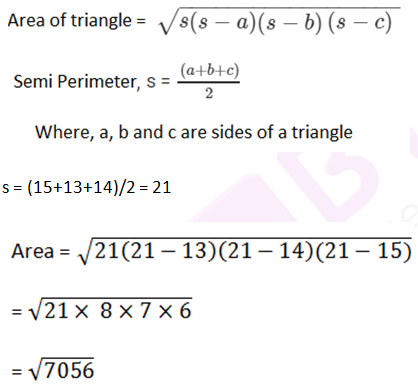
= 84
Area = 84 cm2
Let, BE is a perpendicular on AC
Now, area of triangle = ½ x Base x Height
½ × BE × AC = 84
BE = 12cm
Hence, altitude is 12 cm.
Question 5: The perimeter of a triangular field is 540 m and its sides are in the ratio 25:17:12. Find the area of the triangle.
Solution:
Let the sides of a given triangle be a = 25x, b = 17x, c = 12x respectively,
Given, Perimeter of triangle = 540 cm
2s = a + b + c
a + b + c = 540 cm
25x + 17x + 12x = 540 cm
54x = 540 cm
x = 10 cm
So, the sides of a triangle are
a = 250 cm
b = 170 cm
c = 120 cm
Semi perimeter, s = (a+b+c)/2
= 540/2
= 270
s = 270 cm
From Heron’s Formula;
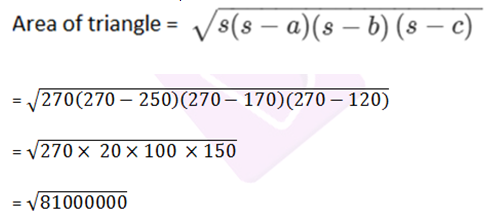
= 9000
Hence, the area of the triangle is 9000 cm2 .
Exercise 12.2 Page No: 12.19
Question 1: Find the area of the quadrilateral ABCD in which AB = 3 cm, BC = 4 cm, CD = 4 cm, DA = 5 cm and AC = 5 cm.
Solution:
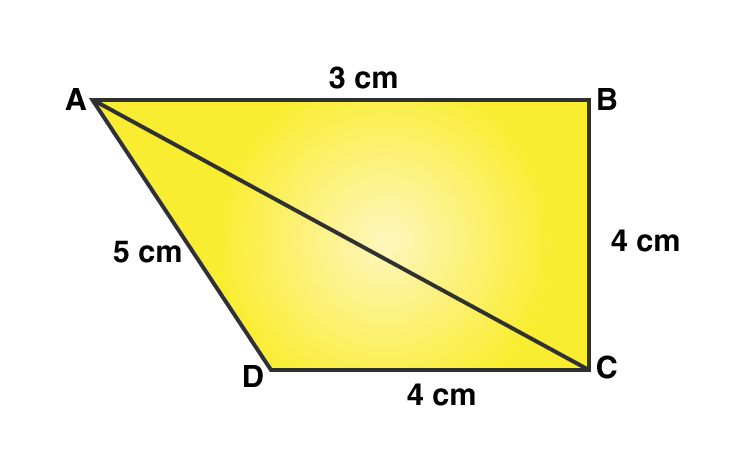
Area of the quadrilateral ABCD = Area of △ABC + Area of △ADC ….(1)
△ABC is a right-angled triangle which B.
Area of △ABC = 1/2 x Base x Height
= 1/2×AB×BC
= 1/2×3×4
= 6
Area of △ABC = 6 cm2 ……(2)
Now, In △CAD,
Sides are given, apply Heron’s Formula.
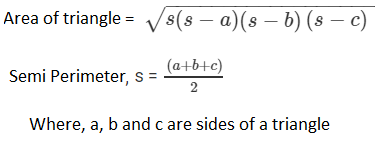
Perimeter = 2s = AC + CD + DA
2s = 5 cm + 4 cm + 5 cm
2s = 14 cm
s = 7 cm
Area of the △CAD = 9.16 cm2 …(3)
Using equation (2) and (3) in (1), we get
Area of quadrilateral ABCD = (6 + 9.16) cm2
= 15.16 cm2.
Question 2: The sides of a quadrilateral field, taken in order are 26 m, 27 m, 7 m, 24 m respectively. The angle contained by the last two sides is a right angle. Find its area.
Solution:
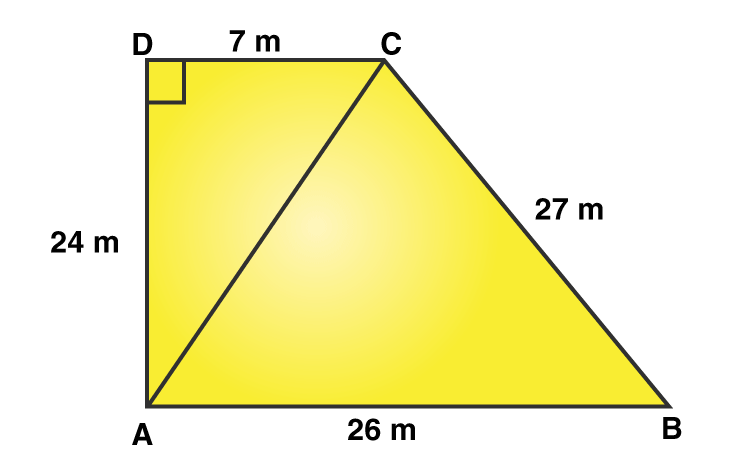
Here,
AB = 26 m, BC = 27 m, CD = 7 m, DA = 24 m
AC is the diagonal joined at A to C point.
Now, in △ADC,
From Pythagoras theorem;
AC2 = AD2 + CD2
AC2 = 142 + 72
AC = 25
Now, area of △ABC
All the sides are known, Apply Heron’s Formula.
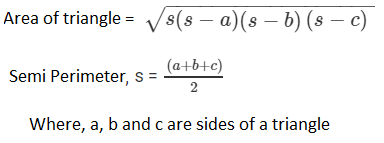
Perimeter of △ABC= 2s = AB + BC + CA
2s = 26 m + 27 m + 25 m
s = 39 m
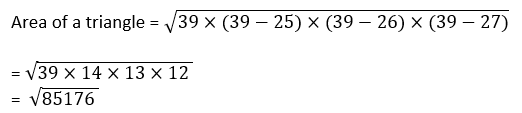
= 291.84
Area of a triangle ABC = 291.84 m2
Now, for area of △ADC, (Right angle triangle)
Area = 1/2 x Base X Height
= 1/2 x 7 x 24
= 84
Thus, the area of a △ADC is 84 m2
Therefore, Area of rectangular field ABCD = Area of △ABC + Area of △ADC
= 291.84 m2 + 84 m2
= 375.8 m2
Question 3: The sides of a quadrilateral, taken in order as 5, 12, 14, 15 meters respectively, and the angle contained by first two sides is a right angle. Find its area.
Solution:
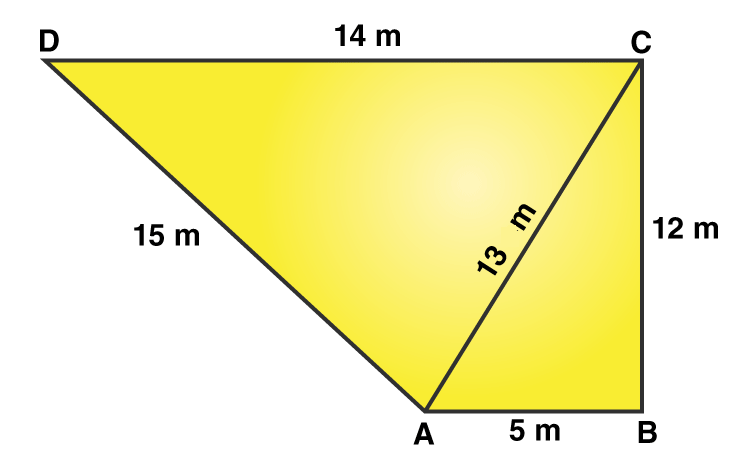
Here, AB = 5 m, BC = 12 m, CD =14 m and DA = 15 m
Join the diagonal AC.
Now, area of △ABC = 1/2 ×AB×BC
= 1/2×5×12 = 30
Area of △ABC is 30 m2
In △ABC, (right triangle).
From Pythagoras theorem,
AC2 = AB2 + BC2
AC2 = 52 + 122
AC2 = 25 + 144 = 169
or AC = 13
Now in △ADC,
All sides are know, Apply Heron’s Formula:
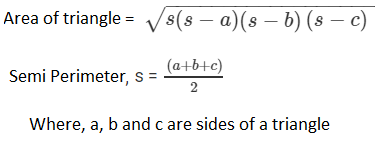
Perimeter of △ADC = 2s = AD + DC + AC
2s = 15 m +14 m +13 m
s = 21 m

= 84
Area of △ADC = 84 m2
Area of quadrilateral ABCD = Area of △ABC + Area of △ADC
= (30 + 84) m2
= 114 m2
Question 4: A park in the shape of a quadrilateral ABCD, has ∠ C = 900, AB = 9 m, BC = 12 m, CD = 5 m, AD = 8 m. How much area does it occupy?
Solution:
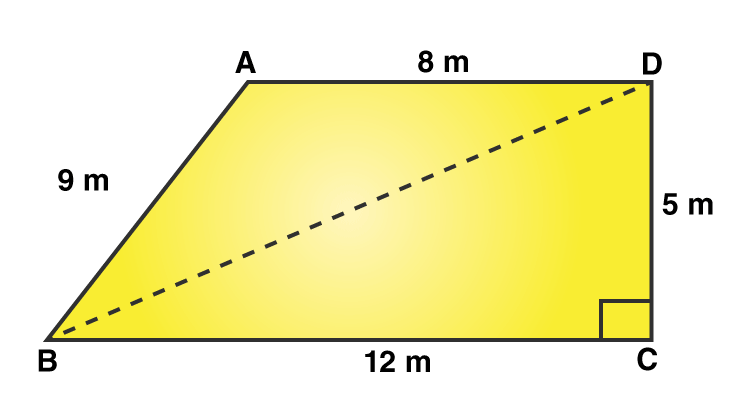
Here, AB = 9 m, BC = 12 m, CD = 5 m, DA = 8 m.
And BD is a diagonal of ABCD.
In right △BCD,
From Pythagoras theorem;
BD2 = BC2 + CD2
BD2 = 122 + 52 = 144 + 25 = 169
BD = 13 m
Area of △BCD = 1/2×BC×CD
= 1/2×12×5
= 30
Area of △BCD = 30 m2
Now, In △ABD,
All sides are known, Apply Heron’s Formula:
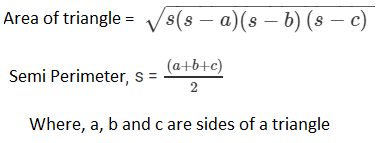
Perimeter of △ABD = 2s = 9 m + 8m + 13m
s = 15 m
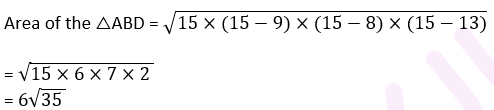
= 35.49
Area of the △ABD = 35.49 m2
Area of quadrilateral ABCD = Area of △ABD + Area of △BCD
= (35.496 + 30) m2
= 65.5m2.
Question 5: Two parallel sides of a trapezium are 60 m and 77 m and the other sides are 25 m and 26 m. Find the area of the trapezium.
Solution:
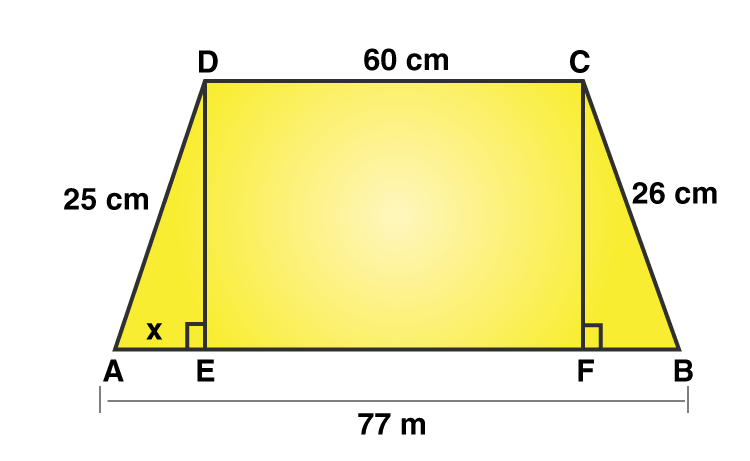
Given: AB = 77 m , CD = 60 m, BC = 26 m and AD = 25m
AE and CF are diagonals.
DE and CF are two perpendiculars on AB.
Therefore, we get, DC = EF = 60 m
Let’s say, AE = x
Then BF = 77 – (60 + x)
BF = 17 – x …(1)
In right △ADE,
From Pythagoras theorem,
DE2 = AD2 − AE2
DE2 = 252 − x2 ….(2)
In right △BCF
From Pythagoras theorem,
CF2 = BC2 − BF2
CF2 = 262 − (17−x) 2[Uisng (1)]
Here, DE = CF
So, DE2 = CF2
(2) ⇒ 252 − x2 = 262 − (17−x)2
625 − x2 = 676 – (289 −34x + x2)
625 − x2 = 676 – 289 +34x – x2
238 = 34x
x =7
(2) ⇒ DE2 = 252 – (7)2
DE2 = 625−49
DE = 24
Area of trapezium = 1/2×(60+77)×24 = 1644
Area of trapezium is 1644 m2 (Answer)
Question 6: Find the area of a rhombus whose perimeter is 80 m and one of whose diagonal is 24 m.
Solution:
Perimeter of a rhombus = 80 m (given)
We know, Perimeter of a rhombus = 4×side
Let a be the side of a rhombus.
4×a = 80
or a = 20
One of the diagonal, AC = 24 m (given)
Therefore OA = 1/2×AC
OA = 12
In △AOB,
Using Pythagoras theorem:
OB2 = AB2 − OA2 = 202 −122 = 400 – 144 = 256
or OB = 16
Since diagonal of rhombus bisect each other at 90 degrees.
And OB = OD
Therefore, BD = 2 OB = 2 x 16 = 32 m
Area of rhombus = 1/2×BD×AC = 1/2×32×24 = 384
Area of rhombus = 384 m2.
Question 7: A rhombus sheet, whose perimeter is 32 m and whose diagonal is 10 m long, is painted on both the sides at the rate of Rs 5 per m2. Find the cost of painting.
Solution:
Perimeter of a rhombus = 32 m
We know, Perimeter of a rhombus = 4×side
⇒ 4×side = 32
side = a = 8 m
Each side of rhombus is 8 m
AC = 10 m (Given)
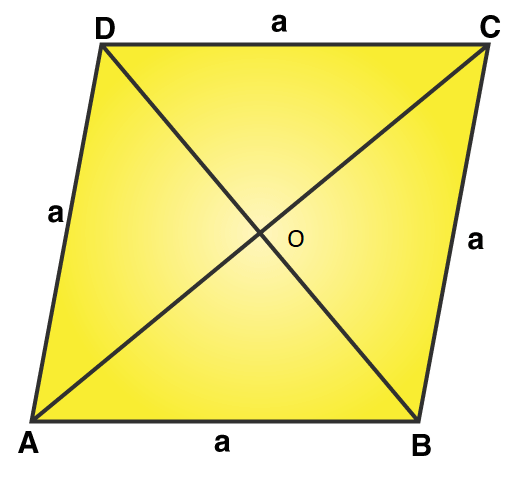
Then, OA = 1/2×AC
OA = 1/2×10
OA = 5 m
In right triangle AOB,
From Pythagoras theorem;
OB2 = AB2–OA2 = 82 – 52 = 64 – 25 = 39
OB = √39 m
And, BD = 2 x OB
BD = 2√39 m
Area of the sheet = 1/2×BD×AC = 1/2 x (2√39 × 10 ) = 10√39
Area of the sheet is 10√39 m2
Therefore, cost of printing on both sides of the sheet, at the rate of Rs. 5 per m2
= Rs. 2 x (10√39 x 5) = Rs. 625.
Exercise VSAQs Page No: 12.23
Question 1: Find the area of a triangle whose base and altitude are 5 cm and 4 cm respectively.
Solution:
Given: Base of a triangle = 5 cm and altitude = 4 cm
Area of triangle = 1/2 x base x altitude
= 1/2 x 5 x 4
= 10
Area of triangle is 10 cm2.
Question 2: Find the area of a triangle whose sides are 3 cm, 4 cm and 5 cm respectively.
Solution:
Given: Sides of a triangle are 3 cm, 4 cm and 5 cm respectively
Apply Heron’s Formula:
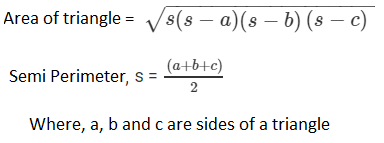
S = (3+4+5)/2 = 6
Semi perimeter is 6 cm
Now,
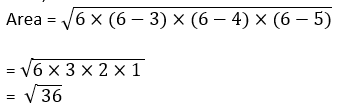
= 6
Area of given triangle is 6 cm2.
Question 3: Find the area of an isosceles triangle having the base x cm and one side y cm.
Solution:
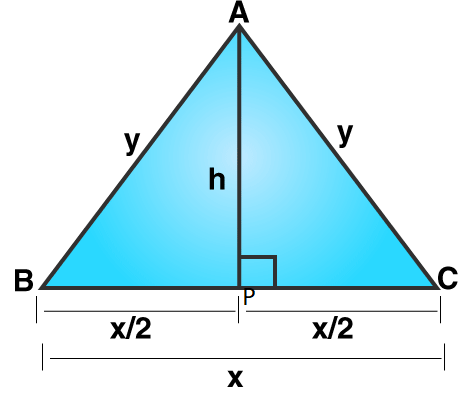
In right triangle APC,
Using Pythagoras theorem,
AC2 = AP2 + PC2
y2 = h2 + (x/2)2
or h2 = y2 – (x/2)2
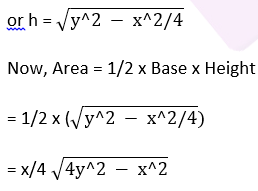
Question 4: Find the area of an equilateral triangle having each side 4 cm.
Solution: Each side of an equilateral triangle = a = 4 cm
Formula for Area of an equilateral triangle = ( √3/4 ) × a²
= ( √3/4 ) × 4²
= 4√3
Area of an equilateral triangle is 4√3 cm2.
Question 5: Find the area of an equilateral triangle having each side x cm.
Solution:
Each side of an equilateral triangle = a = x cm
Formula for Area of an equilateral triangle = ( √3/4 ) × a²
= ( √3/4 ) × x²
= x2 √3/4
Area of an equilateral triangle is √3x2/4 cm2.
RD Sharma Solutions for Class 9 Maths Chapter 12: Download PDF
RD Sharma Solutions for Class 9 Maths Chapter 12–Heron's Formula
Download PDF: RD Sharma Solutions for Class 9 Maths Chapter 12–Heron's Formula PDF
Chapterwise RD Sharma Solutions for Class 9 Maths :
- Chapter 1–Number System
- Chapter 2–Exponents of Real Numbers
- Chapter 3–Rationalisation
- Chapter 4–Algebraic Identities
- Chapter 5–Factorization of Algebraic Expressions
- Chapter 6–Factorization Of Polynomials
- Chapter 7–Introduction to Euclid’s Geometry
- Chapter 8–Lines and Angles
- Chapter 9–Triangle and its Angles
- Chapter 10–Congruent Triangles
- Chapter 11–Coordinate Geometry
- Chapter 12–Heron’s Formula
- Chapter 13–Linear Equations in Two Variables
- Chapter 14–Quadrilaterals
- Chapter 15–Area of Parallelograms and Triangles
- Chapter 16–Circles
- Chapter 17–Construction
- Chapter 18–Surface Area and Volume of Cuboid and Cube
- Chapter 19–Surface Area and Volume of A Right Circular Cylinder
- Chapter 20–Surface Area and Volume of A Right Circular Cone
- Chapter 21–Surface Area And Volume Of Sphere
- Chapter 22–Tabular Representation of Statistical Data
- Chapter 23–Graphical Representation of Statistical Data
- Chapter 24–Measure of Central Tendency
- Chapter 25–Probability
About RD Sharma
RD Sharma isn't the kind of author you'd bump into at lit fests. But his bestselling books have helped many CBSE students lose their dread of maths. Sunday Times profiles the tutor turned internet star
He dreams of algorithms that would give most people nightmares. And, spends every waking hour thinking of ways to explain concepts like 'series solution of linear differential equations'. Meet Dr Ravi Dutt Sharma — mathematics teacher and author of 25 reference books — whose name evokes as much awe as the subject he teaches. And though students have used his thick tomes for the last 31 years to ace the dreaded maths exam, it's only recently that a spoof video turned the tutor into a YouTube star.
R D Sharma had a good laugh but said he shared little with his on-screen persona except for the love for maths. "I like to spend all my time thinking and writing about maths problems. I find it relaxing," he says. When he is not writing books explaining mathematical concepts for classes 6 to 12 and engineering students, Sharma is busy dispensing his duty as vice-principal and head of department of science and humanities at Delhi government's Guru Nanak Dev Institute of Technology.