
Class 10: Maths Chapter 8 solutions. Complete Class 10 Maths Chapter 8 Notes.
RS Aggarwal Solutions for Class 10 Maths Chapter 8–Circles
RS Aggarwal 10th Maths Chapter 8, Class 10 Maths Chapter 8 solutions
Page No 489:
Question 1:
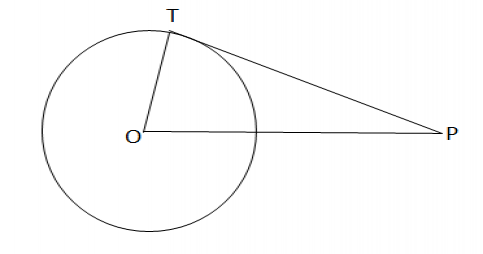
A point P is at a distance of 29 cm from the centre of a circle of radius 20 cm. Find the length of the tangent drawn from P to the circle. [CBSE 2017]
Answer:

Consider the figure.
We know that the tangent is perpendicular to the radius of a circle.
So, OPB is a right angled triangle, with
By using pythagoras theorem in , we get
So, length of the tangent from point P is 21 cm.
Page No 489:
Question 1:
A point P is at a distance of 29 cm from the centre of a circle of radius 20 cm. Find the length of the tangent drawn from P to the circle. [CBSE 2017]
Answer:
Consider the figure.
We know that the tangent is perpendicular to the radius of a circle.
So, OPB is a right angled triangle, with
By using pythagoras theorem in , we get
So, length of the tangent from point P is 21 cm.
Page No 490:
Question 2:
A point P is 25 cm away from the centre of a circle and the length of tangent drawn from P to the circle is 24 cm. Find the radius of the circle.
Answer:
Page No 490:
Question 3:
Two concentric circles are of radii 6.5 cm and 2.5 cm. Find the length of the chord of the larger circle which touches the smaller circle
Answer:

We know that the radius and tangent are perperpendular at their point of contact
In right triangle AOP
AO2 = OP2 + PA2
⇒ (6.5)2 = (2.5)2 + PA2
⇒ PA2 = 36
⇒ PA = 6 cm
Since, the perpendicular drawn from the centre bisect the chord.
∴ PA = PB = 6 cm
Now, AB = AP + PB = 6 + 6 = 12 cm
Hence, the length of the chord of the larger circle is 12 cm.
Page No 490:
Question 4:
In the given figure, a circle inscribed in a triangle ABC, touches the sides AB, BC and AC at point D, E and F respectively. If AB = 12 cm, BC = 8 cm and AC = 10 cm, find the lengths of AD, BE and CF [CBSE 2013]

Answer:
We know that tangent segments to a circle from the same external point are congruent.
Now, we have
AD = AF, BD = BE and CE = CF
Now, AD + BD = 12 cm .....(1)
AF + FC = 10 cm
⇒ AD + FC = 10 cm .....(2)
BE + EC = 8 cm
⇒ BD + FC = 8 cm .....(3)
Adding all these we get
AD + BD + AD + FC + BD + FC = 30
⇒2(AD + BD + FC) = 30
⇒AD + BD + FC = 15 cm .....(4)
Solving (1) and (4), we get
FC = 3 cm
Solving (2) and (4), we get
BD = 5 cm
Solving (3) and (4), we get
and AD = 7 cm
∴ AD = AF = 7 cm, BD = BE = 5 cm and CE = CF = 3 cm
Page No 490:
Question 5:
In the given figure, PA and PB are the tangents to a circle with centre O. Show that the points A, O, B, P are concyclic.

Answer:
Page No 490:
Question 6:
In the given figure, the chord AB of the larger of the two concentric circles, with centre O, touches the smaller circle at C. Prove that AC = CB.

Answer:
Construction: Join OA, OC and OB

We know that the radius and tangent are perperpendular at their point of contact
∴ ∠OCA = ∠OCB = 90∘
Now, In △OCA and △OCB
∠OCA = ∠OCB = 90∘
OA = OB (Radii of the larger circle)
OC = OC (Common)
By RHS congruency
△OCA ≅ △OCB
∴ CA = CB
Page No 490:
Question 7:
From an external point P, tangents PA and PB are drawn to a circle with centre O. If CD is the tangent to the circle at a point E and PA = 14 cm, find the perimeter of ΔPCD.

Answer:
Page No 490:
Question 8:
A circle is inscribed in ΔABC, touching AB, BC and AC at P, Q and R, respectively. If AB = 10 cm, AR = 7 cm and CR = 5 cm, find the length of BC.

Answer:
Page No 491:
Question 9:
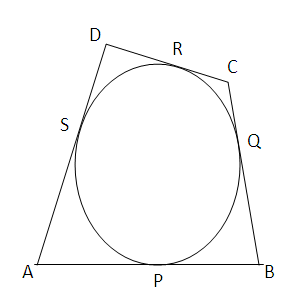
In the given figure, a circle touches all the four sides of a quadrilateral ABCD whose three sides are AB = 6 cm, BC = 7 cm and CD = 4 cm. Find AD.
Answer:
Page No 491:
Question 10:
In the given figure, an isosceles triangle ABC with AB = AC, circumscribes a circle. Prove that the point of contact P bisects the base BC
[CBSE 2012]

Answer:
We know that tangent segments to a circle from the same external point are congruent.
Now, we have
AR = AQ, BR = BP and CP = CQ
Now, AB = AC
⇒ AR + RB = AQ + QC
⇒ AR + RB = AR + QC
⇒ RB = QC
⇒ BP = CP
Hence, P bisects BC at P.
Page No 491:
Question 11:
In the given figure, O is the centre of two concentric circles of radii 4 cm and 6 cm respectively. PA and PB are tangents to the outer and inner circles, respectively. If PA = 10 cm, find the length of PB up to one decimal place.

Answer:
Page No 491:
Question 12:
In the given figure, a triangle ABC is drawn to circumscribe a circle of radius 3 cm such that the segments BD and DC into which BC is divided by the point of contact D are, of lengths 6 cm and 9 cm respectively. If the area of △ABC = 54 cm2 then find the lengths of sides of AB and AC. [CBSE 2011, '15]

Answer:
Construction: Join OA, OB, OC, OE ⊥ AB at E and OF ⊥ AC at F

We know that tangent segments to a circle from the same external point are congruent.
Now, we have
AE = AF, BD = BE = 6 cm and CD = CF = 9 cm
Now,
∴ AB = 6 + 3 = 9cm and AC = 9 + 3 = 12 cm
Page No 491:
Question 13:
PQ is a chord of length 4.8 cm of a circle of radius 3 cm. The tangent at P and Q intersect at a point T as shown in the figure. Find the length of TP [CBSE 2013C]

Answer:

Let TR = y and TP = x
We know that the perpendicular drawn from the centre to the chord bisects it.
∴ PR = RQ
Now, PR + RQ = 4.8
⇒ PR + PR = 4.8
⇒ PR = 2.4
Now, in right triangle POR
By Using Pyhthagoras theorem, we have
PO2 = OR2 + PR2
⇒ 32 = OR2 + (2.4)2
⇒ OR2 = 3.24
⇒ OR = 1.8
Now, in right triangle TPR
By Using Pyhthagoras theorem, we have
TP2 = TR2 + PR2
⇒ x2 = y2 + (2.4)2
⇒ x2 = y2 + 5.76 .....(1)
Again, in right triangle TPQ
By Using Pyhthagoras theorem, we have
TO2 = TP2 + PO2
⇒ (y + 1.8)2 = x2 + 32
⇒ y2 + 3.6y + 3.24 = x2 + 9
⇒ y2 + 3.6y = x2 + 5.76 .....(2)
Solving (1) and (2), we get
x = 4 cm and y = 3.2 cm
∴ TP = 4 cm
Page No 491:
Question 14:
Prove that the line joining the points of contact of two parallel tangents of a circle passes through its centre. [CBSE 2014]
Answer:

Suppose CD and AB are two parallel tangents of a circle with centre O
Construction: Draw a line parallel to CD passing through O i.e, OP
We know that the radius and tangent are perperpendular at their point of contact.
∠OQC = ∠ORA = 90∘
Now, ∠OQC + ∠POQ = 180∘ (co-interior angles)
⇒ ∠POQ = 180∘ − 90∘ = 90∘
Similarly, Now, ∠ORA + ∠POR = 180∘ (co-interior angles)
⇒ ∠POR = 180∘ − 90∘ = 90∘
Now, ∠POR + ∠POQ = 90∘ + 90∘ = 180∘
Since, ∠POR and ∠POQ are linear pair angles whose sum is 180∘
Hence, QR is a straight line passing through centre O.
Page No 492:
Question 15:
In the given figure, a circle with centre O, is inscribed in a quadrilateral ABCD such that it touches the side BC, AB, AD and CD at points P, Q, R and S respectively. If AB = 29 cm, AD = 23 cm, ∠B = 90∘ and DS = 5 cm then find the radius of the circle. [CBSE 2008, 13]

Answer:
We know that tangent segments to a circle from the same external point are congruent.
Now, we have
DS = DR, AR = AQ
Now, AD = 23 cm
⇒ AR + RD = 23
⇒ AR = 23 − RD
⇒ AR = 23 − 5 [∵ DS = DR = 5]
⇒ AR = 18 cm
Again, AB = 29 cm
⇒ AQ + QB = 29
⇒ QB = 29 − AQ
⇒ QB = 29 − 18 [∵ AR = AQ = 18]
⇒ QB = 11 cm
Since all the angles are in a quadrilateral BQOP are right angles and OP = BQ.
Hence, BQOP is a square.
We know that all the sides of square are equal.
Therefore, BQ = PO = 11 cm
Hence, the radius of the circle is 11 cm.
Page No 492:
Question 16:
In the given figure, O is the centre of the circle and TP is the tangent to the circle from an external point T. If ∠PBT = 30∘ , prove that
BA : AT = 2 : 1 [CBSE 2015]

Answer:
AB is the chord passing through the centre
So, AB is the diameter
Since, angle in a semi circle is a right angle
∴∠APB = 90∘
By using alternate segment theorem
We have ∠APB = ∠PAT = 30∘
Now, in △APB
∠BAP + ∠APB + ∠BAP = 180∘ (Angle sum property of triangle)
⇒ ∠BAP = 180∘ − 90∘ − 30∘ = 60∘
Now, ∠BAP = ∠APT + ∠PTA (Exterior angle property)
⇒ 60∘ = 30∘ + ∠PTA
⇒ ∠PTA = 60∘ − 30∘ = 30∘
We know that sides opposite to equal angles are equal.
∴ AP = AT
In right triangle ABP
∴ BA : AT = 2 : 1
Page No 494:
Question 1:
In the adjoining figure, a circle touches all the four sides of a quadrilateral ABCD whose sides are AB = 6 cm, BC = 9 cm and CD = 8 cm. Find the length of AD [CBSE 2011]

Answer:
We know that when a quadrilateral circumscribes a circle then sum of opposites sides is equal to the sum of other opposite sides.
∴ AB + CD = AD + BC
⇒6 + 8 = AD + 9
⇒ AD = 5 cm
Page No 494:
Question 2:
In the given figure, PA and PB are two tangents to the circle with centre O. If ∠APB = 50∘ then what is the measure of ∠OAB is [CBSE 2015]

Answer:
Construction: Join OB

We know that the radius and tangent are perperpendular at their point of contact
∵∠OBP = ∠OAP = 90∘
Now, In quadrilateral AOBP
∠AOB + ∠OBP + ∠APB + ∠OAP = 360∘ [Angle sum property of a quadrilateral]
⇒ ∠AOB + 90∘ + 50∘+ 90∘ = 360∘
⇒ 230∘+ ∠BOC = 360∘
⇒ ∠AOB = 130∘
Now, In isoceles triangle AOB
∠AOB + ∠OAB + ∠OBA = 180∘ [Angle sum property of a triangle]
⇒ 130∘ + 2∠OAB = 1800 [∵∠OAB = ∠OBA ]
⇒ ∠OAB = 25∘
Page No 495:
Question 3:
In the given figure, O is the centre of a circle PT and PQ are tangents to the circle from an external point P. If ∠TPQ = 70∘ then ∠TRQ
[CBSE 2015]

Answer:
Construction: Join OQ and OT

We know that the radius and tangent are perperpendular at their point of contact
∵∠OTP = ∠OQP = 90∘
Now, In quadrilateral OQPT
∠QOT + ∠OTP + ∠OQP + ∠TPQ = 360∘ [Angle sum property of a quadrilateral]
⇒ ∠QOT + 90∘ + 90∘ + 70∘ = 360∘
⇒ 250∘ + ∠QOT = 360∘
⇒ ∠QOT = 110∘
We know that the angle subtended by an arc at the centre is double the angle subtended by the arc at any point on the remaining part of the circle.
Page No 495:
Question 4:
In the given figure, common tangents AB and CD to the two circle with centres O1 and O2 intersect at E. Prove that AB = CD [CBSE 2014]

Answer:
We know that tangent segments to a circle from the same external point are congruent.
So, we have
EA = EC for the circle having centre O1
and
ED = EB for the circle having centre O1
Now, Adding ED on both sides in EA = EC, we get
EA + ED = EC + ED
⇒EA + EB = EC + ED
⇒AB = CD
Page No 495:
Question 5:
If PT is a tangent to a circle with centre O and PQ is a chord of the circle such that ∠QPT = 70∘ then find the measure of ∠POQ

Answer:
We know that the radius and tangent are perperpendular at their point of contact.
∴∠OPT = 90∘
Now, ∠OPQ = ∠OPT − ∠TPQ = 90∘ − 70∘ = 20∘
Since, OP = OQ as both are radius
∴∠OPQ = ∠OQP = 20∘ (Angles opposite to equal sides are equal)
Now, In isosceles △POQ
∠POQ + ∠OPQ + ∠OQP = 180∘ (Angle sum property of a triangle)
⇒ ∠POQ = 180∘ − 20∘ − 20∘ = 140∘
Page No 495:
Question 6:
In the given figure, a triangle ABC is drawn to circumscribe a circle of radius 2 cm such that the segments BD and DC into which BC is divided by the point of contact D are, of lengths 4 cm and 3 cm respectively. If the area of △ABC = 21 cm2 then find the lengths of sides of AB and AC. [CBSE 2011]

Answer:
Construction: Join OA, OB, OC, OE ⊥ AB at E and OF ⊥ AC at F

We know that tangent segments to a circle from the same external point are congruent.
Now, we have
AE = AF, BD = BE = 4 cm and CD = CF = 3 cm
Now,
∴ AB = 4 + 3.5 = 7.5 cm and AC = 3 + 3.5 = 6.5 cm
Page No 495:
Question 7:
Two concentric circles are of radii 5 cm and 3 cm, respectively. Find the length of the chord of the larger circle that touches the smaller circle.
Answer:
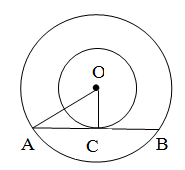
Given: Two circles have the same centre O and AB is a chord of the larger circle touching the
smaller circle at C; also, OA=5 cm and OC=3 cm.
The length of the chord of the larger circle is 8 cm.
Page No 495:
Question 8:
Prove that the perpendicular at the point of contact of the tangent to a circle passes through the centre.
Answer:

Let AB be the tangent to the circle at point P with centre O.
To prove: PQ passes through the point O.
Construction: Join OP.
Through O, draw a straight line CD parallel to the tangent AB.
Proof: Suppose that PQ doesn't passes through point O.
PQ intersect CD at R and also intersect AB at P.
AS, CD ∥ AB, PQ is the line of intersection,
∠ORP = ∠RPA (Alternate interior angles)
but also,
∠RPA = 90∘ (OP ⊥ AB)
⇒ ∠ORP = 90∘
∠ROP + ∠OPA = 180∘ (Co interior angles)
⇒∠ROP + 90∘ = 180∘
⇒∠ROP = 90∘
Thus, the ΔORP has 2 right angles i.e. ∠ORP and ∠ROP which is not possible.
Hence, our supposition is wrong.
∴ PQ passes through the point O.
Page No 495:
Question 9:
In the given figure, two tangents RQ and RP are drawn from an external point R to the circle with centre O. If ∠PRQ = 120∘ then prove that OR = PR + RQ

Answer:

Construction: Join PO and OQ
In △POR and △QOR
OP = OQ (Radii)
RP = RQ (Tangents from the external point are congruent)
OR = OR (Common)
By SSS congruency, △POR ≅ △QOR
∠PRO = ∠QRO (C.P.C.T)
Now, ∠PRO + ∠QRO = ∠PRQ
⇒ 2∠PRO = 120∘
⇒ ∠PRO = 60∘
Now, In △POR
Page No 496:
Question 10:
In the given figure, a circle inscribed in a triangle ABC, touches the sides AB, BC and AC at point D, E and F respectively. If AB = 14 cm, BC = 8 cm and AC = 12 cm. Find the lengths of AD, BE and CF [CBSE 2013]

Answer:
We know that tangent segments to a circle from the same external point are congruent.
Now, we have
AD = AF, BD = BE and CE = CF
Now, AD + BD = 14 cm .....(1)
AF + FC = 12 cm
⇒ AD + FC = 12 cm .....(2)
BE + EC = 8 cm
⇒ BD + FC = 8 cm .....(3)
Adding all these we get
AD + BD + AD + FC + BD + FC = 34
⇒2(AD + BD + FC) = 34
⇒AD + BD + FC = 17 cm .....(4)
Solving (1) and (4), we get
FC = 3 cm
Solving (2) and (4), we get
BD = 5 cm = BE
Solving (3) and (4), we get
and AD = 9 cm
Page No 496:
Question 11:
In the given figure, O is the centre of the circle. PA and PB are tangents. Show that AOBP is a cyclic quadrilateral [CBSE 2014]

Answer:
We know that the radius and tangent are perpendicular at their point of contact
∵∠OBP = ∠OAP = 90∘
Now, In quadrilateral AOBP
∠APB + ∠AOB + ∠OBP + ∠OAP = 360∘ [Angle sum property of a quadrilateral]
⇒ ∠APB + ∠AOB + 90∘ + 90∘ = 360∘
⇒ ∠APB + ∠AOB = 180∘
Also, ∠OBP + ∠OAP = 180∘
Since, the sum of the opposite angles of the quadrilateral is 180∘
Hence, AOBP is a cyclic quadrilateral.
Page No 496:
Question 12:
In two concentric circles, a chord of length 8 cm of the larger circle touches the smaller circle. If the radius of the larger circle is 5 cm then Find the radius of the smaller circle. [CBSE 2013C]
Answer:

We know that the radius and tangent are perperpendular at their point of contact
Since, the perpendicular drawn from the centre bisect the chord.
∴ AP = PB = = 4 cm
In right triangle AOP
AO2 = OP2 + PA2
⇒ 52 = OP2 + 42
⇒ OP2 = 9
⇒ OP = 3 cm
Hence, the radius of the smaller circle is 3 cm.
Page No 496:
Question 13:
In the given figure, PQ is a chord of a circle with centre O and PT is a tangent. If ∠QPT = 60∘ , find ∠PRQ

Answer:
We know that the radius and tangent are perperpendular at their point of contact.
∴∠OPT = 90∘
Now, ∠OPQ = ∠OPT − ∠QPT = 90∘ − 60∘ = 30∘
Since, OP = OQ as both are radius
∴∠OPQ = ∠OQP = 30∘ (Angles opposite to equal sides are equal)
Now, In isosceles △POQ
∠POQ + ∠OPQ + ∠OQP = 180∘ (Angle sum property of a triangle)
⇒ ∠POQ = 180∘ − 30∘ − 30∘ = 120∘
Now, ∠POQ + reflex ∠POQ = 360∘ (Complete angle)
⇒ reflex ∠POQ = 360∘ − 120∘ = 240∘
We know that the angle subtended by an arc at the centre is double the angle subtended by the arc at any point on the remaining part of the circle.
Page No 496:
Question 14:
In the given figure, PA and PB are two tangents to a circle with centre O, If ∠APB = 60∘ then find the measure of ∠OAB

Answer:
Construction: Join OB

We know that the radius and tangent are perperpendular at their point of contact
∵∠OBP = ∠OAP = 90∘
Now, In quadrilateral AOBP
∠AOB + ∠OBP + ∠APB + ∠OAP = 360∘ [Angle sum property of a quadrilateral]
⇒ ∠AOB + 90∘ + 60∘ + 90∘ = 360∘
⇒ 240∘ + ∠AOB = 360∘
⇒ ∠AOB = 1200
Now, In isoceles triangle AOB
∠AOB + ∠OAB + ∠OBA = 180∘ [Angle sum property of a triangle]
⇒ 120∘ + 2∠OAB = 180∘ [∵∠OAB = ∠OBA ]
⇒ ∠OAB = 30∘
Page No 490:
Question 2:
A point P is 25 cm away from the centre of a circle and the length of tangent drawn from P to the circle is 24 cm. Find the radius of the circle.
Answer:
Page No 490:
Question 3:
Two concentric circles are of radii 6.5 cm and 2.5 cm. Find the length of the chord of the larger circle which touches the smaller circle
Answer:
We know that the radius and tangent are perperpendular at their point of contact
In right triangle AOP
AO2 = OP2 + PA2
⇒ (6.5)2 = (2.5)2 + PA2
⇒ PA2 = 36
⇒ PA = 6 cm
Since, the perpendicular drawn from the centre bisect the chord.
∴ PA = PB = 6 cm
Now, AB = AP + PB = 6 + 6 = 12 cm
Hence, the length of the chord of the larger circle is 12 cm.
Page No 490:
Question 4:
In the given figure, a circle inscribed in a triangle ABC, touches the sides AB, BC and AC at point D, E and F respectively. If AB = 12 cm, BC = 8 cm and AC = 10 cm, find the lengths of AD, BE and CF [CBSE 2013]
Answer:
We know that tangent segments to a circle from the same external point are congruent.
Now, we have
AD = AF, BD = BE and CE = CF
Now, AD + BD = 12 cm .....(1)
AF + FC = 10 cm
⇒ AD + FC = 10 cm .....(2)
BE + EC = 8 cm
⇒ BD + FC = 8 cm .....(3)
Adding all these we get
AD + BD + AD + FC + BD + FC = 30
⇒2(AD + BD + FC) = 30
⇒AD + BD + FC = 15 cm .....(4)
Solving (1) and (4), we get
FC = 3 cm
Solving (2) and (4), we get
BD = 5 cm
Solving (3) and (4), we get
and AD = 7 cm
∴ AD = AF = 7 cm, BD = BE = 5 cm and CE = CF = 3 cm
Page No 490:
Question 5:
In the given figure, PA and PB are the tangents to a circle with centre O. Show that the points A, O, B, P are concyclic.
Answer:
Page No 490:
Question 6:
In the given figure, the chord AB of the larger of the two concentric circles, with centre O, touches the smaller circle at C. Prove that AC = CB.
Answer:
Construction: Join OA, OC and OB
We know that the radius and tangent are perperpendular at their point of contact
∴ ∠OCA = ∠OCB = 90∘
Now, In △OCA and △OCB
∠OCA = ∠OCB = 90∘
OA = OB (Radii of the larger circle)
OC = OC (Common)
By RHS congruency
△OCA ≅ △OCB
∴ CA = CB
Page No 490:
Question 7:
From an external point P, tangents PA and PB are drawn to a circle with centre O. If CD is the tangent to the circle at a point E and PA = 14 cm, find the perimeter of ΔPCD.
Answer:
Page No 490:
Question 8:
A circle is inscribed in ΔABC, touching AB, BC and AC at P, Q and R, respectively. If AB = 10 cm, AR = 7 cm and CR = 5 cm, find the length of BC.
Answer:
Page No 491:
Question 9:
In the given figure, a circle touches all the four sides of a quadrilateral ABCD whose three sides are AB = 6 cm, BC = 7 cm and CD = 4 cm. Find AD.
Answer:
Page No 491:
Question 10:
In the given figure, an isosceles triangle ABC with AB = AC, circumscribes a circle. Prove that the point of contact P bisects the base BC
[CBSE 2012]
Answer:
We know that tangent segments to a circle from the same external point are congruent.
Now, we have
AR = AQ, BR = BP and CP = CQ
Now, AB = AC
⇒ AR + RB = AQ + QC
⇒ AR + RB = AR + QC
⇒ RB = QC
⇒ BP = CP
Hence, P bisects BC at P.
Page No 491:
Question 11:
In the given figure, O is the centre of two concentric circles of radii 4 cm and 6 cm respectively. PA and PB are tangents to the outer and inner circles, respectively. If PA = 10 cm, find the length of PB up to one decimal place.
Answer:
Page No 491:
Question 12:
In the given figure, a triangle ABC is drawn to circumscribe a circle of radius 3 cm such that the segments BD and DC into which BC is divided by the point of contact D are, of lengths 6 cm and 9 cm respectively. If the area of △ABC = 54 cm2 then find the lengths of sides of AB and AC. [CBSE 2011, '15]
Answer:
Construction: Join OA, OB, OC, OE ⊥ AB at E and OF ⊥ AC at F
We know that tangent segments to a circle from the same external point are congruent.
Now, we have
AE = AF, BD = BE = 6 cm and CD = CF = 9 cm
Now,
∴ AB = 6 + 3 = 9cm and AC = 9 + 3 = 12 cm
Page No 491:
Question 13:
PQ is a chord of length 4.8 cm of a circle of radius 3 cm. The tangent at P and Q intersect at a point T as shown in the figure. Find the length of TP [CBSE 2013C]
Answer:
Let TR = y and TP = x
We know that the perpendicular drawn from the centre to the chord bisects it.
∴ PR = RQ
Now, PR + RQ = 4.8
⇒ PR + PR = 4.8
⇒ PR = 2.4
Now, in right triangle POR
By Using Pyhthagoras theorem, we have
PO2 = OR2 + PR2
⇒ 32 = OR2 + (2.4)2
⇒ OR2 = 3.24
⇒ OR = 1.8
Now, in right triangle TPR
By Using Pyhthagoras theorem, we have
TP2 = TR2 + PR2
⇒ x2 = y2 + (2.4)2
⇒ x2 = y2 + 5.76 .....(1)
Again, in right triangle TPQ
By Using Pyhthagoras theorem, we have
TO2 = TP2 + PO2
⇒ (y + 1.8)2 = x2 + 32
⇒ y2 + 3.6y + 3.24 = x2 + 9
⇒ y2 + 3.6y = x2 + 5.76 .....(2)
Solving (1) and (2), we get
x = 4 cm and y = 3.2 cm
∴ TP = 4 cm
Page No 491:
Question 14:
Prove that the line joining the points of contact of two parallel tangents of a circle passes through its centre. [CBSE 2014]
Answer:
Suppose CD and AB are two parallel tangents of a circle with centre O
Construction: Draw a line parallel to CD passing through O i.e, OP
We know that the radius and tangent are perperpendular at their point of contact.
∠OQC = ∠ORA = 90∘
Now, ∠OQC + ∠POQ = 180∘ (co-interior angles)
⇒ ∠POQ = 180∘ − 90∘ = 90∘
Similarly, Now, ∠ORA + ∠POR = 180∘ (co-interior angles)
⇒ ∠POR = 180∘ − 90∘ = 90∘
Now, ∠POR + ∠POQ = 90∘ + 90∘ = 180∘
Since, ∠POR and ∠POQ are linear pair angles whose sum is 180∘
Hence, QR is a straight line passing through centre O.
Page No 492:
Question 15:
In the given figure, a circle with centre O, is inscribed in a quadrilateral ABCD such that it touches the side BC, AB, AD and CD at points P, Q, R and S respectively. If AB = 29 cm, AD = 23 cm, ∠B = 90∘ and DS = 5 cm then find the radius of the circle. [CBSE 2008, 13]
Answer:
We know that tangent segments to a circle from the same external point are congruent.
Now, we have
DS = DR, AR = AQ
Now, AD = 23 cm
⇒ AR + RD = 23
⇒ AR = 23 − RD
⇒ AR = 23 − 5 [∵ DS = DR = 5]
⇒ AR = 18 cm
Again, AB = 29 cm
⇒ AQ + QB = 29
⇒ QB = 29 − AQ
⇒ QB = 29 − 18 [∵ AR = AQ = 18]
⇒ QB = 11 cm
Since all the angles are in a quadrilateral BQOP are right angles and OP = BQ.
Hence, BQOP is a square.
We know that all the sides of square are equal.
Therefore, BQ = PO = 11 cm
Hence, the radius of the circle is 11 cm.
Page No 492:
Question 16:
In the given figure, O is the centre of the circle and TP is the tangent to the circle from an external point T. If ∠PBT = 30∘ , prove that
BA : AT = 2 : 1 [CBSE 2015]
Answer:
AB is the chord passing through the centre
So, AB is the diameter
Since, angle in a semi circle is a right angle
∴∠APB = 90∘
By using alternate segment theorem
We have ∠APB = ∠PAT = 30∘
Now, in △APB
∠BAP + ∠APB + ∠BAP = 180∘ (Angle sum property of triangle)
⇒ ∠BAP = 180∘ − 90∘ − 30∘ = 60∘
Now, ∠BAP = ∠APT + ∠PTA (Exterior angle property)
⇒ 60∘ = 30∘ + ∠PTA
⇒ ∠PTA = 60∘ − 30∘ = 30∘
We know that sides opposite to equal angles are equal.
∴ AP = AT
In right triangle ABP
∴ BA : AT = 2 : 1
Page No 494:
Question 1:
In the adjoining figure, a circle touches all the four sides of a quadrilateral ABCD whose sides are AB = 6 cm, BC = 9 cm and CD = 8 cm. Find the length of AD [CBSE 2011]
Answer:
We know that when a quadrilateral circumscribes a circle then sum of opposites sides is equal to the sum of other opposite sides.
∴ AB + CD = AD + BC
⇒6 + 8 = AD + 9
⇒ AD = 5 cm
Page No 494:
Question 2:
In the given figure, PA and PB are two tangents to the circle with centre O. If ∠APB = 50∘ then what is the measure of ∠OAB is [CBSE 2015]
Answer:
Construction: Join OB
We know that the radius and tangent are perperpendular at their point of contact
∵∠OBP = ∠OAP = 90∘
Now, In quadrilateral AOBP
∠AOB + ∠OBP + ∠APB + ∠OAP = 360∘ [Angle sum property of a quadrilateral]
⇒ ∠AOB + 90∘ + 50∘+ 90∘ = 360∘
⇒ 230∘+ ∠BOC = 360∘
⇒ ∠AOB = 130∘
Now, In isoceles triangle AOB
∠AOB + ∠OAB + ∠OBA = 180∘ [Angle sum property of a triangle]
⇒ 130∘ + 2∠OAB = 1800 [∵∠OAB = ∠OBA ]
⇒ ∠OAB = 25∘
Page No 495:
Question 3:
In the given figure, O is the centre of a circle PT and PQ are tangents to the circle from an external point P. If ∠TPQ = 70∘ then ∠TRQ
[CBSE 2015]
Answer:
Construction: Join OQ and OT
We know that the radius and tangent are perperpendular at their point of contact
∵∠OTP = ∠OQP = 90∘
Now, In quadrilateral OQPT
∠QOT + ∠OTP + ∠OQP + ∠TPQ = 360∘ [Angle sum property of a quadrilateral]
⇒ ∠QOT + 90∘ + 90∘ + 70∘ = 360∘
⇒ 250∘ + ∠QOT = 360∘
⇒ ∠QOT = 110∘
We know that the angle subtended by an arc at the centre is double the angle subtended by the arc at any point on the remaining part of the circle.
Page No 495:
Question 4:
In the given figure, common tangents AB and CD to the two circle with centres O1 and O2 intersect at E. Prove that AB = CD [CBSE 2014]
Answer:
We know that tangent segments to a circle from the same external point are congruent.
So, we have
EA = EC for the circle having centre O1
and
ED = EB for the circle having centre O1
Now, Adding ED on both sides in EA = EC, we get
EA + ED = EC + ED
⇒EA + EB = EC + ED
⇒AB = CD
Page No 495:
Question 5:
If PT is a tangent to a circle with centre O and PQ is a chord of the circle such that ∠QPT = 70∘ then find the measure of ∠POQ
Answer:
We know that the radius and tangent are perperpendular at their point of contact.
∴∠OPT = 90∘
Now, ∠OPQ = ∠OPT − ∠TPQ = 90∘ − 70∘ = 20∘
Since, OP = OQ as both are radius
∴∠OPQ = ∠OQP = 20∘ (Angles opposite to equal sides are equal)
Now, In isosceles △POQ
∠POQ + ∠OPQ + ∠OQP = 180∘ (Angle sum property of a triangle)
⇒ ∠POQ = 180∘ − 20∘ − 20∘ = 140∘
Page No 495:
Question 6:
In the given figure, a triangle ABC is drawn to circumscribe a circle of radius 2 cm such that the segments BD and DC into which BC is divided by the point of contact D are, of lengths 4 cm and 3 cm respectively. If the area of △ABC = 21 cm2 then find the lengths of sides of AB and AC. [CBSE 2011]
Answer:
Construction: Join OA, OB, OC, OE ⊥ AB at E and OF ⊥ AC at F
We know that tangent segments to a circle from the same external point are congruent.
Now, we have
AE = AF, BD = BE = 4 cm and CD = CF = 3 cm
Now,
∴ AB = 4 + 3.5 = 7.5 cm and AC = 3 + 3.5 = 6.5 cm
Page No 495:
Question 7:
Two concentric circles are of radii 5 cm and 3 cm, respectively. Find the length of the chord of the larger circle that touches the smaller circle.
Answer:
Given: Two circles have the same centre O and AB is a chord of the larger circle touching the
smaller circle at C; also, OA=5 cm and OC=3 cm.
The length of the chord of the larger circle is 8 cm.
Page No 495:
Question 8:
Prove that the perpendicular at the point of contact of the tangent to a circle passes through the centre.
Answer:
Let AB be the tangent to the circle at point P with centre O.
To prove: PQ passes through the point O.
Construction: Join OP.
Through O, draw a straight line CD parallel to the tangent AB.
Proof: Suppose that PQ doesn't passes through point O.
PQ intersect CD at R and also intersect AB at P.
AS, CD ∥ AB, PQ is the line of intersection,
∠ORP = ∠RPA (Alternate interior angles)
but also,
∠RPA = 90∘ (OP ⊥ AB)
⇒ ∠ORP = 90∘
∠ROP + ∠OPA = 180∘ (Co interior angles)
⇒∠ROP + 90∘ = 180∘
⇒∠ROP = 90∘
Thus, the ΔORP has 2 right angles i.e. ∠ORP and ∠ROP which is not possible.
Hence, our supposition is wrong.
∴ PQ passes through the point O.
Page No 495:
Question 9:
In the given figure, two tangents RQ and RP are drawn from an external point R to the circle with centre O. If ∠PRQ = 120∘ then prove that OR = PR + RQ
Answer:
Construction: Join PO and OQ
In △POR and △QOR
OP = OQ (Radii)
RP = RQ (Tangents from the external point are congruent)
OR = OR (Common)
By SSS congruency, △POR ≅ △QOR
∠PRO = ∠QRO (C.P.C.T)
Now, ∠PRO + ∠QRO = ∠PRQ
⇒ 2∠PRO = 120∘
⇒ ∠PRO = 60∘
Now, In △POR
Page No 496:
Question 10:
In the given figure, a circle inscribed in a triangle ABC, touches the sides AB, BC and AC at point D, E and F respectively. If AB = 14 cm, BC = 8 cm and AC = 12 cm. Find the lengths of AD, BE and CF [CBSE 2013]
Answer:
We know that tangent segments to a circle from the same external point are congruent.
Now, we have
AD = AF, BD = BE and CE = CF
Now, AD + BD = 14 cm .....(1)
AF + FC = 12 cm
⇒ AD + FC = 12 cm .....(2)
BE + EC = 8 cm
⇒ BD + FC = 8 cm .....(3)
Adding all these we get
AD + BD + AD + FC + BD + FC = 34
⇒2(AD + BD + FC) = 34
⇒AD + BD + FC = 17 cm .....(4)
Solving (1) and (4), we get
FC = 3 cm
Solving (2) and (4), we get
BD = 5 cm = BE
Solving (3) and (4), we get
and AD = 9 cm
Page No 496:
Question 11:
In the given figure, O is the centre of the circle. PA and PB are tangents. Show that AOBP is a cyclic quadrilateral [CBSE 2014]
Answer:
We know that the radius and tangent are perpendicular at their point of contact
∵∠OBP = ∠OAP = 90∘
Now, In quadrilateral AOBP
∠APB + ∠AOB + ∠OBP + ∠OAP = 360∘ [Angle sum property of a quadrilateral]
⇒ ∠APB + ∠AOB + 90∘ + 90∘ = 360∘
⇒ ∠APB + ∠AOB = 180∘
Also, ∠OBP + ∠OAP = 180∘
Since, the sum of the opposite angles of the quadrilateral is 180∘
Hence, AOBP is a cyclic quadrilateral.
Page No 496:
Question 12:
In two concentric circles, a chord of length 8 cm of the larger circle touches the smaller circle. If the radius of the larger circle is 5 cm then Find the radius of the smaller circle. [CBSE 2013C]
Answer:
We know that the radius and tangent are perperpendular at their point of contact
Since, the perpendicular drawn from the centre bisect the chord.
∴ AP = PB = = 4 cm
In right triangle AOP
AO2 = OP2 + PA2
⇒ 52 = OP2 + 42
⇒ OP2 = 9
⇒ OP = 3 cm
Hence, the radius of the smaller circle is 3 cm.
Page No 496:
Question 13:
In the given figure, PQ is a chord of a circle with centre O and PT is a tangent. If ∠QPT = 60∘ , find ∠PRQ
Answer:
We know that the radius and tangent are perperpendular at their point of contact.
∴∠OPT = 90∘
Now, ∠OPQ = ∠OPT − ∠QPT = 90∘ − 60∘ = 30∘
Since, OP = OQ as both are radius
∴∠OPQ = ∠OQP = 30∘ (Angles opposite to equal sides are equal)
Now, In isosceles △POQ
∠POQ + ∠OPQ + ∠OQP = 180∘ (Angle sum property of a triangle)
⇒ ∠POQ = 180∘ − 30∘ − 30∘ = 120∘
Now, ∠POQ + reflex ∠POQ = 360∘ (Complete angle)
⇒ reflex ∠POQ = 360∘ − 120∘ = 240∘
We know that the angle subtended by an arc at the centre is double the angle subtended by the arc at any point on the remaining part of the circle.
Page No 496:
Question 14:
In the given figure, PA and PB are two tangents to a circle with centre O, If ∠APB = 60∘ then find the measure of ∠OAB
Answer:
Construction: Join OB
We know that the radius and tangent are perperpendular at their point of contact
∵∠OBP = ∠OAP = 90∘
Now, In quadrilateral AOBP
∠AOB + ∠OBP + ∠APB + ∠OAP = 360∘ [Angle sum property of a quadrilateral]
⇒ ∠AOB + 90∘ + 60∘ + 90∘ = 360∘
⇒ 240∘ + ∠AOB = 360∘
⇒ ∠AOB = 1200
Now, In isoceles triangle AOB
∠AOB + ∠OAB + ∠OBA = 180∘ [Angle sum property of a triangle]
⇒ 120∘ + 2∠OAB = 180∘ [∵∠OAB = ∠OBA ]
⇒ ∠OAB = 30∘
Page No 490:
Question 2:
A point P is 25 cm away from the centre of a circle and the length of tangent drawn from P to the circle is 24 cm. Find the radius of the circle.
Answer:
Page No 490:
Question 3:
Two concentric circles are of radii 6.5 cm and 2.5 cm. Find the length of the chord of the larger circle which touches the smaller circle
Answer:
We know that the radius and tangent are perperpendular at their point of contact
In right triangle AOP
AO2 = OP2 + PA2
⇒ (6.5)2 = (2.5)2 + PA2
⇒ PA2 = 36
⇒ PA = 6 cm
Since, the perpendicular drawn from the centre bisect the chord.
∴ PA = PB = 6 cm
Now, AB = AP + PB = 6 + 6 = 12 cm
Hence, the length of the chord of the larger circle is 12 cm.
Page No 490:
Question 4:
In the given figure, a circle inscribed in a triangle ABC, touches the sides AB, BC and AC at point D, E and F respectively. If AB = 12 cm, BC = 8 cm and AC = 10 cm, find the lengths of AD, BE and CF [CBSE 2013]
Answer:
We know that tangent segments to a circle from the same external point are congruent.
Now, we have
AD = AF, BD = BE and CE = CF
Now, AD + BD = 12 cm .....(1)
AF + FC = 10 cm
⇒ AD + FC = 10 cm .....(2)
BE + EC = 8 cm
⇒ BD + FC = 8 cm .....(3)
Adding all these we get
AD + BD + AD + FC + BD + FC = 30
⇒2(AD + BD + FC) = 30
⇒AD + BD + FC = 15 cm .....(4)
Solving (1) and (4), we get
FC = 3 cm
Solving (2) and (4), we get
BD = 5 cm
Solving (3) and (4), we get
and AD = 7 cm
∴ AD = AF = 7 cm, BD = BE = 5 cm and CE = CF = 3 cm
Page No 490:
Question 5:
In the given figure, PA and PB are the tangents to a circle with centre O. Show that the points A, O, B, P are concyclic.
Answer:
Page No 490:
Question 6:
In the given figure, the chord AB of the larger of the two concentric circles, with centre O, touches the smaller circle at C. Prove that AC = CB.
Answer:
Construction: Join OA, OC and OB
We know that the radius and tangent are perperpendular at their point of contact
∴ ∠OCA = ∠OCB = 90∘
Now, In △OCA and △OCB
∠OCA = ∠OCB = 90∘
OA = OB (Radii of the larger circle)
OC = OC (Common)
By RHS congruency
△OCA ≅ △OCB
∴ CA = CB
Page No 490:
Question 7:
From an external point P, tangents PA and PB are drawn to a circle with centre O. If CD is the tangent to the circle at a point E and PA = 14 cm, find the perimeter of ΔPCD.
Answer:
Page No 490:
Question 8:
A circle is inscribed in ΔABC, touching AB, BC and AC at P, Q and R, respectively. If AB = 10 cm, AR = 7 cm and CR = 5 cm, find the length of BC.
Answer:
Page No 491:
Question 9:
In the given figure, a circle touches all the four sides of a quadrilateral ABCD whose three sides are AB = 6 cm, BC = 7 cm and CD = 4 cm. Find AD.
Answer:
Page No 491:
Question 10:
In the given figure, an isosceles triangle ABC with AB = AC, circumscribes a circle. Prove that the point of contact P bisects the base BC
[CBSE 2012]
Answer:
We know that tangent segments to a circle from the same external point are congruent.
Now, we have
AR = AQ, BR = BP and CP = CQ
Now, AB = AC
⇒ AR + RB = AQ + QC
⇒ AR + RB = AR + QC
⇒ RB = QC
⇒ BP = CP
Hence, P bisects BC at P.
Page No 491:
Question 11:
In the given figure, O is the centre of two concentric circles of radii 4 cm and 6 cm respectively. PA and PB are tangents to the outer and inner circles, respectively. If PA = 10 cm, find the length of PB up to one decimal place.
Answer:
Page No 491:
Question 12:
In the given figure, a triangle ABC is drawn to circumscribe a circle of radius 3 cm such that the segments BD and DC into which BC is divided by the point of contact D are, of lengths 6 cm and 9 cm respectively. If the area of △ABC = 54 cm2 then find the lengths of sides of AB and AC. [CBSE 2011, '15]
Answer:
Construction: Join OA, OB, OC, OE ⊥ AB at E and OF ⊥ AC at F
We know that tangent segments to a circle from the same external point are congruent.
Now, we have
AE = AF, BD = BE = 6 cm and CD = CF = 9 cm
Now,
∴ AB = 6 + 3 = 9cm and AC = 9 + 3 = 12 cm
Page No 491:
Question 13:
PQ is a chord of length 4.8 cm of a circle of radius 3 cm. The tangent at P and Q intersect at a point T as shown in the figure. Find the length of TP [CBSE 2013C]
Answer:
Let TR = y and TP = x
We know that the perpendicular drawn from the centre to the chord bisects it.
∴ PR = RQ
Now, PR + RQ = 4.8
⇒ PR + PR = 4.8
⇒ PR = 2.4
Now, in right triangle POR
By Using Pyhthagoras theorem, we have
PO2 = OR2 + PR2
⇒ 32 = OR2 + (2.4)2
⇒ OR2 = 3.24
⇒ OR = 1.8
Now, in right triangle TPR
By Using Pyhthagoras theorem, we have
TP2 = TR2 + PR2
⇒ x2 = y2 + (2.4)2
⇒ x2 = y2 + 5.76 .....(1)
Again, in right triangle TPQ
By Using Pyhthagoras theorem, we have
TO2 = TP2 + PO2
⇒ (y + 1.8)2 = x2 + 32
⇒ y2 + 3.6y + 3.24 = x2 + 9
⇒ y2 + 3.6y = x2 + 5.76 .....(2)
Solving (1) and (2), we get
x = 4 cm and y = 3.2 cm
∴ TP = 4 cm
Page No 491:
Question 14:
Prove that the line joining the points of contact of two parallel tangents of a circle passes through its centre. [CBSE 2014]
Answer:
Suppose CD and AB are two parallel tangents of a circle with centre O
Construction: Draw a line parallel to CD passing through O i.e, OP
We know that the radius and tangent are perperpendular at their point of contact.
∠OQC = ∠ORA = 90∘
Now, ∠OQC + ∠POQ = 180∘ (co-interior angles)
⇒ ∠POQ = 180∘ − 90∘ = 90∘
Similarly, Now, ∠ORA + ∠POR = 180∘ (co-interior angles)
⇒ ∠POR = 180∘ − 90∘ = 90∘
Now, ∠POR + ∠POQ = 90∘ + 90∘ = 180∘
Since, ∠POR and ∠POQ are linear pair angles whose sum is 180∘
Hence, QR is a straight line passing through centre O.
Page No 492:
Question 15:
In the given figure, a circle with centre O, is inscribed in a quadrilateral ABCD such that it touches the side BC, AB, AD and CD at points P, Q, R and S respectively. If AB = 29 cm, AD = 23 cm, ∠B = 90∘ and DS = 5 cm then find the radius of the circle. [CBSE 2008, 13]
Answer:
We know that tangent segments to a circle from the same external point are congruent.
Now, we have
DS = DR, AR = AQ
Now, AD = 23 cm
⇒ AR + RD = 23
⇒ AR = 23 − RD
⇒ AR = 23 − 5 [∵ DS = DR = 5]
⇒ AR = 18 cm
Again, AB = 29 cm
⇒ AQ + QB = 29
⇒ QB = 29 − AQ
⇒ QB = 29 − 18 [∵ AR = AQ = 18]
⇒ QB = 11 cm
Since all the angles are in a quadrilateral BQOP are right angles and OP = BQ.
Hence, BQOP is a square.
We know that all the sides of square are equal.
Therefore, BQ = PO = 11 cm
Hence, the radius of the circle is 11 cm.
Page No 492:
Question 16:
In the given figure, O is the centre of the circle and TP is the tangent to the circle from an external point T. If ∠PBT = 30∘ , prove that
BA : AT = 2 : 1 [CBSE 2015]
Answer:
AB is the chord passing through the centre
So, AB is the diameter
Since, angle in a semi circle is a right angle
∴∠APB = 90∘
By using alternate segment theorem
We have ∠APB = ∠PAT = 30∘
Now, in △APB
∠BAP + ∠APB + ∠BAP = 180∘ (Angle sum property of triangle)
⇒ ∠BAP = 180∘ − 90∘ − 30∘ = 60∘
Now, ∠BAP = ∠APT + ∠PTA (Exterior angle property)
⇒ 60∘ = 30∘ + ∠PTA
⇒ ∠PTA = 60∘ − 30∘ = 30∘
We know that sides opposite to equal angles are equal.
∴ AP = AT
In right triangle ABP
∴ BA : AT = 2 : 1
Page No 494:
Question 1:
In the adjoining figure, a circle touches all the four sides of a quadrilateral ABCD whose sides are AB = 6 cm, BC = 9 cm and CD = 8 cm. Find the length of AD [CBSE 2011]
Answer:
We know that when a quadrilateral circumscribes a circle then sum of opposites sides is equal to the sum of other opposite sides.
∴ AB + CD = AD + BC
⇒6 + 8 = AD + 9
⇒ AD = 5 cm
Page No 494:
Question 2:
In the given figure, PA and PB are two tangents to the circle with centre O. If ∠APB = 50∘ then what is the measure of ∠OAB is [CBSE 2015]
Answer:
Construction: Join OB
We know that the radius and tangent are perperpendular at their point of contact
∵∠OBP = ∠OAP = 90∘
Now, In quadrilateral AOBP
∠AOB + ∠OBP + ∠APB + ∠OAP = 360∘ [Angle sum property of a quadrilateral]
⇒ ∠AOB + 90∘ + 50∘+ 90∘ = 360∘
⇒ 230∘+ ∠BOC = 360∘
⇒ ∠AOB = 130∘
Now, In isoceles triangle AOB
∠AOB + ∠OAB + ∠OBA = 180∘ [Angle sum property of a triangle]
⇒ 130∘ + 2∠OAB = 1800 [∵∠OAB = ∠OBA ]
⇒ ∠OAB = 25∘
Page No 495:
Question 3:
In the given figure, O is the centre of a circle PT and PQ are tangents to the circle from an external point P. If ∠TPQ = 70∘ then ∠TRQ
[CBSE 2015]
Answer:
Construction: Join OQ and OT
We know that the radius and tangent are perperpendular at their point of contact
∵∠OTP = ∠OQP = 90∘
Now, In quadrilateral OQPT
∠QOT + ∠OTP + ∠OQP + ∠TPQ = 360∘ [Angle sum property of a quadrilateral]
⇒ ∠QOT + 90∘ + 90∘ + 70∘ = 360∘
⇒ 250∘ + ∠QOT = 360∘
⇒ ∠QOT = 110∘
We know that the angle subtended by an arc at the centre is double the angle subtended by the arc at any point on the remaining part of the circle.
Page No 495:
Question 4:
In the given figure, common tangents AB and CD to the two circle with centres O1 and O2 intersect at E. Prove that AB = CD [CBSE 2014]
Answer:
We know that tangent segments to a circle from the same external point are congruent.
So, we have
EA = EC for the circle having centre O1
and
ED = EB for the circle having centre O1
Now, Adding ED on both sides in EA = EC, we get
EA + ED = EC + ED
⇒EA + EB = EC + ED
⇒AB = CD
Page No 495:
Question 5:
If PT is a tangent to a circle with centre O and PQ is a chord of the circle such that ∠QPT = 70∘ then find the measure of ∠POQ
Answer:
We know that the radius and tangent are perperpendular at their point of contact.
∴∠OPT = 90∘
Now, ∠OPQ = ∠OPT − ∠TPQ = 90∘ − 70∘ = 20∘
Since, OP = OQ as both are radius
∴∠OPQ = ∠OQP = 20∘ (Angles opposite to equal sides are equal)
Now, In isosceles △POQ
∠POQ + ∠OPQ + ∠OQP = 180∘ (Angle sum property of a triangle)
⇒ ∠POQ = 180∘ − 20∘ − 20∘ = 140∘
Page No 495:
Question 6:
In the given figure, a triangle ABC is drawn to circumscribe a circle of radius 2 cm such that the segments BD and DC into which BC is divided by the point of contact D are, of lengths 4 cm and 3 cm respectively. If the area of △ABC = 21 cm2 then find the lengths of sides of AB and AC. [CBSE 2011]
Answer:
Construction: Join OA, OB, OC, OE ⊥ AB at E and OF ⊥ AC at F
We know that tangent segments to a circle from the same external point are congruent.
Now, we have
AE = AF, BD = BE = 4 cm and CD = CF = 3 cm
Now,
∴ AB = 4 + 3.5 = 7.5 cm and AC = 3 + 3.5 = 6.5 cm
Page No 495:
Question 7:
Two concentric circles are of radii 5 cm and 3 cm, respectively. Find the length of the chord of the larger circle that touches the smaller circle.
Answer:
Given: Two circles have the same centre O and AB is a chord of the larger circle touching the
smaller circle at C; also, OA=5 cm and OC=3 cm.
The length of the chord of the larger circle is 8 cm.
Page No 495:
Question 8:
Prove that the perpendicular at the point of contact of the tangent to a circle passes through the centre.
Answer:
Let AB be the tangent to the circle at point P with centre O.
To prove: PQ passes through the point O.
Construction: Join OP.
Through O, draw a straight line CD parallel to the tangent AB.
Proof: Suppose that PQ doesn't passes through point O.
PQ intersect CD at R and also intersect AB at P.
AS, CD ∥ AB, PQ is the line of intersection,
∠ORP = ∠RPA (Alternate interior angles)
but also,
∠RPA = 90∘ (OP ⊥ AB)
⇒ ∠ORP = 90∘
∠ROP + ∠OPA = 180∘ (Co interior angles)
⇒∠ROP + 90∘ = 180∘
⇒∠ROP = 90∘
Thus, the ΔORP has 2 right angles i.e. ∠ORP and ∠ROP which is not possible.
Hence, our supposition is wrong.
∴ PQ passes through the point O.
Page No 495:
Question 9:
In the given figure, two tangents RQ and RP are drawn from an external point R to the circle with centre O. If ∠PRQ = 120∘ then prove that OR = PR + RQ
Answer:
Construction: Join PO and OQ
In △POR and △QOR
OP = OQ (Radii)
RP = RQ (Tangents from the external point are congruent)
OR = OR (Common)
By SSS congruency, △POR ≅ △QOR
∠PRO = ∠QRO (C.P.C.T)
Now, ∠PRO + ∠QRO = ∠PRQ
⇒ 2∠PRO = 120∘
⇒ ∠PRO = 60∘
Now, In △POR
Page No 496:
Question 10:
In the given figure, a circle inscribed in a triangle ABC, touches the sides AB, BC and AC at point D, E and F respectively. If AB = 14 cm, BC = 8 cm and AC = 12 cm. Find the lengths of AD, BE and CF [CBSE 2013]
Answer:
We know that tangent segments to a circle from the same external point are congruent.
Now, we have
AD = AF, BD = BE and CE = CF
Now, AD + BD = 14 cm .....(1)
AF + FC = 12 cm
⇒ AD + FC = 12 cm .....(2)
BE + EC = 8 cm
⇒ BD + FC = 8 cm .....(3)
Adding all these we get
AD + BD + AD + FC + BD + FC = 34
⇒2(AD + BD + FC) = 34
⇒AD + BD + FC = 17 cm .....(4)
Solving (1) and (4), we get
FC = 3 cm
Solving (2) and (4), we get
BD = 5 cm = BE
Solving (3) and (4), we get
and AD = 9 cm
Page No 496:
Question 11:
In the given figure, O is the centre of the circle. PA and PB are tangents. Show that AOBP is a cyclic quadrilateral [CBSE 2014]
Answer:
We know that the radius and tangent are perpendicular at their point of contact
∵∠OBP = ∠OAP = 90∘
Now, In quadrilateral AOBP
∠APB + ∠AOB + ∠OBP + ∠OAP = 360∘ [Angle sum property of a quadrilateral]
⇒ ∠APB + ∠AOB + 90∘ + 90∘ = 360∘
⇒ ∠APB + ∠AOB = 180∘
Also, ∠OBP + ∠OAP = 180∘
Since, the sum of the opposite angles of the quadrilateral is 180∘
Hence, AOBP is a cyclic quadrilateral.
Page No 496:
Question 12:
In two concentric circles, a chord of length 8 cm of the larger circle touches the smaller circle. If the radius of the larger circle is 5 cm then Find the radius of the smaller circle. [CBSE 2013C]
Answer:
We know that the radius and tangent are perperpendular at their point of contact
Since, the perpendicular drawn from the centre bisect the chord.
∴ AP = PB = = 4 cm
In right triangle AOP
AO2 = OP2 + PA2
⇒ 52 = OP2 + 42
⇒ OP2 = 9
⇒ OP = 3 cm
Hence, the radius of the smaller circle is 3 cm.
Page No 496:
Question 13:
In the given figure, PQ is a chord of a circle with centre O and PT is a tangent. If ∠QPT = 60∘ , find ∠PRQ
Answer:
We know that the radius and tangent are perperpendular at their point of contact.
∴∠OPT = 90∘
Now, ∠OPQ = ∠OPT − ∠QPT = 90∘ − 60∘ = 30∘
Since, OP = OQ as both are radius
∴∠OPQ = ∠OQP = 30∘ (Angles opposite to equal sides are equal)
Now, In isosceles △POQ
∠POQ + ∠OPQ + ∠OQP = 180∘ (Angle sum property of a triangle)
⇒ ∠POQ = 180∘ − 30∘ − 30∘ = 120∘
Now, ∠POQ + reflex ∠POQ = 360∘ (Complete angle)
⇒ reflex ∠POQ = 360∘ − 120∘ = 240∘
We know that the angle subtended by an arc at the centre is double the angle subtended by the arc at any point on the remaining part of the circle.
Page No 496:
Question 14:
In the given figure, PA and PB are two tangents to a circle with centre O, If ∠APB = 60∘ then find the measure of ∠OAB
Answer:
Construction: Join OB
We know that the radius and tangent are perperpendular at their point of contact
∵∠OBP = ∠OAP = 90∘
Now, In quadrilateral AOBP
∠AOB + ∠OBP + ∠APB + ∠OAP = 360∘ [Angle sum property of a quadrilateral]
⇒ ∠AOB + 90∘ + 60∘ + 90∘ = 360∘
⇒ 240∘ + ∠AOB = 360∘
⇒ ∠AOB = 1200
Now, In isoceles triangle AOB
∠AOB + ∠OAB + ∠OBA = 180∘ [Angle sum property of a triangle]
⇒ 120∘ + 2∠OAB = 180∘ [∵∠OAB = ∠OBA ]
⇒ ∠OAB = 30∘
Page No 490:
Question 2:
A point P is 25 cm away from the centre of a circle and the length of tangent drawn from P to the circle is 24 cm. Find the radius of the circle.
Answer:
Page No 490:
Question 3:
Two concentric circles are of radii 6.5 cm and 2.5 cm. Find the length of the chord of the larger circle which touches the smaller circle
Answer:
We know that the radius and tangent are perperpendular at their point of contact
In right triangle AOP
AO2 = OP2 + PA2
⇒ (6.5)2 = (2.5)2 + PA2
⇒ PA2 = 36
⇒ PA = 6 cm
Since, the perpendicular drawn from the centre bisect the chord.
∴ PA = PB = 6 cm
Now, AB = AP + PB = 6 + 6 = 12 cm
Hence, the length of the chord of the larger circle is 12 cm.
Page No 490:
Question 4:
In the given figure, a circle inscribed in a triangle ABC, touches the sides AB, BC and AC at point D, E and F respectively. If AB = 12 cm, BC = 8 cm and AC = 10 cm, find the lengths of AD, BE and CF [CBSE 2013]
Answer:
We know that tangent segments to a circle from the same external point are congruent.
Now, we have
AD = AF, BD = BE and CE = CF
Now, AD + BD = 12 cm .....(1)
AF + FC = 10 cm
⇒ AD + FC = 10 cm .....(2)
BE + EC = 8 cm
⇒ BD + FC = 8 cm .....(3)
Adding all these we get
AD + BD + AD + FC + BD + FC = 30
⇒2(AD + BD + FC) = 30
⇒AD + BD + FC = 15 cm .....(4)
Solving (1) and (4), we get
FC = 3 cm
Solving (2) and (4), we get
BD = 5 cm
Solving (3) and (4), we get
and AD = 7 cm
∴ AD = AF = 7 cm, BD = BE = 5 cm and CE = CF = 3 cm
Page No 490:
Question 5:
In the given figure, PA and PB are the tangents to a circle with centre O. Show that the points A, O, B, P are concyclic.
Answer:
Page No 490:
Question 6:
In the given figure, the chord AB of the larger of the two concentric circles, with centre O, touches the smaller circle at C. Prove that AC = CB.
Answer:
Construction: Join OA, OC and OB
We know that the radius and tangent are perperpendular at their point of contact
∴ ∠OCA = ∠OCB = 90∘
Now, In △OCA and △OCB
∠OCA = ∠OCB = 90∘
OA = OB (Radii of the larger circle)
OC = OC (Common)
By RHS congruency
△OCA ≅ △OCB
∴ CA = CB
Page No 490:
Question 7:
From an external point P, tangents PA and PB are drawn to a circle with centre O. If CD is the tangent to the circle at a point E and PA = 14 cm, find the perimeter of ΔPCD.
Answer:
Page No 490:
Question 8:
A circle is inscribed in ΔABC, touching AB, BC and AC at P, Q and R, respectively. If AB = 10 cm, AR = 7 cm and CR = 5 cm, find the length of BC.
Answer:
Page No 491:
Question 9:
In the given figure, a circle touches all the four sides of a quadrilateral ABCD whose three sides are AB = 6 cm, BC = 7 cm and CD = 4 cm. Find AD.
Answer:
Page No 491:
Question 10:
In the given figure, an isosceles triangle ABC with AB = AC, circumscribes a circle. Prove that the point of contact P bisects the base BC
[CBSE 2012]
Answer:
We know that tangent segments to a circle from the same external point are congruent.
Now, we have
AR = AQ, BR = BP and CP = CQ
Now, AB = AC
⇒ AR + RB = AQ + QC
⇒ AR + RB = AR + QC
⇒ RB = QC
⇒ BP = CP
Hence, P bisects BC at P.
Page No 491:
Question 11:
In the given figure, O is the centre of two concentric circles of radii 4 cm and 6 cm respectively. PA and PB are tangents to the outer and inner circles, respectively. If PA = 10 cm, find the length of PB up to one decimal place.
Answer:
Page No 491:
Question 12:
In the given figure, a triangle ABC is drawn to circumscribe a circle of radius 3 cm such that the segments BD and DC into which BC is divided by the point of contact D are, of lengths 6 cm and 9 cm respectively. If the area of △ABC = 54 cm2 then find the lengths of sides of AB and AC. [CBSE 2011, '15]
Answer:
Construction: Join OA, OB, OC, OE ⊥ AB at E and OF ⊥ AC at F
We know that tangent segments to a circle from the same external point are congruent.
Now, we have
AE = AF, BD = BE = 6 cm and CD = CF = 9 cm
Now,
∴ AB = 6 + 3 = 9cm and AC = 9 + 3 = 12 cm
Page No 491:
Question 13:
PQ is a chord of length 4.8 cm of a circle of radius 3 cm. The tangent at P and Q intersect at a point T as shown in the figure. Find the length of TP [CBSE 2013C]
Answer:
Let TR = y and TP = x
We know that the perpendicular drawn from the centre to the chord bisects it.
∴ PR = RQ
Now, PR + RQ = 4.8
⇒ PR + PR = 4.8
⇒ PR = 2.4
Now, in right triangle POR
By Using Pyhthagoras theorem, we have
PO2 = OR2 + PR2
⇒ 32 = OR2 + (2.4)2
⇒ OR2 = 3.24
⇒ OR = 1.8
Now, in right triangle TPR
By Using Pyhthagoras theorem, we have
TP2 = TR2 + PR2
⇒ x2 = y2 + (2.4)2
⇒ x2 = y2 + 5.76 .....(1)
Again, in right triangle TPQ
By Using Pyhthagoras theorem, we have
TO2 = TP2 + PO2
⇒ (y + 1.8)2 = x2 + 32
⇒ y2 + 3.6y + 3.24 = x2 + 9
⇒ y2 + 3.6y = x2 + 5.76 .....(2)
Solving (1) and (2), we get
x = 4 cm and y = 3.2 cm
∴ TP = 4 cm
Page No 491:
Question 14:
Prove that the line joining the points of contact of two parallel tangents of a circle passes through its centre. [CBSE 2014]
Answer:
Suppose CD and AB are two parallel tangents of a circle with centre O
Construction: Draw a line parallel to CD passing through O i.e, OP
We know that the radius and tangent are perperpendular at their point of contact.
∠OQC = ∠ORA = 90∘
Now, ∠OQC + ∠POQ = 180∘ (co-interior angles)
⇒ ∠POQ = 180∘ − 90∘ = 90∘
Similarly, Now, ∠ORA + ∠POR = 180∘ (co-interior angles)
⇒ ∠POR = 180∘ − 90∘ = 90∘
Now, ∠POR + ∠POQ = 90∘ + 90∘ = 180∘
Since, ∠POR and ∠POQ are linear pair angles whose sum is 180∘
Hence, QR is a straight line passing through centre O.
Page No 492:
Question 15:
In the given figure, a circle with centre O, is inscribed in a quadrilateral ABCD such that it touches the side BC, AB, AD and CD at points P, Q, R and S respectively. If AB = 29 cm, AD = 23 cm, ∠B = 90∘ and DS = 5 cm then find the radius of the circle. [CBSE 2008, 13]
Answer:
We know that tangent segments to a circle from the same external point are congruent.
Now, we have
DS = DR, AR = AQ
Now, AD = 23 cm
⇒ AR + RD = 23
⇒ AR = 23 − RD
⇒ AR = 23 − 5 [∵ DS = DR = 5]
⇒ AR = 18 cm
Again, AB = 29 cm
⇒ AQ + QB = 29
⇒ QB = 29 − AQ
⇒ QB = 29 − 18 [∵ AR = AQ = 18]
⇒ QB = 11 cm
Since all the angles are in a quadrilateral BQOP are right angles and OP = BQ.
Hence, BQOP is a square.
We know that all the sides of square are equal.
Therefore, BQ = PO = 11 cm
Hence, the radius of the circle is 11 cm.
Page No 492:
Question 16:
In the given figure, O is the centre of the circle and TP is the tangent to the circle from an external point T. If ∠PBT = 30∘ , prove that
BA : AT = 2 : 1 [CBSE 2015]
Answer:
AB is the chord passing through the centre
So, AB is the diameter
Since, angle in a semi circle is a right angle
∴∠APB = 90∘
By using alternate segment theorem
We have ∠APB = ∠PAT = 30∘
Now, in △APB
∠BAP + ∠APB + ∠BAP = 180∘ (Angle sum property of triangle)
⇒ ∠BAP = 180∘ − 90∘ − 30∘ = 60∘
Now, ∠BAP = ∠APT + ∠PTA (Exterior angle property)
⇒ 60∘ = 30∘ + ∠PTA
⇒ ∠PTA = 60∘ − 30∘ = 30∘
We know that sides opposite to equal angles are equal.
∴ AP = AT
In right triangle ABP
∴ BA : AT = 2 : 1
Page No 494:
Question 1:
In the adjoining figure, a circle touches all the four sides of a quadrilateral ABCD whose sides are AB = 6 cm, BC = 9 cm and CD = 8 cm. Find the length of AD [CBSE 2011]
Answer:
We know that when a quadrilateral circumscribes a circle then sum of opposites sides is equal to the sum of other opposite sides.
∴ AB + CD = AD + BC
⇒6 + 8 = AD + 9
⇒ AD = 5 cm
Page No 494:
Question 2:
In the given figure, PA and PB are two tangents to the circle with centre O. If ∠APB = 50∘ then what is the measure of ∠OAB is [CBSE 2015]
Answer:
Construction: Join OB
We know that the radius and tangent are perperpendular at their point of contact
∵∠OBP = ∠OAP = 90∘
Now, In quadrilateral AOBP
∠AOB + ∠OBP + ∠APB + ∠OAP = 360∘ [Angle sum property of a quadrilateral]
⇒ ∠AOB + 90∘ + 50∘+ 90∘ = 360∘
⇒ 230∘+ ∠BOC = 360∘
⇒ ∠AOB = 130∘
Now, In isoceles triangle AOB
∠AOB + ∠OAB + ∠OBA = 180∘ [Angle sum property of a triangle]
⇒ 130∘ + 2∠OAB = 1800 [∵∠OAB = ∠OBA ]
⇒ ∠OAB = 25∘
Page No 495:
Question 3:
In the given figure, O is the centre of a circle PT and PQ are tangents to the circle from an external point P. If ∠TPQ = 70∘ then ∠TRQ
[CBSE 2015]
Answer:
Construction: Join OQ and OT
We know that the radius and tangent are perperpendular at their point of contact
∵∠OTP = ∠OQP = 90∘
Now, In quadrilateral OQPT
∠QOT + ∠OTP + ∠OQP + ∠TPQ = 360∘ [Angle sum property of a quadrilateral]
⇒ ∠QOT + 90∘ + 90∘ + 70∘ = 360∘
⇒ 250∘ + ∠QOT = 360∘
⇒ ∠QOT = 110∘
We know that the angle subtended by an arc at the centre is double the angle subtended by the arc at any point on the remaining part of the circle.
Page No 495:
Question 4:
In the given figure, common tangents AB and CD to the two circle with centres O1 and O2 intersect at E. Prove that AB = CD [CBSE 2014]
Answer:
We know that tangent segments to a circle from the same external point are congruent.
So, we have
EA = EC for the circle having centre O1
and
ED = EB for the circle having centre O1
Now, Adding ED on both sides in EA = EC, we get
EA + ED = EC + ED
⇒EA + EB = EC + ED
⇒AB = CD
Page No 495:
Question 5:
If PT is a tangent to a circle with centre O and PQ is a chord of the circle such that ∠QPT = 70∘ then find the measure of ∠POQ
Answer:
We know that the radius and tangent are perperpendular at their point of contact.
∴∠OPT = 90∘
Now, ∠OPQ = ∠OPT − ∠TPQ = 90∘ − 70∘ = 20∘
Since, OP = OQ as both are radius
∴∠OPQ = ∠OQP = 20∘ (Angles opposite to equal sides are equal)
Now, In isosceles △POQ
∠POQ + ∠OPQ + ∠OQP = 180∘ (Angle sum property of a triangle)
⇒ ∠POQ = 180∘ − 20∘ − 20∘ = 140∘
Page No 495:
Question 6:
In the given figure, a triangle ABC is drawn to circumscribe a circle of radius 2 cm such that the segments BD and DC into which BC is divided by the point of contact D are, of lengths 4 cm and 3 cm respectively. If the area of △ABC = 21 cm2 then find the lengths of sides of AB and AC. [CBSE 2011]
Answer:
Construction: Join OA, OB, OC, OE ⊥ AB at E and OF ⊥ AC at F
We know that tangent segments to a circle from the same external point are congruent.
Now, we have
AE = AF, BD = BE = 4 cm and CD = CF = 3 cm
Now,
∴ AB = 4 + 3.5 = 7.5 cm and AC = 3 + 3.5 = 6.5 cm
Page No 495:
Question 7:
Two concentric circles are of radii 5 cm and 3 cm, respectively. Find the length of the chord of the larger circle that touches the smaller circle.
Answer:
Given: Two circles have the same centre O and AB is a chord of the larger circle touching the
smaller circle at C; also, OA=5 cm and OC=3 cm.
The length of the chord of the larger circle is 8 cm.
Page No 495:
Question 8:
Prove that the perpendicular at the point of contact of the tangent to a circle passes through the centre.
Answer:
Let AB be the tangent to the circle at point P with centre O.
To prove: PQ passes through the point O.
Construction: Join OP.
Through O, draw a straight line CD parallel to the tangent AB.
Proof: Suppose that PQ doesn't passes through point O.
PQ intersect CD at R and also intersect AB at P.
AS, CD ∥ AB, PQ is the line of intersection,
∠ORP = ∠RPA (Alternate interior angles)
but also,
∠RPA = 90∘ (OP ⊥ AB)
⇒ ∠ORP = 90∘
∠ROP + ∠OPA = 180∘ (Co interior angles)
⇒∠ROP + 90∘ = 180∘
⇒∠ROP = 90∘
Thus, the ΔORP has 2 right angles i.e. ∠ORP and ∠ROP which is not possible.
Hence, our supposition is wrong.
∴ PQ passes through the point O.
Page No 495:
Question 9:
In the given figure, two tangents RQ and RP are drawn from an external point R to the circle with centre O. If ∠PRQ = 120∘ then prove that OR = PR + RQ
Answer:
Construction: Join PO and OQ
In △POR and △QOR
OP = OQ (Radii)
RP = RQ (Tangents from the external point are congruent)
OR = OR (Common)
By SSS congruency, △POR ≅ △QOR
∠PRO = ∠QRO (C.P.C.T)
Now, ∠PRO + ∠QRO = ∠PRQ
⇒ 2∠PRO = 120∘
⇒ ∠PRO = 60∘
Now, In △POR
Page No 496:
Question 10:
In the given figure, a circle inscribed in a triangle ABC, touches the sides AB, BC and AC at point D, E and F respectively. If AB = 14 cm, BC = 8 cm and AC = 12 cm. Find the lengths of AD, BE and CF [CBSE 2013]
Answer:
We know that tangent segments to a circle from the same external point are congruent.
Now, we have
AD = AF, BD = BE and CE = CF
Now, AD + BD = 14 cm .....(1)
AF + FC = 12 cm
⇒ AD + FC = 12 cm .....(2)
BE + EC = 8 cm
⇒ BD + FC = 8 cm .....(3)
Adding all these we get
AD + BD + AD + FC + BD + FC = 34
⇒2(AD + BD + FC) = 34
⇒AD + BD + FC = 17 cm .....(4)
Solving (1) and (4), we get
FC = 3 cm
Solving (2) and (4), we get
BD = 5 cm = BE
Solving (3) and (4), we get
and AD = 9 cm
Page No 496:
Question 11:
In the given figure, O is the centre of the circle. PA and PB are tangents. Show that AOBP is a cyclic quadrilateral [CBSE 2014]
Answer:
We know that the radius and tangent are perpendicular at their point of contact
∵∠OBP = ∠OAP = 90∘
Now, In quadrilateral AOBP
∠APB + ∠AOB + ∠OBP + ∠OAP = 360∘ [Angle sum property of a quadrilateral]
⇒ ∠APB + ∠AOB + 90∘ + 90∘ = 360∘
⇒ ∠APB + ∠AOB = 180∘
Also, ∠OBP + ∠OAP = 180∘
Since, the sum of the opposite angles of the quadrilateral is 180∘
Hence, AOBP is a cyclic quadrilateral.
Page No 496:
Question 12:
In two concentric circles, a chord of length 8 cm of the larger circle touches the smaller circle. If the radius of the larger circle is 5 cm then Find the radius of the smaller circle. [CBSE 2013C]
Answer:
We know that the radius and tangent are perperpendular at their point of contact
Since, the perpendicular drawn from the centre bisect the chord.
∴ AP = PB = = 4 cm
In right triangle AOP
AO2 = OP2 + PA2
⇒ 52 = OP2 + 42
⇒ OP2 = 9
⇒ OP = 3 cm
Hence, the radius of the smaller circle is 3 cm.
Page No 496:
Question 13:
In the given figure, PQ is a chord of a circle with centre O and PT is a tangent. If ∠QPT = 60∘ , find ∠PRQ
Answer:
We know that the radius and tangent are perperpendular at their point of contact.
∴∠OPT = 90∘
Now, ∠OPQ = ∠OPT − ∠QPT = 90∘ − 60∘ = 30∘
Since, OP = OQ as both are radius
∴∠OPQ = ∠OQP = 30∘ (Angles opposite to equal sides are equal)
Now, In isosceles △POQ
∠POQ + ∠OPQ + ∠OQP = 180∘ (Angle sum property of a triangle)
⇒ ∠POQ = 180∘ − 30∘ − 30∘ = 120∘
Now, ∠POQ + reflex ∠POQ = 360∘ (Complete angle)
⇒ reflex ∠POQ = 360∘ − 120∘ = 240∘
We know that the angle subtended by an arc at the centre is double the angle subtended by the arc at any point on the remaining part of the circle.
Page No 496:
Question 14:
In the given figure, PA and PB are two tangents to a circle with centre O, If ∠APB = 60∘ then find the measure of ∠OAB
Answer:
Construction: Join OB
We know that the radius and tangent are perperpendular at their point of contact
∵∠OBP = ∠OAP = 90∘
Now, In quadrilateral AOBP
∠AOB + ∠OBP + ∠APB + ∠OAP = 360∘ [Angle sum property of a quadrilateral]
⇒ ∠AOB + 90∘ + 60∘ + 90∘ = 360∘
⇒ 240∘ + ∠AOB = 360∘
⇒ ∠AOB = 1200
Now, In isoceles triangle AOB
∠AOB + ∠OAB + ∠OBA = 180∘ [Angle sum property of a triangle]
⇒ 120∘ + 2∠OAB = 180∘ [∵∠OAB = ∠OBA ]
⇒ ∠OAB = 30∘
Page No 490:
Question 2:
A point P is 25 cm away from the centre of a circle and the length of tangent drawn from P to the circle is 24 cm. Find the radius of the circle.
Answer:
Page No 490:
Question 3:
Two concentric circles are of radii 6.5 cm and 2.5 cm. Find the length of the chord of the larger circle which touches the smaller circle
Answer:
We know that the radius and tangent are perperpendular at their point of contact
In right triangle AOP
AO2 = OP2 + PA2
⇒ (6.5)2 = (2.5)2 + PA2
⇒ PA2 = 36
⇒ PA = 6 cm
Since, the perpendicular drawn from the centre bisect the chord.
∴ PA = PB = 6 cm
Now, AB = AP + PB = 6 + 6 = 12 cm
Hence, the length of the chord of the larger circle is 12 cm.
Page No 490:
Question 4:
In the given figure, a circle inscribed in a triangle ABC, touches the sides AB, BC and AC at point D, E and F respectively. If AB = 12 cm, BC = 8 cm and AC = 10 cm, find the lengths of AD, BE and CF [CBSE 2013]
Answer:
We know that tangent segments to a circle from the same external point are congruent.
Now, we have
AD = AF, BD = BE and CE = CF
Now, AD + BD = 12 cm .....(1)
AF + FC = 10 cm
⇒ AD + FC = 10 cm .....(2)
BE + EC = 8 cm
⇒ BD + FC = 8 cm .....(3)
Adding all these we get
AD + BD + AD + FC + BD + FC = 30
⇒2(AD + BD + FC) = 30
⇒AD + BD + FC = 15 cm .....(4)
Solving (1) and (4), we get
FC = 3 cm
Solving (2) and (4), we get
BD = 5 cm
Solving (3) and (4), we get
and AD = 7 cm
∴ AD = AF = 7 cm, BD = BE = 5 cm and CE = CF = 3 cm
Page No 490:
Question 5:
In the given figure, PA and PB are the tangents to a circle with centre O. Show that the points A, O, B, P are concyclic.
Answer:
Page No 490:
Question 6:
In the given figure, the chord AB of the larger of the two concentric circles, with centre O, touches the smaller circle at C. Prove that AC = CB.
Answer:
Construction: Join OA, OC and OB
We know that the radius and tangent are perperpendular at their point of contact
∴ ∠OCA = ∠OCB = 90∘
Now, In △OCA and △OCB
∠OCA = ∠OCB = 90∘
OA = OB (Radii of the larger circle)
OC = OC (Common)
By RHS congruency
△OCA ≅ △OCB
∴ CA = CB
Page No 490:
Question 7:
From an external point P, tangents PA and PB are drawn to a circle with centre O. If CD is the tangent to the circle at a point E and PA = 14 cm, find the perimeter of ΔPCD.
Answer:
Page No 490:
Question 8:
A circle is inscribed in ΔABC, touching AB, BC and AC at P, Q and R, respectively. If AB = 10 cm, AR = 7 cm and CR = 5 cm, find the length of BC.
Answer:
Page No 491:
Question 9:
In the given figure, a circle touches all the four sides of a quadrilateral ABCD whose three sides are AB = 6 cm, BC = 7 cm and CD = 4 cm. Find AD.
Answer:
Page No 491:
Question 10:
In the given figure, an isosceles triangle ABC with AB = AC, circumscribes a circle. Prove that the point of contact P bisects the base BC
[CBSE 2012]
Answer:
We know that tangent segments to a circle from the same external point are congruent.
Now, we have
AR = AQ, BR = BP and CP = CQ
Now, AB = AC
⇒ AR + RB = AQ + QC
⇒ AR + RB = AR + QC
⇒ RB = QC
⇒ BP = CP
Hence, P bisects BC at P.
Page No 491:
Question 11:
In the given figure, O is the centre of two concentric circles of radii 4 cm and 6 cm respectively. PA and PB are tangents to the outer and inner circles, respectively. If PA = 10 cm, find the length of PB up to one decimal place.
Answer:
Page No 491:
Question 12:
In the given figure, a triangle ABC is drawn to circumscribe a circle of radius 3 cm such that the segments BD and DC into which BC is divided by the point of contact D are, of lengths 6 cm and 9 cm respectively. If the area of △ABC = 54 cm2 then find the lengths of sides of AB and AC. [CBSE 2011, '15]
Answer:
Construction: Join OA, OB, OC, OE ⊥ AB at E and OF ⊥ AC at F
We know that tangent segments to a circle from the same external point are congruent.
Now, we have
AE = AF, BD = BE = 6 cm and CD = CF = 9 cm
Now,
∴ AB = 6 + 3 = 9cm and AC = 9 + 3 = 12 cm
Page No 491:
Question 13:
PQ is a chord of length 4.8 cm of a circle of radius 3 cm. The tangent at P and Q intersect at a point T as shown in the figure. Find the length of TP [CBSE 2013C]
Answer:
Let TR = y and TP = x
We know that the perpendicular drawn from the centre to the chord bisects it.
∴ PR = RQ
Now, PR + RQ = 4.8
⇒ PR + PR = 4.8
⇒ PR = 2.4
Now, in right triangle POR
By Using Pyhthagoras theorem, we have
PO2 = OR2 + PR2
⇒ 32 = OR2 + (2.4)2
⇒ OR2 = 3.24
⇒ OR = 1.8
Now, in right triangle TPR
By Using Pyhthagoras theorem, we have
TP2 = TR2 + PR2
⇒ x2 = y2 + (2.4)2
⇒ x2 = y2 + 5.76 .....(1)
Again, in right triangle TPQ
By Using Pyhthagoras theorem, we have
TO2 = TP2 + PO2
⇒ (y + 1.8)2 = x2 + 32
⇒ y2 + 3.6y + 3.24 = x2 + 9
⇒ y2 + 3.6y = x2 + 5.76 .....(2)
Solving (1) and (2), we get
x = 4 cm and y = 3.2 cm
∴ TP = 4 cm
Page No 491:
Question 14:
Prove that the line joining the points of contact of two parallel tangents of a circle passes through its centre. [CBSE 2014]
Answer:
Suppose CD and AB are two parallel tangents of a circle with centre O
Construction: Draw a line parallel to CD passing through O i.e, OP
We know that the radius and tangent are perperpendular at their point of contact.
∠OQC = ∠ORA = 90∘
Now, ∠OQC + ∠POQ = 180∘ (co-interior angles)
⇒ ∠POQ = 180∘ − 90∘ = 90∘
Similarly, Now, ∠ORA + ∠POR = 180∘ (co-interior angles)
⇒ ∠POR = 180∘ − 90∘ = 90∘
Now, ∠POR + ∠POQ = 90∘ + 90∘ = 180∘
Since, ∠POR and ∠POQ are linear pair angles whose sum is 180∘
Hence, QR is a straight line passing through centre O.
Page No 492:
Question 15:
In the given figure, a circle with centre O, is inscribed in a quadrilateral ABCD such that it touches the side BC, AB, AD and CD at points P, Q, R and S respectively. If AB = 29 cm, AD = 23 cm, ∠B = 90∘ and DS = 5 cm then find the radius of the circle. [CBSE 2008, 13]
Answer:
We know that tangent segments to a circle from the same external point are congruent.
Now, we have
DS = DR, AR = AQ
Now, AD = 23 cm
⇒ AR + RD = 23
⇒ AR = 23 − RD
⇒ AR = 23 − 5 [∵ DS = DR = 5]
⇒ AR = 18 cm
Again, AB = 29 cm
⇒ AQ + QB = 29
⇒ QB = 29 − AQ
⇒ QB = 29 − 18 [∵ AR = AQ = 18]
⇒ QB = 11 cm
Since all the angles are in a quadrilateral BQOP are right angles and OP = BQ.
Hence, BQOP is a square.
We know that all the sides of square are equal.
Therefore, BQ = PO = 11 cm
Hence, the radius of the circle is 11 cm.
Page No 492:
Question 16:
In the given figure, O is the centre of the circle and TP is the tangent to the circle from an external point T. If ∠PBT = 30∘ , prove that
BA : AT = 2 : 1 [CBSE 2015]
Answer:
AB is the chord passing through the centre
So, AB is the diameter
Since, angle in a semi circle is a right angle
∴∠APB = 90∘
By using alternate segment theorem
We have ∠APB = ∠PAT = 30∘
Now, in △APB
∠BAP + ∠APB + ∠BAP = 180∘ (Angle sum property of triangle)
⇒ ∠BAP = 180∘ − 90∘ − 30∘ = 60∘
Now, ∠BAP = ∠APT + ∠PTA (Exterior angle property)
⇒ 60∘ = 30∘ + ∠PTA
⇒ ∠PTA = 60∘ − 30∘ = 30∘
We know that sides opposite to equal angles are equal.
∴ AP = AT
In right triangle ABP
∴ BA : AT = 2 : 1
Page No 494:
Question 1:
In the adjoining figure, a circle touches all the four sides of a quadrilateral ABCD whose sides are AB = 6 cm, BC = 9 cm and CD = 8 cm. Find the length of AD [CBSE 2011]
Answer:
We know that when a quadrilateral circumscribes a circle then sum of opposites sides is equal to the sum of other opposite sides.
∴ AB + CD = AD + BC
⇒6 + 8 = AD + 9
⇒ AD = 5 cm
Page No 494:
Question 2:
In the given figure, PA and PB are two tangents to the circle with centre O. If ∠APB = 50∘ then what is the measure of ∠OAB is [CBSE 2015]
Answer:
Construction: Join OB
We know that the radius and tangent are perperpendular at their point of contact
∵∠OBP = ∠OAP = 90∘
Now, In quadrilateral AOBP
∠AOB + ∠OBP + ∠APB + ∠OAP = 360∘ [Angle sum property of a quadrilateral]
⇒ ∠AOB + 90∘ + 50∘+ 90∘ = 360∘
⇒ 230∘+ ∠BOC = 360∘
⇒ ∠AOB = 130∘
Now, In isoceles triangle AOB
∠AOB + ∠OAB + ∠OBA = 180∘ [Angle sum property of a triangle]
⇒ 130∘ + 2∠OAB = 1800 [∵∠OAB = ∠OBA ]
⇒ ∠OAB = 25∘
Page No 495:
Question 3:
In the given figure, O is the centre of a circle PT and PQ are tangents to the circle from an external point P. If ∠TPQ = 70∘ then ∠TRQ
[CBSE 2015]
Answer:
Construction: Join OQ and OT
We know that the radius and tangent are perperpendular at their point of contact
∵∠OTP = ∠OQP = 90∘
Now, In quadrilateral OQPT
∠QOT + ∠OTP + ∠OQP + ∠TPQ = 360∘ [Angle sum property of a quadrilateral]
⇒ ∠QOT + 90∘ + 90∘ + 70∘ = 360∘
⇒ 250∘ + ∠QOT = 360∘
⇒ ∠QOT = 110∘
We know that the angle subtended by an arc at the centre is double the angle subtended by the arc at any point on the remaining part of the circle.
Page No 495:
Question 4:
In the given figure, common tangents AB and CD to the two circle with centres O1 and O2 intersect at E. Prove that AB = CD [CBSE 2014]
Answer:
We know that tangent segments to a circle from the same external point are congruent.
So, we have
EA = EC for the circle having centre O1
and
ED = EB for the circle having centre O1
Now, Adding ED on both sides in EA = EC, we get
EA + ED = EC + ED
⇒EA + EB = EC + ED
⇒AB = CD
Page No 495:
Question 5:
If PT is a tangent to a circle with centre O and PQ is a chord of the circle such that ∠QPT = 70∘ then find the measure of ∠POQ
Answer:
We know that the radius and tangent are perperpendular at their point of contact.
∴∠OPT = 90∘
Now, ∠OPQ = ∠OPT − ∠TPQ = 90∘ − 70∘ = 20∘
Since, OP = OQ as both are radius
∴∠OPQ = ∠OQP = 20∘ (Angles opposite to equal sides are equal)
Now, In isosceles △POQ
∠POQ + ∠OPQ + ∠OQP = 180∘ (Angle sum property of a triangle)
⇒ ∠POQ = 180∘ − 20∘ − 20∘ = 140∘
Page No 495:
Question 6:
In the given figure, a triangle ABC is drawn to circumscribe a circle of radius 2 cm such that the segments BD and DC into which BC is divided by the point of contact D are, of lengths 4 cm and 3 cm respectively. If the area of △ABC = 21 cm2 then find the lengths of sides of AB and AC. [CBSE 2011]
Answer:
Construction: Join OA, OB, OC, OE ⊥ AB at E and OF ⊥ AC at F
We know that tangent segments to a circle from the same external point are congruent.
Now, we have
AE = AF, BD = BE = 4 cm and CD = CF = 3 cm
Now,
∴ AB = 4 + 3.5 = 7.5 cm and AC = 3 + 3.5 = 6.5 cm
Page No 495:
Question 7:
Two concentric circles are of radii 5 cm and 3 cm, respectively. Find the length of the chord of the larger circle that touches the smaller circle.
Answer:
Given: Two circles have the same centre O and AB is a chord of the larger circle touching the
smaller circle at C; also, OA=5 cm and OC=3 cm.
The length of the chord of the larger circle is 8 cm.
Page No 495:
Question 8:
Prove that the perpendicular at the point of contact of the tangent to a circle passes through the centre.
Answer:
Let AB be the tangent to the circle at point P with centre O.
To prove: PQ passes through the point O.
Construction: Join OP.
Through O, draw a straight line CD parallel to the tangent AB.
Proof: Suppose that PQ doesn't passes through point O.
PQ intersect CD at R and also intersect AB at P.
AS, CD ∥ AB, PQ is the line of intersection,
∠ORP = ∠RPA (Alternate interior angles)
but also,
∠RPA = 90∘ (OP ⊥ AB)
⇒ ∠ORP = 90∘
∠ROP + ∠OPA = 180∘ (Co interior angles)
⇒∠ROP + 90∘ = 180∘
⇒∠ROP = 90∘
Thus, the ΔORP has 2 right angles i.e. ∠ORP and ∠ROP which is not possible.
Hence, our supposition is wrong.
∴ PQ passes through the point O.
Page No 495:
Question 9:
In the given figure, two tangents RQ and RP are drawn from an external point R to the circle with centre O. If ∠PRQ = 120∘ then prove that OR = PR + RQ
Answer:
Construction: Join PO and OQ
In △POR and △QOR
OP = OQ (Radii)
RP = RQ (Tangents from the external point are congruent)
OR = OR (Common)
By SSS congruency, △POR ≅ △QOR
∠PRO = ∠QRO (C.P.C.T)
Now, ∠PRO + ∠QRO = ∠PRQ
⇒ 2∠PRO = 120∘
⇒ ∠PRO = 60∘
Now, In △POR
Page No 496:
Question 10:
In the given figure, a circle inscribed in a triangle ABC, touches the sides AB, BC and AC at point D, E and F respectively. If AB = 14 cm, BC = 8 cm and AC = 12 cm. Find the lengths of AD, BE and CF [CBSE 2013]
Answer:
We know that tangent segments to a circle from the same external point are congruent.
Now, we have
AD = AF, BD = BE and CE = CF
Now, AD + BD = 14 cm .....(1)
AF + FC = 12 cm
⇒ AD + FC = 12 cm .....(2)
BE + EC = 8 cm
⇒ BD + FC = 8 cm .....(3)
Adding all these we get
AD + BD + AD + FC + BD + FC = 34
⇒2(AD + BD + FC) = 34
⇒AD + BD + FC = 17 cm .....(4)
Solving (1) and (4), we get
FC = 3 cm
Solving (2) and (4), we get
BD = 5 cm = BE
Solving (3) and (4), we get
and AD = 9 cm
Page No 496:
Question 11:
In the given figure, O is the centre of the circle. PA and PB are tangents. Show that AOBP is a cyclic quadrilateral [CBSE 2014]
Answer:
We know that the radius and tangent are perpendicular at their point of contact
∵∠OBP = ∠OAP = 90∘
Now, In quadrilateral AOBP
∠APB + ∠AOB + ∠OBP + ∠OAP = 360∘ [Angle sum property of a quadrilateral]
⇒ ∠APB + ∠AOB + 90∘ + 90∘ = 360∘
⇒ ∠APB + ∠AOB = 180∘
Also, ∠OBP + ∠OAP = 180∘
Since, the sum of the opposite angles of the quadrilateral is 180∘
Hence, AOBP is a cyclic quadrilateral.
Page No 496:
Question 12:
In two concentric circles, a chord of length 8 cm of the larger circle touches the smaller circle. If the radius of the larger circle is 5 cm then Find the radius of the smaller circle. [CBSE 2013C]
Answer:
We know that the radius and tangent are perperpendular at their point of contact
Since, the perpendicular drawn from the centre bisect the chord.
∴ AP = PB = = 4 cm
In right triangle AOP
AO2 = OP2 + PA2
⇒ 52 = OP2 + 42
⇒ OP2 = 9
⇒ OP = 3 cm
Hence, the radius of the smaller circle is 3 cm.
Page No 496:
Question 13:
In the given figure, PQ is a chord of a circle with centre O and PT is a tangent. If ∠QPT = 60∘ , find ∠PRQ
Answer:
We know that the radius and tangent are perperpendular at their point of contact.
∴∠OPT = 90∘
Now, ∠OPQ = ∠OPT − ∠QPT = 90∘ − 60∘ = 30∘
Since, OP = OQ as both are radius
∴∠OPQ = ∠OQP = 30∘ (Angles opposite to equal sides are equal)
Now, In isosceles △POQ
∠POQ + ∠OPQ + ∠OQP = 180∘ (Angle sum property of a triangle)
⇒ ∠POQ = 180∘ − 30∘ − 30∘ = 120∘
Now, ∠POQ + reflex ∠POQ = 360∘ (Complete angle)
⇒ reflex ∠POQ = 360∘ − 120∘ = 240∘
We know that the angle subtended by an arc at the centre is double the angle subtended by the arc at any point on the remaining part of the circle.
Page No 496:
Question 14:
In the given figure, PA and PB are two tangents to a circle with centre O, If ∠APB = 60∘ then find the measure of ∠OAB
Answer:
Construction: Join OB
We know that the radius and tangent are perperpendular at their point of contact
∵∠OBP = ∠OAP = 90∘
Now, In quadrilateral AOBP
∠AOB + ∠OBP + ∠APB + ∠OAP = 360∘ [Angle sum property of a quadrilateral]
⇒ ∠AOB + 90∘ + 60∘ + 90∘ = 360∘
⇒ 240∘ + ∠AOB = 360∘
⇒ ∠AOB = 1200
Now, In isoceles triangle AOB
∠AOB + ∠OAB + ∠OBA = 180∘ [Angle sum property of a triangle]
⇒ 120∘ + 2∠OAB = 180∘ [∵∠OAB = ∠OBA ]
⇒ ∠OAB = 30∘
Page No 496:
Question 15:
If the angle between two tangents drawn from an external point P to a circle of radius a and centre O, is 60° then find the length of OP.
Answer:
Let PA and PB be the two tangents drawn to the circle with centre O and radius a such that

In ∆OPB and ∆OPA
OB = OA = a (Radii of the circle)
(Tangents are perpendicular to radius at the point of contact)
BP = PA (Lengths of tangents drawn from an external point to the circle are equal)
So, ∆OPB ≌ ∆OPA (SAS Congruence Axiom)
(CPCT)
Now,
In ∆OPB,
Thus, the length of OP is 2a.
Disclaimer: The answer given in the book is incorrect.
Page No 499:
Question 1:
The number of tangents that can be drawn from an external point to a circle is [CBSE 2011, 12]
(1) 1
(2) 2
(3) 3
(4) 4
Answer:
We can draw only two tangents from an external point to a circle.

Hence, the correct answer is option (b)
Page No 499:
Question 2:
In the given figure, RQ is a tangent to the circle with centre O. If SQ = 6 cm and QR = 4 cm, then OR is equal to [CBSE 2014]
(a) 2.5 cm
(b) 3 cm
(c) 5 cm
(d) 8 cm

Answer:
We know that the radius and tangent are perperpendular at their point of contact
[∵Radius is half of diameter]
Now, in right triangle OQR
By using Pythagoras theorem, we have
OR2 = RQ2 + OQ2
= 42 + 32
= 16 + 9
= 25
∴OR2 = 25
⇒OR = 5 cm
Hence, the correct answer is option (c).
Page No 499:
Question 3:
In a circle of radius 7 cm, tangent PT is drawn from a point P, such that PT = 24 cm. If O is the centre of the circle, then OP = ?

(a) 30 cm
(b) 28 cm
(c) 25 cm
(d) 18 cm
Answer:
(c) 25 cm
The tangent at any point of a circle is perpendicular to the radius at the point of contact.
Page No 499:
Question 4:
Which of the following pair of lines in a circle cannot be parallel?
(a) two chords
(b) a chord and a tangent
(c) two tangents
(d) two diameters
Answer:
Two diameters cannot be parallel as they perpendicularly bisect each other.
Hence, the correct answer is option (d)
Page No 499:
Question 5:
The chord of a circle of radius 10 cm subtends a right angle at its centre. The length of the chord (in cm) is [CBSE 2014]
(a) cm
(b) cm
(c) cm
(d) cm
Answer:

In right triangle AOB
By using Pythagoras theorem, we have
AB2 = BO2 + OA2
= 102 + 102
= 100 + 100
= 200
∴OR2 = 200
⇒OR = cm
Hence, the correct answer is option (c).
Page No 499:
Question 6:
In the given figure, PT is a tangent to a circle with centre O. If OT = 6 cm and OP = 10 cm, then the length of tangent PT is
(a) 8 cm
(b) 10 cm
(c) 12 cm
(d) 16 cm

Answer:
In right triangle PTO
By using Pythagoras theorem, we have
PO2 = OT2 + TP2
⇒ 102 = 62 + TP2
⇒ 100 = 36 + TP2
⇒ TP2 = 64
⇒ TP = 8 cm
Hence, the correct answer is option (a).
Page No 500:
Question 7:
In the given figure, point P is 26 cm away from the centre O of a circle and the length PT of the tangent drawn from P to the circle is 24 cm. Then the radius of the circle is [CBSE 2011, 12]
(a) 10 cm
(b) 12 cm
(c) 13 cm
(d) 15 cm

Answer:
Construction: Join OT

We know that the radius and tangent are perperpendular at their point of contact
In right triangle PTO
By using Pythagoras theorem, we have
PO2 = OT2 + TP2
⇒ 262 = OT2 + 242
⇒ 676 = OT2 + 576
⇒ TP2 = 100
⇒ TP = 10 cm
Hence, the correct answer is option (a).
Page No 500:
Question 8:
PQ is a tangent to a circle with centre O at the point P. If △OPQ is an isosceles triangle, then ∠OQP is equal to [CBSE 2014]
(a) 30∘
(b) 45∘
(c) 60∘
(d) 90∘
Answer:

We know that the radius and tangent are perperpendular at their point of contact
Now, In isoceles right triangle POQ
∠POQ + ∠OPQ + ∠OQP = 180∘ [Angle sum property of a triangle]
⇒ 2∠OQP + 90∘ = 180∘
⇒ ∠OQP = 45∘
Hence, the correct answer is option (b).
Page No 500:
Question 9:
In the given figure, AB and AC are tangents to a circle with centre O such that ∠BAC = 40∘ .Then ∠BOC is equal to [CBSE 2011, 14]
(a) 80∘
(b) 100∘
(c) 120∘
(d) 140∘

Answer:
We know that the radius and tangent are perperpendular at their point of contact
∵∠OBA = ∠OCA = 90∘
Now, In quadrilateral ABOC
∠BAC + ∠OCA + ∠OBA + ∠BOC = 360∘ [Angle sum property of a quadrilateral]
⇒ 40∘ + 90∘ + 90∘ + ∠BOC = 360∘
⇒ 220∘ + ∠BOC = 360∘
⇒ ∠BOC = 140∘
Hence, the correct answer is option (d).
Page No 500:
Question 10:
If a chord AB subtends an angle of 60∘ at the centre of a circle, then the angle between the tangents to the circle drawn from A and B isl to [CBSE 2013C]
(a) 30∘
(b) 60∘
(c) 90∘
(d) 120∘
Answer:

We know that the radius and tangent are perperpendular at their point of contact
∵∠OBC = ∠OAC = 90∘
Now, In quadrilateral ABOC
∠ACB + ∠OAC + ∠OBC + ∠AOB = 360∘ [Angle sum property of a quadrilateral]
⇒ ∠ACB + 90∘ + 90∘ + 60∘ = 360∘
⇒ ∠ACB + 240∘ = 360∘
⇒ ∠ACB = 120∘
Hence, the correct answer is option (d).
Page No 500:
Question 11:
In the given figure, O is the centre of two concentric circles of radii 6 cm and 10 cm. AB is a chord of outer circle which touches the inner circle. The length of AB is
(a) 8 cm
(b) 14 cm
(c) 16 cm
(d) cm

Answer:
We know that the radius and tangent are perperpendular at their point of contact
In right triangle AOP
AO2 = OP2 + PA2
⇒ 102 = 62 + PA2
⇒ PA2 = 64
⇒ PA = 8 cm
Since, the perpendicular drawn from the centre bisect the chord.
∴ PA = PB = 8 cm
Now, AB = AP + PB = 8 + 8 = 16 cm
Hence, the correct answer is option (c).
Page No 500:
Question 12:
In the given figure, AB and AC are tangents to a circle with centre O and radius 8 cm. If OA = 17 cm, then the length of AC (in cm) is
(a) 9 cm
(b) 15 cm
(c) cm
(d) 25 cm

Answer:
We know that the radius and tangent are perperpendular at their point of contact
In right triangle AOB
By using Pythagoras theorem, we have
OA2 = AB2 + OB2
⇒ 172 = AB2 + 82
⇒ 289 = AB2 + 64
⇒ AB2 = 225
⇒ AB = 15 cm
The tangents drawn from the external point are equal.
Therefore, the length of AC is 15 cm
Hence, the correct answer is option (b).
Page No 500:
Question 13:
In the given figure, O is the centre of a circle. AOC is its diameter, such that ∠ACB = 50°. If AT is the tangent to the circle at the point A, then ∠BAT = ?

(a) 40°
(b) 50°
(c) 60°
(d) 65°
Answer:
(b) 50°
Page No 501:
Question 14:
In the given figure, O is the centre of the circle, PQ is a chord and PT is the tangent at P. If ∠POQ = 70∘ , then ∠TPQ is equal to [CBSE 2011]
(a) 35∘
(b) 45∘
(c) 55∘
(d) 70∘

Answer:
We know that the radius and tangent are perperpendular at their point of contact
Since, OP = OQ
∵POQ is a isosceles right triangle
Now, In isoceles right triangle POQ
∠POQ + ∠OPQ + ∠OQP = 180∘ [Angle sum property of a triangle]
⇒ 70∘ + 2∠OPQ = 180∘
⇒ ∠OPQ = 55∘
Now, ∠TPQ + ∠OPQ = 90∘
⇒ ∠TPQ = 35∘
Hence, the correct answer is option (a).
Page No 501:
Question 15:
In the given figure, AT is a tangent to the circle with centre O, such that OT = 4 cm and ∠OTA = 30°. Then, AT = ?

(a) 4 cm
(b) 2 cm
(c)
(d)
Answer:
(c)
Page No 501:
Question 16:
If PA and PB are two tangents to a circle with centre O, such that ∠AOB = 110°, find ∠APB.

(a) 55°
(b) 60°
(c) 70°
(d) 90°
Answer:
(c) 70°
Page No 501:
Question 17:
In the given figure, the length of BC is [CBSE 2012, '14]
(a) 7 cm
(b) 10 cm
(c) 14 cm
(d) 15 cm

Answer:
We know that tangent segments to a circle from the same external point are congruent.
Therefore, we have
AF = AE = 4 cm
BF = BD = 3 cm
EC = AC − AE = 11 − 4 = 7 cm
CD = CE = 7 cm
∴ BC = BD + DC = 3 + 7 = 10 cm
Hence, the correct answer is option (b).
Page No 501:
Question 18:
In the given figure, ∠AOD = 135∘ then ∠BOC is equal to
(a) 25∘
(b) 45∘
(c) 52.5∘
(d) 62.5∘

Answer:
We know that the sum of angles subtended by opposite sides of a quadrilateral having a circumscribed circle is 180 degrees.
∴∠AOD + ∠BOC = 180∘
⇒∠BOC = 180∘ − 135∘ = 45∘
Hence, the correct answer is option (b).
Page No 501:
Question 19:
In the given figure, O is the centre of a circle and PT is the tangent to the circle. If PQ is a chord, such that ∠QPT = 50° then ∠POQ = ?

(a) 100°
(b) 90°
(c) 80°
(d) 75°
Answer:
Page No 501:
Question 20:
In the given figure, PA and PB are two tangents to the circle with centre O. If ∠APB = 60∘ then ∠OAB is [CBSE 2011]
(a) 15∘
(b) 30∘
(c) 60∘
(d) 90∘

Answer:
Construction: Join OB

We know that the radius and tangent are perperpendular at their point of contact
∵∠OBP = ∠OAP = 90∘
Now, In quadrilateral AOBP
∠AOB + ∠OBP + ∠APB + ∠OAP = 360∘ [Angle sum property of a quadrilateral]
⇒ ∠AOB + 90∘ + 60∘ + 90∘ = 360∘
⇒ 240∘ + ∠AOB = 360∘
⇒ ∠AOB = 120∘
Now, In isoceles triangle AOB
∠AOB + ∠OAB + ∠OBA = 180∘ [Angle sum property of a triangle]
⇒ 120∘ + 2∠OAB = 180∘ [∵∠OAB = ∠OBA ]
⇒ ∠OAB = 30∘
Hence, the correct answer is option (b).
Page No 502:
Question 21:
If two tangents inclined at an angle of 60° are drawn to a circle of radius 3 cm, then the length of each tangent is
(a) 3 cm
(b)
(c)
(d) 6 cm
Answer:
(c)
Page No 502:
Question 22:
In the given figure, PQ and PR are tangents to a circle with centre A. If ∠QPA = 27∘ then ∠QAR equals [CBSE 2012]
(a) 63∘
(b) 117∘
(c) 126∘
(d) 153∘

Answer:
We know that the radius and tangent are perperpendular at their point of contact
Now, In △PQA
∠PQA + ∠QAP + ∠APQ = 180∘ [Angle sum property of a triangle]
⇒ 90∘ + ∠QAP + 27∘ = 180∘ [∵∠OAB = ∠OBA ]
⇒ ∠QAP = 63∘
In △PQA and △PRA
PQ = PR (Tangents draw from same external point are equal)
QA = RA (Radii of the circle)
AP = AP (common)
By SSS congruency
△PQA ≅ △PRA
∠QAP = ∠RAP = 63∘
∴∠QAR = ∠QAP + ∠RAP = 63∘ + 63∘ = 126∘
Hence, the correct answer is option (c).
Page No 502:
Question 23:
In the given figure, PA and PB are two tangents drawn from an external point P to a circle with centre C and radius 4 cm. If PA ⊥ PB
then the length of each tangent. [CBSE 2013]
(a) 3 cm
(b) 4 cm
(c) 5 cm
(d) 6 cm

Answer:
Construction: Join CA and CB

We know that the radius and tangent are perperpendular at their point of contact
∵∠CAP = ∠CBP = 90∘
Since, in quadrilateral ACBP all the angles are right angles
∴ ACPB is a rectangle
Now, we know that the pair of opposite sides are equal in rectangle
∴ CB = AP and CA = BP
Therefore, CB = AP = 4 cm and CA = BP = 4 cm
Hence, the correct answer is option (b).
Page No 502:
Question 24:
If PA and PB are two tangents to a circle with centre O, such that ∠APB = 80°, then ∠AOP = ?

(a) 40°
(b) 50°
(c) 60°
(d) 70°
Answer:
(b) 50&dedeg;
Page No 502:
Question 25:
In the given figure, O is the centre of the circle. AB is the tangent to the circle at the point P. If ∠APQ = 58∘ then the measue of ∠PQB is [CBSE 2014]
(a) 32∘
(b) 58∘
(c) 122∘
(d) 132∘

Answer:
We know that a chord passing through the centre is the diameter of the circle.
∵∠QPR = 90∘ (Angle in a semi circle is 90∘)
By using alternate segment theorem
We have ∠APQ = ∠PRQ = 58∘
Now, In △PQR
∠PQR + ∠PRQ + ∠QPR = 1800 [Angle sum property of a triangle]
⇒ ∠PQR + 58∘ + 900 = 180∘
⇒ ∠PQR= 32∘
Hence, the correct answer is option (a).
Page No 502:
Question 26:
In the given figure, O is the centre of the circle. AB is the tangent to the circle at the point P. If ∠PAO = 30∘ then ∠CPB + ∠ACP is equal to
(a) 60∘
(b) 90∘
(c) 120∘
(d) 150∘

Answer:
We know that a chord passing through the centre is the diameter of the circle.
∵∠DPC = 90∘ (Angle in a semi circle is 90∘)
Now, In △CDP
∠CDP + ∠DCP + ∠DPC = 180∘ [Angle sum property of a triangle]
⇒ ∠CDP + ∠DCP + 90∘ = 180∘
⇒ ∠CDP + ∠DCP = 90∘
By using alternate segment theorem
We have ∠CDP = ∠CPB
∴∠CPB + ∠ACP = 90∘
Hence, the correct answer is option (b).
Page No 502:
Question 27:
In the given figure, PQ is a tangent to a circle with centre O. A is the point of contact. If ∠PAB = 67∘, then the measure of ∠AQB is
(a) 73∘
(b) 64∘
(c) 53∘
(d) 44∘

Answer:
We know that a chord passing through the centre is the diameter of the circle.
∵∠BAC = 90∘ (Angle in a semi circle is 90∘)
By using alternate segment theorem
We have ∠PAB = ∠ACB = 67∘
Now, In △ABC
∠ABC + ∠ACB + ∠BAC = 180∘ [Angle sum property of a triangle]
⇒ ∠ABC + 67∘ + 90∘ = 180∘
⇒ ∠ABC= 23∘
Now, ∠BAQ = 180∘ − ∠PAB [Linear pair angles]
= 180∘ − 67∘
= 113∘
Now, In △ABQ
∠ABQ + ∠AQB + ∠BAQ = 180∘ [Angle sum property of a triangle]
⇒ 23∘ + ∠AQB + 113∘ = 180∘
⇒ ∠AQB = 44∘
Hence, the correct answer is option (d).
Page No 503:
Question 28:
In the given figure, two circles touch each other at C and AB is a tangent to both the circles. The measure of ∠ACB is
(a) 45∘
(b) 60∘
(c) 90∘
(d) 120∘

Answer:

We know that tangent segments to a circle from the same external point are congruent.
Therefore, we have
NA = NC and NC = NB
We also know that angle opposite to equal sides are equal
∴ ∠NAC = ∠NCA and ∠NBC = ∠NCB
Now, ∠ANC + ∠BNC = 180∘ [Linear pair angles]
⇒ ∠NBC + ∠NCB + ∠NAC + ∠NCA= 180∘ [Exterior angle property]
⇒ 2∠NCB + 2∠NCA= 180∘
⇒ 2(∠NCB + ∠NCA) = 180∘
⇒ ∠ACB = 90∘
Hence, the correct answer is option (c).
Page No 503:
Question 29:
O is the centre of a circle of radius 5 cm. At a distance of 13 cm from O, a point P is taken. From this point, two tangents PQ and PR are drawn to the circle. Then, the area of quadrilateral PQOR is

(a) 60 cm2
(b) 32.5 cm2
(c) 65 cm2
(d) 30 cm2
Answer:
(a) 60 cm2
Page No 503:
Question 30:
In the given figure, PQR is a tangent to the circle at Q, whose centre is O and AB is a chord parallel to PR, such that ∠BQR = 70°. Then, ∠AQB = ?

(a) 20°
(b) 35°
(c) 40°
(d) 45°
Answer:
(c) 40°
Page No 503:
Question 31:
The length of the tangent from an external point P to a circle of radius 5 cm is 10 cm. The distance of the point from the centre of the circle is
(a) 8 cm
(b) cm
(c) 12 cm
(d) cm
Answer:

We know that the radius and tangent are perperpendular at their point of contact
In right triangle PTO
By using Pythagoras theorem, we have
PO2 = OT2 + TP2
⇒ PO2 = 52 + 102
⇒ PO2 = 25 + 100
⇒ PO2 = 125
⇒ PO = cm
Hence, the correct answer is option (d).
Page No 503:
Question 32:
In the given figure, O is the centre of a circle, BOA is its diameter and the tangent at the point P meets BA extended at T. If ∠PBO = 30∘ then ∠PTA = ?
(a) 60∘
(b) 30∘
(c) 15∘
(d) 45∘

Answer:
We know that a chord passing through the centre is the diameter of the circle.
∵∠BPA = 90∘ (Angle in a semi circle is 90∘)
By using alternate segment theorem
We have ∠APT = ∠ABP = 30∘
Now, In △ABP
∠PBA + ∠BPA + ∠BAP = 1800 [Angle sum property of a triangle]
⇒ 30∘ + 900 + ∠BAP = 180∘
⇒ ∠BAP = 60∘
Now, ∠BAP = ∠APT + ∠PTA
⇒ 60∘ = 30∘ + ∠PTA
⇒ ∠PTA = 30∘
Hence, the correct answer is option (b).
Page No 503:
Question 33:
In the given figure, a circle touches the side DF of △EDF at H and touches ED and EF produced at K and M respectively. If EK = 9 cm then the perimeter of △EDF is
(a) 9 cm
(b) 12 cm
(c) 13.5 cm
(d) 18 cm

Answer:
We know that tangent segments to a circle from the same external point are congruent.
Therefore, we have
EK = EM = 9 cm
Now, EK + EM = 18 cm
⇒ ED + DK + EF + FM = 18 cm
⇒ ED + DH + EF + HF = 18 cm (∵DK = DH and FM = FH)
⇒ ED + DF + EF = 18 cm
⇒ Perimeter of △EDF = 18 cm
Hence, the correct answer is option (d)
Page No 503:
Question 34:
To draw a pair of tangents to a circle, which are inclined to each other at angle of 450 , we have to draw the tangents at the end points of those two radii, the angle between which is [CBSE 2011]
(a) 1050
(b) 1350
(c) 1400
(d) 1450
Answer:
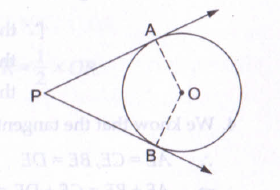
Suppose PA and PB are two tangents we want to draw which inclined at an angle of 450
We know that the radius and tangent are perperpendular at their point of contact
∵∠OBP = ∠OAP = 900
Now, In quadrilateral AOBP
∠AOB + ∠OBP + + ∠OAP + ∠APB = 3600 [Angle sum property of a quadrilateral]
⇒ ∠AOB + 900 + 900 + 450 = 3600
⇒ ∠AOB + 2250 = 3600
⇒ ∠AOB = 1350
Hence, the correct answer is option (b).
Page No 504:
Question 35:
In the given figure, O is the centre of a circle; PQL and PRM are the tangents at the points Q and R respectively, and S is a point on the circle, such that ∠SQL = 50° and ∠SRM = 60°. Find ∠QSR.

(a) 40°
(b) 50°
(c) 60°
(d) 70°
Answer:
Page No 504:
Question 36:
In the given figure, a triangle PQR is drawn to circumscribe a circle of radius 6 cm such that the segments QT and TR into which QR is divided by the point of contact T are of lengths 12 cm and 9 cm respectively. If the area of △PQR = 189 cm2 then the length of side PQ is [CBSE 2011]
(a) 17.5 cm
(b) 20 cm
(c) 22.5 cm
(d) 7.6 cm

Answer:

We know that tangent segments to a circle from the same external point are congruent.
Therefore, we have
PS = PU = x
QT = QS = 12 cm
RT = RU = 9 cm
Now,
Now, PQ = QS + SP = 12 + 10.5 = 22.5 cm
Hence, the correct answer is option (c ).
Page No 504:
Question 37:
In the given figure, QR is a common tangent to the given circle, touching externally at the point T. The tangent at T meets QR at P. If PT = 3.8 cm then the length of QR is
(a) 1.9 cm
(b) 3.8 cm
(c) 5.7 cm
(d) 7.6 cm

Answer:
We know that tangent segments to a circle from the same external point are congruent.
Therefore, we have
PT = PQ = 3.8 cm and PT = PR = 3.8 cm
∴ QR = QP + PR = 3.8 + 3.8 = 7.6 cm
Hence, the correct answer is option (d)
Page No 504:
Question 38:
In the given figure, quadrilateral ABCD is circumscribed, touching the circle at P, Q, R and S. If AP = 5 cm, BC = 7 cm and CS = 3 cm, AB = ?

(a) 9 cm
(b) 10 cm
(c) 12 cm
(d) 8 cm
Answer:
(a) 9 cm
Page No 504:
Question 39:
In the given figure, quadrilateral ABCD is circumscribed, touching the circle at P, Q, R and S. If AP = 6 cm, BP = 5 cm, CQ = 3 cm and DR = 4 cm, then the perimeter of quadrilateral ABCD is

(a) 18 cm
(b) 27 cm
(c) 36 cm
(d) 32 cm
Answer:
Page No 505:
Question 40:
In the given figure, O is the centre of the circle AB is a chord and AT is the tangent at A. If ∠AOB = 100∘ then ∠BAT is equal to
(a) 40∘
(b) 50∘
(c) 90∘
(d) 100∘

Answer:
Given: AO and BO are the radius of the circle
Since, AO = BO
∴ △AOB is an isosceles triangle.
Now, in △AOB
∠AOB + ∠OBA + ∠OAB = 180∘ (Angle sum property of triangle)
⇒ 100∘ + ∠OAB + ∠OAB = 180∘ (∠OBA = ∠OAB)
⇒ 2∠OAB = 80∘
⇒ ∠OAB = 40∘
We know that the radius and tangent are perperpendular at their point of contact
∵∠OAT = 90∘
⇒ ∠OAB + ∠BAT = 90∘
⇒ ∠BAT = 90∘ − 40∘ = 50∘
Hence, the correct answer is option (b).
Page No 505:
Question 41:
In a right triangle ABC, right angled at B, BC = 12 cm and AB = 5 cm. The radius of the circle inscribed in the triangle is [CBSE 2014]
(a) 1 cm
(b) 2 cm
(c) 3 cm
(d) 4 cm
Answer:

In right triangle ABC
By using Pythagoras theorem we have
AC2 = AB2 + BC2
= 52 + 122
= 25 + 144
= 169
∴ AC2 = 169
⇒ AC = 13 cm
Now,
Hence, the correct answer is option (b).
Page No 505:
Question 42:
In the given figure, a circle is inscribed in a quadrilateral ABCD touching its sides Ab, BC, CD and AD at P, Q, R and S respectively.
If the radius of the circle is 10 cm, BC = 38 cm, PB = 27 cm and AD ⊥ CD then the length of CD is [CBSE 2013]
(a) 11 cm
(b) 15 cm
(c) 20 cm
(d) 21 cm

Answer:
Construction: Join OR

We know that tangent segments to a circle from the same external point are congruent.
Therefore, we have
BP = BQ = 27 cm
CQ = CR
Now, BC = 38 cm
⇒ BQ + QC = 38
⇒ QC = 38 − 27 = 11 cm
Since, all the angles in quadrilateral DROS are right angles.
Hence, DROS is a rectangle.
We know that opposite sides of rectangle are equal
∴ OS = RD = 10 cm
Now, CD = CR + RD
= CQ + RD
= 11 + 10
= 21 cm
Hence, the correct answer is option(d)
Page No 505:
Question 43:
In the given figure, ΔABC is right-angled at B, such that BC = 6 cm and AB = 8 cm. A circle with centre O has been inscribed in the triangle. OP ⊥ AB, OQ ⊥ BC and OR ⊥ AC.
If OP = OQ = OR = x cm, then x = ?

(a) 2 cm
(b) 2.5 cm
(c) 3 cm
(d) 3.5 cm
Answer:
(a) 2 cm
Page No 505:
Question 44:
Quadrilateral ABCD is circumscribed to a circle. If AB = 6 cm, BC = 7 cm and CD = 4 cm, then the length of AD is [CBSE 2012]
(a) 3 cm
(b) 4 cm
(c) 6 cm
(d) 7 cm
Answer:

We know that when a quadrilateral circumscribes a circle then sum of opposites sides is equal to the sum of other opposite sides.
∴ AB + DC = AD + BC
⇒6 + 4 = AD + 7
⇒ AD = 3 cm
Hence, the correct answer is option (a).
Page No 505:
Question 45:
In the given figure, PA and PB are tangents to the given circle, such that PA = 5 cm and ∠APB = 60°. The length of chord AB is

(a)
(b) 5 cm
(c)
(d) 7.5 cm
Answer:
(b) 5 cm
The lengths of tangents drawn from a point to a circle are equal.
Page No 506:
Question 46:
In the given figure, DE and DF are two tangents drawn from an external point D to a circle with centre A. If DE = 5 cm. and DE ⊥ DF then the radius of the circle is [CBSE 2013]
(a) 3 cm
(b) 4 cm
(c) 5 cm
(d) 6 cm

Answer:
Construction: Join AF and AE

We know that the radius and tangent are perperpendular at their point of contact
∵∠AED = ∠AFD = 90∘
Since, in quadrilateral AEDF all the angles are right angles
∴ AEDF is a rectangle
Now, we know that the pair of opposite sides are equal in rectangle
∴ AF = DE = 5 cm
Therefore, the radius of the circle is 5 cm
Hence, the correct answer is option (c).
Page No 506:
Question 47:
In the given figure, three circles with centres A, B, C, respectively, touch each other externally. If AB = 5 cm, BC = 7 cm and CA = 6 cm, the radius of the circle with centre A is

(a) 1.5 cm
(b) 2 cm
(c) 2.5 cm
(d) 3 cm
Answer:
(b) 2 cm
(a) 1.5 cm
(b) 2 cm
(c) 2.5 cm
(d) 3 cm
Answer:
(b) 2 cm
Page No 506:
Question 48:
In the given figure, AP, AQ and BC are tangents to the circle. If AB = 5 cm, AC = 6 cm and BC = 4 cm then the length of AP is [CBSE 2012]
(a) 15 cm
(b) 10 cm
(c) 9 cm
(d) 7.5 cm

Answer:

We know that tangent segments to a circle from the same external point are congruent.
Therefore, we have
AP = AQ
BP = BD
CQ = CD
Now, AB + BC + AC = 5 + 4 + 6 = 15
⇒AB + BD + DC + AC = 15 cm
⇒AB + BP + CQ + AC = 15 cm
⇒AP + AQ= 15 cm
⇒2AP = 15 cm
⇒AP = 7.5 cm
Hence, the correct answer is option(d)
Page No 506:
Question 49:
In the given figure, O is the centre of two concentric circles of radii 5 cm and 3 cm. From an external point P tangents PA and PB are drawn to these circles. If PA = 12 cm then PB is equal to

(a)
(b)
(c)
(d)
Answer:

(c)
Page No 506:
Question 50:
Which of the following statements is not true?
Answer:
(c)
Page No 506:
Question 50:
Which of the following statements is not true?
(a) If a point P lies inside a circle, no tangent can be drawn to the circle passing through P.
(b) If a point P lies on a circle, then one and only one tangent can be drawn to the circle at P.
(c) If a point P lies outside a circle, then only two tangents can be drawn to the circle from P.
(d) A circle can have more than two parallel tangents parallel to a given line.
Answer:
(d) A circle can have more than two parallel tangents, parallel to a given line.
This statement is false because there can only be two parallel tangents to the given line in a circle.
Page No 507:
Question 51:
Which of the following statements is not true?
(a) A tangent to a circle intersects the circle exactly at one point.
(b) The point common to a circle and its tangent is called the point of contact.
(c) The tangent at any point of a circle is perpendicular to the radius of the circle through the point of contact.
(d) A straight line can meet a circle at one point only.
Answer:
(d)A straight line can meet a circle at one point only.
This statement is not true because a straight line that is not a tangent but a secant cuts the circle at two points.
Page No 507:
Question 52:
Which of the following statements is not true?
(a) A line which intersects a circle at two points, is called a secant of the circle.
(b) A line intersecting a circle at one point only is called a tangent to the circle.
(c) The point at which a line touches the circle is called the point of contact.
(d) A tangent to the circle can be drawn from a point inside the circle.
Answer:
(d) A tangent to the circle can be drawn from a point inside the circle.
This statement is false because tangents are the lines drawn from an external point to the circle that touch the circle at one point.
Page No 507:
Question 53:
Assertion (A)
At point P of a circle with centre O and radius 12 cm, a tangent PQ of length 16 cm is drawn. Then, OQ = 20 cm.
Reason (R)
The tangent at any point of a circle is perpendicular to the radius through the point of contact.
(a) Both Assertion (A) and Reason (R) are true and Reason (R) is a correct explanation of Assertion (A).
(b) Both Assertion (A) and Reason (R) are true but Reason (R) is not a correct explanation of Assertion (A).
(c) Assertion (A) is true and Reason (R) is false.
(d) Assertion (A) is false and Reason (R)is true.
Answer:

(a) Both Assertion (A) and Reason (R) are true and Reason (R) is a correct explanation of Assertion (A).
Page No 507:
Question 54:
Assertion (A)
If two tangents are drawn to a circle from an external point, they subtend equal angles at the centre.
Reason (R)
A parallelogram circumscribing a circle is a rhombus.
(a) Both Assertion (A) and Reason (R) are true and Reason (R) is a correct explanation of Assertion (A).
(b) Both Assertion (A) and Reason (R) are true but Reason (R) is not a correct explanation of Assertion (A).
(c) Assertion (A) is true and Reason (R) is false.
(d) Assertion (A) is false and Reason (R)is true.
Answer:
(b) Both Assertion (A) and Reason (R) are true but Reason (R) is not a correct explanation of Assertion (A).
Assertion :-
We know that if two tangents are drawn to a circle from an external point, they subtend equal angles at the centre.
Reason:-
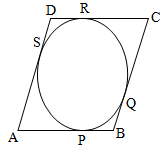
Given, a parallelogram ABCD circumscribes a circle with centre O.
We know that the tangents drawn from an external point to circle are equal .
Hence, ABCD is a rhombus.
(b) Both Assertion (A) and Reason (R) are true but Reason (R) is not a correct explanation of Assertion (A).
(c) Assertion (A) is true and Reason (R) is false.
(d) Assertion (A) is false and Reason (R)is true.
Answer:
(b) Both Assertion (A) and Reason (R) are true but Reason (R) is not a correct explanation of Assertion (A).
Assertion :-
We know that if two tangents are drawn to a circle from an external point, they subtend equal angles at the centre.
Reason:-
Given, a parallelogram ABCD circumscribes a circle with centre O.
We know that the tangents drawn from an external point to circle are equal .
Hence, ABCD is a rhombus.
Page No 508:
Question 55:
| Assertion (A) | Reason (R) |
| In the given figure, a quad. ABCD is drawn to circumscribe a given circle, as shown. Then, AB + BC = AD + DC |
In two concentric circles, the chord of the larger circle, which touches the smaller circle, is bisected at the point of contact. |

The correct answer is (a)/(b)/(c)/(d)
Answer:
(d) Assertion(A) is false and Reasoning(R) is true.
Assertion: In this situation given in the diagram, the sum of opposite sides is always equal.
So, the correct relation should be: AB + CD = AD + CB
Hence, the assertion is false.
Reasoning: We know that in two concentric circles, the chord of the larger circle, which touches( or acts as a tangent to) the smaller circle, is bisected at the point of contact.
Therefore, Reasoning (R) is correct.
Hence, the correct answer is option (d).
Page No 513:
Question 1:
In the given figure, O is the centre of a circle, PQ is a chord and the tangent PT at P makes an angle of 50° with PQ. Then, ∠POQ = ?

(a) 130°
(b) 100°
(c) 90°
(d) 75°
Answer:
Page No 513:
Question 2:
If the angle between two radii of a circle is 130°, then the angle between the tangent at the ends of the radii is
(a) 65°
(b) 40°
(c) 50°
(d) 90°
Answer:

Page No 513:
Question 3:
If tangents PA and PB from a point P to a circle with centre O are drawn, so that ∠APB = 80°, then ∠POA = ?

Question 2:
If the angle between two radii of a circle is 130°, then the angle between the tangent at the ends of the radii is
(a) 65°
(b) 40°
(c) 50°
(d) 90°
Answer:
Page No 513:
Question 3:
If tangents PA and PB from a point P to a circle with centre O are drawn, so that ∠APB = 80°, then ∠POA = ?
(a) 40°
(b) 50°
(c) 80°
(d) 60°
Answer:
(b) 50°
Page No 513:
Question 4:
In the given figure, AD and AE are the tangents to a circle with centre O and BC touches the circle at F. If AE = 5 cm, then perimeter of ∆ABC is

(a) 15 cm
(b) 10 cm
(c) 22.5 cm
(d) 20 cm
Answer:
(b) 10 cm
Since the tangents from an external point are equal, we have:
Page No 513:
Question 5:
In the given figure, a quadrilateral ABCD is drawn to circumscribe a circle such that its side AB, BC, CD and AD touch the circle at P, Q, R and S respectively. If AB = x cm, BC = 7 cm, CR = 3 cm and AS = 5 cm , find x

Answer:
We know that tangent segments to a circle from the same external point are congruent.
Now, we have
CR = CQ, AS = AP and BQ = BP
Now, BC = 7 cm
⇒ CQ + BQ = 7
⇒ BQ = 7 − CQ
⇒ BQ = 7 − 3 [∵ CQ = CR = 3]
⇒ BQ = 4 cm
Again, AB = AP + PB
= AP + BQ
= 5 + 4 [∵ AS = AP = 5]
= 9 cm
Hence, the value of x is 9 cm.
Page No 514:
Question 6:
In the given figure, PA and PB are the tangents to a circle with centre O. Show that the points A, O, B, P are concyclic.

Answer:
Page No 514:
Question 7:
In the given figure, PA and PB are two tangents from an external point P to a circle with centre O. If ∠PBA = 65∘ , find ∠OAB and ∠APB

Answer:
We know that tangents drawn from the external point are congruent.
∴ PA = PB
Now, In isoceles triangle APB
∠APB + ∠PBA + ∠PAB = 180∘ [Angle sum property of a triangle]
⇒ ∠APB + 65∘ + 65∘ = 180∘ [∵∠PBA = ∠PAB = 65∘ ]
⇒ ∠APB = 50∘
We know that the radius and tangent are perperpendular at their point of contact
∴∠OBP = ∠OAP = 90∘
Now, In quadrilateral AOBP
∠AOB + ∠OBP + ∠APB + ∠OAP = 360∘ [Angle sum property of a quadrilateral]
⇒ ∠AOB + 90∘ + 50∘ + 90∘ = 360∘
⇒ 230∘ + ∠BOC = 360∘
⇒ ∠AOB = 130∘
Now, In isoceles triangle AOB
∠AOB + ∠OAB + ∠OBA = 180∘ [Angle sum property of a triangle]
⇒ 130∘ + 2∠OAB = 1800 [∵∠OAB = ∠OBA ]
⇒ ∠OAB = 25∘
Page No 514:
Question 8:
Two tangents BC and BD are drawn to a circle with centre O, such that ∠CBD = 120°. Prove that OB = 2BC.

Answer:
Page No 514:
Question 9:
Fill in the blanks.
(i) A line intersecting a circle at two distinct points is called a ....... .
(ii) A circle can have ....... parallel tangents at the most.
(iii) The common point of a tangent to a circle and the circle is called the ....... .
(iv) A circle can have ...... tangents.
Answer:
(i) A line intersecting a circle at two distinct points is called a secant.
(ii) A circle can have two parallel tangents at the most.
(iii) The common point of a tangent to a circle and the circle is called the point of contact.
(iv) A circle can have infinite tangents.
Page No 514:
Question 10:
Prove that the length of two tangents drawn from an external point to a circle are equal.
Answer:
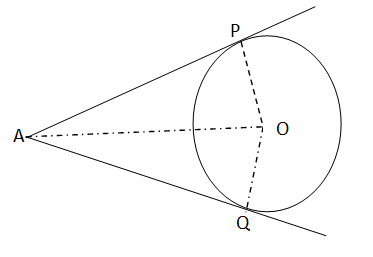
Given two tangents AP and AQ are drawn from a point A to a circle with centre O.
Page No 514:
Question 11:
Prove that the tangents drawn at the ends of the diameter of a circle are parallel.
Answer:
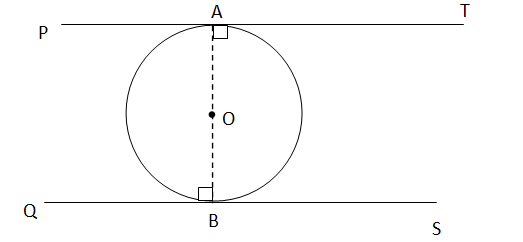
Now, radius of a circle is perpendicular to the tangent at the point of contact.
Page No 514:
Question 8:
Two tangents BC and BD are drawn to a circle with centre O, such that ∠CBD = 120°. Prove that OB = 2BC.
Answer:
Page No 514:
Question 9:
Fill in the blanks.
(i) A line intersecting a circle at two distinct points is called a ....... .
(ii) A circle can have ....... parallel tangents at the most.
(iii) The common point of a tangent to a circle and the circle is called the ....... .
(iv) A circle can have ...... tangents.
Answer:
(i) A line intersecting a circle at two distinct points is called a secant.
(ii) A circle can have two parallel tangents at the most.
(iii) The common point of a tangent to a circle and the circle is called the point of contact.
(iv) A circle can have infinite tangents.
Page No 514:
Question 10:
Prove that the length of two tangents drawn from an external point to a circle are equal.
Answer:
Given two tangents AP and AQ are drawn from a point A to a circle with centre O.
Page No 514:
Question 11:
Prove that the tangents drawn at the ends of the diameter of a circle are parallel.
Answer:
Now, radius of a circle is perpendicular to the tangent at the point of contact.
Page No 514:
Question 12:
In the given figure, if AB = AC, prove that BE = CE.

Answer:
We know that the tangents from an external point are equal.
Page No 514:
Question 13:
If two tangents are drawn to a circle from an external point,show that they subtend equal angles at the centre.
Answer:
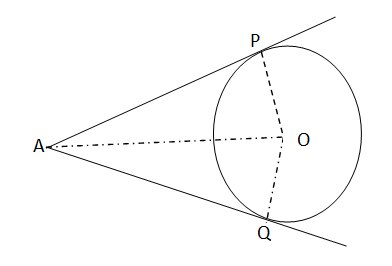
Given : A circle with centre O and a point A outside it. Also, AP and AQ are the two tangents to the circle.
:
Page No 514:
Question 14:
Prove that the tangents drawn at the ends of a chord of a circle make equal angles with the chord.
Answer:
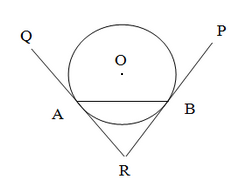
Page No 514:
Question 12:
In the given figure, if AB = AC, prove that BE = CE.
Answer:
We know that the tangents from an external point are equal.
Page No 514:
Question 13:
If two tangents are drawn to a circle from an external point,show that they subtend equal angles at the centre.
Answer:
Given : A circle with centre O and a point A outside it. Also, AP and AQ are the two tangents to the circle.
:
Page No 514:
Question 14:
Prove that the tangents drawn at the ends of a chord of a circle make equal angles with the chord.
Answer:
Page No 515:
Question 15:
Prove that the parallelogram circumscribing a circle is a rhombus.
Answer:
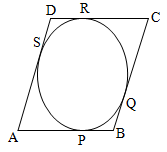
Given, a parallelogram ABCD circumscribes a circle with centre O.
We know that the lengths of tangents drawn from an exterior point to a circle are equal.
Hence, ABCD is a rhombus.
Page No 515:
Question 16:
Two concentric circles are of radii 5 cm and 3 cm, respectively. Find the length of the chord of the larger circle that touches the smaller circle.
Answer:
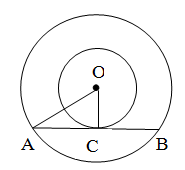
Given: Two circles have the same centre O and AB is a chord of the larger circle touching the
smaller circle at C; also, OA = 5 cm and OC = 3 cm.
The length of the chord of the larger circle is 8 cm.
Page No 515:
Question 17:
A quadrilateral ABCD is drawn to circumscribe a circle. Prove that sums of opposite sides are equal.
Answer:
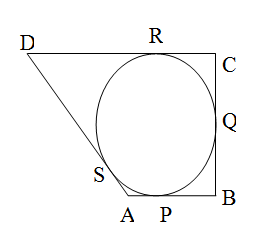
We know that the tangents drawn from an external point to a circle are equal.
Page No 515:
Question 18:
Prove that the opposite sides of a quadrilateral circumscribing a circle subtend supplementary angles at the centre of the circle.
Answer:

Given, a quadrilateral ABCD circumscribes a circle with centre O.
Page No 515:
Question 19:
Prove that the angles between the two tangents drawn form an external point to a circle is supplementary to the angle subtended by the line segments joining the points of contact at the centre.
Answer:
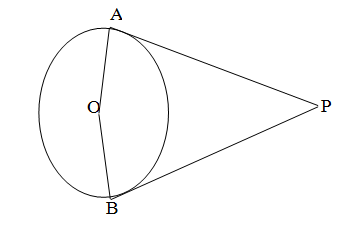
Given, PA and PB are the tangents drawn from a point P to a circle with centre O. Also, the line segments OA and OB are drawn.
We know that the tangent to a circle is perpendicular to the radius through the point of contact.
From (i) and (ii), we get:
Page No 515:
Question 20:
PQ is a chord of length 16 cm of a circle of radius 10 cm. The tangent at P and Q intersect at a point T as shown in the figure. Find the length of TP [CBSE 2013C]

Answer:

RS Aggarwal Solutions for Class 10 Maths Chapter 8: Download PDF
RS Aggarwal Solutions for Class 10 Maths Chapter 8–Circles
Download PDF: RS Aggarwal Solutions for Class 10 Maths Chapter 8–Circles PDF
Chapterwise RS Aggarwal Solutions for Class 10 Maths :
- Chapter 1–Real Numbers
- Chapter 2–Polynomials
- Chapter 3–Linear Equations In Two Variables
- Chapter 4–Quadratic Equations
- Chapter 5–Arithmetic Progression
- Chapter 6–Coordinate Geometry
- Chapter 7–Triangles
- Chapter 8–Circles
- Chapter 9–Constructions
- Chapter 10–Trigonometric Ratios
- Chapter 11–T Ratios Of Some Particular Angles
- Chapter 12–Trigonometric Ratios Of Some Complementary Angles
- Chapter 13–Trigonometric Identities
- Chapter 14–Height and Distance
- Chapter 15–Perimeter and Areas of Plane Figures
- Chapter 16–Areas of Circle, Sector and Segment
- Chapter 17–Volume and Surface Areas of Solids
- Chapter 18–Mean, Median, Mode of Grouped Data
- Chapter 19–Probability
About RS Aggarwal Class 10 Book
Investing in an R.S. Aggarwal book will never be of waste since you can use the book to prepare for various competitive exams as well. RS Aggarwal is one of the most prominent books with an endless number of problems. R.S. Aggarwal's book very neatly explains every derivation, formula, and question in a very consolidated manner. It has tonnes of examples, practice questions, and solutions even for the NCERT questions.
He was born on January 2, 1946 in a village of Delhi. He graduated from Kirori Mal College, University of Delhi. After completing his M.Sc. in Mathematics in 1969, he joined N.A.S. College, Meerut, as a lecturer. In 1976, he was awarded a fellowship for 3 years and joined the University of Delhi for his Ph.D. Thereafter, he was promoted as a reader in N.A.S. College, Meerut. In 1999, he joined M.M.H. College, Ghaziabad, as a reader and took voluntary retirement in 2003. He has authored more than 75 titles ranging from Nursery to M. Sc. He has also written books for competitive examinations right from the clerical grade to the I.A.S. level.
FAQs
Why must I refer to the RS Aggarwal textbook?
RS Aggarwal is one of the most important reference books for high school grades and is recommended to every high school student. The book covers every single topic in detail. It goes in-depth and covers every single aspect of all the mathematics topics and covers both theory and problem-solving. The book is true of great help for every high school student. Solving a majority of the questions from the book can help a lot in understanding topics in detail and in a manner that is very simple to understand. Hence, as a high school student, you must definitely dwell your hands on RS Aggarwal!
Why should you refer to RS Aggarwal textbook solutions on Indcareer?
RS Aggarwal is a book that contains a few of the hardest questions of high school mathematics. Solving them and teaching students how to solve questions of such high difficulty is not the job of any neophyte. For solving such difficult questions and more importantly, teaching the problem-solving methodology to students, an expert teacher is mandatory!
Does IndCareer cover RS Aggarwal Textbook solutions for Class 6-12?
RS Aggarwal is available for grades 6 to 12 and hence our expert teachers have formulated detailed solutions for all the questions of each edition of the textbook. On our website, you'll be able to find solutions to the RS Aggarwal textbook right from Class 6 to Class 12. You can head to the website and download these solutions for free. All the solutions are available in PDF format and are free to download!