

Class 3: Environmental Studies Chapter 11 solutions. Complete Class 3 Environmental Studies Chapter 11 Notes.
Contents
NCERT Solutions for 3rd Class Environmental Studies: Chapter 11-From Here To There
NCERT 3rd Environmental Studies Chapter 11, class 3 Environmental Studies Chapter 11 solutions
The Train
1.How did you like the poem?
Ans. I liked the poem very much.
2.Have you ever travelled in a train? When?
Ans. Yes, I have travelled in a train many times. Last time when I was going to visit my maternal uncle at Allahabad, I travelled in a train.
3.Can a train move anywhere? Why?
Ans. No, a train can not move anywhere. It r^oves only on the iron rails.
4.What is meant by ‘roads of iron’?
Ans. ‘Roads of iron’ means railway tracks on which trains run. They are made of iron.
5.What places did the train pass by? Make a list.
Ans. Meadows, Hills, Temples, Mills, Village wells, Potato fields.
6.Which vehicles have you travelled in? Write their names in your notebook.
Ans. I have travelled in car, bus, metro rail, train, and also in a bullock cart.
7.Which all vehicles did the children travel in?
Ans. Children travelled in all kinds of vehicles. They are—bus, metro rail, car, boat, horse, bicycle, rickshaw and bullock cart.
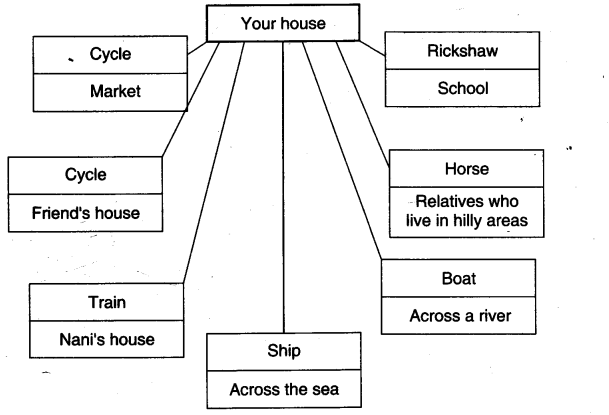
8.How would you choose to go from your house to the places written below? Write in the box.
Ans.
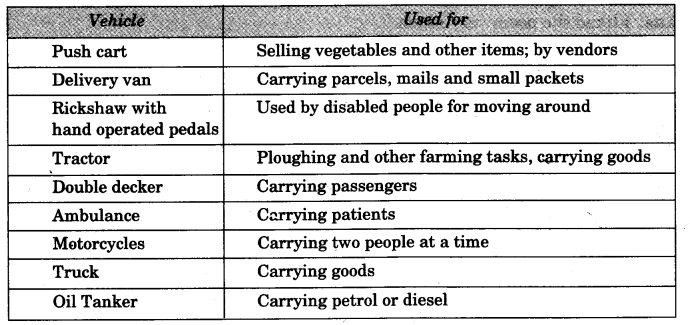
9.Write in front of each picture what the vehicle is used for. In the spaces provided, draw the pictures of some other vehicles. Write their names and what they are used for. Are all these vehicles used for our travel?
Ans.
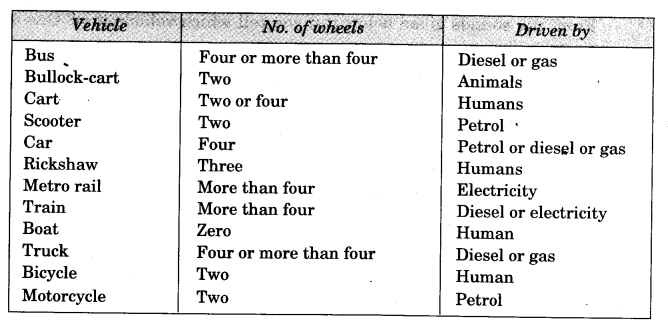
10.Names of some vehicles are given in the centre of a wheel. Join these on one side to the number of wheels each vehicle has and on the other, join them to what is used to run them.
Ans.
11.Find out from your elders—How did people travel fifty years ago? Were the present means of travel available at that time also?
Ans. Fifty years ago people travelled by bus, bullock cart, train, rickshaw, cycle, etc. Except metro rail, all the modes of transport have been in use since more than fifty years.
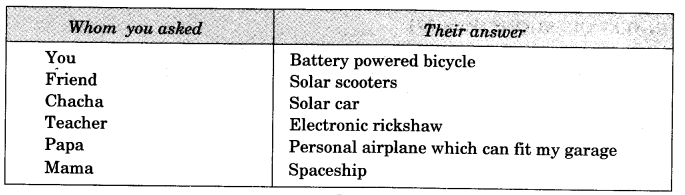
12.Can you imagine which vehicles people will use for travel twenty years from now? Ask your family members and friends and fill in the table. You can add more.
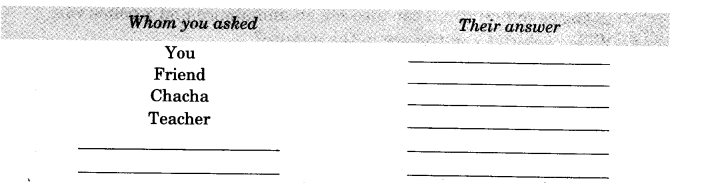
Ans.
NCERT 3rd Environmental Studies Chapter 11, class 3 Environmental Studies Chapter 11 solutions
Your Own Train
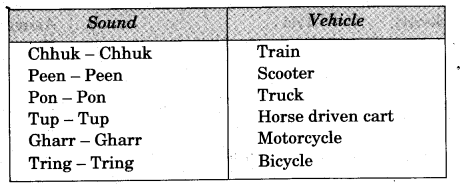
1.If anybody makes a ‘chhuk-chhuk’ sound you know at once that it is being made for a train.From the sounds given below can you tell which vehicle it is? One example is given.
Ans.
2.These are the sounds of single vehicles. How does it sound when many vehicles run together on the road making different noises? Isn’t there a lot of noise?
Ans.Yes, there is lot of noise on the road.
3.Where have you heard the maximum noise?
Ans.On a busy road during peak traffic.
4.Do you like so much noise? Why?
Ans.I do not like so much noise because it disturbs me. It also damages our hearing capacity.
5.What all can you see in the picture?
Ans. A building has caught fire. Fire truck is seen in front of building. Firemen are trying to put off fire. I can also see an ambulance and a police van.
6.Which vehicles can you see in the picture?
Ans. 1.An ambulance
2.A police van
3.Fire brigade van.
7.What are these vehicles doing?
Ans. Fire brigade men are trying to control the fire. Ambulance is taking the injured to the hospital. Police is there for security.
8.Look at the boxes in the picture on the top. Draw them in the correct sequence in the bottom boxes and colour. What did you get? Write its name.
Ans. Attempt yourself.
It is an elephant.
NCERT 3rd Environmental Studies Chapter 11, class 3 Environmental Studies Chapter 11 solutions
NCERT Solutions for 3rd Class Environmental Studies: Chapter 11: Download PDF
NCERT Solutions for 3rd Class Environmental Studies: Chapter 11-From Here To There
Download PDF: NCERT Solutions for 3rd Class Environmental Studies: Chapter 11-From Here To There PDF
Chapterwise NCERT Solutions for Class 3 Environmental Studies :
- Chapter 1 Poonam’s Day Out
- Chapter 2 The Plant Fairy
- Chapter 3 Water O’ Water!
- Chapter 4 Our First School
- Chapter 5 Chhotu’s House
- Chapter 6 Foods We Eat
- Chapter 7 Saying without Speaking
- Chapter 8 Flying High
- Chapter 9 It’s Raining
- Chapter 10 What is Cooking
- Chapter 11 From Here to There
- Chapter 12 Work We Do
- Chapter 13 Sharing Our Feelings
- Chapter 14 The Story of Food
- Chapter 15 Making Pots
- Chapter 16 Games we Play
- Chapter 17 Here comes a Letter
- Chapter 18 A House Like This
- Chapter 19 Our Friends- Animal
- Chapter 20 Drop by Drop
- Chapter 21 Families can be Different
- Chapter 22 Left-Right
- Chapter 23 A Beautiful Cloth
- Chapter 24 Web of Life
About NCERT
The National Council of Educational Research and Training is an autonomous organization of the Government of India which was established in 1961 as a literary, scientific, and charitable Society under the Societies Registration Act. Its headquarters are located at Sri Aurbindo Marg in New Delhi. Visit the Official NCERT website to learn more.