
Class 3: Environmental Studies Chapter 10 solutions. Complete Class 3 Environmental Studies Chapter 10 Notes.
NCERT Solutions for 3rd Class Environmental Studies: Chapter 10-What is Cooking?
NCERT 3rd Environmental Studies Chapter 10, class 3 Environmental Studies Chapter 10 solutions
1.What are utensils made of?
Ans. Steel, Iron, Copper, Glass, Bronze and Earth (earthen pots) etc.
2.Ask some elderly people what kinds of utensils were used earlier. What were they made of?
Ans. In earlier times utensils were bigger in size than they are today. There were beautiful carvings on them. They were made of bronze, brass and copper.
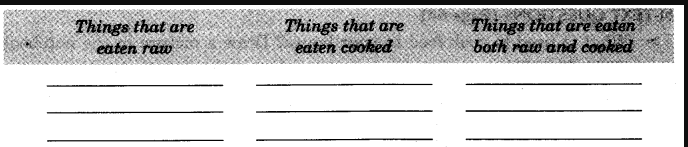
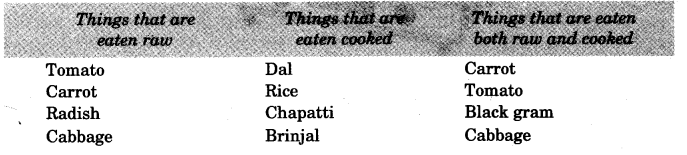
3.We do not cook all the things we eat. Find out which things we eat raw and which ones we cook before eating. Which are the things we eat both cooked and raw? Fill in the table given below.
Ans.
NCERT 3rd Environmental Studies Chapter 10, class 3 Environmental Studies Chapter 10 solutions
4.Go tb the kitchen and observe something being cooked. What all was done to cook it? Write the sequence. Don’t forget to write the name of the item being cooked. Look at the notebook of your classmates and discuss in a group.
Ans.Name of the item: Rice
1.Take a bowl of rice grains.
2.Wash them with plain water.
3.Take about two glasses of water in a pan.
4.Put rice grains in the pan.
5.Boil on the stove.
6.Cook till rice is done.
NCERT 3rd Environmental Studies Chapter 10, class 3 Environmental Studies Chapter 10 solutions
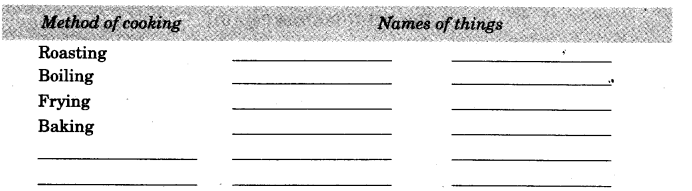
5.Given below are different methods of cooking. Write the names of two things cooked by each of these methods. Add some more methods of cooking to the list and give examples too.
Ans.

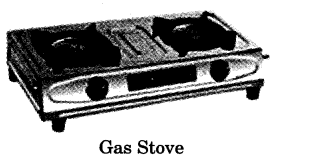
6.What is used to cook food in your house? Draw a picture in the notebook and write its name.
Ans.
NCERT 3rd Environmental Studies Chapter 10, class 3 Environmental Studies Chapter 10 solutions
Make and Eat
1.Soak whole moong seeds overnight in the water. In the morning wrap the soaked moong in a wet cloth and cover it. Take it out after a day. Do you find any difference?
Ans. Yes, the moong seeds germinate after a day.
Add sliced onions, tomatoes, salt and lemon juice to the moong and mix. Share it with your classmates.
NCERT 3rd Environmental Studies Chapter 10, class 3 Environmental Studies Chapter 10 solutions
2.Which are the other things you can prepare without cooking? Write their names and the method of preparing them. One example is given below.
1.Lemon water: Mix sugar in water —> Add lemon juice -4 Strain it —>Lemon water is ready
2.Fruit salad: Chop some fruits in small pieces -> Sprinkle salt, sugar and chaat masala -4 Fruit chaat is ready
3.Lassi: Take one cup curd -4 Add sugar —> Add crushed ice —>Mix well using a mixer —> Lassi is ready.
NCERT 3rd Environmental Studies Chapter 10, class 3 Environmental Studies Chapter 10 solutions
NCERT Solutions for 3rd Class Environmental Studies: Chapter 10: Download PDF
NCERT Solutions for 3rd Class Environmental Studies: Chapter 10-What is Cooking?
Download PDF: NCERT Solutions for 3rd Class Environmental Studies: Chapter 10-What is Cooking? PDF
Chapterwise NCERT Solutions for Class 3 Environmental Studies :
- Chapter 1 Poonam’s Day Out
- Chapter 2 The Plant Fairy
- Chapter 3 Water O’ Water!
- Chapter 4 Our First School
- Chapter 5 Chhotu’s House
- Chapter 6 Foods We Eat
- Chapter 7 Saying without Speaking
- Chapter 8 Flying High
- Chapter 9 It’s Raining
- Chapter 10 What is Cooking
- Chapter 11 From Here to There
- Chapter 12 Work We Do
- Chapter 13 Sharing Our Feelings
- Chapter 14 The Story of Food
- Chapter 15 Making Pots
- Chapter 16 Games we Play
- Chapter 17 Here comes a Letter
- Chapter 18 A House Like This
- Chapter 19 Our Friends- Animal
- Chapter 20 Drop by Drop
- Chapter 21 Families can be Different
- Chapter 22 Left-Right
- Chapter 23 A Beautiful Cloth
- Chapter 24 Web of Life
About NCERT
The National Council of Educational Research and Training is an autonomous organization of the Government of India which was established in 1961 as a literary, scientific, and charitable Society under the Societies Registration Act. Its headquarters are located at Sri Aurbindo Marg in New Delhi. Visit the Official NCERT website to learn more.