
Class 6: Maths Chapter 17 solutions. Complete Class 6 Maths Chapter 17 Notes.
Maharashtra Board Solutions Class 6-Maths (Practice Set 40): Chapter 17- Geometrical Constructions
Maharashtra Board 6th Maths Chapter 17, Class 6 Maths Chapter 17 solutions
Question 1.
Draw line l. Take point P anywhere outside the line. Using a set square draw a line PQ perpendicular to line l.
Solution:
Step 1: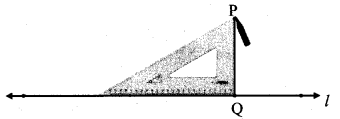
Step 2:
line PQ ⊥ line l.
Question 2.
Draw line AB. Take point M anywhere outside the line. Using a compass and ruler, draw a line MN perpendicular to line AB.
Solution:
Step 1:
Step 2: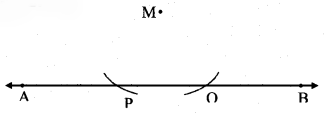
Step 3: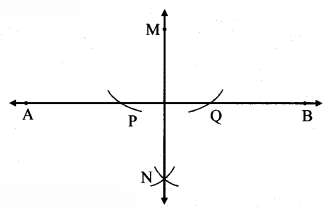
line MN ⊥ line AB.
Question 3.
Draw a line segment AB of length 5.5 cm. Bisect it using a compass and ruler.
Solution:
Step 1: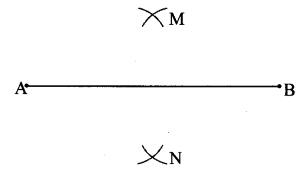
Step 2:
line MN is the perpendicular bisector of seg AB.
Question 4.
Take point R on line XY. Draw a perpendicular to XY at R, using a set square.
Solution:
Step 1:
Step 2: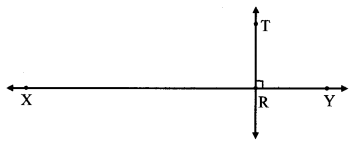
line TR ⊥ line XY.
Questions and Activities
Question 1.
In the above construction, why must the distance in the compass be kept constant? (Textbook pg. no. 90)
Solution:
The point N is at equal distance from points P and Q.
If we change the distance of the compass while drawing arcs from points P and Q, we will not get a point which is at equal distance from P and Q. Hence, the distance in the compass must be kept constant.
Question 2.
The Perpendicular Bisector. (Textbook pg. no. 90)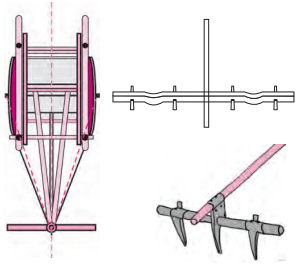
- A wooden ‘yoke’ is used for pulling a bullock cart. How is the position of the yoke determined?
- To do that, a rope is used to measure equal distances from the spine/midline of the bullock cart. Which geometrical property is used here?
- Find out from the craftsmen or from other experienced persons, why this is done.
Solution:
- For the bullock cart to be pulled in the correct direction by the yoke, its Centre O should be equidistant from the either sides of the cart.
- The property of perpendicular bisector is used to make the point equidistant from both the ends
- A rope is used just like a compass to get equal distances from the spine/midline of bullock cart.
Question 3.
Take a rectangular sheet of paper. Fold the paper so that the lower edge of the paper falls on its top edge, and fold it over again from right to left. Observe the two folds that have formed on the . paper. Verify that each fold is a perpendicular bisector of the other. Then measure the following distances. (Textbook pg. no. 91)
i. l(XP)
ii. l(XA)
iii. l(XB)
iv. l(YP)
v. l(YA)
You will observe that l(XP) = l(YP), l(XA) = l(YA) and l(XB) = l(YB)
Therefore we can conclude that all points on the vertical fold (perpendicular bisector) are equidistant from the endpoints of the horizontal fold.
Solution:
[Note: Students should attempt this activity on their own.]
Download PDF
Maharashtra Board Solutions Class 6-Maths (Practice Set 40): Chapter 17- Geometrical Constructions
Chapterwise Maharashtra Board Solutions Class 6 Maths :
- Chapter 1- Basic Concepts in Geometry (Practice Set 1)
- Chapter 2- Angles (Practice Set 2)
- Chapter 2- Angles (Practice Set 3)
- Chapter 3- Integers (Practice Set 4)
- Chapter 3- Integers (Practice Set 5)
- Chapter 3- Integers (Practice Set 6)
- Chapter 3- Integers (Practice Set 7)
- Chapter 3- Integers (Practice Set 8)
- Chapter 4- Operations on Fractions (Practice Set 9)
- Chapter 4- Operations on Fractions (Practice Set 10)
- Chapter 4- Operations on Fractions (Practice Set 11)
- Chapter 4- Operations on Fractions (Practice Set 12)
- Chapter 4- Operations on Fractions (Practice Set 13)
- Chapter 5- Decimal Fractions (Practice Set 14)
- Chapter 5- Decimal Fractions (Practice Set 15)
- Chapter 5- Decimal Fractions (Practice Set 16)
- Chapter 5- Decimal Fractions (Practice Set 17)
- Chapter 6- Bar Graphs (Practice Set 18)
- Chapter 6- Bar Graphs (Practice Set 19)
- Chapter 7- Symmetry (Practice Set 20)
- Chapter 7- Symmetry (Practice Set 21)
- Chapter 8- Divisibility (Practice Set 22)
- Chapter 9- HCF-LCM (Practice Set 23)
- Chapter 9- HCF-LCM (Practice Set 24)
- Chapter 9- HCF-LCM (Practice Set 25)
- Chapter 10- Equations (Practice Set 26)
- Chapter 10- Equations (Practice Set 27)
- Chapter 11- Ratio-Proportion (Practice Set 28)
- Chapter 11- Ratio-Proportion (Practice Set 29)
- Chapter 12- Percentage (Practice Set 30)
- Chapter 13- Profit-Loss (Practice Set 31)
- Chapter 13- Profit-Loss (Practice Set 32)
- Chapter 13- Profit-Loss (Practice Set 33)
- Chapter 13- Profit-Loss (Practice Set 34)
- Chapter 14- Banks and Simple Interest (Practice Set 35)
- Chapter 15- Triangles and their Properties (Practice Set 36)
- Chapter 16- Quadrilaterals (Practice Set 37)
- Chapter 16- Quadrilaterals (Practice Set 38)
- Chapter 17- Geometrical Constructions (Practice Set 39)
- Chapter 17- Geometrical Constructions (Practice Set 40)
- Chapter 18- Three Dimensional Shapes (Practice Set 41)