
Class 6: Maths Chapter 2 solutions. Complete Class 6 Maths Chapter 2 Notes.
Maharashtra Board Solutions Class 6-Maths (Practice Set 3): Chapter 2- Angles
Maharashtra Board 6th Maths Chapter 2, Class 6 Maths Chapter 2 solutions
Question 1.
Use the proper geometrical instruments to construct the following angles. Use the compass and the ruler to bisect them:
- 50°
- 115°
- 80°
- 90°
Solution: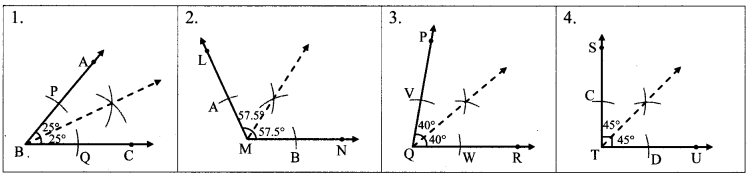
Questions and Activities
Question 1.
Construct an angle bisector to obtain an angle of 30°. (Textbook pg. no. 11)
Solution: .
In order to get a bisected angle of a given measure, the student has to draw the angle having twice the measurement of required bisected angle.
For getting measurement of 30° (for the bisected angle), one has to make an angle of 60° (i.e. 30° × 2).
Step 1:
Draw ∠ABC of 60°.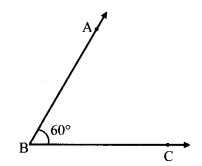
Step 2:
Cut arcs on the rays BA and BC. Name these points as D and E respectively.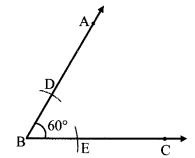
Step 3:
Place the compass point on point D and draw an arc inside the angle.
Without changing the distance of the compass, place the compass point on point E and cut the previous arc. Name the point of intersection as O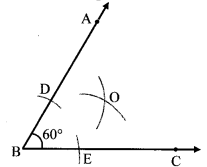
Step 4:
Draw ray BO.
Ray BO is the angle bisector of ∠ABC.
i.e. m∠ABO = m∠CBO = 30°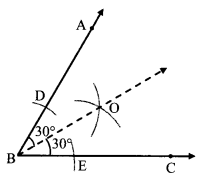
Question 2.
Construct an angle bisector to draw an angle of 45°. (Textbook pg. no. 11)
Solution:
For getting measurement of 45° (for the bisected angle), one has to make an angle of 90° (i.e. 45° × 2).
Step 1:
Draw ∠PQR of 90°.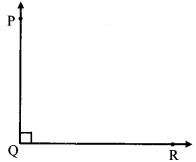
Step 2:
Cut arcs on the rays QP and QR.
Name these points as M and N respectively.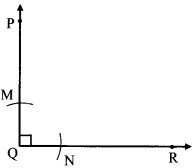
Step 3:
Place the compass point on point M and draw an arc inside the angle.
Without changing the distance of the compass, place the compass point on point N and cut the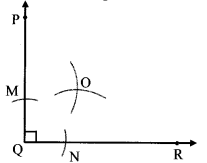
Step 4:
Draw ray QO.
Ray QO is the angle bisector of ∠PQR.
i.e. m∠PQO = m∠RQO = 45°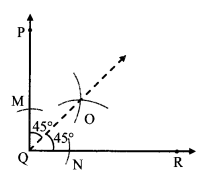
Question 3.
Ask three or more children to stand in a straight line. Take two long ropes. Let the child in the middle hold one end of each rope. With the help of the ropes, make the children on either side stand along a straight line. Tell them to move so as to form an acute angle, a right angle, an obtuse angle, a straight angle, a reflex angle and a full or complete angle in turn. Keeping the rope stretched will help to ensure that the children form straight lines. (Textbook pg. no. 6)
Solution: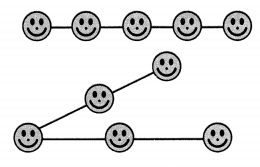
Question 4.
Look at the pictures below and identify the different types of angles. (Textbook pg. no. 8)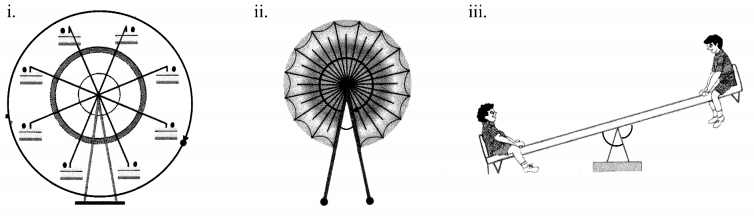
Solution:
i. Complete angle
ii. Reflex and Acute angle
iii. Acute and Obtuse angle
Download PDF
Maharashtra Board Solutions Class 6-Maths (Practice Set 3): Chapter 2- Angles
Download PDF: Maharashtra Board Solutions Class 6-Maths (Practice Set 3): Chapter 2- Angles PDF
Chapterwise Maharashtra Board Solutions Class 6 Maths :
- Chapter 1- Basic Concepts in Geometry (Practice Set 1)
- Chapter 2- Angles (Practice Set 2)
- Chapter 2- Angles (Practice Set 3)
- Chapter 3- Integers (Practice Set 4)
- Chapter 3- Integers (Practice Set 5)
- Chapter 3- Integers (Practice Set 6)
- Chapter 3- Integers (Practice Set 7)
- Chapter 3- Integers (Practice Set 8)
- Chapter 4- Operations on Fractions (Practice Set 9)
- Chapter 4- Operations on Fractions (Practice Set 10)
- Chapter 4- Operations on Fractions (Practice Set 11)
- Chapter 4- Operations on Fractions (Practice Set 12)
- Chapter 4- Operations on Fractions (Practice Set 13)
- Chapter 5- Decimal Fractions (Practice Set 14)
- Chapter 5- Decimal Fractions (Practice Set 15)
- Chapter 5- Decimal Fractions (Practice Set 16)
- Chapter 5- Decimal Fractions (Practice Set 17)
- Chapter 6- Bar Graphs (Practice Set 18)
- Chapter 6- Bar Graphs (Practice Set 19)
- Chapter 7- Symmetry (Practice Set 20)
- Chapter 7- Symmetry (Practice Set 21)
- Chapter 8- Divisibility (Practice Set 22)
- Chapter 9- HCF-LCM (Practice Set 23)
- Chapter 9- HCF-LCM (Practice Set 24)
- Chapter 9- HCF-LCM (Practice Set 25)
- Chapter 10- Equations (Practice Set 26)
- Chapter 10- Equations (Practice Set 27)
- Chapter 11- Ratio-Proportion (Practice Set 28)
- Chapter 11- Ratio-Proportion (Practice Set 29)
- Chapter 12- Percentage (Practice Set 30)
- Chapter 13- Profit-Loss (Practice Set 31)
- Chapter 13- Profit-Loss (Practice Set 32)
- Chapter 13- Profit-Loss (Practice Set 33)
- Chapter 13- Profit-Loss (Practice Set 34)
- Chapter 14- Banks and Simple Interest (Practice Set 35)
- Chapter 15- Triangles and their Properties (Practice Set 36)
- Chapter 16- Quadrilaterals (Practice Set 37)
- Chapter 16- Quadrilaterals (Practice Set 38)
- Chapter 17- Geometrical Constructions (Practice Set 39)
- Chapter 17- Geometrical Constructions (Practice Set 40)
- Chapter 18- Three Dimensional Shapes (Practice Set 41)