

Class 6: Maths Chapter 16 solutions. Complete Class 6 Maths Chapter 16 Notes.
Contents
Maharashtra Board Solutions Class 6-Maths (Practice Set 38): Chapter 16- Quadrilaterals
Maharashtra Board 6th Maths Chapter 16, Class 6 Maths Chapter 16 solutions
Question 1.
Draw ₹XYZW and answer the following:
i. The pairs of opposite angles.
ii. The pairs of opposite sides.
iii. The pairs of adjacent sides.
iv. The pairs of adjacent angles.
v. The diagonals of the quadrilateral.
vi. The name of the quadrilateral in different ways.
Solution: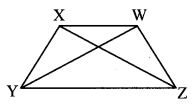
i. a. ∠XYZ and ∠XWZ
b. ∠YXW and ∠YZW
ii. a. side XY and side WZ
b. side XW and side YZ
iii. a. side XY and side XW
b. side WX and side WZ
c. side ZW and side ZY
d. side YZ and side YX
iv. a. ∠XYZ and ∠YZW
b. ∠YZW and ∠ZWX
c. ∠ZWX and ∠WXY
d. ∠WXY and ∠XYZ
v. Seg XZ and seg YW
vi. ₹XYZW
₹YZWX
₹ZWXY
₹WXYZ
₹XWZY
₹WZYX
₹ZYXW
₹YXWZ
Question 2.
In the table below, write the number of sides the polygon has.
| Names | Quadrilateral | Octagon | Pentagon | Heptagon | Hexagon |
| Number of sides |
Solution:
| Names | Quadrilateral | Octagon | Pentagon | Heptagon | Hexagon |
| Number of sides | 4 | 8 | 5 | 7 | 6 |
Question 3.
Look for examples of polygons in your surroundings. Draw them.
Solution: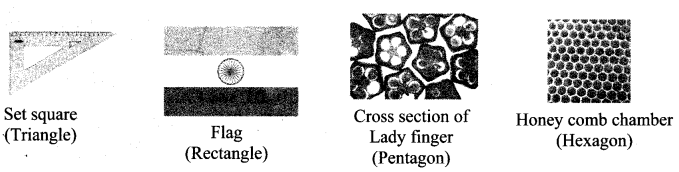
Question 4.
We see polygons when we join the tips of the petals of various flowers. Draw these polygons and write down the number of sides of each polygon.
Solution: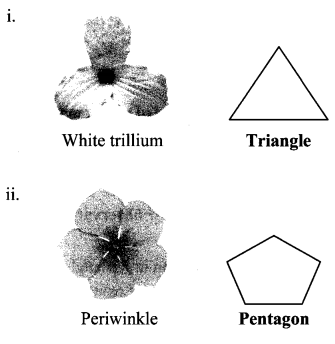
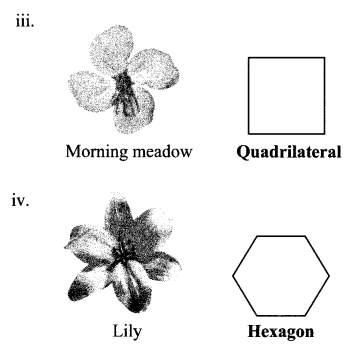
Question 5.
Draw any polygon and divide it into triangular parts as shown here. Thus work out the sum of the measures of the angles of the polygon.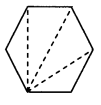
Solution: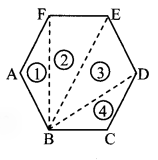
Hexagon ABCDEF can be divided in 4 triangles namely ∆BAF, ∆BFE, ∆BED and ∆BCD
Sum of the measures of the angles of a triangle = 180°
∴ Sum of measures of the angles of the polygon ABCDEF = Sum of the measures of all the four triangles
= 180° + 180° + 180°+ 180°
= 720°
∴ The sum of the measures of the angles of the given polygon (hexagon) is 720°.
Questions and Activities
Question 1.
From your compass boxes, collect set squares of the same shapes and place them side by side in all possible different ways. What figures do you get? Write their names. (Textbook pg. no. 85)
a. Two set squares
b. Three set squares
c. four set squares
Solution:
a. Two set squares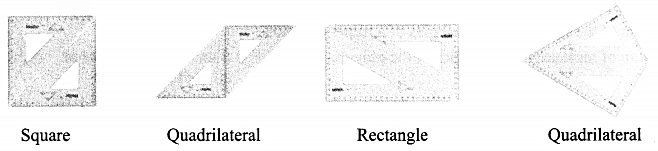
b. Three set squares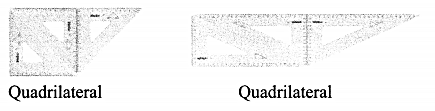
c. four set squares
Question 2.
Kaprekar Number. (Textbook pg. no. 86)
i. Take any 4-digit number in which all the digits are not the same.
ii. Obtain a new 4-digit number by arranging the digits in descending order.
iii. Obtain another 4-digit number by arranging the digits of the new number in ascending order.
iv. Subtract the smaller of these two new numbers from the bigger number. The difference obtained will be a 4-digit number. If it is a 3-digit number, put a 0 in the thousands place. Repeat the above steps with the difference obtained as a result of the subtraction.
v. After some repetitions, you will get the number 6174. If you continue to repeat the same steps you will get the number 6174 every time. Let us begin with the number 8531.
8531 → 7173 → 6354 → 3087 → 8352 → 6174 → 6174
This discovery was made by the mathematician, Dattatreya Ramchandra Kaprekar. That is why the number 6174 was named the Kaprekar number.
Solution:
Download PDF
Maharashtra Board Solutions Class 6-Maths (Practice Set 38): Chapter 16- Quadrilaterals
Chapterwise Maharashtra Board Solutions Class 6 Maths :
- Chapter 1- Basic Concepts in Geometry (Practice Set 1)
- Chapter 2- Angles (Practice Set 2)
- Chapter 2- Angles (Practice Set 3)
- Chapter 3- Integers (Practice Set 4)
- Chapter 3- Integers (Practice Set 5)
- Chapter 3- Integers (Practice Set 6)
- Chapter 3- Integers (Practice Set 7)
- Chapter 3- Integers (Practice Set 8)
- Chapter 4- Operations on Fractions (Practice Set 9)
- Chapter 4- Operations on Fractions (Practice Set 10)
- Chapter 4- Operations on Fractions (Practice Set 11)
- Chapter 4- Operations on Fractions (Practice Set 12)
- Chapter 4- Operations on Fractions (Practice Set 13)
- Chapter 5- Decimal Fractions (Practice Set 14)
- Chapter 5- Decimal Fractions (Practice Set 15)
- Chapter 5- Decimal Fractions (Practice Set 16)
- Chapter 5- Decimal Fractions (Practice Set 17)
- Chapter 6- Bar Graphs (Practice Set 18)
- Chapter 6- Bar Graphs (Practice Set 19)
- Chapter 7- Symmetry (Practice Set 20)
- Chapter 7- Symmetry (Practice Set 21)
- Chapter 8- Divisibility (Practice Set 22)
- Chapter 9- HCF-LCM (Practice Set 23)
- Chapter 9- HCF-LCM (Practice Set 24)
- Chapter 9- HCF-LCM (Practice Set 25)
- Chapter 10- Equations (Practice Set 26)
- Chapter 10- Equations (Practice Set 27)
- Chapter 11- Ratio-Proportion (Practice Set 28)
- Chapter 11- Ratio-Proportion (Practice Set 29)
- Chapter 12- Percentage (Practice Set 30)
- Chapter 13- Profit-Loss (Practice Set 31)
- Chapter 13- Profit-Loss (Practice Set 32)
- Chapter 13- Profit-Loss (Practice Set 33)
- Chapter 13- Profit-Loss (Practice Set 34)
- Chapter 14- Banks and Simple Interest (Practice Set 35)
- Chapter 15- Triangles and their Properties (Practice Set 36)
- Chapter 16- Quadrilaterals (Practice Set 37)
- Chapter 16- Quadrilaterals (Practice Set 38)
- Chapter 17- Geometrical Constructions (Practice Set 39)
- Chapter 17- Geometrical Constructions (Practice Set 40)
- Chapter 18- Three Dimensional Shapes (Practice Set 41)
FAQs
You can download the Maharashtra State Board Books from the eBalbharti official website, i.e. cart.ebalbharati.in or from this article.
Students can get the Maharashtra Books for primary, secondary, and senior secondary classes from here. You can view or download the Maharashtra State Board Books from this page or from the official website for free of cost. Students can follow the detailed steps below to visit the official website and download the e-books for all subjects or a specific subject in different mediums.
Step 1: Visit the official website ebalbharati.in
Step 2: On the top of the screen, select “Download PDF textbooks”
Step 3: From the “Classes” section, select your class.
Step 4: From “Medium”, select the medium suitable to you.
Step 5: All Maharashtra board books for your class will now be displayed on the right side.
Step 6: Click on the “Download” option to download the PDF book.
As of now, the MSCERT and Balbharti are responsible for the syllabus and textbooks of Classes 1 to 8, while Classes 9 and 10 are under the Maharashtra State Board of Secondary and Higher Secondary Education (MSBSHSE).
The Maharashtra State Board of Secondary & Higher Secondary Education, conducts the HSC and SSC Examinations in the state of Maharashtra through its nine Divisional Boards located at Pune, Mumbai, Aurangabad, Nasik, Kolhapur, Amravati, Latur, Nagpur and Ratnagiri.
About Maharashtra State Board (MSBSHSE)
The Maharashtra State Board of Secondary and Higher Secondary Education or MSBSHSE (Marathi: महाराष्ट्र राज्य माध्यमिक आणि उच्च माध्यमिक शिक्षण मंडळ), is an autonomous and statutory body established in 1965. The board was amended in the year 1977 under the provisions of the Maharashtra Act No. 41 of 1965.
The Maharashtra State Board of Secondary & Higher Secondary Education (MSBSHSE), Pune is an independent body of the Maharashtra Government. There are more than 1.4 million students that appear in the examination every year. The Maha State Board conducts the board examination twice a year. This board conducts the examination for SSC and HSC.
The Maharashtra government established the Maharashtra State Bureau of Textbook Production and Curriculum Research, also commonly referred to as Ebalbharati, in 1967 to take up the responsibility of providing quality textbooks to students from all classes studying under the Maharashtra State Board. MSBHSE prepares and updates the curriculum to provide holistic development for students. It is designed to tackle the difficulty in understanding the concepts with simple language with simple illustrations. Every year around 10 lakh students are enrolled in schools that are affiliated with the Maharashtra State Board.