

Class 6: Maths Chapter 13 solutions. Complete Class 6 Maths Chapter 13 Notes.
Contents
Maharashtra Board Solutions Class 6-Maths (Practice Set 32): Chapter 13- Profit-Loss
Maharashtra Board 6th Maths Chapter 13, Class 6 Maths Chapter 13 solutions
Question 1.
From a wholesaler, Santosh bought 400 eggs for Rs 1500 and spent Rs 300 on transport. 50 eggs fell down and broke. He sold the rest at Rs 5 each. Did he make a profit or a loss? How much?
Solution:
Cost price of 400 eggs = Rs 1500
Transportation cost = Rs 300
∴ Total cost price of 400 eggs = Cost price of 400 eggs + Transportation cost
= 1500 + 300 = Rs 1800
50 eggs fell and broke
∴ Remaining eggs = 400 – 50 = 350
Selling price of 1 egg = Rs 5
∴ Selling price of 350 eggs = 5 x 350 = Rs 1750
Total cost price is greater than the selling price.
∴ Santosh suffered a loss.
Loss = Total cost price – Selling price
= 1800 – 1750
= Rs 50
∴ Santosh incurred a loss of Rs 50.
Question 2.
Abraham bought goods worth Rs 50000 and spent Rs 7000 on transport and octroi. If he sold the goods for Rs 65000, did he make a profit or a loss? How much?
Solution:
Cost price of goods = Rs 50000
Transportation cost and octroi = Rs 7000
∴ Total cost price for buying goods = Cost price of goods + Transportation cost and octroi
= 50000 + 7000 = Rs 57000
Selling price of goods = Rs 65000
Selling price is greater than the total cost price
∴ Abraham made a profit.
Profit = Selling price – Total cost price
= 65000 – 57000
= Rs 8000
∴ Abraham made a profit of Rs 8000.
Question 3.
Ajit Kaur bought a 50 kg sack of sugar for Rs 1750, but as sugar prices fell, she had to sell it at Rs 32 per kg. How much loss did she incur?
Solution:
Cost price of 50 kg sugar = Rs 1750
Selling price of 1 kg sugar = Rs 32
∴ Selling price of 50 kg sugar = 50 x 32 = Rs 1600
Loss = Total cost price – Selling price
= 1750 – 1600 = Rs 150
∴ Ajit Kaur incurred a loss of Rs 150.
Question 4.
Kusumtai bought 80 cookers at Rs 700 each. Transport cost her Rs 1280. If she wants a profit of Rs 18000, what should be the selling price per cooker?
Solution:
Cost price of one cooker = Rs 700
∴ Cost price of 80 cookers = 700 x 80 = Rs 56000
Transportation cost = Rs 1280
∴ Total cost price = Cost price of 80 cookers + Transportation cost
= 56000 + 1280
= Rs 57280
Profit = Rs 18000
Profit = Selling Price – Total Cost Price
∴ Required selling price = Total cost price + profit
= 57280 + 18000
= Rs 75280
∴ Selling price of 80 cookers = Rs 75280
∴ Selling price of 1 cooker = \frac { 75280 }{ 80 }7528080 = Rs 941
∴ The selling price per cooker should be Rs 941.
Question 5.
Indrajit bought 10 refrigerators at Rs 12000 each and spent Rs 5000 on transport. For how much should he sell each refrigerator in order to make a profit of Rs 20000?
Solution:
Cost price of 1 refrigerator = Rs 12000
Cost price of 10 refrigerator = 10 x 12000 = Rs 120000
Transportation cost = Rs 5000
∴ Total cost price of 10 refrigerators = Cost price of 10 refrigerators + Transportation cost
= 120000 + 5000 = Rs 125000
Profit = Rs 20000
Profit = Selling Price – Total Cost Price
∴ Required selling price = Total cost price + Profit
= 125000 + 20000 = Rs 145000
∴ Selling price of 10 refrigerators = Rs 145000
∴ Selling price of 1 refrigerator = \frac { 145000 }{ 10 }14500010 = Rs 14500
∴ Indrajit must sell each refrigerator at Rs 14500 to make a profit of Rs 20000.
Question 6.
Lalitabai sowed seeds worth Rs 13700 in her field. She had to spend Rs 5300 on fertilizers and spraying pesticides and Rs 7160 on labor. If, on selling her produce, she earned Rs 35400 what was her profit or her loss?
Solution:
Cost price of seeds = Rs 13700
Cost of fertilizers and pesticides = Rs 5300
Labor cost = Rs 7160
∴ Total cost price = Cost price of seeds + Cost of fertilizers and pesticides + Labor cost
= 13700 + 5300 + 7160
= Rs 26160
Selling price = Rs 35400
Selling price is greater than the total cost price.
∴ Lalitabai made a profit.
Profit = Selling price – Cost price
= 35400 – 26160
= Rs 9240
∴ Lalitabai made a profit of Rs 9240.
Questions and Activities
Question 1.
At Diwali, in a certain school, the students undertook a Design a Diya project. They bought 1000 diyas for Rs 1000 and some paint for Rs 200. To bring the diyas to the school, they spent Rs 100 on transport. They sold the painted lamps at Rs 2 each. Did they make a profit or incur a loss? (Textbook pg. no. 67 and 68)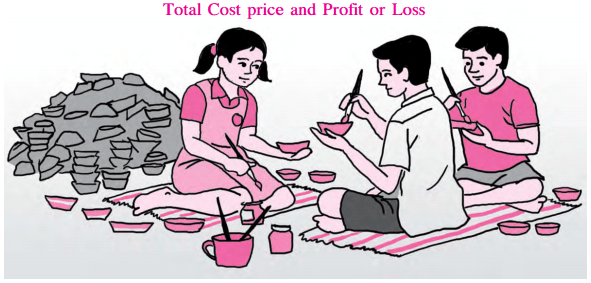
i. Is Anju right?
ii. What about the money spent on paints and transport?
iii. How much money was actually spent before the diyas could be sold?
iv. How much actual profit was made in this project of colouring the diyas and selling them?
Ans:
i. No, Anju is wrong.
Cost price of diyas also includes the painting and transportation cost.
∴ Total cost price of diyas = Cost of diyas + Cost of paint + Transportation cost
= 1000 + 200+ 100
= Rs 1300
ii. The cost of paint was Rs 200 and that for transportation was Rs 100. These costs are also to be added to the cost price of diyas.
iii. Rs 1300 was actually spent before the diyas could be sold.
iv. Total Cost Price of 1000 Diyas = Rs 1300
Selling Price of 1 Diya = Rs 2
∴ Selling Price of 1000 Diyas = 2 x 1000 = Rs 2000
∴ Profit = Selling Price – Total Cost Price
= 2000 – 1300
= Rs 700
∴ The profit made by coloring the diyas and selling them was Rs 700.
Question 2.
A farmer sells what he grows in his fields. How is the total cost price calculated? What does a farmer spend on his produce before he can sell it? What are the other expenses besides seeds, fertilizers and transport? (Textbook pg. no. 68)
Solution:
The farmer, in order to calculate the total cost price of his produce, needs to consider all the expenses associated with the growing and selling of his produce.
Following are the things on which farmer spends money before he can sell it.
- Time and energy
- Ploughing and tilling
- Irrigation and electricity cost
- Harvesting and cleaning
- Packing
As given above, there are a multiple of costs to be included besides seeds, fertilizers and transport for the farmer to price its produce appropriately.
Download PDF
Maharashtra Board Solutions Class 6-Maths (Practice Set 32): Chapter 13- Profit-Loss
Chapterwise Maharashtra Board Solutions Class 6 Maths :
- Chapter 1- Basic Concepts in Geometry (Practice Set 1)
- Chapter 2- Angles (Practice Set 2)
- Chapter 2- Angles (Practice Set 3)
- Chapter 3- Integers (Practice Set 4)
- Chapter 3- Integers (Practice Set 5)
- Chapter 3- Integers (Practice Set 6)
- Chapter 3- Integers (Practice Set 7)
- Chapter 3- Integers (Practice Set 8)
- Chapter 4- Operations on Fractions (Practice Set 9)
- Chapter 4- Operations on Fractions (Practice Set 10)
- Chapter 4- Operations on Fractions (Practice Set 11)
- Chapter 4- Operations on Fractions (Practice Set 12)
- Chapter 4- Operations on Fractions (Practice Set 13)
- Chapter 5- Decimal Fractions (Practice Set 14)
- Chapter 5- Decimal Fractions (Practice Set 15)
- Chapter 5- Decimal Fractions (Practice Set 16)
- Chapter 5- Decimal Fractions (Practice Set 17)
- Chapter 6- Bar Graphs (Practice Set 18)
- Chapter 6- Bar Graphs (Practice Set 19)
- Chapter 7- Symmetry (Practice Set 20)
- Chapter 7- Symmetry (Practice Set 21)
- Chapter 8- Divisibility (Practice Set 22)
- Chapter 9- HCF-LCM (Practice Set 23)
- Chapter 9- HCF-LCM (Practice Set 24)
- Chapter 9- HCF-LCM (Practice Set 25)
- Chapter 10- Equations (Practice Set 26)
- Chapter 10- Equations (Practice Set 27)
- Chapter 11- Ratio-Proportion (Practice Set 28)
- Chapter 11- Ratio-Proportion (Practice Set 29)
- Chapter 12- Percentage (Practice Set 30)
- Chapter 13- Profit-Loss (Practice Set 31)
- Chapter 13- Profit-Loss (Practice Set 32)
- Chapter 13- Profit-Loss (Practice Set 33)
- Chapter 13- Profit-Loss (Practice Set 34)
- Chapter 14- Banks and Simple Interest (Practice Set 35)
- Chapter 15- Triangles and their Properties (Practice Set 36)
- Chapter 16- Quadrilaterals (Practice Set 37)
- Chapter 16- Quadrilaterals (Practice Set 38)
- Chapter 17- Geometrical Constructions (Practice Set 39)
- Chapter 17- Geometrical Constructions (Practice Set 40)
- Chapter 18- Three Dimensional Shapes (Practice Set 41)
FAQs
You can download the Maharashtra State Board Books from the eBalbharti official website, i.e. cart.ebalbharati.in or from this article.
Students can get the Maharashtra Books for primary, secondary, and senior secondary classes from here. You can view or download the Maharashtra State Board Books from this page or from the official website for free of cost. Students can follow the detailed steps below to visit the official website and download the e-books for all subjects or a specific subject in different mediums.
Step 1: Visit the official website ebalbharati.in
Step 2: On the top of the screen, select “Download PDF textbooks”
Step 3: From the “Classes” section, select your class.
Step 4: From “Medium”, select the medium suitable to you.
Step 5: All Maharashtra board books for your class will now be displayed on the right side.
Step 6: Click on the “Download” option to download the PDF book.
As of now, the MSCERT and Balbharti are responsible for the syllabus and textbooks of Classes 1 to 8, while Classes 9 and 10 are under the Maharashtra State Board of Secondary and Higher Secondary Education (MSBSHSE).
The Maharashtra State Board of Secondary & Higher Secondary Education, conducts the HSC and SSC Examinations in the state of Maharashtra through its nine Divisional Boards located at Pune, Mumbai, Aurangabad, Nasik, Kolhapur, Amravati, Latur, Nagpur and Ratnagiri.
About Maharashtra State Board (MSBSHSE)
The Maharashtra State Board of Secondary and Higher Secondary Education or MSBSHSE (Marathi: महाराष्ट्र राज्य माध्यमिक आणि उच्च माध्यमिक शिक्षण मंडळ), is an autonomous and statutory body established in 1965. The board was amended in the year 1977 under the provisions of the Maharashtra Act No. 41 of 1965.
The Maharashtra State Board of Secondary & Higher Secondary Education (MSBSHSE), Pune is an independent body of the Maharashtra Government. There are more than 1.4 million students that appear in the examination every year. The Maha State Board conducts the board examination twice a year. This board conducts the examination for SSC and HSC.
The Maharashtra government established the Maharashtra State Bureau of Textbook Production and Curriculum Research, also commonly referred to as Ebalbharati, in 1967 to take up the responsibility of providing quality textbooks to students from all classes studying under the Maharashtra State Board. MSBHSE prepares and updates the curriculum to provide holistic development for students. It is designed to tackle the difficulty in understanding the concepts with simple language with simple illustrations. Every year around 10 lakh students are enrolled in schools that are affiliated with the Maharashtra State Board.