

Class 6: Maths Chapter 13 solutions. Complete Class 6 Maths Chapter 13 Notes.
Contents
Maharashtra Board Solutions Class 6-Maths (Practice Set 31): Chapter 13- Profit-Loss
Maharashtra Board 6th Maths Chapter 13, Class 6 Maths Chapter 13 solutions
Question 1.
The cost price and selling price are given in the following table. Find out whether there was a profit or a loss and how much it was.
| Ex. | Cost price (in Rs) | Selling price (in Rs) | Profit or Loss | How much? |
| i. | 4500 | 5000 | ||
| ii. | 4100 | 4090 | ||
| iii. | 700 | 799 | ||
| iv. | 1000 | 920 |
Solution:
i. Cost price = Rs 4500
Selling price = Rs 5000
Selling price is greater than cost price.
∴ There is a profit.
∴ Profit = Selling price – Cost price
= 5000 – 4500
Profit = Rs 500
ii. Cost price = Rs 4100
Selling price = Rs 4090
Cost price is greater than selling price.
∴ There is a loss.
∴ Loss = Cost price – Selling price
= 4100 – 4090
∴ Loss = Rs 10
iii. Cost price = Rs 700
Selling price = Rs 799
Selling price is greater than cost price.
∴ There is a profit.
∴ Profit = Selling price – Cost price
= 799 – 700
∴ Profit = Rs 99
iv. Cost price = Rs 1000
Selling price = Rs 920
Cost price is greater than selling price.
∴ There is a loss.
∴ Loss = Cost price – Selling price
= 1000 – 920
∴ Loss = Rs 80
| Ex. | Cost price (in Rs) | Selling price (in Rs) | Profit or Loss | How much? |
| i. | 4500 | 5000 | Profit | Rs 500 |
| ii. | 4100 | 4090 | Loss | Rs 10 |
| iii. | 700 | 799 | Profit | Rs 99 |
| iv. | 1000 | 920 | Loss | Rs 80 |
Question 2.
A shopkeeper bought a bicycle for Rs 3000 and sold the same for Rs 3400. How much was his profit?
Solution:
Cost price = Rs 3000, Selling price = Rs 3400
∴ Profit = Selling price – Cost price
= 3400 – 3000
= Rs 400
The shopkeeper’s profit was Rs 400.
Question 3.
Sunandabai bought milk for Rs 475. She converted it into yogurt and sold it for Rs 700. How much profit did she make?
Solution:
∴ Cost price = Rs 475, Selling price = Rs 700
∴ Profit = Selling price – Cost price
= 700 – 475
= Rs 225
∴ Sunandabai made a profit of Rs 225.
Question 4.
The Jijamata Women’s Saving Group bought raw materials worth Rs 15000 for making chakalis.
They sold the chakalis for Rs 22050. How much profit did the WSG make?
Solution:
Cost price of raw materials = Rs 15000
Selling price of chakalis = Rs 22050
∴ Profit = Selling price – Cost price
= 22050 – 15000
= Rs 7050
∴ The Women’s Saving Group made a profit of Rs 7050.
Question 5.
Pramod bought 100 bunches of methi greens for Rs 400. In a sudden downpour, 30 of the bunches on his handcart got spoil. He sold the rest at the rate of Rs 5 each. Did he make a profit or a loss? How much?
Solution:
Cost price of 100 bunches of methi green = Rs 400
Since, 30 bunches got spoil,
∴ Remaining bunches of methi green = 100 – 30 = 70
Selling price of 1 bunch of methi green = Rs 5
∴ Selling price of 70 bunches of methi green = 5 x 70 = Rs 350
Cost price is greater than selling price
∴ Pramod suffered a loss.
Loss = Cost price – Selling price
= 400 – 350
= Rs 50
∴ Pramod suffered a loss of Rs 50.
Question 6.
Sharad bought one quintal of onions for Rs 2000. Later he sold them all at the rate of Rs 18 per kg. Did he make a profit or incur a loss? How much was it?
Solution:
Cost price of one quintal onions = Rs 2000
Selling price of 1 kg onions = Rs 18
Since, 1 quintal = 100 kg
∴ Selling price of 1 quintal (100 kg) onions = 18 x 100 = Rs 1800
Cost price is greater than selling price
∴ Sharad suffered a loss.
∴ Loss = Cost price – Selling price
= Rs 2000 – Rs 1800
= Rs 200
∴ Sharad incurred a loss of Rs 200.
Question 7.
Kantabai bought 25 saris from a wholesale merchant for Rs 10000 and sold them all at Rs 460 each. How much profit did Kantabai get in this transaction?
Solution:
Cost price of 25 saris = Rs 10000
Selling price of 1 sari = Rs 460
∴ Selling price of 25 saris = 460 x 25 = Rs 11500
Selling price is greater than cost price.
∴ Profit = Selling price – Cost price
= 11500 – 10000
= Rs 1500
∴ Kantabai made a profit of Rs 1500.
Questions and Activities
Question 1.
Pranav and sarita had set up stalls in a fun fair. Study the data given below and answer the questions. (Textbook pg. no. 65)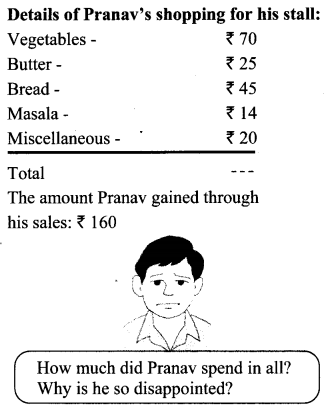
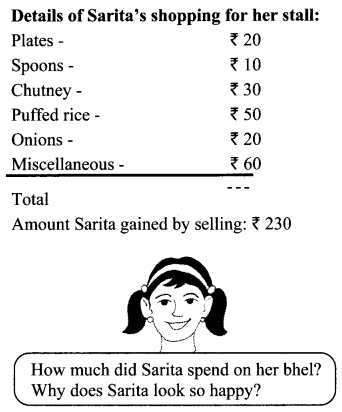
Solution:
Total amount invested by Pranav = 70 + 25 + 45 + 14 + 20 = Rs 174
Amount gained through sale = Rs 160
∴ Selling price is less than invested price.
∴ Pranav incurred a loss in his Pav Bhaji business. Hence, he is disappointed.
Total amount invested by Sarita = 20 + 10 + 30 + 50 + 20 + 60 = Rs 190
Amount gained by selling = Rs 230
∴ Selling price is more than invested price.
∴ Sarita made profit in her business. Hence, she is happy.
Question 2.
For the above example,
- If Sarita had bought twice as much, would she have gained twice as much?
- What should Pranav do the next time he sets up a stall to sell more pav bhaji and make more gains? (Textbook pg. no. 66)
Solution:
- If Sarita would have bought twice as much, she would have prepared double quantity of food items. Hence, she would have gained twice as much.
- Next time Pranav sets a stall, he must sell pav bhaji at a higher cost than he had sold earlier in order to make more gains.
Download PDF
Maharashtra Board Solutions Class 6-Maths (Practice Set 31): Chapter 13- Profit-Loss
Chapterwise Maharashtra Board Solutions Class 6 Maths :
- Chapter 1- Basic Concepts in Geometry (Practice Set 1)
- Chapter 2- Angles (Practice Set 2)
- Chapter 2- Angles (Practice Set 3)
- Chapter 3- Integers (Practice Set 4)
- Chapter 3- Integers (Practice Set 5)
- Chapter 3- Integers (Practice Set 6)
- Chapter 3- Integers (Practice Set 7)
- Chapter 3- Integers (Practice Set 8)
- Chapter 4- Operations on Fractions (Practice Set 9)
- Chapter 4- Operations on Fractions (Practice Set 10)
- Chapter 4- Operations on Fractions (Practice Set 11)
- Chapter 4- Operations on Fractions (Practice Set 12)
- Chapter 4- Operations on Fractions (Practice Set 13)
- Chapter 5- Decimal Fractions (Practice Set 14)
- Chapter 5- Decimal Fractions (Practice Set 15)
- Chapter 5- Decimal Fractions (Practice Set 16)
- Chapter 5- Decimal Fractions (Practice Set 17)
- Chapter 6- Bar Graphs (Practice Set 18)
- Chapter 6- Bar Graphs (Practice Set 19)
- Chapter 7- Symmetry (Practice Set 20)
- Chapter 7- Symmetry (Practice Set 21)
- Chapter 8- Divisibility (Practice Set 22)
- Chapter 9- HCF-LCM (Practice Set 23)
- Chapter 9- HCF-LCM (Practice Set 24)
- Chapter 9- HCF-LCM (Practice Set 25)
- Chapter 10- Equations (Practice Set 26)
- Chapter 10- Equations (Practice Set 27)
- Chapter 11- Ratio-Proportion (Practice Set 28)
- Chapter 11- Ratio-Proportion (Practice Set 29)
- Chapter 12- Percentage (Practice Set 30)
- Chapter 13- Profit-Loss (Practice Set 31)
- Chapter 13- Profit-Loss (Practice Set 32)
- Chapter 13- Profit-Loss (Practice Set 33)
- Chapter 13- Profit-Loss (Practice Set 34)
- Chapter 14- Banks and Simple Interest (Practice Set 35)
- Chapter 15- Triangles and their Properties (Practice Set 36)
- Chapter 16- Quadrilaterals (Practice Set 37)
- Chapter 16- Quadrilaterals (Practice Set 38)
- Chapter 17- Geometrical Constructions (Practice Set 39)
- Chapter 17- Geometrical Constructions (Practice Set 40)
- Chapter 18- Three Dimensional Shapes (Practice Set 41)
FAQs
You can download the Maharashtra State Board Books from the eBalbharti official website, i.e. cart.ebalbharati.in or from this article.
Students can get the Maharashtra Books for primary, secondary, and senior secondary classes from here. You can view or download the Maharashtra State Board Books from this page or from the official website for free of cost. Students can follow the detailed steps below to visit the official website and download the e-books for all subjects or a specific subject in different mediums.
Step 1: Visit the official website ebalbharati.in
Step 2: On the top of the screen, select “Download PDF textbooks”
Step 3: From the “Classes” section, select your class.
Step 4: From “Medium”, select the medium suitable to you.
Step 5: All Maharashtra board books for your class will now be displayed on the right side.
Step 6: Click on the “Download” option to download the PDF book.
As of now, the MSCERT and Balbharti are responsible for the syllabus and textbooks of Classes 1 to 8, while Classes 9 and 10 are under the Maharashtra State Board of Secondary and Higher Secondary Education (MSBSHSE).
The Maharashtra State Board of Secondary & Higher Secondary Education, conducts the HSC and SSC Examinations in the state of Maharashtra through its nine Divisional Boards located at Pune, Mumbai, Aurangabad, Nasik, Kolhapur, Amravati, Latur, Nagpur and Ratnagiri.
About Maharashtra State Board (MSBSHSE)
The Maharashtra State Board of Secondary and Higher Secondary Education or MSBSHSE (Marathi: महाराष्ट्र राज्य माध्यमिक आणि उच्च माध्यमिक शिक्षण मंडळ), is an autonomous and statutory body established in 1965. The board was amended in the year 1977 under the provisions of the Maharashtra Act No. 41 of 1965.
The Maharashtra State Board of Secondary & Higher Secondary Education (MSBSHSE), Pune is an independent body of the Maharashtra Government. There are more than 1.4 million students that appear in the examination every year. The Maha State Board conducts the board examination twice a year. This board conducts the examination for SSC and HSC.
The Maharashtra government established the Maharashtra State Bureau of Textbook Production and Curriculum Research, also commonly referred to as Ebalbharati, in 1967 to take up the responsibility of providing quality textbooks to students from all classes studying under the Maharashtra State Board. MSBHSE prepares and updates the curriculum to provide holistic development for students. It is designed to tackle the difficulty in understanding the concepts with simple language with simple illustrations. Every year around 10 lakh students are enrolled in schools that are affiliated with the Maharashtra State Board.