
Class 6: Maths Chapter 14 solutions. Complete Class 6 Maths Chapter 14 Notes.
Maharashtra Board Solutions Class 6-Maths (Practice Set 35): Chapter 14- Banks and Simple Interest
Maharashtra Board 6th Maths Chapter 14, Class 6 Maths Chapter 14 solutions
Question 1.
At a rate of 10 p.c.p.a., what would be the interest for one year on Rs 6000?
Solution:
Principal Amount = Rs 6000
Rate of Interest = 10 p.c.p.a.
Let interest on principal Rs 6000 be Rs x.
By taking ratio of the interest to the principal for both, we obtain an equation x 10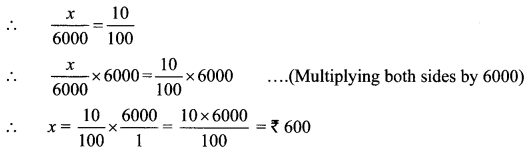
∴ The interest for one year is Rs 600.
Question 2.
Mahesh deposited Rs 8650 in a bank at a rate of 6 p.c.p.a. How much money will he get at the end of the year in all?
Solution:
Principal Amount = Rs 8650
Rate of interest = 6 p.c.p.a.
Let interest on principal Rs 8650 be Rs x
By taking ratio of the interest to the principal for both, we obtain an equation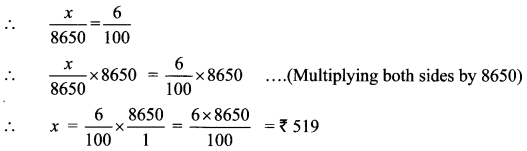
∴ Amount received at the end of the year = Principal amount + Interest
= Rs 8650 + Rs 519
= Rs 9169
∴ Mahesh will get Rs 9169 at the end of the year.
Question 3.
Ahmad Chacha borrowed Rs 25,000 at 12 p.c.p.a. for a year. What amount will he have to return to the bank at the end of the year?
Solution:
Principal Amount = Rs 25,000
Rate of interest = 12 p.c.p.a.
Let interest on principal Rs 25,000 be Rs x
By taking ratio of the interest to the principal for both, we obtain an equation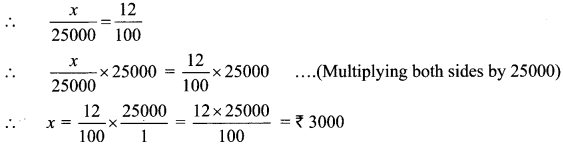
Amount to be returned to the bank at the end of the year = Principal Amount + Interest
= Rs 25,000 + Rs 3,000
= Rs 28,000
Ahmad Chacha has to return Rs 28,000 to the bank at the end of the year.
Question 4.
Kisanrao wanted to make a pond in his field. He borrowed Rs 35,250 from a bank at an interest rate of 6 p.c.p.a. How much interest will he have to pay to the bank at the end of the year?
Solution:
Principal Amount = Rs 35,250
Rate of interest = 6 p.c.p.a.
Let interest on principal Rs 35,250 be Rs x
By taking ratio of the interest to the principal for both, we obtain an equation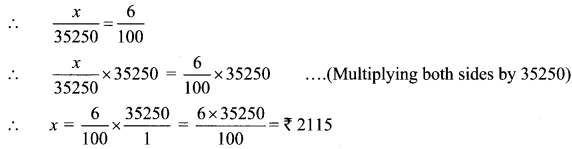
∴ Kisanrao will have to pay an interest of Rs 2115 to the bank at the end of the year.
Questions and Activities
Question 1.
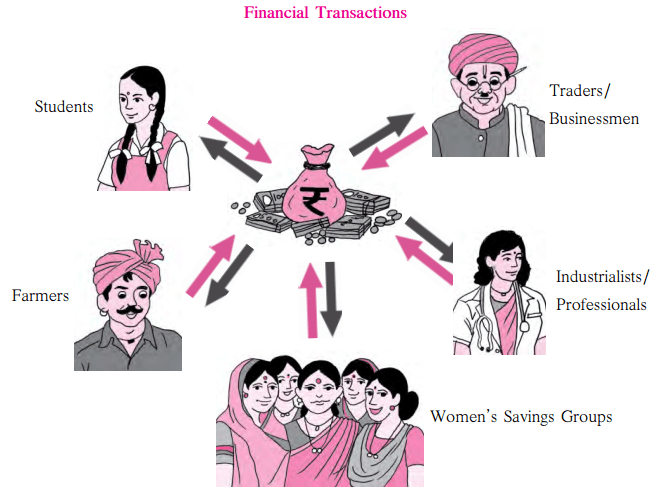
Study the figure given below and answer the following questions (Textbook pg. no. 74)
- In the above picture, who are the people shown to be using bank services?
- What does the symbol on the bag in the centre stand for?
- What do the arrows in the given picture tell you?
Solution:
- Students, farmers, Women’s savings groups, industrialists / professionals and traders / businessmen are shown to be using bank services.
- The symbol on the bag in the center stands for rupees.
- The arrows tell us about the monetary transactions taking place. In simple words, it explains the give and take relationship.
Question 2.
Visit the Bank (Textbook pg. no. 74)
- Teachers should organise a visit to a bank. Encourage the children to obtain some preliminary information about banks.
- Help them to fill some bank forms and slips for withdrawals and deposits.
- If there is no bank nearby, teachers could obtain specimen forms and get the children to fill them in class.
- Give a demonstration of banking transactions by setting up a mock bank in the school.
- Invite participation of parents who work in banks or other bank employees to give the children more detailed information about banking.
Solution:
(Students should attempt this activity with the help of their teacher/parents.)
Download PDF
Maharashtra Board Solutions Class 6-Maths (Practice Set 35): Chapter 14- Banks and Simple Interest
Chapterwise Maharashtra Board Solutions Class 6 Maths :
- Chapter 1- Basic Concepts in Geometry (Practice Set 1)
- Chapter 2- Angles (Practice Set 2)
- Chapter 2- Angles (Practice Set 3)
- Chapter 3- Integers (Practice Set 4)
- Chapter 3- Integers (Practice Set 5)
- Chapter 3- Integers (Practice Set 6)
- Chapter 3- Integers (Practice Set 7)
- Chapter 3- Integers (Practice Set 8)
- Chapter 4- Operations on Fractions (Practice Set 9)
- Chapter 4- Operations on Fractions (Practice Set 10)
- Chapter 4- Operations on Fractions (Practice Set 11)
- Chapter 4- Operations on Fractions (Practice Set 12)
- Chapter 4- Operations on Fractions (Practice Set 13)
- Chapter 5- Decimal Fractions (Practice Set 14)
- Chapter 5- Decimal Fractions (Practice Set 15)
- Chapter 5- Decimal Fractions (Practice Set 16)
- Chapter 5- Decimal Fractions (Practice Set 17)
- Chapter 6- Bar Graphs (Practice Set 18)
- Chapter 6- Bar Graphs (Practice Set 19)
- Chapter 7- Symmetry (Practice Set 20)
- Chapter 7- Symmetry (Practice Set 21)
- Chapter 8- Divisibility (Practice Set 22)
- Chapter 9- HCF-LCM (Practice Set 23)
- Chapter 9- HCF-LCM (Practice Set 24)
- Chapter 9- HCF-LCM (Practice Set 25)
- Chapter 10- Equations (Practice Set 26)
- Chapter 10- Equations (Practice Set 27)
- Chapter 11- Ratio-Proportion (Practice Set 28)
- Chapter 11- Ratio-Proportion (Practice Set 29)
- Chapter 12- Percentage (Practice Set 30)
- Chapter 13- Profit-Loss (Practice Set 31)
- Chapter 13- Profit-Loss (Practice Set 32)
- Chapter 13- Profit-Loss (Practice Set 33)
- Chapter 13- Profit-Loss (Practice Set 34)
- Chapter 14- Banks and Simple Interest (Practice Set 35)
- Chapter 15- Triangles and their Properties (Practice Set 36)
- Chapter 16- Quadrilaterals (Practice Set 37)
- Chapter 16- Quadrilaterals (Practice Set 38)
- Chapter 17- Geometrical Constructions (Practice Set 39)
- Chapter 17- Geometrical Constructions (Practice Set 40)
- Chapter 18- Three Dimensional Shapes (Practice Set 41)