

Class 6: Maths Chapter 1 solutions. Complete Class 6 Maths Chapter 1 Notes.
Contents
Maharashtra Board Solutions Class 6-Maths (Practice Set 1): Chapter 1- Basic Concepts in Geometry
Maharashtra Board 6th Maths Chapter 1, Class 6 Maths Chapter 1 solutions
Question 1.
Look at the figure alongside and name the following:
i. Collinear points
ii. Rays
iii. Line segments
iv. Lines
Solution:
| i. | Collinear Points | Points M, 0 and T |
| Points R, O and N | ||
| ii. | Rays | ray OP, ray OM, ray OR, ray OS, ray OT and ray ON |
| iii. | Line Segments | seg MT, seg RN, seg OP, seg OM, seg OR, seg OS, seg OT and seg ON |
| iv. | Lines | line MT and line RN |
Question 2.
Write the different names of the line.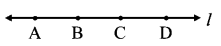
Solution:
The different names of the given line are line l, line AB, line AC, line AD, line BC, line BD and line CD.
Question 3.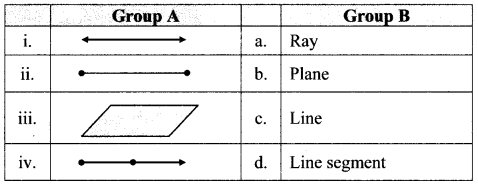
Solution:
(i – Line),
(ii – Line Segment),
(iii – Plane),
(iv – Ray)
Question 4.
Observe the given figure. Name the parallel lines, the concurrent lines and the points of concurrence in the figure.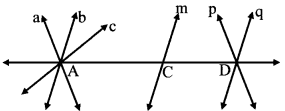
Solution:
| Parallel Lines | line b, line m and line q are parallel to each other. |
| line a and line p are parallel to each other. | |
| Concurrent Lines and Point of Concurrence | line AD, line a, line b and line c are concurrent. Point A is their point of concurrence. |
| line AD, line p and line q are concurrent. Point D is their point of concurrence. |
Questions and Activities
Question 1.
Complete the rangoli. Then, have a class discussion with the help of the following questions:
- What kind of surface do you need for making a rangoli?
- How do you start making a rangoli?
- What did you do in order to complete the rangoli?
- Name the different shapes you see in the rangoli.
- Would it be possible to make a rangoli on a scooter or on an elephant’s back?
- When making a rangoli on paper, what do you use to make the dots?
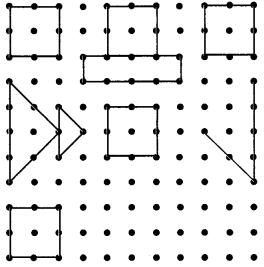
Solution:
- For making a rangoli, I need a flat surface.
- I can start making a rangoli by drawing equally spaced dots on the flat surface using a chalk.
- In order to complete the rangoli, I joined the dots by straight lines to make a design.
- In the rangoli, I find various shapes such as square, rectangle and triangles of two different size.
- No. It won’t be possible to make a rangoli on a scooter or on an elephant’s back as they do not have a flat surface.
- When making a rangoli on paper, I made use of scale and pencil to make equally spaced dots.
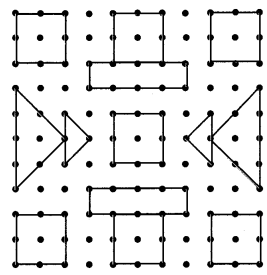
Question 2.
Write the proper term, ‘intersecting lines’ or ‘parallel lines’ in each of the empty boxes. (Textbook pg. no. 4)
Solution:
i. Intersecting Lines
ii. Parallel Lines
iii. Intersecting Lines
Question 3.
Draw a point on the blackboard. Every student now draws a line that passes through that point. How many such lines can be drawn? (Textbook pg. no. 2)
Solution:
An infinite number of lines can be drawn through one point.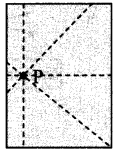
Question 4.
Draw a point on a paper and use your ruler to draw lines that pass through it. How many such lines can you draw? (Textbook pg. no. 2)
Solution:
An infinite number of lines can be drawn through one point.
Question 5.
There are 9 points in the figure. Name them. (Textbook pg. no. 3)
i. If you choose any two points, how many lines can pass through the pair?
ii. Which three or more of these nine points lie on a straight line?
iii. Of these nine points, name any three or more points which do not lie on the same line.
Solution:
i. One and only one line can be drawn through two distinct , points.
ii. Points A, B, C and D lie on the same line. Points F, G and C lie on the same line.
iii. Points E, F, G, H and I do not lie on the same line, points A, B, E, H and I do not lie on the same line.
Question 6.
Observe the picture of the game being played. Identify the collinear players, non-collinear players, parallel lines and the plane. (Textbook pg. no. 4)
Solution:
| i. | Collinear Players | Players A, B, C, D, E, F, G |
| ii. | Non-collinear Players | Players I, H, C Players I, A, B etc. |
| iii. | Parallel Lines | line l, line m, line n, line p, line q, line r and line s |
| iv. | Plane | The ground on which the boys are playing is the plane |

Question 7.
In January, we can see the constellation of Orion in the eastern sky after seven in the evening. Then it moves up slowly in the sky. Can you see the three collinear stars in this constellation? Do you also see a bright star on the same line some distance away? (Textbook pg. no. 4)
Solution:
- The three stars shown by points C, D and E are collinear.
- The star shown by point H lies on the same line as the stars C, D and E.

Question 8.
Maths is fun! (Textbook pg. no. 5)
Take a flat piece of thermocol or cardboard, a needle and thread. Tie a big knot or button or bead at one end of the thread. Thread the needle with the other end. Pass the needle up through any convenient point P. Pull the thread up, leaving the knot or the button below. Remove the needle and put it aside. Now hold the free end of the thread and gently pull it straight. Which figure do you see? Now, holding the thread straight, turn it in different directions. See how a countless number of lines can pass through a single point P.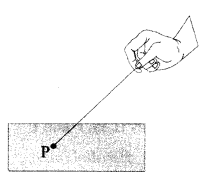
Solution:
- The pulled thread forms a straight line.
- An infinite number of lines can be drawn through one point.
Question 9.
Choose the correct option for each of the following questions:
i. ______ is used to name a point.
(A) Capital letter
(B) Small letter
(C) Number
(D) Roman numeral
Solution :
(A) Capital letter
ii. A line segment has two points showing its limits. They are called_____
(A) origin
(B) end points
(C) arrow heads
(D) infinite points
Solution :
(B) end points
iii. An arrow head is drawn at one end of the ray to show that it is _____ on that side.
(A) finite
(B) ending
(C) infinite
(D) broken
Solution :
(C) infinite
iv. Lines which lie in the same plane but do not intersect are said to be ____ to each other.
(A) intersecting
(B) collinear
(C) parallel
(D) non-collinear
Solution :
(C) parallel
Question 10.
Determine the collinear and non-collinear points in the figure alongside: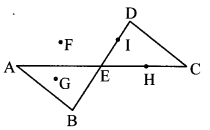
Solution:
Collinear points:
- Points A, E, H and C.
- Points B, E, I and D.
Non-collinear points:
Points B, G, F and I
Question 11.
Look at the figure alongside and answer the questions given below:
i. Name the parallel lines.
ii. Name the concurrent lines and the point of concurrence.
iii. Write the different names of line PV.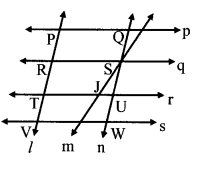
Solution:
i. Parallel lines:
a. line l and line n
b. line p, line q, line r and line s
ii. Concurrent Lines: line q, line m, line n
Point of Concurrence: point S
iii. line l, line PT, line PR, line PV, line RT, line RV and line TV.
Question 12.
Name the different line segments and rays in the given figure:
Solution:
Line Segments:
seg UV, seg OY, seg OX, seg OV and seg OU
Rays:
ray OV, ray OX, ray OY and ray UV.
Download PDF
Maharashtra Board Solutions Class 6-Maths (Practice Set 1): Chapter 1- Basic Concepts in Geometry
Chapterwise Maharashtra Board Solutions Class 6 Maths :
- Chapter 1- Basic Concepts in Geometry (Practice Set 1)
- Chapter 2- Angles (Practice Set 2)
- Chapter 2- Angles (Practice Set 3)
- Chapter 3- Integers (Practice Set 4)
- Chapter 3- Integers (Practice Set 5)
- Chapter 3- Integers (Practice Set 6)
- Chapter 3- Integers (Practice Set 7)
- Chapter 3- Integers (Practice Set 8)
- Chapter 4- Operations on Fractions (Practice Set 9)
- Chapter 4- Operations on Fractions (Practice Set 10)
- Chapter 4- Operations on Fractions (Practice Set 11)
- Chapter 4- Operations on Fractions (Practice Set 12)
- Chapter 4- Operations on Fractions (Practice Set 13)
- Chapter 5- Decimal Fractions (Practice Set 14)
- Chapter 5- Decimal Fractions (Practice Set 15)
- Chapter 5- Decimal Fractions (Practice Set 16)
- Chapter 5- Decimal Fractions (Practice Set 17)
- Chapter 6- Bar Graphs (Practice Set 18)
- Chapter 6- Bar Graphs (Practice Set 19)
- Chapter 7- Symmetry (Practice Set 20)
- Chapter 7- Symmetry (Practice Set 21)
- Chapter 8- Divisibility (Practice Set 22)
- Chapter 9- HCF-LCM (Practice Set 23)
- Chapter 9- HCF-LCM (Practice Set 24)
- Chapter 9- HCF-LCM (Practice Set 25)
- Chapter 10- Equations (Practice Set 26)
- Chapter 10- Equations (Practice Set 27)
- Chapter 11- Ratio-Proportion (Practice Set 28)
- Chapter 11- Ratio-Proportion (Practice Set 29)
- Chapter 12- Percentage (Practice Set 30)
- Chapter 13- Profit-Loss (Practice Set 31)
- Chapter 13- Profit-Loss (Practice Set 32)
- Chapter 13- Profit-Loss (Practice Set 33)
- Chapter 13- Profit-Loss (Practice Set 34)
- Chapter 14- Banks and Simple Interest (Practice Set 35)
- Chapter 15- Triangles and their Properties (Practice Set 36)
- Chapter 16- Quadrilaterals (Practice Set 37)
- Chapter 16- Quadrilaterals (Practice Set 38)
- Chapter 17- Geometrical Constructions (Practice Set 39)
- Chapter 17- Geometrical Constructions (Practice Set 40)
- Chapter 18- Three Dimensional Shapes (Practice Set 41)
FAQs
You can download the Maharashtra State Board Books from the eBalbharti official website, i.e. cart.ebalbharati.in or from this article.
Students can get the Maharashtra Books for primary, secondary, and senior secondary classes from here. You can view or download the Maharashtra State Board Books from this page or from the official website for free of cost. Students can follow the detailed steps below to visit the official website and download the e-books for all subjects or a specific subject in different mediums.
Step 1: Visit the official website ebalbharati.in
Step 2: On the top of the screen, select “Download PDF textbooks”
Step 3: From the “Classes” section, select your class.
Step 4: From “Medium”, select the medium suitable to you.
Step 5: All Maharashtra board books for your class will now be displayed on the right side.
Step 6: Click on the “Download” option to download the PDF book.
As of now, the MSCERT and Balbharti are responsible for the syllabus and textbooks of Classes 1 to 8, while Classes 9 and 10 are under the Maharashtra State Board of Secondary and Higher Secondary Education (MSBSHSE).
The Maharashtra State Board of Secondary & Higher Secondary Education, conducts the HSC and SSC Examinations in the state of Maharashtra through its nine Divisional Boards located at Pune, Mumbai, Aurangabad, Nasik, Kolhapur, Amravati, Latur, Nagpur and Ratnagiri.
About Maharashtra State Board (MSBSHSE)
The Maharashtra State Board of Secondary and Higher Secondary Education or MSBSHSE (Marathi: महाराष्ट्र राज्य माध्यमिक आणि उच्च माध्यमिक शिक्षण मंडळ), is an autonomous and statutory body established in 1965. The board was amended in the year 1977 under the provisions of the Maharashtra Act No. 41 of 1965.
The Maharashtra State Board of Secondary & Higher Secondary Education (MSBSHSE), Pune is an independent body of the Maharashtra Government. There are more than 1.4 million students that appear in the examination every year. The Maha State Board conducts the board examination twice a year. This board conducts the examination for SSC and HSC.
The Maharashtra government established the Maharashtra State Bureau of Textbook Production and Curriculum Research, also commonly referred to as Ebalbharati, in 1967 to take up the responsibility of providing quality textbooks to students from all classes studying under the Maharashtra State Board. MSBHSE prepares and updates the curriculum to provide holistic development for students. It is designed to tackle the difficulty in understanding the concepts with simple language with simple illustrations. Every year around 10 lakh students are enrolled in schools that are affiliated with the Maharashtra State Board.