
Class 11: Physics Chapter 10 solutions. Complete Class 11 Physics Chapter 10 Notes.
Maharashtra Board Solutions Class 11-Physics: Chapter 10- Electrostatics
Maharashtra Board 11th Physics Chapter 10, Class 11 Physics Chapter 10 solutions
1. Choose the correct option.
Question 1.
A positively charged glass rod is brought close to a metallic rod isolated from the ground. The charge on the side of the metallic rod away from the glass rod will be
(A) same as that on the glass rod and equal in quantity
(B) opposite to that on the glass of and equal in quantity
(C) same as that on the glass rod but lesser in quantity
(D) same as that on the glass rod but more in quantity
Answer:
(A) same as that on the glass rod and equal in quantity
Question 2.
An electron is placed between two parallel plates connected to a battery. If the battery is switched on, the electron will
(A) be attracted to the +ve plate
(B) be attracted to the -ve plate
(C) remain stationary
(D) will move parallel to the plates
Answer:
(A) be attracted to the +ve plate
Question 3.
A charge of + 7 µC is placed at the centre of two concentric spheres with radius 2.0 cm and 4.0 cm respectively. The ratio of the flux through them will be
(A) 1 : 4
(B) 1 : 2
(C) 1 : 1
(D) 1 : 16
Answer:
(C) 1 : 1
Question 4.
Two charges of 1.0 C each are placed one meter apart in free space. The force between them will be
(A) 1.0 N
(B) 9 × 10⁹ N
(C) 9 × 10⁻⁹ N
(D) 10 N
Answer:
(B) 9 × 10⁹ N
Question 5.
Two point charges of +5 µC are so placed that they experience a force of 80 × 10-3 N. They are then moved apart, so that the force is now 2.0 × 10⁻³ N. The distance between them is now
(A) 1/4 the previous distance
(B) double the previous distance
(C) four times the previous distance
(D) half the previous distance
Answer:
(B) double the previous distance
Question 6.
A metallic sphere A isolated from ground is charged to +50 µC. This sphere is brought in contact with other isolated metallic sphere B of half the radius of sphere A. The charge on the two sphere will be now in the ratio
(A) 1 : 2
(B) 2 : 1
(C) 4 : 1
(D) 1 : 1
Answer:
(D) 1 : 1
Question 7.
Which of the following produces uniform electric field?
(A) point charge
(B) linear charge
(C) two parallel plates
(D) charge distributed an circular any
Answer:
(C) two parallel plates
Question 8.
Two point charges of A = +5.0 µC and B = -5.0 µC are separated by 5.0 cm. A point charge C = 1.0 µC is placed at 3.0 cm away from the centre on the perpendicular bisector of the line joining the two point charges. The charge at C will experience a force directed towards
(A) point A
(B) point B
(C) a direction parallel to line AB
(D) a direction along the perpendicular bisector
Answer:
(C) a direction parallel to line AB
2. Answer the following questions.
Question 1.
What is the magnitude of charge on an electron?
Answer:
The magnitude of charge on an electron is 1.6 × 10⁻¹⁹ C
Question 2.
State the law of conservation of charge.
Answer:
In any given physical process, charge may get transferred from one part of the system to another, but the total charge in the system remains constant”
OR
For an isolated system, total charge cannot be created nor destroyed.
Question 3.
Define a unit charge.
Answer:
Unit charge (one coulomb) is the amount of charge which, when placed at a distance of one metre from another charge of the same magnitude in vacuum, experiences a force of 9.0 × 10⁹ N.
Question 4.
Two parallel plates have a potential difference of 10V between them. If the plates are 0.5 mm apart, what will be the strength of electric charge.
Answer:
V=10V
d = 0.5 mm = 0.5 × 10⁻³ m
To find: The strength of electric field (E)
Formula: E = Vd
Calculation: From formula,
E = 100.5×10⁻³
20 × 103 V/m
Question 5.
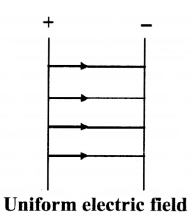
What is uniform electric field?
Answer:
A uniform electric field is a field whose magnitude and direction are same at all points. For example, field between two parallel plates as shown in the diagram.
Question 6.
If two lines of force intersect of one point. What does it mean?
Answer:
If two lines of force intersect of one point, it would mean that electric field has two directions at a single point.
Question 7.
State the units of linear charge density.
Answer:
SI unit of λ is (C / m).
Question 8.
What is the unit of dipole moment?
Answer:
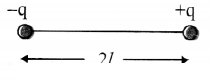
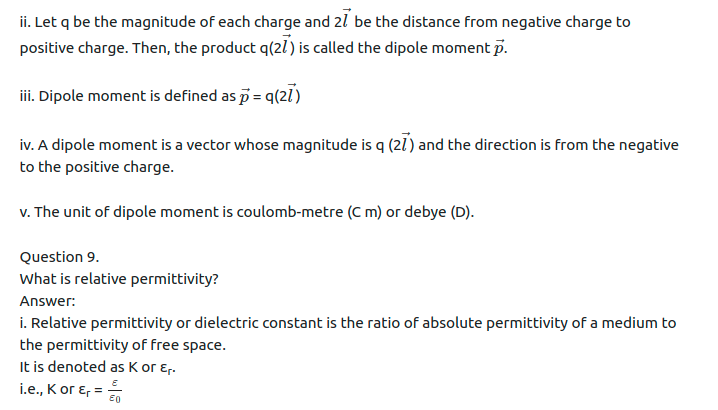
i. Strength of a dipole is measured in terms of a quantity called the dipole moment.
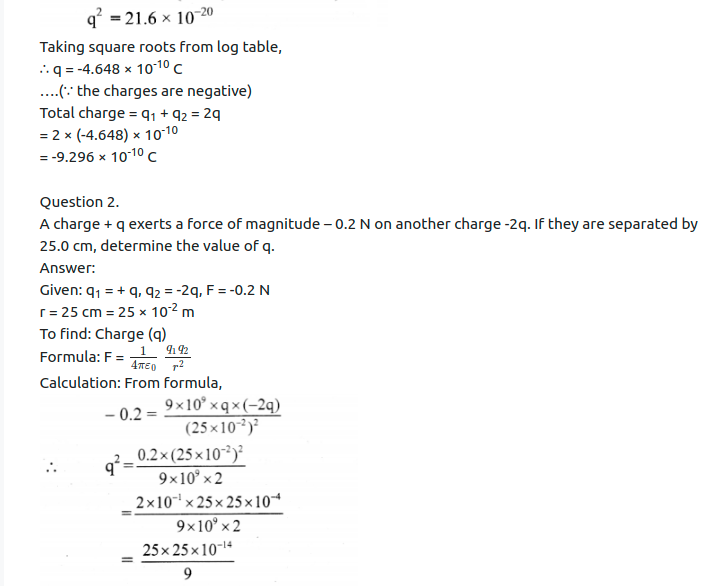
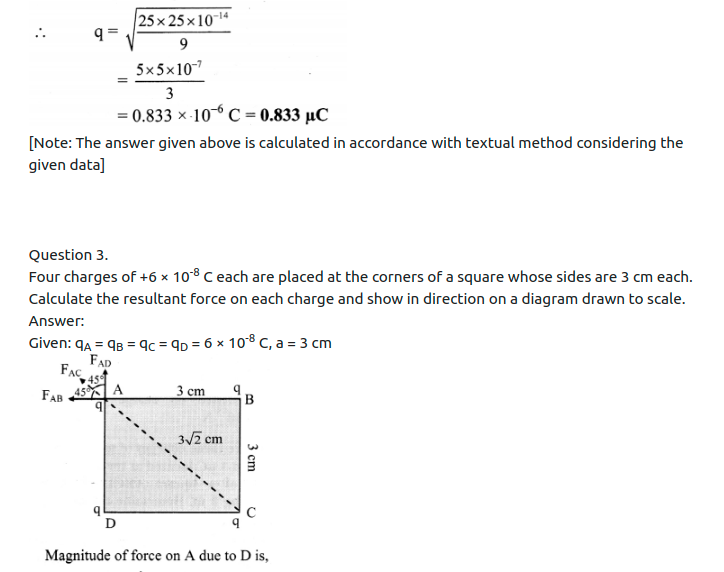
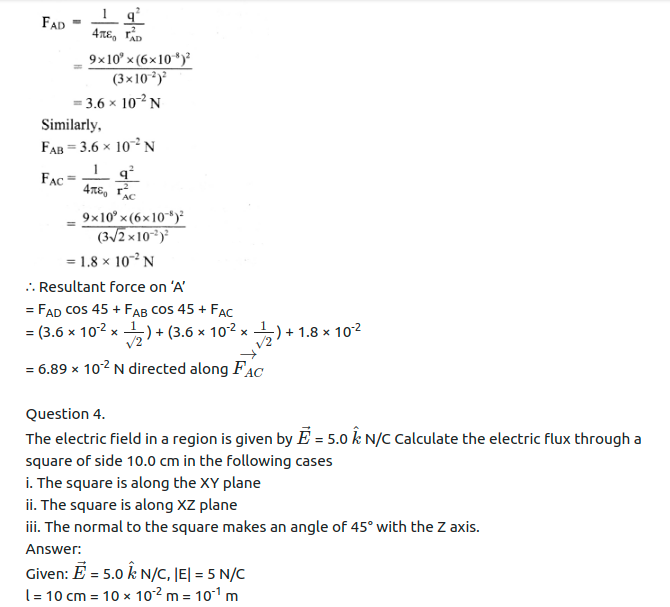
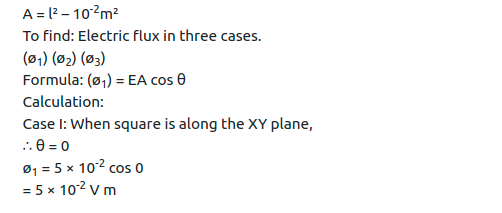
Case II: When square is along XZ plane,
∴ θ = 90°
ø1 = 5 × 10⁻² cos 90° = 0 V m
Case III: When normal to the square makes an angle of 45° with the Z axis.
∴ 0 = 45°
∴ ø3 = 5 × 10⁻² × cos 45°
= 3.5 × 10⁻² V m
Question 5.
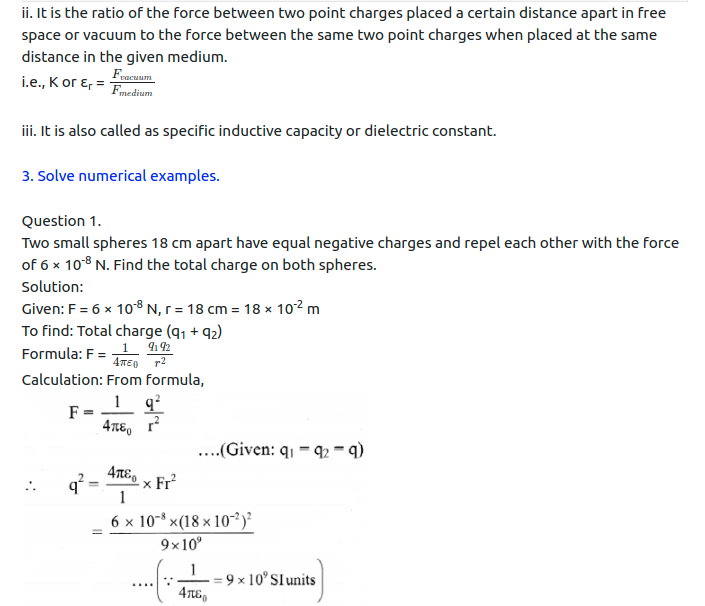
Three equal charges of 10 × 10-8 C respectively, each located at the corners of a right triangle whose sides are 15 cm, 20 cm and 25 cm respectively. Find the force exerted on the charge located at the 90° angle.
Answer:
Given: qA = qB = qC = 10 × 10-8
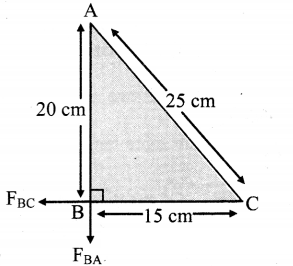
Force on B due to A,
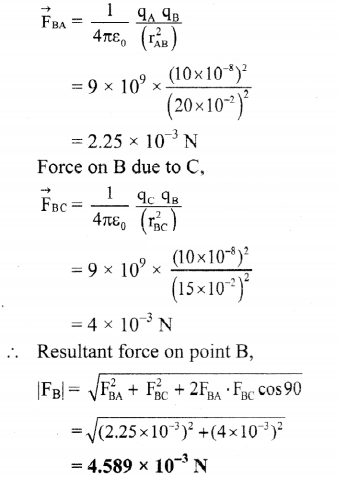
Question 6.
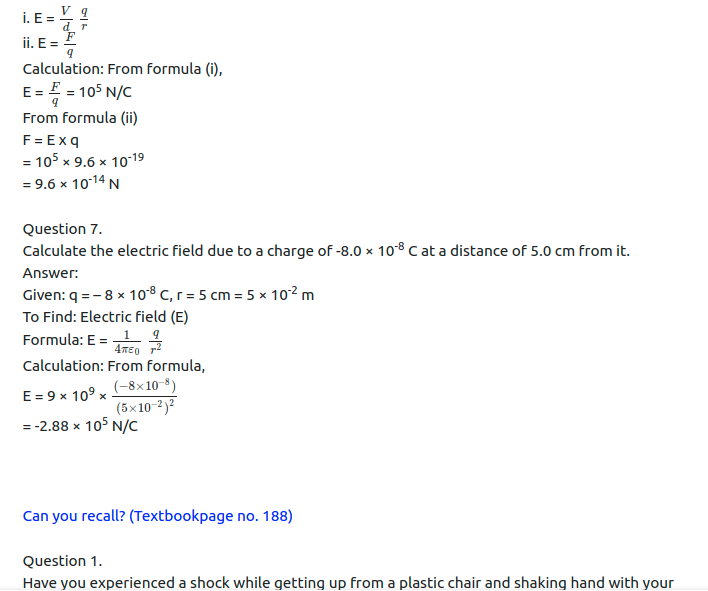
A potential difference of 5000 volt is applied between two parallel plates 5 cm apart. A small oil drop having a charge of 9.6 x 10⁻¹⁹ C falls between the plates. Find (i) electric field intensity between the plates and (ii) the force on the oil drop.
Answer:
Given: V = 5000 volt, d = 5 cm = 5 × 10⁻² m
q = 9.6 × 10⁻¹⁹ C
To find:
i. Electric field intensity (E)
ii. Force (F)
Formula:
friend?
Answer:
Yes, sometimes a shock while getting up from a plastic chair and shaking hand with friend is experienced.
Question 2.
Ever heard a crackling sound while taking out your sweater in winter?
Answer:
Yes, sometimes while removing our sweater in winter, some crackling sound is heard and the sweater appears to stick to body.
Question 3.
Have you seen the lightning striking during pre-monsoon weather?
Answer:
Yes, sometimes lightning striking during pre-pre-monsoon weather seen.
Can you tell? (Textbook page no. 189)
i. When a petrol or a diesel tanker is emptied in a tank, it is grounded.
ii. A thick chain hangs from a petrol or a diesel tanker and it is in contact with ground when the tanker is moving.
Answer:
i. When a petrol or a diesel tanker is emptied in a tank, it is grounded so that it has an electrically conductive connection from the petrol or diesel tank to ground (Earth) to allow leakage of static and electrical charges.
ii. Metallic bodies of cars, trucks or any other big vehicles get charged because of friction between them and the air rushing past them. Hence, a thick chain is hanged from a petrol or a diesel tanker to make a contact with ground so that charge produced can leak to the ground through chain.
Can you tell? (Textbook page no. 194)
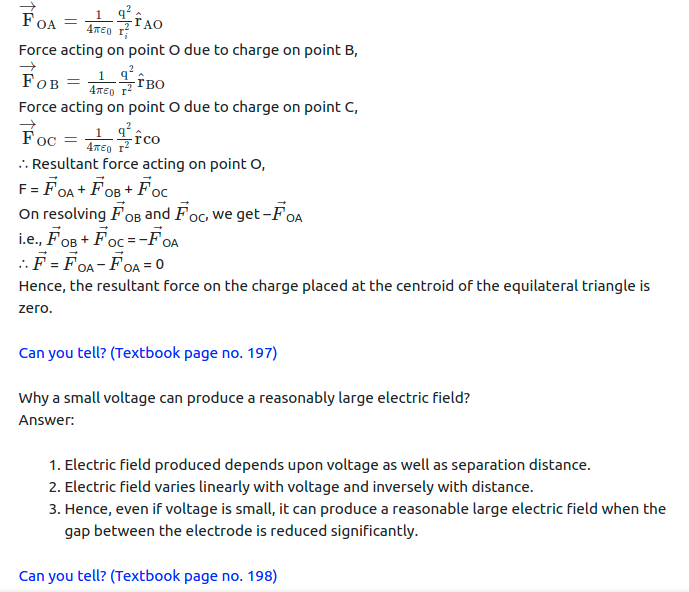
Three charges, q each, are placed at the vertices of an equilateral triangle. What will be the resultant force on charge q placed at the centroid of the triangle?
Answer:
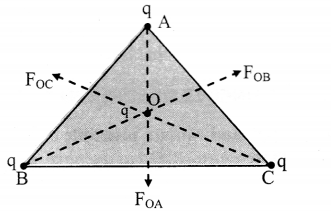
Since AD. BE and CF meets at O, as centroid of an equilateral triangle.
∴ OA = OB = OC
∴ Let, r = OA = OB = OC
Force acting on point O due to charge on point A,
Lines of force are imaginary; can they have any practical use?
Answer:
Yes, electric lines of force help us to visualise the nature of electric field in a region.
Can you tell? (Textbook page no. 204)
The surface charge density of Earth is σ = -1.33 nC/m². That is about 8.3 × 10⁹ electrons per square metre. If that is the case why don’t we feel it?
Answer:
The Earth along with its atmosphere acts as a neutral system. The atmosphere (ionosphere in particular) has nearly equal and opposite charge.
As a result, there exists a mechanism to replenish electric charges in the form of continual thunderstorms and lightning that occurs in different parts of the globe. This makes average charge on surface of the Earth as zero at any given time instant. Hence, we do not feel it.
Internet my friend (Textbook page no. 205)
i. https://www.physicsclassroom.com/class
ii. https://courses.lumenleaming.com/physics/
iii. https://www,khanacademy.org/science
iv. https://www.toppr.com/guides/physics/
[Students are expected to visit the above mentioned websites and collect more information about electrostatics.]
Download PDF
Maharashtra Board Solutions Class 11-Physics: Chapter 10- Electrostatics
Download PDF: Maharashtra Board Solutions Class 11-Physics: Chapter 10- Electrostatics PDF
Chapterwise Maharashtra Board Solutions Class 11 Physics :
- Chapter 1- Units and Measurements
- Chapter 2- Mathematical Methods
- Chapter 3- Motion in a Plane
- Chapter 4- Laws of Motion
- Chapter 5- Gravitation
- Chapter 6- Mechanical Properties of Solids
- Chapter 7- Thermal Properties of Matter
- Chapter 8- Sound
- Chapter 9- Optics
- Chapter 10- Electrostatics
- Chapter 11- Electric Current Through Conductors
- Chapter 12- Magnetism
- Chapter 13- Electromagnetic Waves and Communication System
- Chapter 14- Semiconductors