Class 11: Physics Chapter 12 solutions. Complete Class 11 Physics Chapter 12 Notes.
Contents
Maharashtra Board Solutions Class 11-Physics: Chapter 12- Magnetism
Maharashtra Board 11th Physics Chapter 12, Class 11 Physics Chapter 12 solutions
1. Choose the correct option.
Question 1.
Let r be the distance of a point on the axis of a bar magnet from its center. The magnetic field at r is always proportional to
(A) 1r2
(B) 1r3
(C) 1r
(D) Not necessarily 1r3 at all points
Answer:
(B) 1r3
Question 2.
Magnetic meridian is the plane
(A) perpendicular to the magnetic axis of Earth
(B) perpendicular to geographic axis of Earth
(C) passing through the magnetic axis of Earth
(D) passing through the geographic axis
Answer:
(C) passing through the magnetic axis of Earth
Question 3.
The horizontal and vertical component of magnetic field of Earth are same at some place on the surface of Earth. The magnetic dip angle at this place will be
(A) 30°
(B) 45°
(C) 0°
(D) 90°
Answer:
(B) 45°
Question 4.
Inside a bar magnet, the magnetic field lines
(A) are not present
(B) are parallel to the cross sectional area of the magnet
(C) are in the direction from N pole to S pole
(D) are in the direction from S pole to N pole
Answer:
(D) are in the direction from S pole to N pole
Question 5.
A place where the vertical components of Earth’s magnetic field is zero has the angle of dip equal to
(A) 0°
(B) 45°
(C) 60°
(D) 90°
Answer:
(A) 0°
Question 6.
A place where the horizontal component of Earth’s magnetic field is zero lies at
(A) geographic equator
(B) geomagnetic equator
(C) one of the geographic poles
(D) one of the geomagnetic poles
Answer:
(D) one of the geomagnetic poles
Question 7.
A magnetic needle kept nonparallel to the magnetic field in a nonuniform magnetic field experiences
(A) a force but not a torque
(B) a torque but not a force
(C) both a force and a torque
(D) neither force nor a torque
Answer:
(C) both a force and a torque
2. Answer the following questions in brief.
Question 1.
What happens if a bar magnet is cut into two pieces transverse to its length/ along its length?
Answer:
i. When a magnet is cut into two pieces, then each piece behaves like an independent magnet.
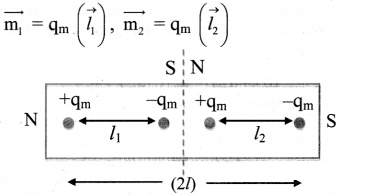
ii. When a bar magnet is cut transverse to its length, the two pieces generated will behave as independent magnets of reduced magnetic length. However, the pole strength of all the four poles formed will be same as that of the original bar magnet. Thus, the new dipole moment of the smaller magnets will be,
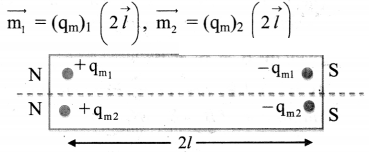
iii. When the bar magnet is cut along its length, the two pieces generated will behave like an independent magnet with reduced pole strength. However, the magnetic length of both the new magnets will be same as that of the original bar magnet. Thus, the new dipole moment of the smaller magnets will be,
Question 2.
What could be the equation for Gauss’ law of magnetism, if a monopole of pole strength p is enclosed by a surface?
Answer:
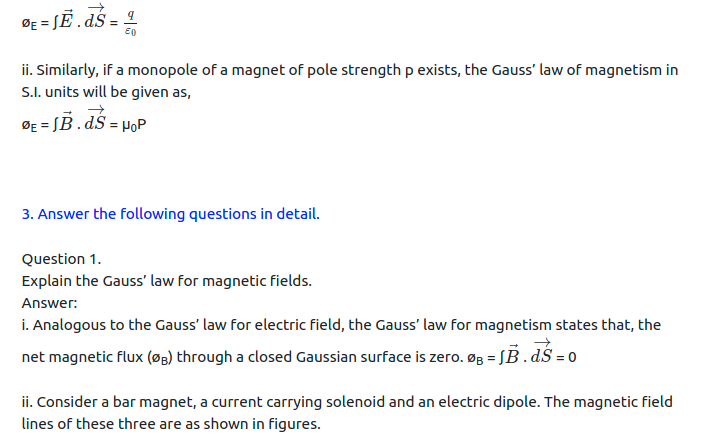
i. According to Gauss’ law of electrostatics, the net electric flux through any Gaussian surface is proportional to net charge enclosed in it. The equation is given as,
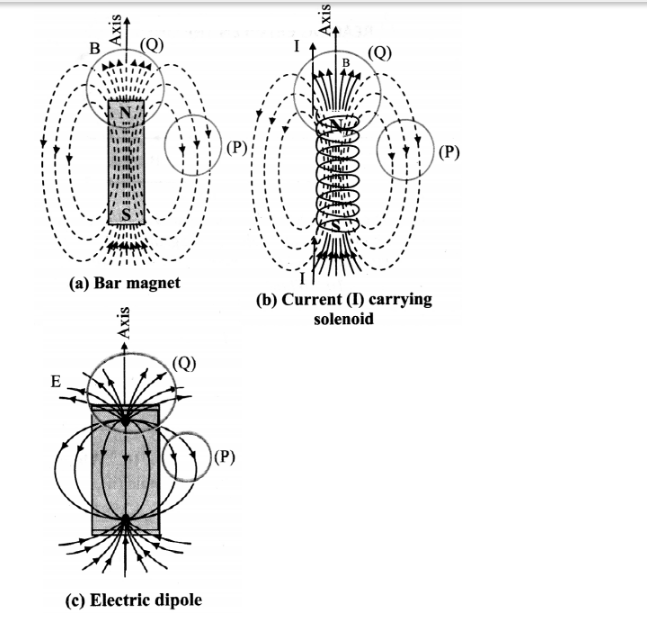
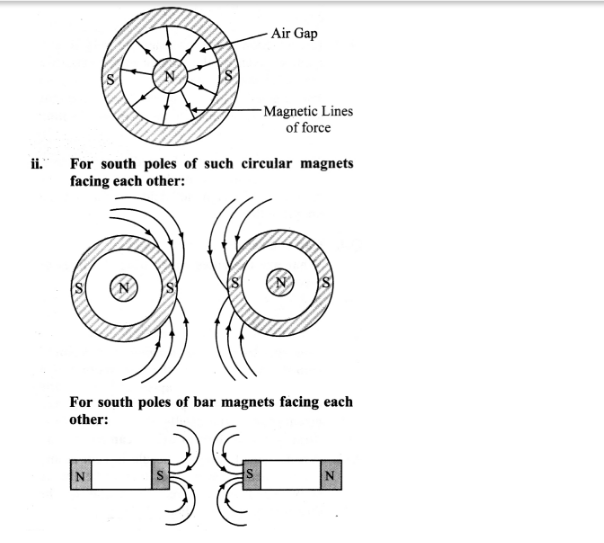
iii. The areas (P) and (Q) are the cross – sections of three dimensional closed Gaussian surfaces. The Gaussian surface (P) does not include poles while the Gaussian surface (Q) includes N-pole of bar magnet, solenoid and the positive charge in case of electric dipole.
iv. The number of lines of force entering the surface (P) is equal to the number of lines of force leaving the surface. This can be observed in all the three cases.
v. However, Gaussian surface (Q) of bar magnet, enclose north pole. As, even thin slice of a bar magnet will have both north and south poles associated with it, the number of lines of Force entering surface (Q) are equal to the number of lines of force leaving the surface.
vi. For an electric dipole, the field lines begin from positive charge and end on negative charge. For a closed surface (Q), there is a net outward flux since it does include a net (positive) charge.
vii. Thus, according to the Gauss’ law of electrostatics øE = ∫E⃗ . dS→ = qε0, where q is the positive charge enclosed.
viii. The situation is entirely different from magnetic lines of force. Gauss’ law of magnetism can be written as øB = ∫B⃗ . dS→ = 0
From this, one can conclude that for electrostatics, an isolated electric charge exists but an isolated magnetic pole does not exist.
Question 2.
What is a geographic meridian? How does the declination vary with latitude? Where is it minimum?
Answer:
A plane perpendicular to the surface of the Earth (vertical plane) and passing through geographic axis is geographic meridian.
i. Angle between the geographic and the magnetic meridian at a place is called magnetic declination (a).
ii. Magnetic declination varies with location and over time. As one moves away from the true north the declination changes depending on the latitude as well as longitude of the place. By convention, declination is positive when magnetic north is east of true north, and negative when it is to the west. The declination is small in India. It is 0° 58′ west at Mumbai and 0° 41′ east at Delhi.
Question 3.
Define the angle of dip. What happens to angle of dip as we move towards magnetic pole from magnetic equator?
Answer:
Angle made by the direction of resultant magnetic field with the horizontal at a place is inclination or angle of dip (ø) at the place.
At the magnetic pole value of ø = 90° and it goes on decreasing when we move towards equator such that at equator value of (ø) = 0°.
4. Solve the following problems.
Question 1.
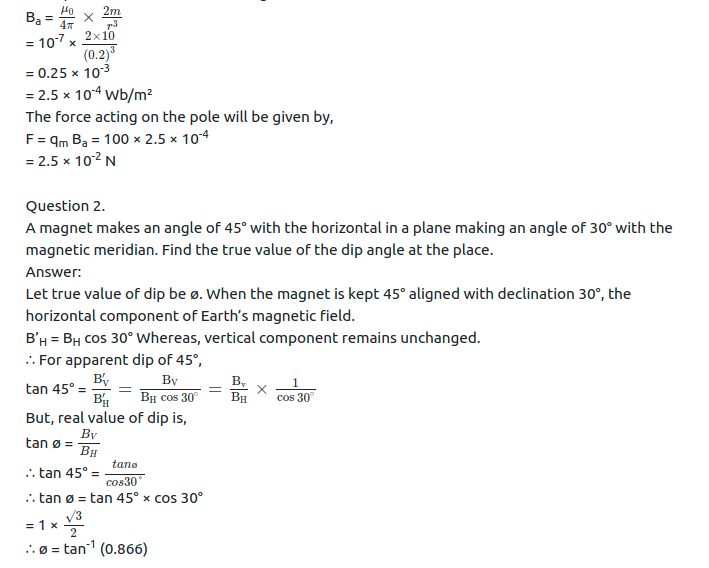
A magnetic pole of bar magnet with pole strength of 100 Am is 20 cm away from the centre of a bar magnet. Bar magnet has pole strength of 200 Am and has a length 5 cm. If the magnetic pole is on the axis of the bar magnet, find the force on the magnetic pole.
Answer:
Given that, (qm)1 = 200 Am
and (2l) = 5 cm = 5 × 10⁻² m
∴ m = 200 × 5 × 10-2 = 10 Am²
For a bar magnet, magnetic dipole moment is,
m = qm (21)
For a point on the axis of a bar magnet at distance, r = 20 cm = 0.2 m,
Question 3.
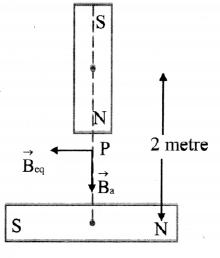
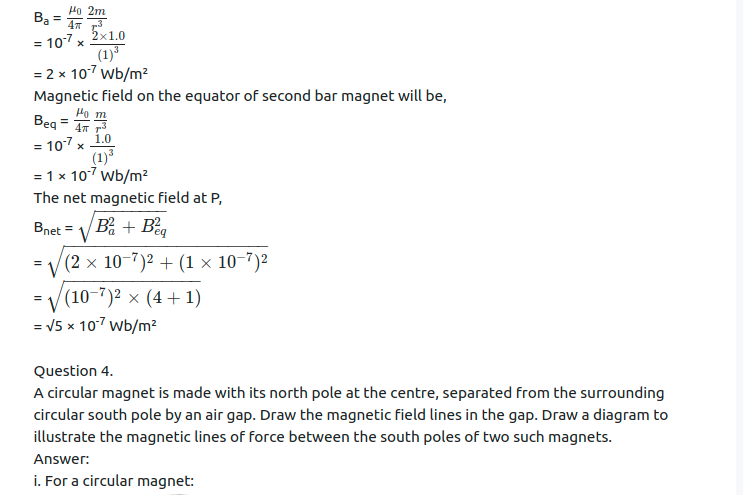
Two small and similar bar magnets have magnetic dipole moment of 1.0 Am² each. They are kept in a plane in such a way that their axes are perpendicular to each other. A line drawn through the axis of one magnet passes through the centre of other magnet. If the distance between their centres is 2 m, find the magnitude of magnetic field at the midpoint of the line joining their centres.
Answer:
Let P be the midpoint of the line joining the centres of two bar magnets. As shown in figure, P is at the axis of one bar magnet and at the equator of another bar magnet. Thus, the magnetic field on the axis of the first bar magnet at distance of 1 m from the centre will be,
Question 5.
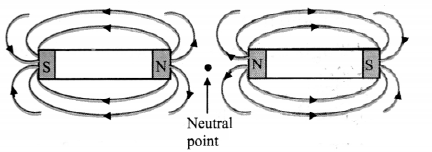
Two bar magnets are placed on a horizontal surface. Draw magnetic lines around them. Mark the position of any neutral points (points where there is no resultant magnetic field) on your diagram.
Answer:
The magnetic lines of force between two magnets will depend on their relative positions. Considering the magnets to be placed one besides the other as shown in figure, the magnetic lines of force will be as shown.
Can you recall? (Textbook page no. 221)
Question 1.
What are the magnetic lines of force?
Answer:
The magnetic field around a magnet is shown by lines going from one end of the magnet to the other. These lines are named as magnetic lines of force.
Question 2.
What are the rules concerning the lines of force?
Answer:
i. Magnetic lines of force originate from the north pole and end at the south pole.
ii. The magnetic lines of force of a magnet or a solenoid form closed loops. This is in contrast to the case of an electric dipole, where the electric lines of force originate from the positive charge and end on the negative charge.
iii. The direction of the net magnetic field B⃗ at a point is given by the tangent to the magnetic line of force at that point.
iv. The number of lines of force crossing per unit area decides the magnitude of magnetic field B⃗
v. The magnetic lines of force do not intersect. This is because had they intersected, the direction of magnetic field would not be unique at that point.
Question 3.
What is a bar magnet?
Answer:
Bar magnet is a magnet in the shape of bar having two poles of equal and opposite pole strengths separated by certain distance (2l).
Question 4.
If you freely hang a bar magnet horizontally, in which direction will it become stable?
Answer:
A bar magnet suspended freely in air always aligns itself along geographic N-S direction.
Try this (Textbook page no. 221)
You can take a bar magnet and a small compass needle. Place the bar magnet at a fixed position on a paper and place the needle at various positions. Noting the orientation of the needle, the magnetic field direction at various locations can be traced.
Answer:
When a small compass needle is kept at any position near a bar magnet, the needle always aligns itself in the direction parallel to the direction of magnetic lines of force.
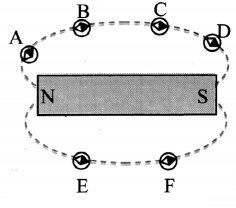
Hence, by placing it at different positions, A, B, C, D,… as shown in the figure, the direction of magnetic lines of force can be traced. The direction of magnetic field will be a tangent at that point.
Internet my friend: (Text book page no. 227)
https://www.ngdc.noaa.gov
[Students are expected to visit above mentioned link and collect more information about Geomagnetism.]
Download PDF
Maharashtra Board Solutions Class 11-Physics: Chapter 12- Magnetism
Download PDF: Maharashtra Board Solutions Class 11-Physics: Chapter 12- Magnetism PDF
Chapterwise Maharashtra Board Solutions Class 11 Physics :
- Chapter 1- Units and Measurements
- Chapter 2- Mathematical Methods
- Chapter 3- Motion in a Plane
- Chapter 4- Laws of Motion
- Chapter 5- Gravitation
- Chapter 6- Mechanical Properties of Solids
- Chapter 7- Thermal Properties of Matter
- Chapter 8- Sound
- Chapter 9- Optics
- Chapter 10- Electrostatics
- Chapter 11- Electric Current Through Conductors
- Chapter 12- Magnetism
- Chapter 13- Electromagnetic Waves and Communication System
- Chapter 14- Semiconductors
FAQs
You can download the Maharashtra State Board Books from the eBalbharti official website, i.e. cart.ebalbharati.in or from this article.
Students can get the Maharashtra Books for primary, secondary, and senior secondary classes from here. You can view or download the Maharashtra State Board Books from this page or from the official website for free of cost. Students can follow the detailed steps below to visit the official website and download the e-books for all subjects or a specific subject in different mediums.
Step 1: Visit the official website ebalbharati.in
Step 2: On the top of the screen, select “Download PDF textbooks”
Step 3: From the “Classes” section, select your class.
Step 4: From “Medium”, select the medium suitable to you.
Step 5: All Maharashtra board books for your class will now be displayed on the right side.
Step 6: Click on the “Download” option to download the PDF book.
As of now, the MSCERT and Balbharti are responsible for the syllabus and textbooks of Classes 1 to 8, while Classes 9 and 10 are under the Maharashtra State Board of Secondary and Higher Secondary Education (MSBSHSE).
The Maharashtra State Board of Secondary & Higher Secondary Education, conducts the HSC and SSC Examinations in the state of Maharashtra through its nine Divisional Boards located at Pune, Mumbai, Aurangabad, Nasik, Kolhapur, Amravati, Latur, Nagpur and Ratnagiri.
About Maharashtra State Board (MSBSHSE)
The Maharashtra State Board of Secondary and Higher Secondary Education or MSBSHSE (Marathi: महाराष्ट्र राज्य माध्यमिक आणि उच्च माध्यमिक शिक्षण मंडळ), is an autonomous and statutory body established in 1965. The board was amended in the year 1977 under the provisions of the Maharashtra Act No. 41 of 1965.
The Maharashtra State Board of Secondary & Higher Secondary Education (MSBSHSE), Pune is an independent body of the Maharashtra Government. There are more than 1.4 million students that appear in the examination every year. The Maha State Board conducts the board examination twice a year. This board conducts the examination for SSC and HSC.
The Maharashtra government established the Maharashtra State Bureau of Textbook Production and Curriculum Research, also commonly referred to as Ebalbharati, in 1967 to take up the responsibility of providing quality textbooks to students from all classes studying under the Maharashtra State Board. MSBHSE prepares and updates the curriculum to provide holistic development for students. It is designed to tackle the difficulty in understanding the concepts with simple language with simple illustrations. Every year around 10 lakh students are enrolled in schools that are affiliated with the Maharashtra State Board.
Read More
IndCareer Board Book Solutions App
IndCareer Board Book App provides complete study materials for students from classes 1 to 12 of Board. The App contains complete solutions of NCERT books, notes, and other important materials for students. Download the IndCareer Board Book Solutions now.