Class 11: Physics Chapter 14 solutions. Complete Class 11 Physics Chapter 14 Notes.
Contents
Maharashtra Board Solutions Class 11-Physics: Chapter 14- Semiconductors
Maharashtra Board 11th Physics Chapter 14, Class 11 Physics Chapter 14 solutions
1. Choose the correct option.
Question 1.
Electric conduction through a semiconductor is due to:
(A) Electrons
(B) holes
(C) none of these
(D) both electrons and holes
Answer:
(D) both electrons and holes
Question 2.
The energy levels of holes are:
(A) in the valence band
(B) in the conduction band
(C) in the band gap but close to valence band
(D) in the band gap but close to conduction band
Answer:
(C) in the band gap but close to valence band
Question 3.
Current through a reverse biased p-n junction, increases abruptly at:
(A) Breakdown voltage
(B) 0.0 V
(C) 0.3V
(D) 0.7V
Answer:
(A) Breakdown voltage
Question 4.
A reverse biased diode, is equivalent to:
(A) an off switch
(B) an on switch
(C) a low resistance
(D) none of the above
Answer:
(A) an off switch
Question 5.
The potential barrier in p-n diode is due to:
(A) depletion of positive charges near the junction
(B) accumulation of positive charges near the junction
(C) depletion of negative charges near the junction,
(D) accumulation of positive and negative charges near the junction
Answer:
(D) accumulation of positive and negative charges near the junction
2. Answer the following questions.
Question 1.
What is the importance of energy gap in a semiconductor?
Answer:
- The gap between the bottom of the conduction band and the top of the valence band is called the energy gap or the band gap.
- This band gap is present only in semiconductors and insulators.
- Magnitude of the band gap plays a very important role in the electronic properties of a solid.
- Band gap in semiconductors is of the order of 1 eV.
- If electrons in valence band of a semiconductor are provided with energy more than band gap energy (in the form of thermal energy or electrical energy), then the electrons get excited and occupy energy levels in conduction band. These electrons can easily take part in conduction.
Question 2.
Which element would you use as an impurity to make germanium an n-type semiconductor?
Answer:
Germanium can be made an n-type semiconductor by doping it with pentavalent impurity, like phosphorus (P), arsenic (As) or antimony (Sb).
Question 3.
What causes a larger current through a p-n junction diode when forward biased?
Answer:
In case of forward bias the width of the depletion region decreases and the p-n junction offers a low resistance path allowing a high current to flow across the junction.
Question 4.
On which factors does the electrical conductivity of a pure semiconductor depend at a given temperature?
Answer:
For pure semiconductor, the number density of free electrons and number density of holes is equal. Thus, at a given temperature, the conductivity of pure semiconductor depends on the number density of charge carriers in the semiconductor.
Question 5.
Why is the conductivity of a n-type semiconductor greater than that of p-type semiconductor even when both of these have same level of doping?
Answer:
- In a p-type semiconductor, holes are majority charge carriers.
- When a p-type semiconductor is connected to terminals of a battery, holes, which are not actual charges, behave like a positive charge and get attracted towards the negative terminal of the battery.
- During transportation of hole, there is an indirect movement of electrons.
- The drift speed of these electrons is less than that in the n-type semiconductors. Mobility of the holes is also less than that of the electrons.
- As, electrical conductivity depends on the mobility of charge carriers, the conductivity of a n-type semiconductor is greater than that of p-type semiconductor even when both of these have same level of doping.
3. Answer in detail.
Question 1.
Explain how solids are classified on the basis of band theory of solids.
Answer:
i. The solids can be classified into conductors, insulators and semiconductors depending on the distribution of electron energies in each atom.
ii. As an outcome of the small distances between atoms, the resulting interaction amongst electrons and the Pauli’s exclusion principle, energy bands are formed in the solids.
iii. In metals, conduction band and valence band overlap. However, in a semiconductor or an insulator, there is gap between the bottom of the conduction band and the top of the valence band. This is called the energy gap or the band gap.

iv. For metals, the valence band and the conduction band overlap and there is no band gap as shown in figure (b). Therefore, electrons can easily gain electrical energy when an external electric field is applied and are easily available for conduction.

v. In case of semiconductors, the band gap is fairly small, of the order of 1 eV or less as shown in figure (c). Hence, with application of external electric field, electrons get excited and occupy energy levels in conduction band. These can take part in conduction easily.
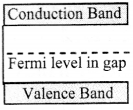
vi. Insulators, on the contrary, have a wide gap between valence band and conduction band of the order of 5 eV (for diamond) as shown in figure (d). Therefore, electrons find it very difficult to gain sufficient energy to occupy energy levels in conduction band.

vii. Thus, an energy band gap plays an important role in classifying solids into conductors, insulators and semiconductors based on band theory of solids.
Question 2.
Distinguish between intrinsic semiconductors and extrinsic semiconductors
Answer:
| Intrinsic semiconductors | Extrinsic semiconductors |
| 1. A pure semiconductor is known as intrinsic semiconductors. | The semiconductor, resulting |
| 2. Their conductivity is low | Their conductivity is high even at room temperature. |
| 3. Its electrical conductivity is a function of temperature alone. | Its electrical conductivity depends upon the temperature as well as on the quantity of impurity atoms doped in the structure. |
| 4. The number density of holes (nh) is same as the number density of free electron (ne) (nh = ne). | The number density of free electrons and number density of holes are unequal. |
Question 3.
Explain the importance of the depletion region in a p-n junction diode.
Answer:
i. The region across the p-n junction where there are no charges is called the depletion layer or the depletion region.
ii. During diffusion of charge carriers across the junction, electrons migrate from the n-side to the p-side of the junction. At the same time, holes are transported from p-side to n-side of the junction.
iii. As a result, in the p-type region near the junction there are negatively charged acceptor ions, and in the n-type region near the junction there are positively charged donor ions.
iv. The potential barrier thus developed, prevents continuous flow of charges across the junction. A state of electrostatic equilibrium is thus reached across the junction.
v. Free charge carriers cannot be present in a region where there is a potential barrier. This creates the depletion region.
vi. In absence of depletion region, all the majority charge carriers from n-region (i.e., electron) will get transferred to the p-region and will get combined with the holes present in that region. This will result in the decreased efficiency of p-n junction.
vii. Hence, formation of depletion layer across the junction is important to limit the number of majority carriers crossing the junction.
Question 4.
Explain the I-V characteristic of a forward biased junction diode.
Answer:

- Figure given below shows the I-V characteristic of a forward biased diode.
- When connected in forward bias mode, initially, the current through diode is very low and then there is a sudden rise in the current.
- The point at which current rises sharply is shown as the ‘knee’ point on the I-V characteristic curve.
- The corresponding voltage is called the knee voltage. It is about 0.7 V for silicon and 0.3 V for germanium.
- A diode effectively becomes a short circuit above this knee point and can conduct a very large current.
- To limit current flowing through the diode, resistors are used in series with the diode.
- If the current through a diode exceeds the specified value, the diode can heat up due to the Joule’s heating and this may result in its physical damage.
Question 5.
Discuss the effect of external voltage on the width of depletion region of a p-n junction.
Answer:
- A p-n junction can be connected to an external voltage supply in two possible ways.
- A p-n junction is said to be connected in a forward bias when the p-region connected to the positive terminal and the n-region is connected to the negative terminal of an external voltage source.
- In forward bias connection, the external voltage effectively opposes the built-in potential of the junction. The width of depletion region is thus reduced.
- The second possibility of connecting p-n junction is in reverse biased electric circuit.
- In reverse bias connection, the p-region is connected to the negative terminal and the n-region is connected to the positive terminal of the external voltage source. This external voltage effectively adds to the built-in potential of the junction. The width of potential barrier is thus increased
Internet my friend (Textbookpage no. 256)
i. https://www.electronics-tutorials.ws/diode
ii. https://www.hitachi-hightech.com
iii. https://nptel.ac.in/courses
iv. https://physics.info/semiconductors
v. http://hyperphysics.phy- astr.gsu.edu/hbase/Solids/semcn.html
[Students are expected to visit above mentioned links and collect more information regarding semiconductors.]
Download PDF
Maharashtra Board Solutions Class 11-Physics: Chapter 14- Semiconductors
Download PDF: Maharashtra Board Solutions Class 11-Physics: Chapter 14- Semiconductors PDF
Chapterwise Maharashtra Board Solutions Class 11 Physics :
- Chapter 1- Units and Measurements
- Chapter 2- Mathematical Methods
- Chapter 3- Motion in a Plane
- Chapter 4- Laws of Motion
- Chapter 5- Gravitation
- Chapter 6- Mechanical Properties of Solids
- Chapter 7- Thermal Properties of Matter
- Chapter 8- Sound
- Chapter 9- Optics
- Chapter 10- Electrostatics
- Chapter 11- Electric Current Through Conductors
- Chapter 12- Magnetism
- Chapter 13- Electromagnetic Waves and Communication System
- Chapter 14- Semiconductors
FAQs
You can download the Maharashtra State Board Books from the eBalbharti official website, i.e. cart.ebalbharati.in or from this article.
Students can get the Maharashtra Books for primary, secondary, and senior secondary classes from here. You can view or download the Maharashtra State Board Books from this page or from the official website for free of cost. Students can follow the detailed steps below to visit the official website and download the e-books for all subjects or a specific subject in different mediums.
Step 1: Visit the official website ebalbharati.in
Step 2: On the top of the screen, select “Download PDF textbooks”
Step 3: From the “Classes” section, select your class.
Step 4: From “Medium”, select the medium suitable to you.
Step 5: All Maharashtra board books for your class will now be displayed on the right side.
Step 6: Click on the “Download” option to download the PDF book.
As of now, the MSCERT and Balbharti are responsible for the syllabus and textbooks of Classes 1 to 8, while Classes 9 and 10 are under the Maharashtra State Board of Secondary and Higher Secondary Education (MSBSHSE).
The Maharashtra State Board of Secondary & Higher Secondary Education, conducts the HSC and SSC Examinations in the state of Maharashtra through its nine Divisional Boards located at Pune, Mumbai, Aurangabad, Nasik, Kolhapur, Amravati, Latur, Nagpur and Ratnagiri.
About Maharashtra State Board (MSBSHSE)
The Maharashtra State Board of Secondary and Higher Secondary Education or MSBSHSE (Marathi: महाराष्ट्र राज्य माध्यमिक आणि उच्च माध्यमिक शिक्षण मंडळ), is an autonomous and statutory body established in 1965. The board was amended in the year 1977 under the provisions of the Maharashtra Act No. 41 of 1965.
The Maharashtra State Board of Secondary & Higher Secondary Education (MSBSHSE), Pune is an independent body of the Maharashtra Government. There are more than 1.4 million students that appear in the examination every year. The Maha State Board conducts the board examination twice a year. This board conducts the examination for SSC and HSC.
The Maharashtra government established the Maharashtra State Bureau of Textbook Production and Curriculum Research, also commonly referred to as Ebalbharati, in 1967 to take up the responsibility of providing quality textbooks to students from all classes studying under the Maharashtra State Board. MSBHSE prepares and updates the curriculum to provide holistic development for students. It is designed to tackle the difficulty in understanding the concepts with simple language with simple illustrations. Every year around 10 lakh students are enrolled in schools that are affiliated with the Maharashtra State Board.
Read More
IndCareer Board Book Solutions App
IndCareer Board Book App provides complete study materials for students from classes 1 to 12 of Board. The App contains complete solutions of NCERT books, notes, and other important materials for students. Download the IndCareer Board Book Solutions now.