
Class 7: Maths Chapter 12 solutions. Complete Class 7 Maths Chapter 12 Notes.
Maharashtra Board Solutions Class 7-Maths (Practice Set 45): Chapter 12- Perimeter and Area
Maharashtra Board 7th Maths Chapter 12, Class 7 Maths Chapter 12 solutions
Question 1.
If the side of a square is 12 cm, find its area.
Solution:
Area of a square = (side)² = (12)²
= 144 sq. cm.
∴ The area of the square is 144 sq. cm.
Question 2.
If the length of a rectangle is 15 cm and breadth is 5 cm, find its area.
Solution:
Area of a rectangle = length × breadth
= 15 × 5
= 75 sq. cm.
∴ The area of the rectangle is 75 sq. cm.
Question 3.
The area of a rectangle is 102 sq. cm. If its length is 17 cm, what is its perimeter?
Solution:
Area of a rectangle = length × breadth
∴ 102 = 17 × breadth
∴ breadth = 10217 = 6 cm
Perimeter of rectangle = 2 (length + breadth)
= 2 (17 + 6)
= 2 × 23
= 46 cm
∴ The perimeter of rectangle is 46 cm.
Question 4.
If the side of a square is tripled, how many times will its area be as compared to the area of the original square?
Solution:
Let the side of the square be a.
∴ Area of a square = (side)² = a²
New side of the square = 3 × a = 3a
∴ New area of the square = (3a)²
= 9a²
= 9 × area of original square
∴ If the side of a square is tripled, its area will become 9 times the area of the original square.
Intext Questions and Activities
Question 1.
A rectangular playground is 65m long and 30m wide. A pathway of 1.5 m width goes all around the ground, outside it. Find the area of the pathway. (Textbook pg. no. 82)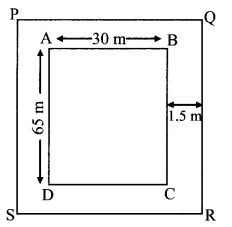
Solution:
The playground is rectangular.
₹ABCD is the playground. Around it is a pathway 1.5 m wide.
Around ₹ABCD we get the rectangle ₹PQRS
Length of new rectangle PQRS = 65 + 1.5 + 1.5 = 68 m
Breadth of new rectangle PQRS = 30 + 1.5 + 1.5 = 33m
Area of path = Area of rectangle PQRS – Area of rectangle ABCD = 68 x 33 – 65 x 30
= 2244 – 1950
= 294 sq m
Question 2.
Is there another way to find the area of the pathway in the problem above? (Textbook pg. no. 82)
Solution:
Yes. The area of the pathway can be found by dividing it into rectangles and adding the areas of these rectangles.
Length of rectangle 1 = 30 + 1.5 + 1.5 = 33 m
Breadth of rectangle 1 = 1.5 m
∴ Area of rectangle 1 = 33 x 1.5
= 49.5 sq. m
Area of rectangle 4 = Area of rectangle 1
= 49.5 sq. m.
Length of rectangle 2 = 65 m
breadth of rectangle 2 = 1.5 m
∴ Area of rectangle 2 = 65 x 1.5
= 97.5 sq. m.
Area of rectangle 3 = area of rectangle 2
= 97.5 sq. m.
∴ Area of pathway = Sum of area of the 4 rectangles = 49.5 + 49.5 + 97.5 + 97.5
= 294 sq. m.
Question 3.
The length and the width of a mobile phone are 13 cm and 7 cm respectively. It has a screen PQRS as shown in the figure. What is the area of the screen? (Textbook pg. no. 82)
Solution:
ABCD is the rectangle formed by the edges of the mobile. PQRS is the rectangle formed by leaving a 1.5 cm wide edge alongside AB, BC, and DC, and a 2 cm edge alongside DA.
Length of rectangle PQRS = 9.5 cm
Breadth of rectangle PQRS = 4 cm
Area of screen = Area of rectangle PQRS = 9.5 x 4
= 38 sq .cm
Download PDF
Maharashtra Board Solutions Class 7-Maths (Practice Set 45): Chapter 12- Perimeter and Area
Chapterwise Maharashtra Board Solutions Class 7 Maths :
- Chapter 1- Geometrical Constructions (Practice Set 1)
- Chapter 1- Geometrical Constructions (Practice Set 2)
- Chapter 1- Geometrical Constructions (Practice Set 3)
- Chapter 1- Geometrical Constructions (Practice Set 4)
- Chapter 1- Geometrical Constructions (Practice Set 5)
- Chapter 1- Geometrical Constructions (Practice Set 6)
- Chapter 1- Geometrical Constructions (Practice Set 7)
- Chapter 2- Multiplication and Division of Integers (Practice Set 8)
- Chapter 2- Multiplication and Division of Integers (Practice Set 9)
- Chapter 3- HCF and LCM (Practice Set 10)
- Chapter 3- HCF and LCM (Practice Set 11)
- Chapter 3- HCF and LCM (Practice Set 12)
- Chapter 3- HCF and LCM (Practice Set 13)
- Chapter 3- HCF and LCM (Practice Set 14)
- Chapter 4- Angles and Pairs of Angles (Practice Set 15)
- Chapter 4- Angles and Pairs of Angles (Practice Set 16)
- Chapter 4- Angles and Pairs of Angles (Practice Set 17)
- Chapter 4- Angles and Pairs of Angles (Practice Set 18)
- Chapter 4- Angles and Pairs of Angles (Practice Set 19)
- Chapter 4- Angles and Pairs of Angles (Practice Set 20)
- Chapter 4- Angles and Pairs of Angles (Practice Set 21)
- Chapter 5- Operations on Rational Numbers (Practice Set 22)
- Chapter 5- Operations on Rational Numbers (Practice Set 23)
- Chapter 5- Operations on Rational Numbers (Practice Set 24)
- Chapter 5- Operations on Rational Numbers (Practice Set 25)
- Chapter 6- Indices (Practice Set 26)
- Chapter 6- Indices (Practice Set 27)
- Chapter 6- Indices (Practice Set 28)
- Chapter 6- Indices (Practice Set 29)
- Chapter 6- Indices (Practice Set 30)
- Chapter 7- Joint Bar Graph (Practice Set 31)
- Chapter 8- Algebraic Expressions and Operations on them (Practice Set 32)
- Chapter 8- Algebraic Expressions and Operations on them (Practice Set 33)
- Chapter 8- Algebraic Expressions and Operations on them (Practice Set 34)
- Chapter 8- Algebraic Expressions and Operations on them (Practice Set 35)
- Chapter 8- Algebraic Expressions and Operations on them (Practice Set 36)
- Chapter 9- Direct Proportion and Inverse Proportion (Practice Set 37)
- Chapter 9- Direct Proportion and Inverse Proportion (Practice Set 38)
- Chapter 9- Direct Proportion and Inverse Proportion (Practice Set 39)
- Chapter 10- Bank and Simple Interest (Practice Set 40)
- Chapter 10- Bank and Simple Interest (Practice Set 41)
- Chapter 11- Circle (Practice Set 42)
- Chapter 11- Circle (Practice Set 43)
- Chapter 12- Perimeter and Area (Practice Set 44)
- Chapter 12- Perimeter and Area (Practice Set 45)
- Chapter 12- Perimeter and Area (Practice Set 46)
- Chapter 12- Perimeter and Area (Practice Set 47)
- Chapter 13- Pythagoras Theorem (Practice Set 48)
- Chapter 13- Pythagoras Theorem (Practice Set 49)
- Chapter 14- Algebraic Formulae - Expansion of Squares (Practice Set 50)
- Chapter 14- Algebraic Formulae - Expansion of Squares (Practice Set 51)
- Chapter 14- Algebraic Formulae - Expansion of Squares (Practice Set 52)
- Chapter 14- Algebraic Formulae - Expansion of Squares (Practice Set 53)
- Chapter 15- Statistics (Practice Set 54)
- Chapter 14- Statistics (Practice Set 55)