
Class 11: Maths Chapter 6 solutions. Complete Class 11 Maths Chapter 6 Notes.
Maharashtra Board Solutions Class 11-Arts & Science Maths (Part 1): Chapter 6- Circle
Maharashtra Board 11th Maths Chapter 6, Class 11 Maths Chapter 6 solutions
Ex 6.1
Question 1.
Find the equation of a circle with
(i) centre at origin and radius 4.
(ii) centre at (-3, -2) and radius 6.
(iii) centre at (2, -3) and radius 5.
(iv) centre at (-3, -3) passing through point (-3, -6).
Solution:
(i) The equation of a circle with centre at origin and radius ‘r’ is given by
x2 + y2 = r2
Here, r = 4
∴ The required equation of the circle is x2 + y2 = 42 i.e., x2 + y2 = 16.
(ii) The equation of a circle with centre at (h, k) and radius ‘r’ is given by
(x – h)2 + (y – k)2 = r2
Here, h = -3, k = -2 and r = 6
∴ The required equation of the circle is
[x – (-3)]2 + [y – (-2)]2 = 62
⇒ (x + 3)2 + (y + 2)2 = 36
⇒ x2 + 6x + 9 + y2 + 4y + 4 – 36 = 0
⇒ x2 + y2 + 6x + 4y – 23 = 0
(iii) The equation of a circle with centre at (h, k) and radius ‘r’ is given by
(x – h)2 + (y – k)2 = r2
Here, h = 2, k = -3 and r = 5
The required equation of the circle is
(x – 2)2 + [y – (-3)]2 = 52
⇒ (x – 2)2 + (y + 3)2 = 25
⇒ x2 – 4x + 4 + y2 + 6y + 9 – 25 = 0
⇒ x2 + y2 – 4x + 6y – 12 = 0
(iv) Centre of the circle is C (-3, -3) and it passes through the point P (-3, -6).
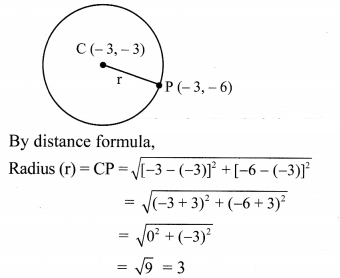
The equation of a circle with centre at (h, k) and radius ‘r’ is given by
(x – h)2 + (y – k)2 = r2
Here, h = -3, k = -3, r = 3
The required equation of the circle is
[x – (-3)]2 + [y – (-3)]2 = 32
⇒ (x + 3)2 + (y + 3)2 = 9
⇒ x2 + 6x + 9 + y2 + 6y + 9 – 9 = 0
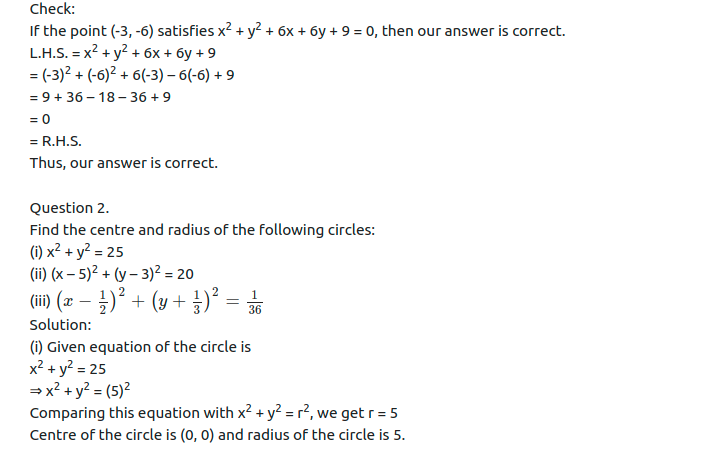
⇒ x2 + y2 + 6x + 6y + 9 = 0

Solution:
(i) Since the circle is touching the Y-axis, the radius of the circle is X-co-ordinate of the centre.
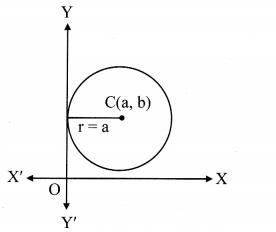
∴ r = a
The equation of a circle with centre at (h, k) and radius r is given by
(x – h)2 + (y – k)2 = r2
Here, h = a, k = b
The required equation of the circle is
⇒ (x – a)2 + (y – b)2 = a2
⇒ x2 – 2ax + a2 + y2 – 2by + b2 = a2
⇒ x2 + y2 – 2ax – 2by + b2 = 0
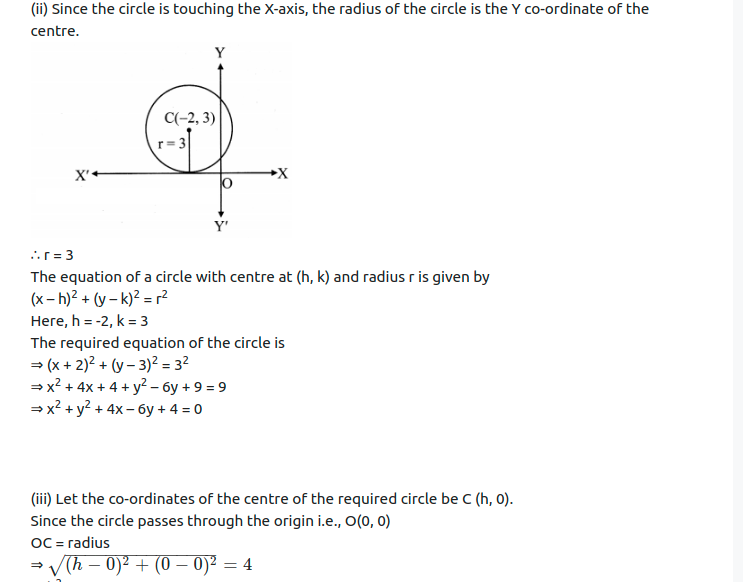
⇒ h2 = 16
⇒ h = ±4
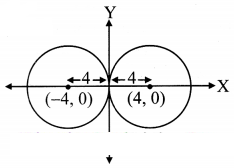
the co-ordinates of the centre are (4, 0) or (-4, 0).
The equation of a circle with centre at (h, k) and radius r is given by
(x – h)2 + (y – k)2 = r2
Here, h = ± 4, k = 0, r = 4
The required equation of the circle is
⇒ (x – 4)2 + (y – 0)2 = 42 or (x + 4)2 + (y – 0)2 = 42
⇒ x2 – 8x + 16 + y2 = 16 or x2 + 8x + 16 + y2 = 16
⇒ x2 + y2 – 8x = 0 or x2 + y2 + 8x = 0
(iv) Centre of the circle is C (3, 1).
Let the circle touch the line 8x – 15y + 25 = 0 at point M.
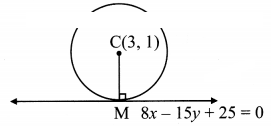
CM = radius (r)
CM = Length of perpendicular from centre C(3, 1) on the line 8x – 15y + 25 = 0
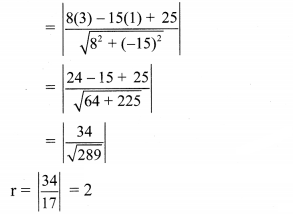
The equation of a circle with centre at (h, k) and radius r is given by
(x – h)2 + (y – k)2 = r2
Here, h = 3, k = 1 and r = 2
The required equation of the circle is
⇒ (x – 3)2 + (y – 1)2 = 22
⇒ x2 – 6x + 9 + y2 – 2y + 1 = 4
⇒ x2 + y2 – 6x – 2y + 10 – 4 = 0
⇒ x2 + y2 – 6x – 2y + 6 = 0
Question 4.
Find the equation of the circle, if the equations of two diameters are 2x + y = 6 and 3x + 2y = 4 and radius is 9.
Solution:
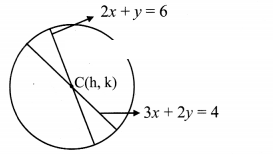
Given equations of diameters are 2x + y = 6 and 3x + 2y = 4.
Let C (h, k) be the centre of the required circle.
Since point of intersection of diameters is the centre of the circle,
x = h, y = k
Equations of diameters become
2h + k = 6 …..(i)
and 3h + 2k = 4 ……..(ii)
By (ii) – 2 × (i), we get
-h = -8
⇒ h = 8
Substituting h = 8 in (i), we get
2(8) + k = 6
⇒ k = 6 – 16
⇒ k = -10
Centre of the circle is C (8, -10) and radius, r = 9
The equation of a circle with centre at (h, k) and radius r is given by
(x – h)2 + (y – k)2 = r2
Here, h = 8, k = -10
The required equation of the circle is
⇒ (x – 8)2 + (y + 10)2 = 92
⇒ x2 – 16x + 64 + y2 + 20y + 100 = 81
⇒ x2 + y2 – 16x + 20y + 100 + 64 – 81 = 0
⇒ x2 + y2 – 16x + 20y + 83 = 0
Question 5.
If y = 2x is a chord of the circle x2 + y2 – 10x = 0, find the equation of the circle with this chord as diameter.
Solution:
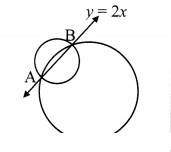
y = 2x is the chord of the given circle.
It satisfies the equation of a given circle.
Substituting y = 2x in x2 + y2 – 10x = 0, we get
⇒ x2 + (2x)2 – 10x = 0
⇒ x2 + 4x2 – 10x = 0
⇒ 5x2 – 10x = 0
⇒ 5x(x – 2) = 0
⇒ x = 0 or x = 2
When x = 0, y = 2x = 2(0) = 0
∴ A = (0, 0)
When x = 2, y = 2x = 2 (2) = 4
∴ B = (2, 4)
End points of chord AB are A(0, 0) and B(2, 4).
Chord AB is the diameter of the required circle.
The equation of a circle having (x1, y1) and (x2, y2) as end points of diameter is given by
(x – x1) (x – x2) + (y – y1) (y – y2) = 0
Here, x1 = 0, y1 = 0, x2 = 2, y2 = 4
The required equation of the circle is
⇒ (x – 0) (x – 2) + (y – 0) (y – 4 ) = 0
⇒ x2 – 2x + y2 – 4y = 0
⇒ x2 + y2 – 2x – 4y = 0
Question 6.
Find the equation of a circle with a radius of 4 units and touch both the co-ordinate axes having centre in the third quadrant. Solution:
The radius of the circle = 4 units
Since the circle touches both the co-ordinate axes and its centre is in the third quadrant,
the centre of the circle is C(-4, -4).
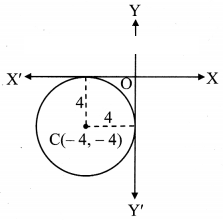
The equation of a circle with centre at (h, k) and radius r is given by (x – h)2 + (y – k)2 = r2
Here, h = -4, k = -4, r = 4
the required equation of the circle is
⇒ [x – (-4)]2 + [y – (-4)]2 = 42
⇒ (x + 4)2 + (y + 4)2 = 16
⇒ x2 + 8x + 16 + y2 + 8y + 16 – 16 = 0
⇒ x2 + y2 + 8x + 8y + 16 = 0
Question 7.
Find the equation of the circle passing through the origin and having intercepts 4 and -5 on the co-ordinate axes.
Solution:
Let the circle intersect X-axis at point A and intersect Y-axis at point B.
the co-ordinates of point A are (4, 0) and the co-ordinates of point B are (0, -5).
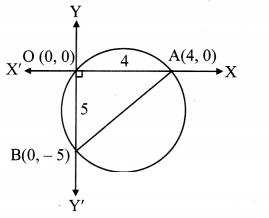
Since ∠AOB is a right angle,
AB represents the diameter of the circle.
The equation of a circle having (x1, y1) and (x2, y2) as end points of diameter is given by
(x – x1) (x – x2) + (y – y1) (y – y2) = 0
Here, x1 = 4, y1 = 0, x2 = 0, y2 = -5
The required equation of the circle is
⇒ (x – 4) (x – 0) + (y – 0) [y – (-5)] = 0
⇒ x(x – 4) + y(y + 5) = 0
⇒ x2 – 4x + y2 + 5y = 0
⇒ x2 + y2 – 4x + 5y = 0
Question 8.
Find the equation of a circle passing through the points (1, -4), (5, 2) and having its centre on line x – 2y + 9 = 0.
Solution:
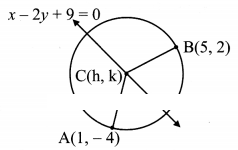
Let C(h, k) be the centre of the required circle which lies on the line x – 2y + 9 = 0.
Equation of line becomes
h – 2k + 9 = 0 …..(i)
Also, the required circle passes through points A(1, -4) and B(5, 2).
CA = CB = radius
CA = CB
By distance formula,
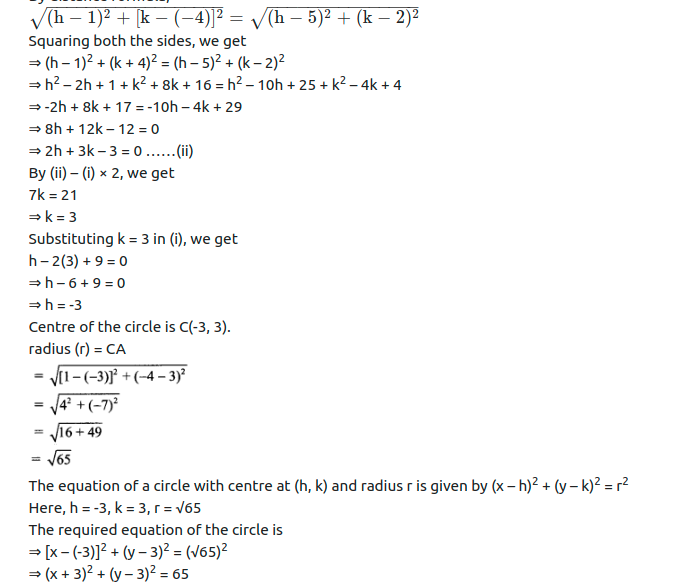
⇒ x2 + 6x + 9 + y2 – 6y + 9 – 65 = 0
⇒ x2 + y2 + 6x – 6y – 47 = 0
Ex 6.2
Question 1.
Find the centre and radius of each of the following circles:
(i) x2 + y2 – 2x + 4y – 4 = 0
(ii) x2 + y2 – 6x – 8y – 24 = 0
(iii) 4x2 + 4y2 – 24x – 8y – 24 = 0
Solution:
(i) Given equation of the circle is x2 + y2 – 2x + 4y – 4 = 0
Comparing this equation with x2 + y2 + 2gx + 2fy + c = 0, we get
2g = -2, 2f = 4 and c = -4
⇒ g = -1, f = 2 and c = -4
Centre of the circle = (-g, -f) = (1, -2)
and radius of the circle
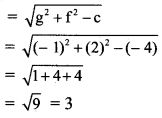
(ii) Given equation of the circle is x2 + y2 – 6x – 8y – 24 = 0
Comparing this equation with x2 + y2 + 2gx + 2fy + c = 0, we get
2g = -6, 2f = -8 and c = -24
⇒ g = -3, f = -4 and c = -24
Centre of the circle = (-g, -f) = (3, 4)
and radius of the circle

(iii) Given equation of the circle is 4x2 + 4y2 – 24x – 8y – 24 = 0
Dividing throughout by 4, we get x2 + y2 – 6x – 2y – 6 = 0
Comparing this equation with x2 + y2 + 2gx + 2fy + c = 0, we get
2g = -6, 2f = -2 and c = -6
⇒ g = -3, f = -1 and c = -6
Centre of the circle = (-g, -f) = (3, 1)
and radius of the circle
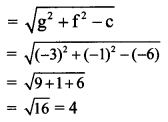
Question 2.
Show that the equation 3x2 + 3y2 + 12x + 18y – 11 = 0 represents a circle.
Solution:
Given equation is 3x2 + 3y2 + 12x + 18y – 11 = 0
Dividing throughout by 3, we get
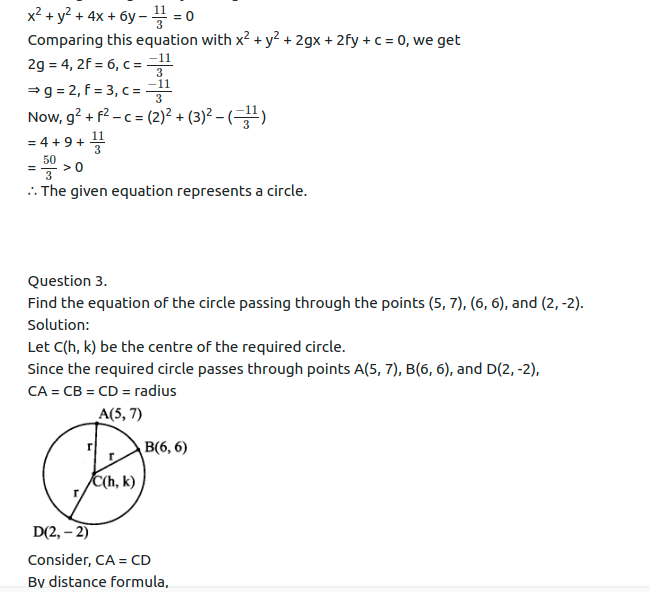

The equation of a circle with centre at (h, k) and radius r is given by (x – h)2+ (y – k)2 = r2
Here, h = 2, k = 3
The required equation of the circle is
(x – 2)2 + (y – 3)2 = 52
⇒ x2 – 4x + 4 + y2 – 6y + 9 = 25
⇒ x2 + y2 – 4x – 6y + 4 + 9 – 25 = 0
⇒ x2 + y2 – 4x – 6y – 12 = 0
Question 4.
Show that the points (3, -2), (1, 0), (-1, -2) and (1, -4) are concyclic.
Solution:
Let the equation of the circle passing through the points (3, -2), (1, 0) and (-1, -2) be
x2 + y2 + 2gx + 2fy + c = 0 …..(i)
For point (3, -2),
Substituting x = 3 and y = -2 in (i), we get
9 + 4 + 6g – 4f + c = 0
⇒ 6g – 4f + c = -13 ….(ii)
For point (1, 0),
Substituting x = 1 andy = 0 in (i), we get
1 + 0 + 2g + 0 + c = 0
⇒ 2g + c = -1 ……(iii)
For point (-1, -2),
Substituting x = -1 and y = -2, we get
1 + 4 – 2g – 4f + c = 0
⇒ 2g + 4f – c = 5 …….(iv)
Adding (ii) and (iv), we get
8g = -8
⇒ g = -1
Substituting g = -1 in (iii), we get
-2 + c = -1
⇒ c = 1
Substituting g = -1 and c = 1 in (iv), we get
-2 + 4f – 1 = 5
⇒ 4f = 8
⇒ f = 2
Substituting g = -1, f = 2 and c = 1 in (i), we get
x2 + y2 – 2x + 4y + 1 = 0 ……….(v)
If (1, -4) satisfies equation (v), the four points are concyclic.
Substituting x = 1, y = -4 in L.H.S of (v), we get
L.H.S. = (1)2 + (-4)2 – 2(1) + 4(-4) + 1
= 1 + 16 – 2 – 16 + 1
= 0
= R.H.S.
Point (1, -4) satisfies equation (v).
∴ The given points are concyclic.
Ex 6.3
Question 1.
Write the parametric equations of the circles:
(i) x2 + y2 = 9
(ii) x2 + y2 + 2x – 4y – 4 = 0
(iii) (x – 3)2 + (y + 4)2 = 25
Solution:
(i) Given equation of the circle is
x2 + y2 = 9
⇒ x2 + y2 = 32
Comparing this equation with x2 + y2 = r2, we get r = 3
The parametric equations of the circle in terms of θ are
x = r cos θ and y = r sin θ
⇒ x = 3 cos θ and y = 3 sin θ
(ii) Given equation of the circle is
x2 + y2 + 2x – 4y – 4 = 0
⇒ x2 + 2x + y2 – 4y – 4 = 0
⇒ x2 + 2x + 1 – 1 + y2 – 4y + 4 – 4 – 4 = 0
⇒ (x2 + 2x + 1 ) + (y2 – 4y + 4) – 9 = 0
⇒ (x + 1)2 + (y – 2)2 = 9
⇒ (x + 1)2 + (y – 2)2 = 32
Comparing this equation with (x – h)2 + (y – k)2 = r2, we get
h = -1, k = 2 and r = 3
The parametric equations of the circle in terms of θ are
x = h + r cos θ and y = k + r sin θ
⇒ x = -1 + 3 cos θ and y = 2 + 3 sin θ
(iii) Given equation of the circle is
(x – 3)2 + (y + 4)2 = 25
⇒ (x – 3)2 + (y + 4)2 = 52
Comparing this equation with (x – h)2 + (y – k)2 = r2, we get
h = 3, k = -4 and r = 5
The parametric equations of the circle in terms of θ are
x = h + r cos θ and y = k + r sin θ
⇒ x = 3 + 5 cos θ and y = -4 + 5 sin θ
Question 2.
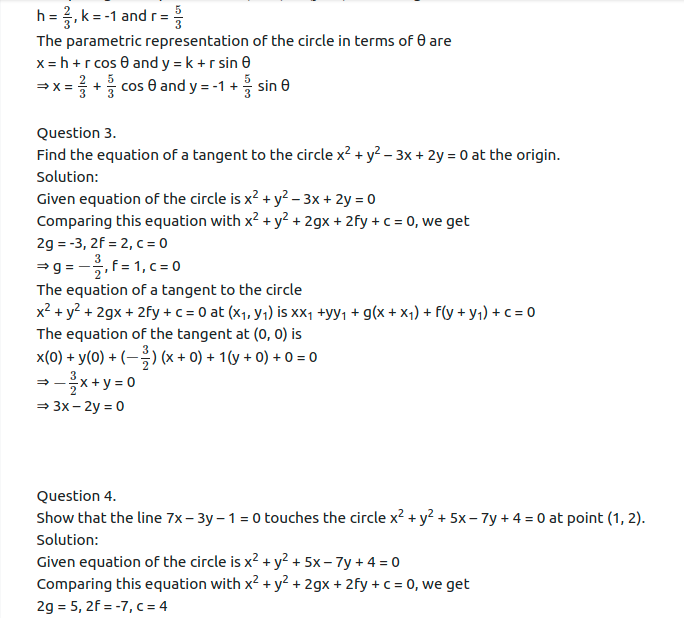
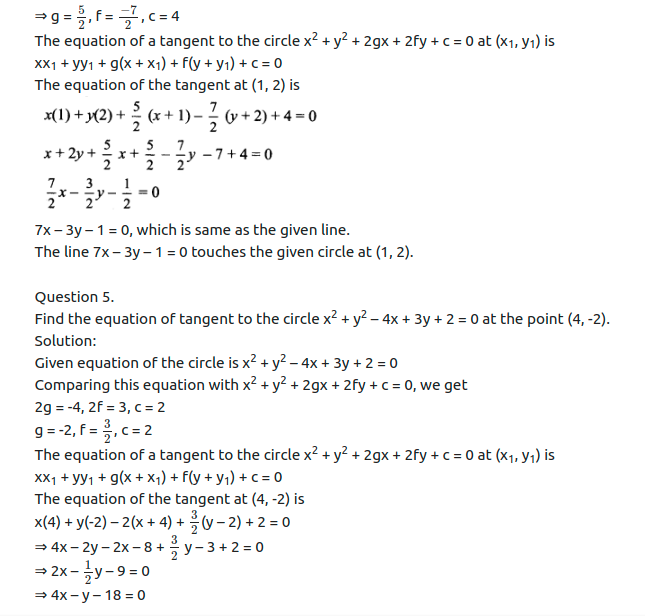
Find the parametric representation of the circle 3x2 + 3y2 – 4x + 6y – 4 = 0.
Solution:
Given equation of the circle is 3x2 + 3y2 – 4x + 6y – 4 = 0
Dividing throughout by 3, we get

Comparing this equation with (x – h)2 + (y – k)2 = r2, we get
Download PDF
Maharashtra Board Solutions Class 11-Arts & Science Maths (Part 1): Chapter 6- Circle
Chapterwise Maharashtra Board Solutions Class 11 Arts & Science Maths (Part 1) :
- Chapter 1- Angle and its Measurement
- Chapter 2- Trigonometry – I
- Chapter 3- Trigonometry – II
- Chapter 4- Determinants and Matrices
- Chapter 5- Straight Line
- Chapter 6- Circle
- Chapter 7- Conic Sections
- Chapter 8- Measures of Dispersion
- Chapter 9- Probability