
Class 11: Maths Chapter 5 solutions. Complete Class 11 Maths Chapter 5 Notes.
Maharashtra Board Solutions Class 11-Arts & Science Maths (Part 1): Chapter 5- Straight Line
Maharashtra Board 11th Maths Chapter 5, Class 11 Maths Chapter 5 solutions
Ex 5.1
Question 1.
If A(1, 3) and B(2, 1) are points, find the equation of the locus of point P such that PA = PB.
Solution:
Let P(x, y) be any point on the required locus.
Given, A(1, 3), B(2, 1) and
PA = PB
∴ PA2 = PB2
∴ (x – 1)2 + ( y – 3)2 = (x – 2)2 + (y – 1)2
∴ x2 – 2x + 1 + y2 – 6y + 9 = x2 – 4x + 4 + y2 – 2y + 1
-2x – 6y + 10 = -4x – 2y + 5
∴ 2x – 4y + 5 = 0
∴ The required equation of locus is 2x – 4y + 5 = 0.
Question 2.
A(- 5,2) and B(4,1). Find the equation of the locus of point P, which is equidistant from A and B.
Solution:
Let P(x, y) be any point on the required locus.
P is equidistant from A(- 5, 2) and B(4, 1).
∴ PA = PB
∴ PA2 = PB2
∴ (x + 5)2 + (y – 2)2 = (x – 4)2 + (y – 1)2
∴ x2 + 10x + 25 + y2 — 4y + 4
= x2 – 8x + 16 + y2 – 2y + 1
∴ 10x – 4y + 29 = -8x – 2y + 17
∴ 18x – 2y + 12 = 0
∴ 9x – y + 6 = 0
The required equation of locus is 9x -y + 6 = 0.
Question 3.
If A(2, 0) and B(0, 3) are two points, find the equation of the locus of point P such that AP = 2BP.
Solution:
Let P(x, y) be any point on the required locus.
Given, A(2, 0), B(0, 3) and AP = 2BP
∴ AP2 = 4BP2
∴ (x – 2)2 + (y – 0)2 = 4[(x – 0)2 + (y – 3)2]
∴ x2 – 4x + 4 + y2 = 4(x2 + y2 – 6y + 9)
x2 – 4x + 4 + y2 = 4x2 + 4y2 – 24y + 36
∴ 3x2 + 3 y2 + 4x – 24y + 32 = 0
∴ The required equation of locus is
3x2 + 3y2 + 4x – 24y + 32 = 0.
[Note: Answer given in the textbook , is
‘3x2 + 3y2 + 4x + 24y + 32 = O’.
However, as per our calculation it is ‘3x2 + 3y2 + 4x – 24y + 32 = 0’.]
Question 4.
If A(4,1) and B(5,4), find the equation of the locus of point P such that PA2 = 3PB2.
Solution:
Let P(x, y) be any point on the required locus. Given, A(4,1), B(5,4) and PA2 = 3PB2
∴ (x – 4)2 + (y – 1)2 = 3[(x – 5)2 + (y – 4)2]
∴ x2 – 8x + 16 + y2 – 2y + 1 = 3(x2 – 10x + 25 + y2 – 8y + 16)
∴ x2 – 8x + y2 – 2y + 17 = 3x2 -30x + 75 + 3y2 – 24y + 48
∴ 2x2 + 2y2 – 22x – 22y + 106 = 0
∴ x2 + y2 – 11x – 11y + 53 = 0
∴ The required equation of locus is
x2 + y2 – 11x – 11y + 53 = 0.
Question 5.
A(2, 4) and B(5, 8), find the equation of the
locus of point P such that PA2 – PB2 = 13.
Solution:
Let P(x, y) be any point on the required locus. Given, A(2,4), B(5, 8) and PA2-PB2 = 13
∴ [(x -2)2 + (y – 4)2] – [(x -5)2 + (y- 8)2] = 13
∴ (x2 – 4x + 4 + y2 – 8y + 16) – (x2 – 10x + 25 + y2 – 16y + 64) =13
∴ x2 – 4x+ y2 – 8y + 20 – x2 + 10x – y2 + 16y – 89 = 13
∴ 6x + 8y- 69 = 13
∴ 6x + 8y – 82 = 0
∴ 3x + 4y – 41 = 0
∴ The required equation of locus is 3x + 4y- 41 = 0.
Question 6.
A(1, 6) and B(3, 5), find the equation of the locus of point P such that segment AB subtends right angle at P. (∠APB = 90°)
Solution:
Let P(x, y) be any point on the required locus. Given,
A(l, 6) and B(3, 5),
∠APB = 90°
∴ ΔAPB is a right angled triangle,
By Pythagoras theorem,
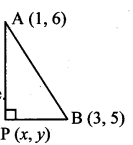
AP2 + PB2 = AB2 P (x,y)
∴ [(x – 1)2 + (y – 6)2] + [(x – 3)2 + (y – 5)2] = (1 – 3)2 + (6 -5)2
∴ x2 — 2x + 1 + y2 — 12y + 36 + x2 – 6x + 9 + y2 – 10y + 25 = 4 + 1
∴ 2x2 + 2y2 – 8x – 22y + 66 = 0
∴ x2 + y2 – 4x – 11y + 33 = 0
∴ The required equation of locus is x2 + y2 – 4x – 11y + 33 = 0.
[Note: Answer given in the textbook is
‘3x2 + 4y2 – 4x – 11y + 33 = 0’.
However, as per our calculation it is ‘x2 + y2 – 4x – 11y + 33 = O
Question 7.
If the origin is shifted to the point 0′(2, 3), the axes remaining parallel to the original axes, find the new co-ordinates of the points
i. A(1, 3) ii. B(2,5)
Solution:
Origin is shifted to (2, 3) = (h, k)
Let the new co-ordinates be (X, Y).
x = X + handy = Y + k
x = X + 2 andy = Y + 3 …(i)
i. Given, A(x, y) = A( 1, 3)
x = X + 2 andy = Y + 3 …[From(i)]
∴ 1 = X + 2 and 3 = Y + 3 X = – 1 and Y = 0
∴ The new co-ordinates of point A are (- 1,0).
ii. Given, B(x, y) = B(2, 5)
x = X + 2 and y = Y + 3 …[From(i)]
∴ 2 = X + 2 and 5 = Y + 3
∴ X = 0 and Y = 2
∴ The new co-ordinates of point B are (0, 2).
Question 8.
If the origin is shifted to the point O'(1, 3), the axes remaining parallel to the original axes, find the old co-ordinates of the points
i. C(5,4) ii. D(3,3)
Solution:
Origin is shifted to (1,3) = (h, k)
Let the new co-ordinates be (X, Y).
x = X + h andy = Y + k
∴ x = X+1 andy = Y + 3 …(i)
i. Given, C(X, Y) = C(5, 4)
x = X +1 andy = Y + 3 …[From(i)]
∴ x = 5 + 1 = 6 andy = 4 + 3 = 7
∴ The old co-ordinates of point C are (6, 7).
ii. Given, D(X, Y) = D(3, 3)
x = X + 1 andy = Y + 3 …[From(i)]
∴ x = 3 + 1 = 4 and y = 3 + 3 = 6
∴ The old co-ordinates of point D are (4, 6).
Question 9.
If the co-ordinates A(5, 14) change to B(8, 3) by shift of origin, find the co-ordinates of the point, where the origin is shifted.
Solution:
Let the origin be shifted to (h, k).
Given, A(x, y) = A(5,14), B(X, Y) = B(8, 3)
Since x = X + h andy = Y + k,
5 = 8 + hand 14 = 3 + k ,
∴ h = – 3 and k = 11
The co-ordinates of the point, where the origin is shifted are (- 3, 11).
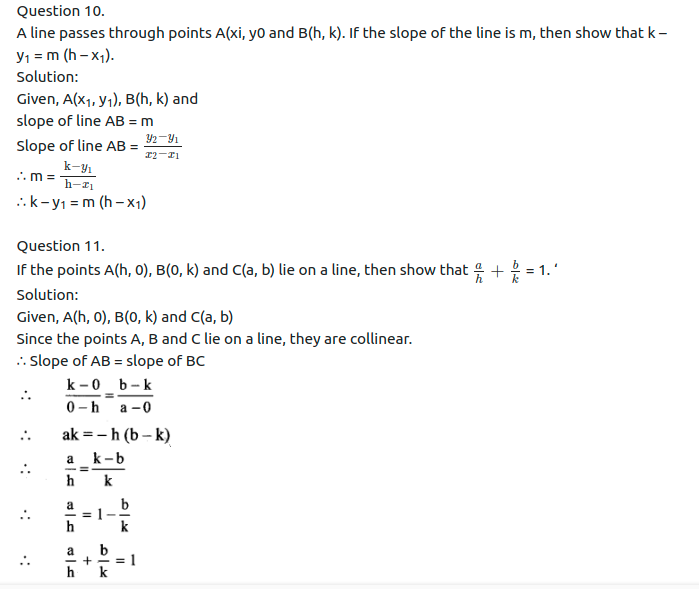
Question 10.
Obtain the new equations of the following loci if the origin is shifted to the point 0′(2,2), the direction of axes remaining the same:
i. 3x-y + 2 = 0
11. x2+y2-3x = 7
iii. xy – 2x – 2y + 4 = 0
iv. y2 – 4x – 4y + 12 = 0
Solution:
Given, (h,k) = (2,2)
Let (X, Y) be the new co-ordinates of the point (x,y).
∴ x = X + handy = Y + k
∴ x = X + 2 andy = Y + 2
i. Substituting the values of x and y in the equation 3x -y + 2 = 0, we get
3(X + 2) – (Y + 2) + 2 = 0
∴ 3X + 6-Y-2 + 2 = 0
∴ 3 X – Y + 6 = 0, which is the new equation of locus.
ii. Substituting the values of x and y in the equation
x2 + y2 – 3x = 7, we get
(X + 2)2 + (Y + 2)2 – 3(X + 2) = 7
∴ X2 + 4X + 4 + Y2 + 4Y + 4 – 3X – 6 = 7
∴ X2 + Y2 + X + 4Y – 5 = 0, which is the new
equation of locus.
iii; Substituting the values of x and y in the equation xy – 2x – 2y + 4 = 0, we get
(X + 2) (Y + 2) – 2(X + 2) – 2(Y + 2) + 4 = 0
∴ XY + 2X + 2Y + 4 – 2X – 4-2Y- 4 + 4 = 0
∴ XY = 0, which is the new equation of locus.
iv. Substituting the values of x and y in the equation y2 – 4x – 4y + 12 = 0, we get
(Y + 2)2 – 4(X + 2) – 4(Y + 2) + 12 = 0
∴ Y2 + 4Y + 4 – 4X – 8 – 4Y -8 + 12 = 0
∴ Y2 – 4X = 0, which is the new equation of locus.
Ex 5.2
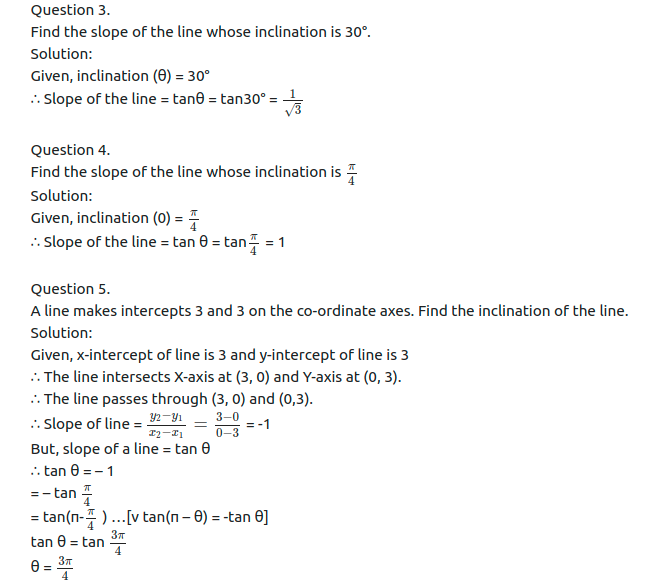

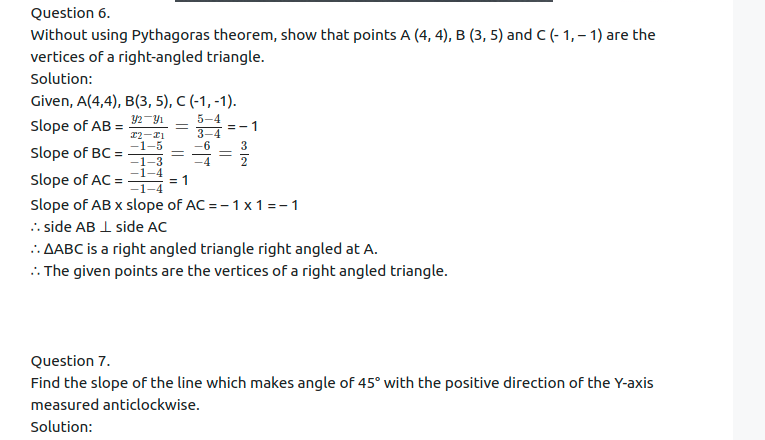
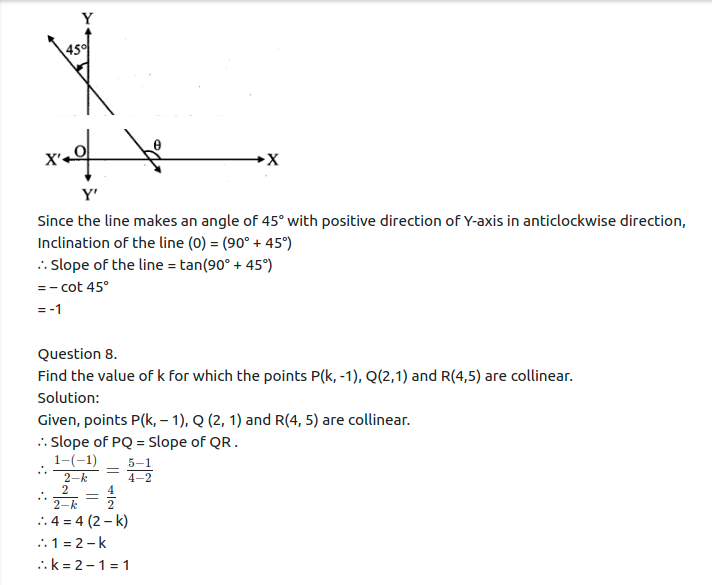
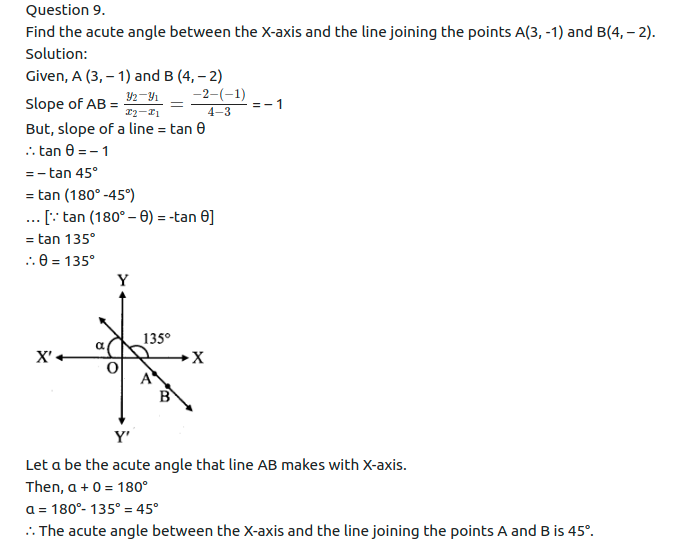
Ex 5.3
Question 1.
Write the equation of the line:
i. parallel to the X-axis and at a distance of 5 units from it and above it.
ii. parallel to the Y-axis and at a distance of 5 units from it and to the left of it.
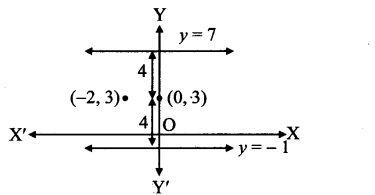
iii. parallel to the X-axis and at a distance of 4 units from the point (- 2,3).
Solution:
i. Equation of a line parallel to X-axis is y = k. Since the line is at a distance of 5 units above X-axis, k = 5
∴ The equation of the required line is y = 5.
ii. Equation of a line parallel to Y-axis is x = h. Since the line is at a distance of 5 units to the left of Y-axis, h = -5
∴ The equation of the required line is x = -5.
[Note: Answer given in the textbook is ‘y = -5
However, we found that ‘x = – 5’.]
iii. Equation of a line parallel to the X-axis is of the form y = k (k > 0 or k < 0).
Since the line is at a distance of 4 units from the point (- 2, 3),
k = 4 + 3 = 7 or k = 3- 4 = -1
∴ The equation of the required line is y = 1 or y = – 1.
Question 2.
Obtain the equation of the line:
i. parallel to the X-axis and making an intercept of 3 units on the Y-axis.
ii. parallel to the Y-axis and making an intercept of 4 units on the X-axis.
Solution:
i. Equation of a line parallel to X-axis with y-intercept ‘k’ isy = k.
Here, y-intercept = 3
∴ The equation of the required line is y = 3.
ii. Equation of a line parallel to Y-axis with x-intercept ‘h’ is x = h.
Here, x-intercept = 4
∴ The equation of the required line is x = 4.
Question 3.
Obtain the equation of the line containing the point:
i. A(2, – 3) and parallel to the Y-axis.
ii. B(4, – 3) and parallel to the X-axis.
Solution:
i. Equation of a line parallel to Y-axis is of the form x = h.
Since the line passes through A(2, – 3), h = 2
∴ The equation of the required line is x = 2.
ii. Equation of a line parallel to X-axis is of the formy = k.
Since the line passes through B(4, – 3), k = -3
∴ The equation of the required line is y = – 3.
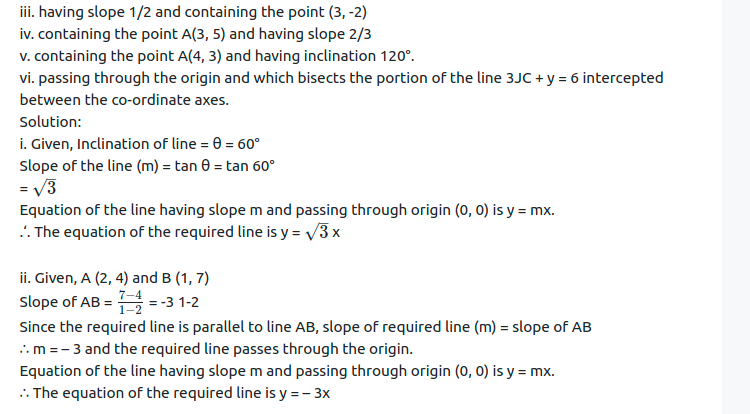
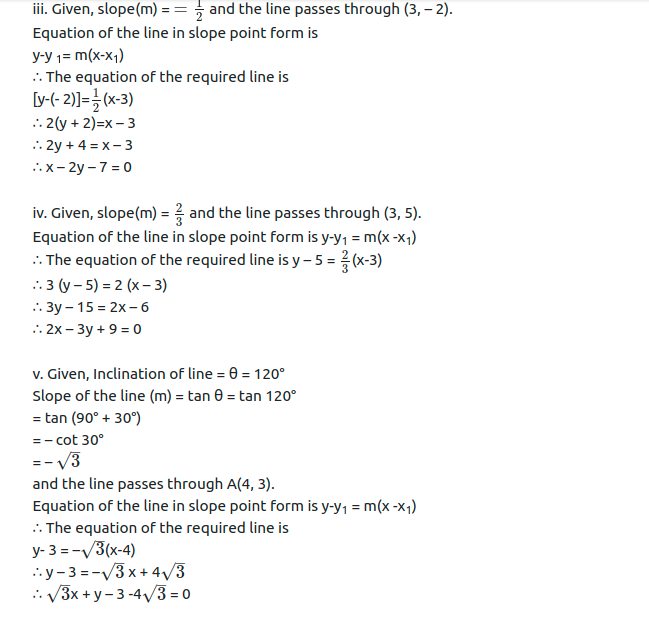
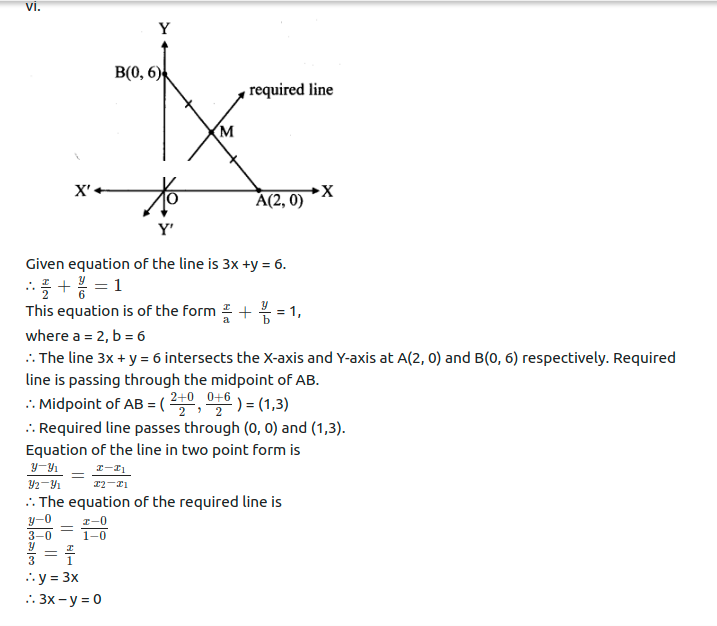
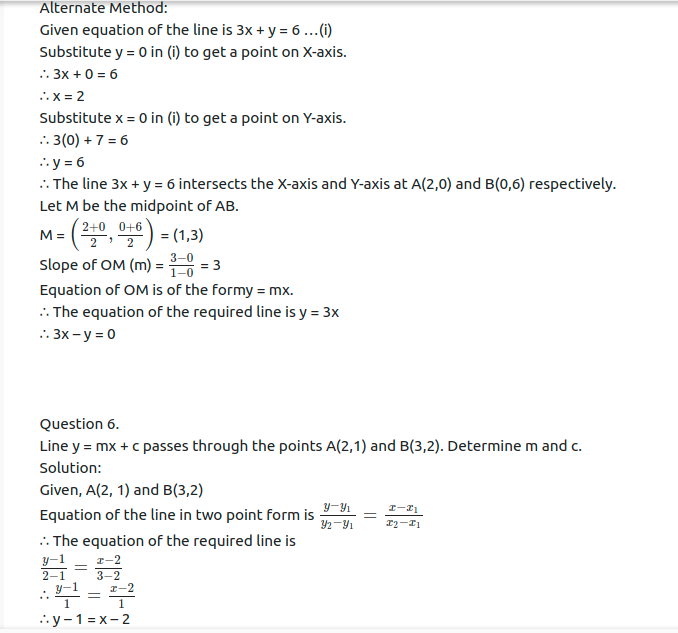
∴ y = x – 1
Comparing this equation with y = mx + c, we get
m = 1 and c = – 1
Alternate Method:
Points A(2, 1) and B(3, 2) lie on the line y = mx + c.
∴ They must satisfy the equation.
∴ 2m + c = 1 …(i)
and 3m + c = 2 …(ii)
equation (ii) – equation (i) gives m = 1
Substituting m = 1 in (i), we get 2(1) + c = 1
∴ c = 1 – 2 = – 1
Question 7.
Find the equation of the line having inclination 135° and making x-intercept 7.
Solution:
Given, Inclination of line = 0 = 135°
∴ Slope of the line (m) = tan 0 = tan 135°
= tan (90° + 45°)
= – cot 45° = – 1 x-intercept of the required line is 7.
∴ The line passes through (7, 0).
Equation of the line in slope point form is y – y1 = m(x – x1)
∴ The equation of the required line is y — 0 = – 1 (x – 7)
∴ y = -x + 7
∴ x + y – 7 = 0
Question 8.
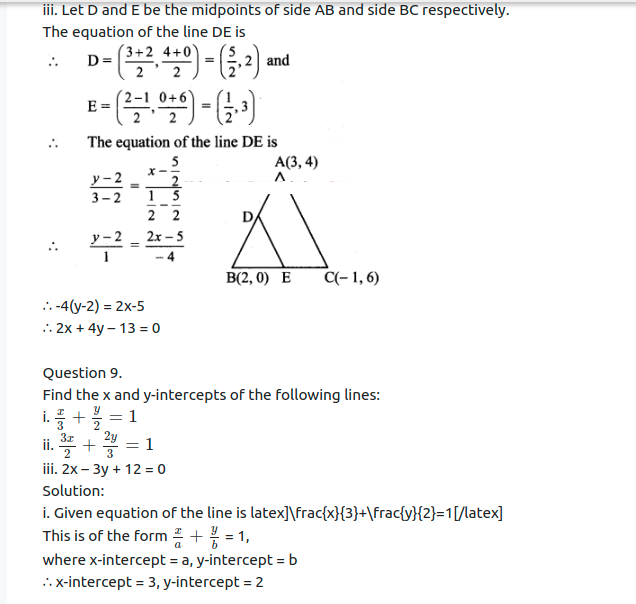
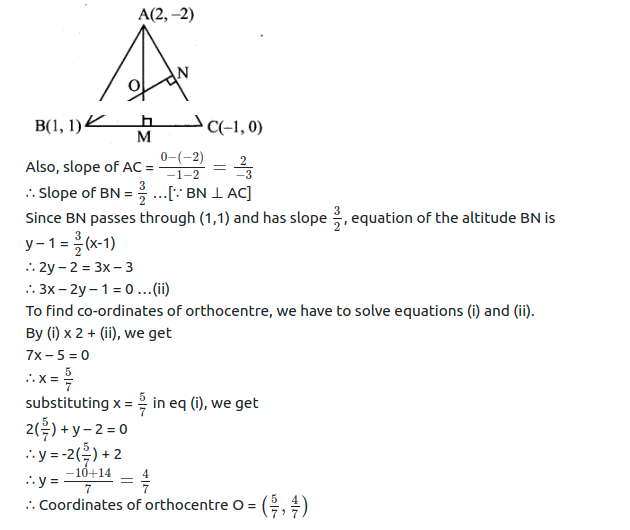
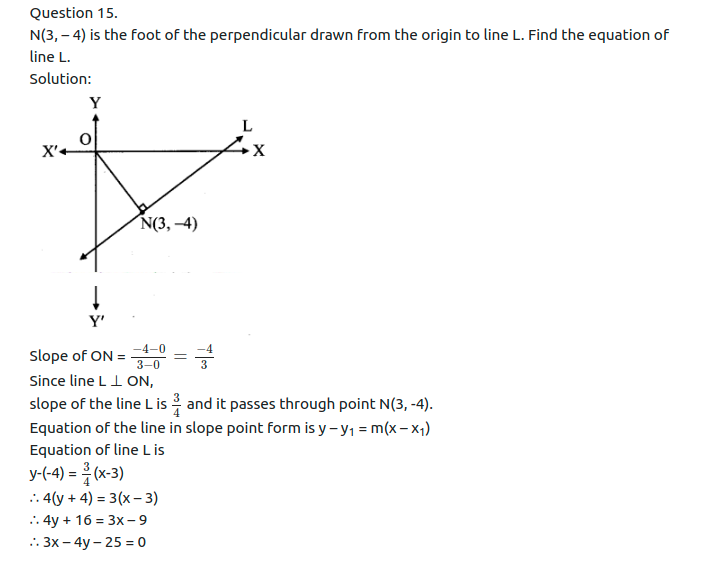
The vertices of a triangle are A(3, 4), B(2, 0) and C(- 1, 6). Find the equations of the lines containing
i. side BC
ii. the median AD
iii. the midpoints of sides AB and BC.
Solution:
Vertices of AABC are A(3, 4), B(2, 0) and C(- 1, 6).
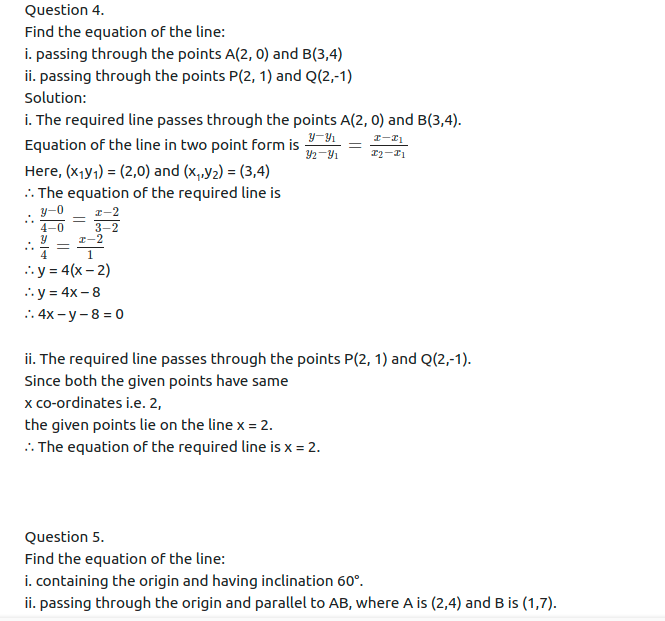
i. Equation of the line in two point form is
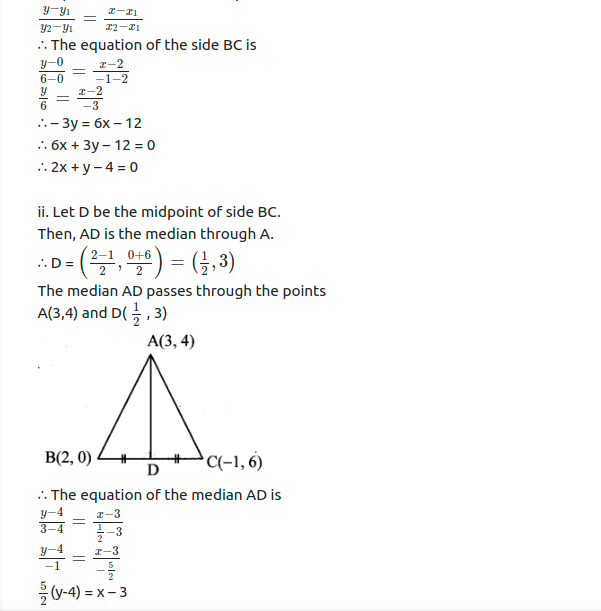
∴ 5y – 20 = 2x – 6
∴ 2x – 5y + 14 = 0
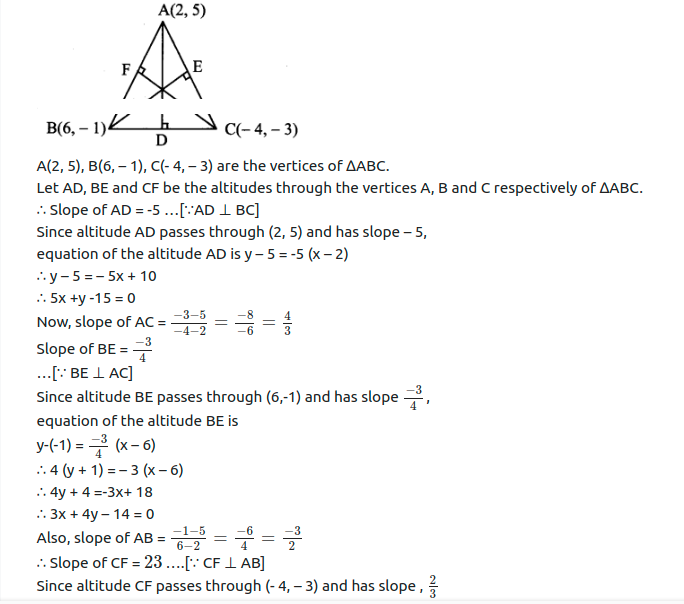
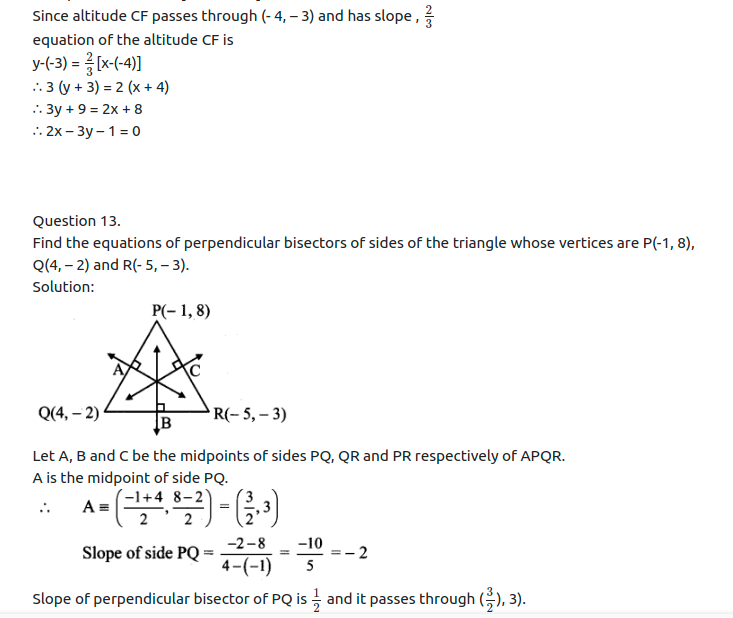
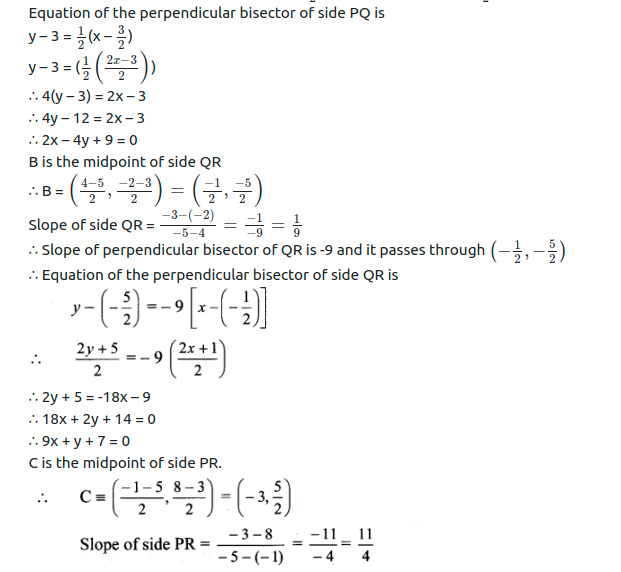
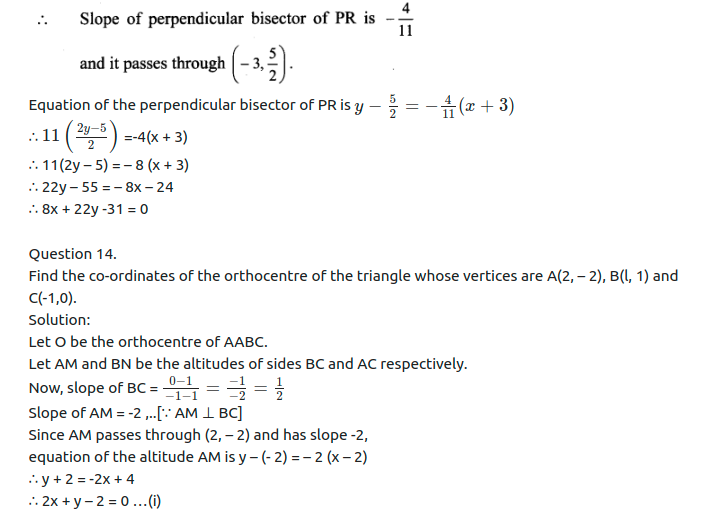
Ex 5.4
Question 1.
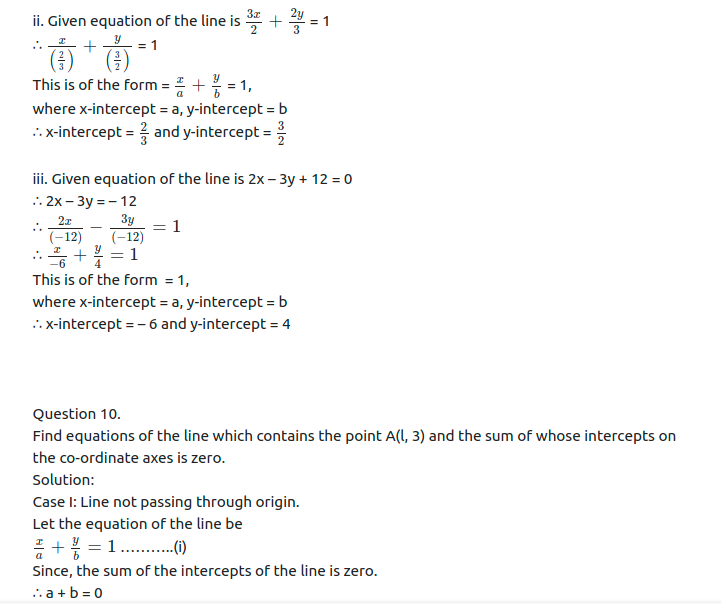
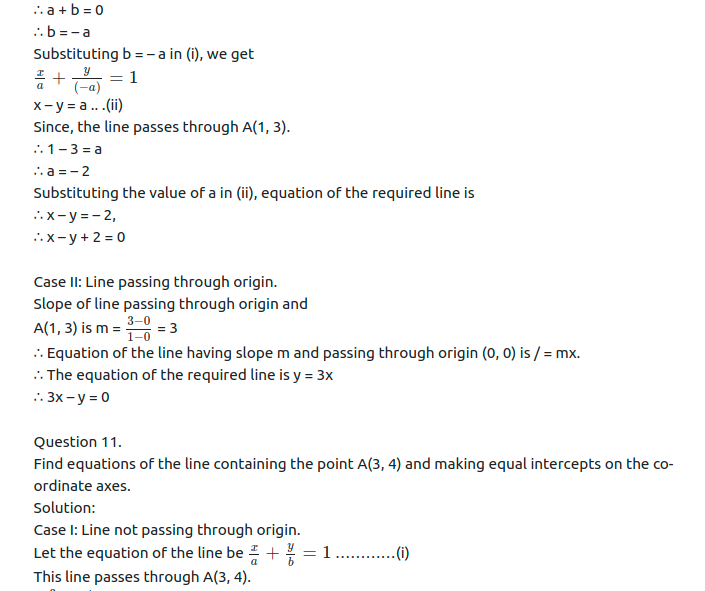
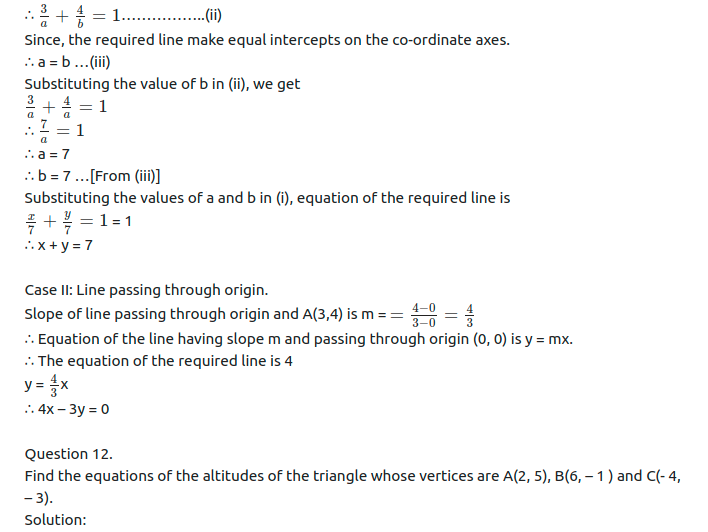
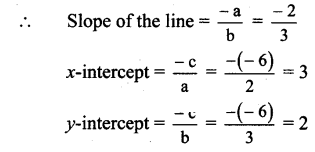
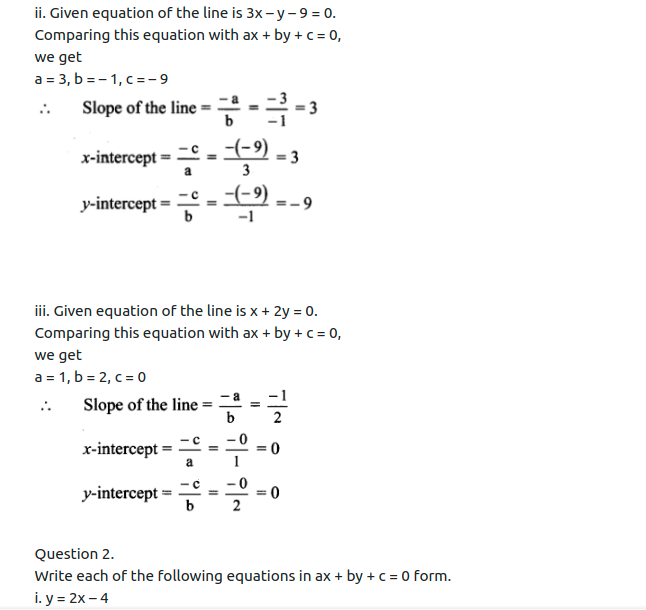
Find the slope, x-intercept, y-intercept of each of the following lines, i. 2x + 3y-6 = 0 ii. 3x-y-9 = 0 iii. x + 2y = 0
Solution:
i. Given equation of the line is 2x + 3y – 6 = 0.
Comparing this equation with ax + by + c = 0,
we get
a = 2, b = 3, c = -6
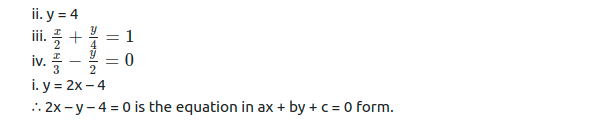
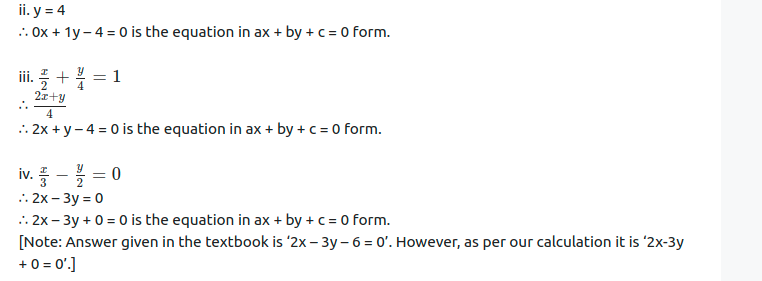
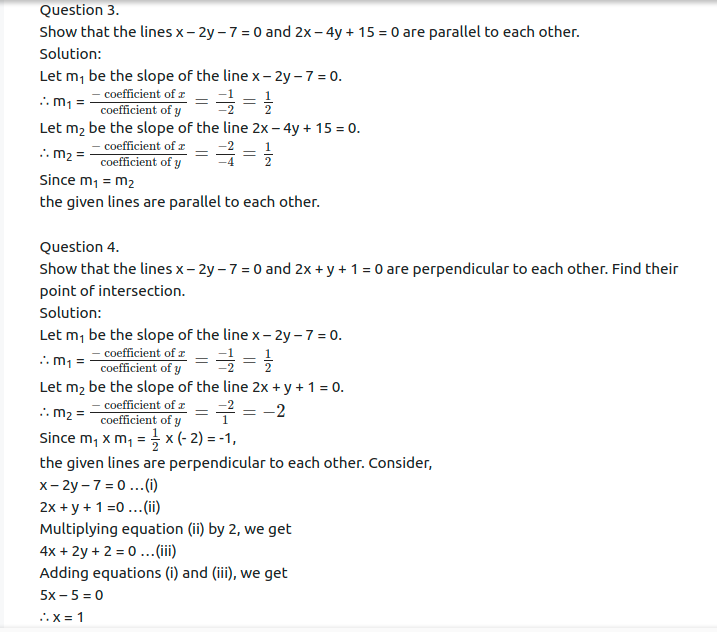
Substituting x = 1 in equation (ii), we get
2 + y + 1 = 0
∴ y = – 3
∴ The point of intersection of the given lines is (1,-3).
Question 5.
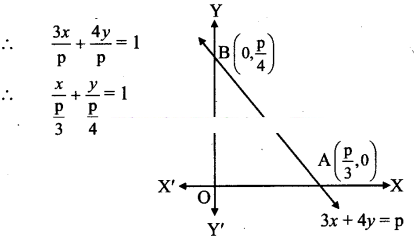
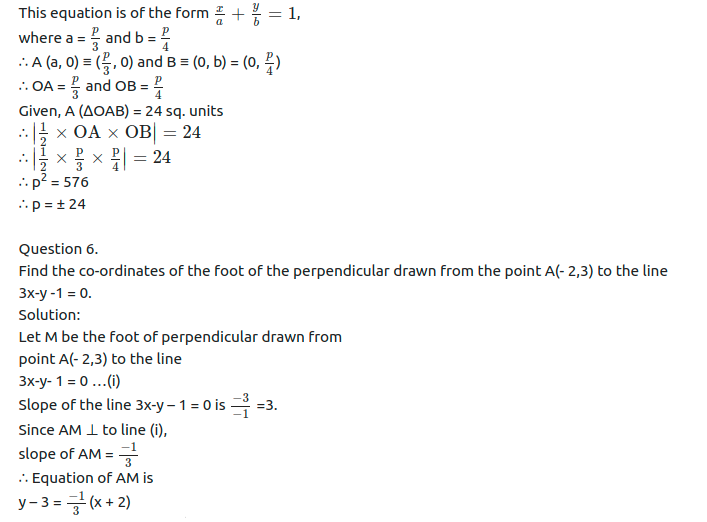
If the line 3x + 4y = p makes a triangle of area 24 square units with the co-ordinate axes, then find the value of p.
Solution:
Let the line 3x + 4y = p cuts the X and Y axes at points A and B respectively.
3x + 4y = p
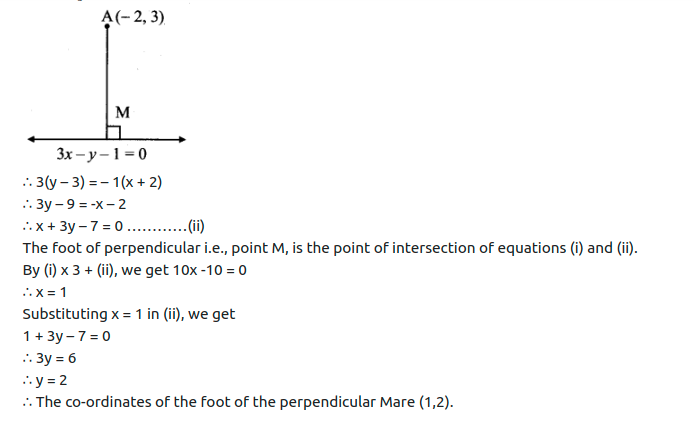
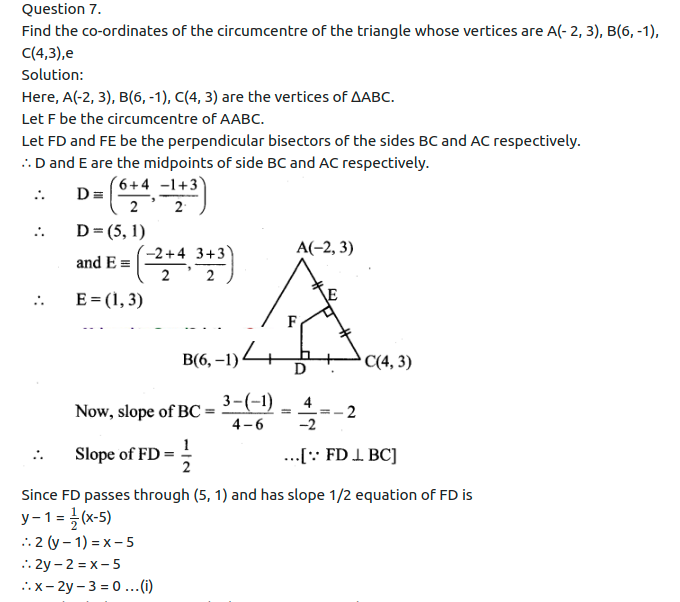
Since both the points A and C have same y co-ordinates i.e. 3,
the given points lie on the line y = 3.
Since the equation FE passes through E(1, 3),
the equation of FE is x = 1. .. .(ii)
To find co-ordinates of circumcentre, we have to solve equations (i) and (ii).
Substituting the value of x in (i), we get
1 – 2y -3 = 0
∴ y = -1
∴ Co-ordinates of circumcentre F ≡ (1, – 1).
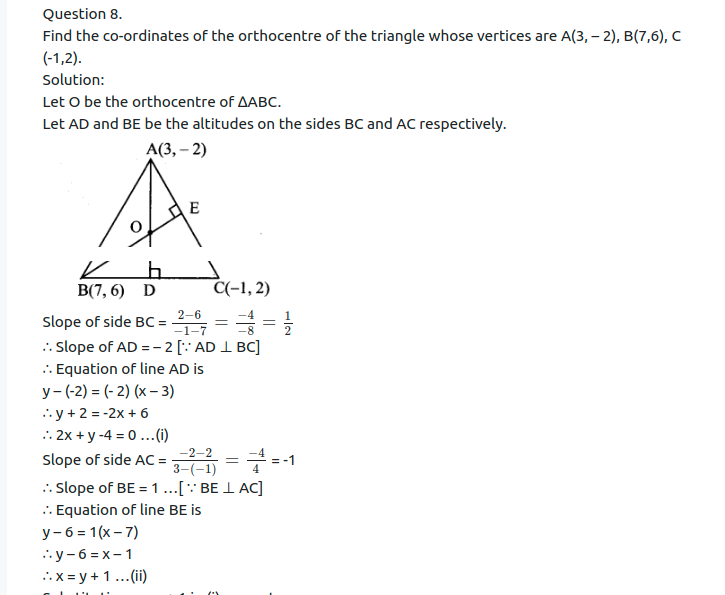
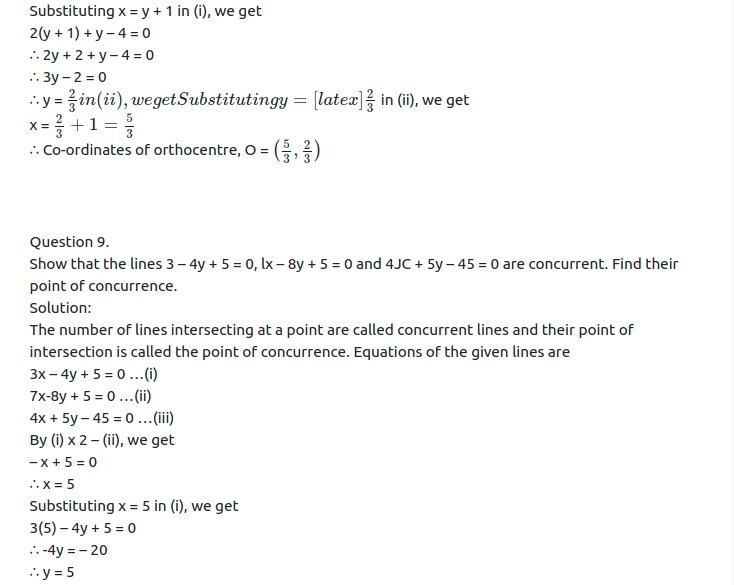
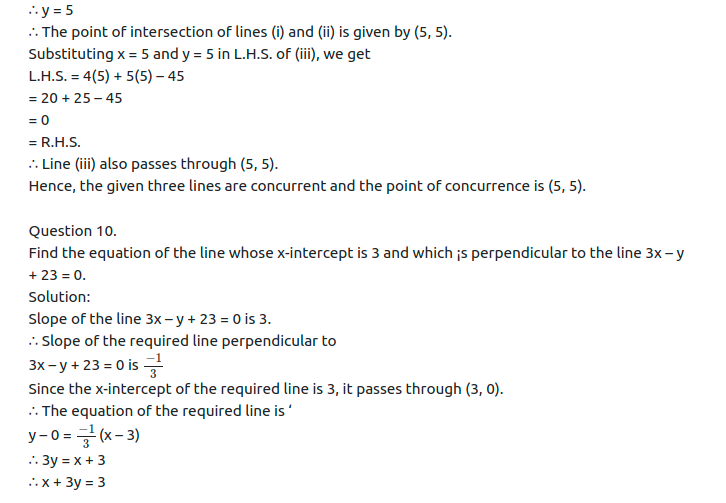
Question 11.
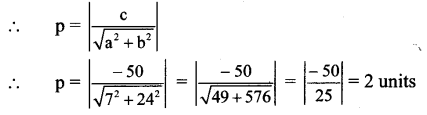
Find the distance of the origin from the line 7x + 24y – 50 = 0.
Solution:
Let p be the perpendicular distance of origin
fromtheline7x + 24y – 50 = 0
Here, a = 7, b = 24, c = -50
Question 12.
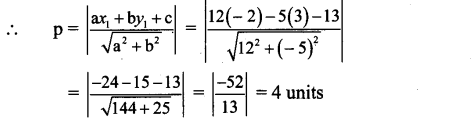
Find the distance of the point A(- 2, 3) from the line 12x – 5y – 13 = 0.
Solution:
Let p be the perpendicular distance of the point A(- 2, 3) from the line 12x – 5y – 13 = 0
Here, a = 12, b = – 5, c = – 13, x1 = -2, y1 = 3
Question 13.
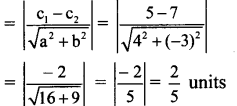
Find the distance between parallel lines 4x – 3y + 5 = 0 and 4xr – 3y + 7 = 0.
Solution:
Equations of the given parallel lines are 4x – 3y + 5 = 0 and 4x – 3y + 1 = 0
Here, a = 4, b = – 3, c1 = 5 and c2 = 7
∴ Distance between the parallel lines
Question 14.
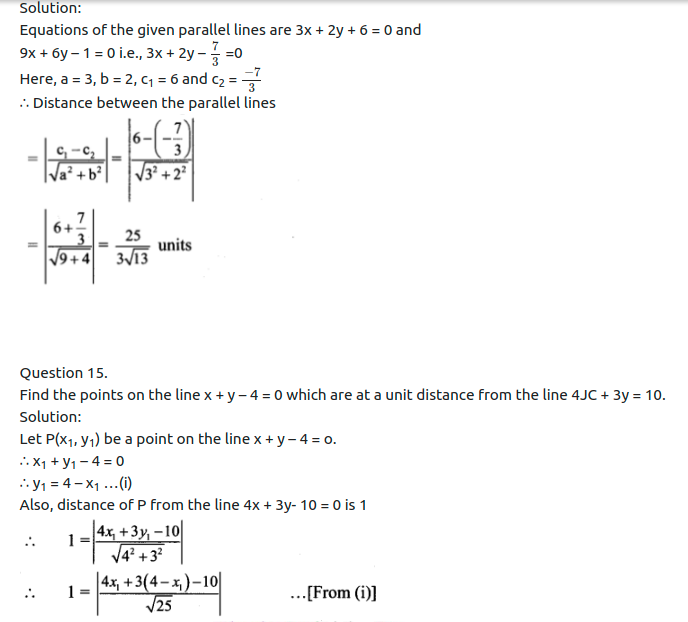
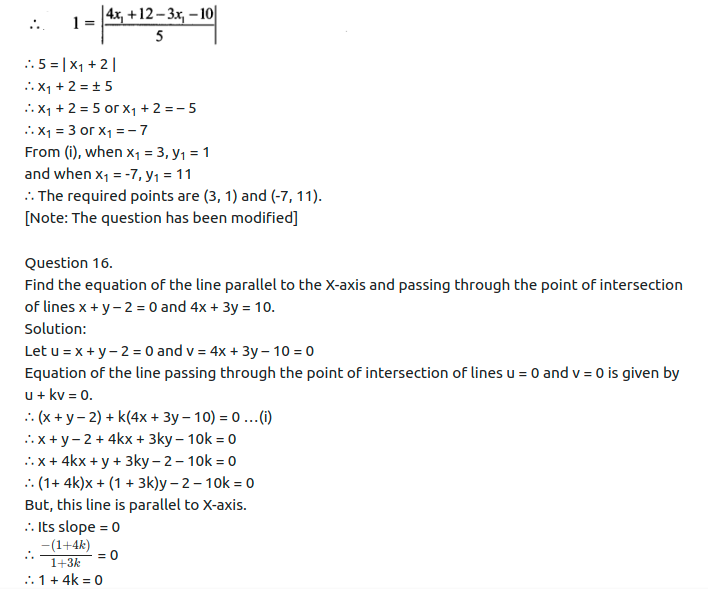
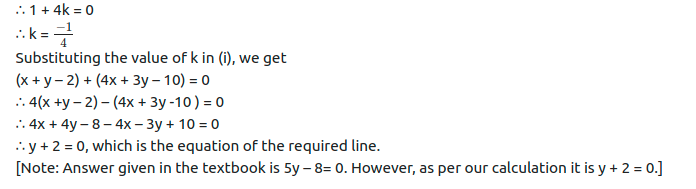
Find the distance between the parallel lines 9x + 6y – 7 = 0 and 3x + 2y + 6 = 0.
Solution:
Equations of the given parallel lines are 3x + 2y + 6 = 0 and
Question 19.
D(- 1, 8), E(4, – 2), F(- 5, – 3) are midpoints of sides BC, CA and AB of AABC. Find
i. equations of sides of ΔABC.
ii. co-ordinates of the circumcentre of ΔABC.
Solution:
Let A(x1, y1), B(x2, y2) and C(x3, y3) be the vertices of ΔABC.
Given, points D, E and F are midpoints of sides BC, CA and AB respectively of ΔABC.
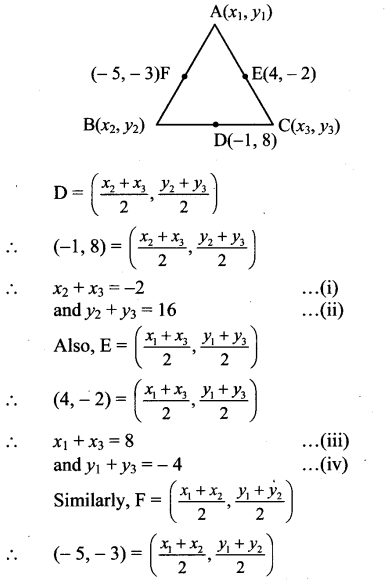
∴ x1 + x2 = -10 …………. (v)
and y1 + y2 = – 6 …………(vi)
For x-coordinates:
Adding (i), (iii) and (v), we get
2x1 + 2x2 + 2x3 = – 4
∴ x1 + x2 + x3 = -2 …………..(vii)
Solving (i) and (vii), we get x1 = 0
Solving (iii) and (vii), we get x2 = – 10
Solving (v) and (vii), we get x3 = 8
For y-coordinates:
Adding (ii), (iv) and (vi), we get 2y1 + 2y2 + 2y3 = 6
y1 + y2 + y3 = 3 …….(viii)
Solving (ii) and (viii), we get y1 = -13
Solving (iv) and (viii), we get y2 = 7
Solving (vi) and (viii), we get y3 = 9
∴ Vertices of AABC are A(0, – 13), B(- 10, 7), C(8, 9)
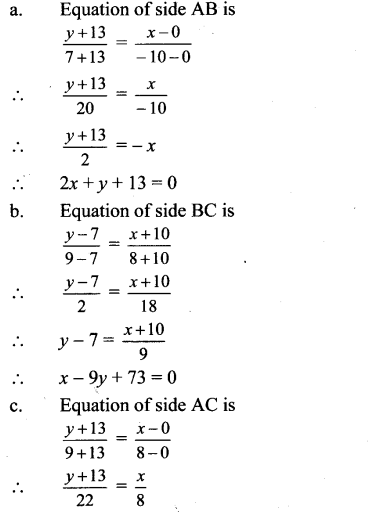
∴ 8(y + 13) = 22x
∴ 4(y + 13) = 11x
∴ 11x – 4y – 52 = 0
ii. Here, A(0, – 13), B(- 10, 7), C(8, 9) are the vertices of ΔABC.
Let F be the circumcentre of AABC.
Let FD and FE be perpendicular bisectors of the sides BC and AC respectively.
D and E are the midpoints of side BC and AC.
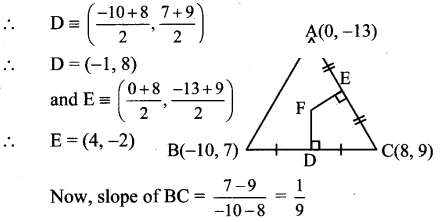
∴ Slope of FD = -9 … [ ∵ FD ⊥ BC]
Since FD passes through (-1, 8) and has slope -9, equation of FD is
y – 8 = -9 (x +1)
∴ y – 8 = -9x – 9
∴ y = -9x – 1
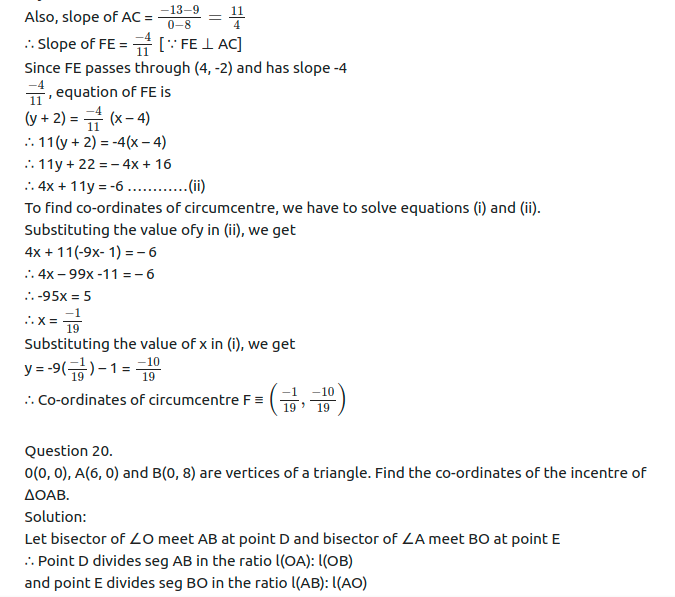
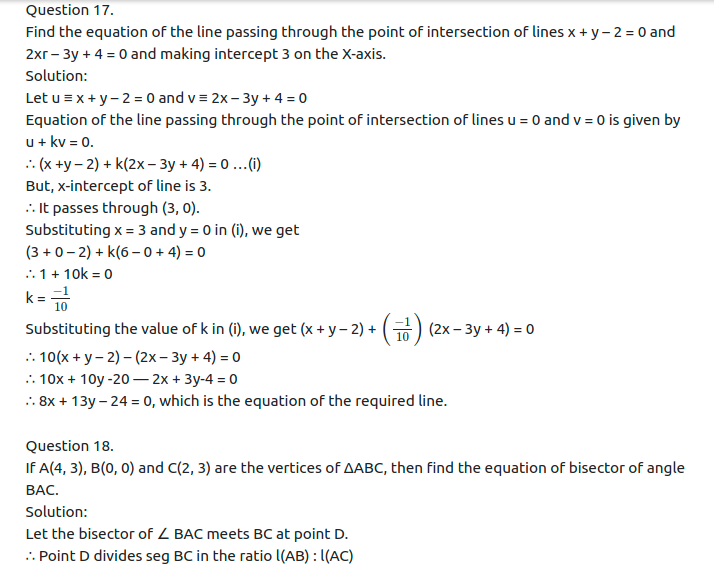
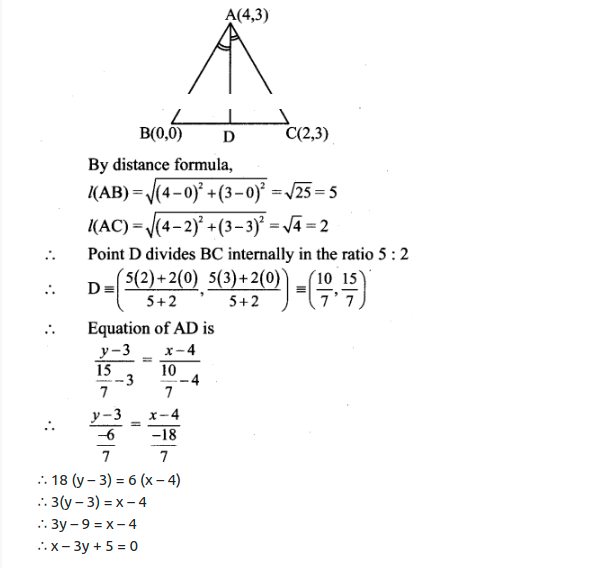
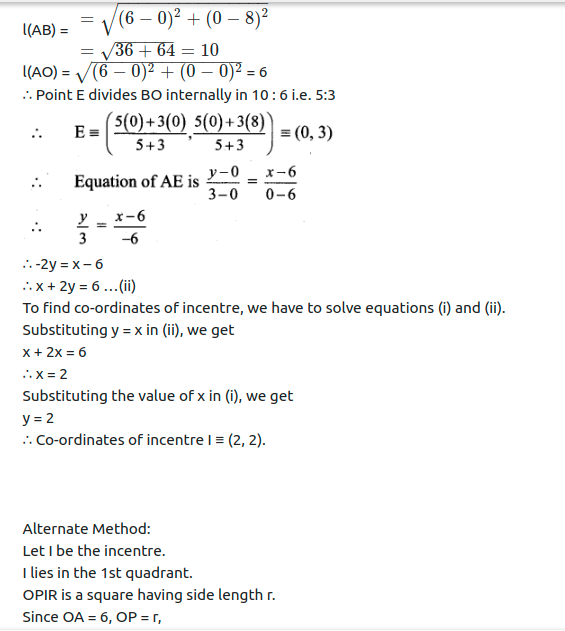
and point E divides seg BO in the ratio l(AB): l(AO)
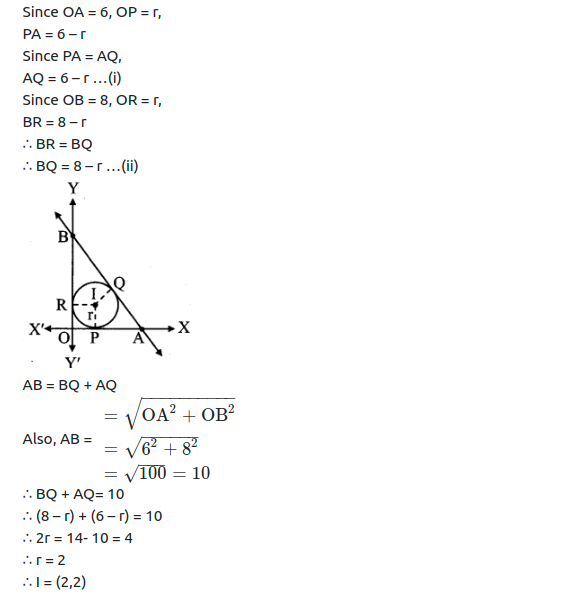
Let I be the incentre of ∠OAB.
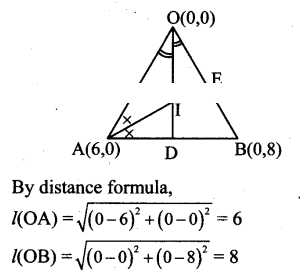
∴ Point D divides AB internally in 6 : 8
i.e. 3 :4
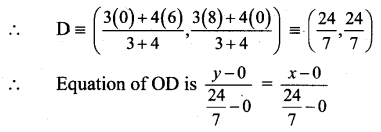
∴ y = x …(i)
Now, by distance formula,
Download PDF
Maharashtra Board Solutions Class 11-Arts & Science Maths (Part 1): Chapter 5- Straight Line
Chapterwise Maharashtra Board Solutions Class 11 Arts & Science Maths (Part 1) :
- Chapter 1- Angle and its Measurement
- Chapter 2- Trigonometry – I
- Chapter 3- Trigonometry – II
- Chapter 4- Determinants and Matrices
- Chapter 5- Straight Line
- Chapter 6- Circle
- Chapter 7- Conic Sections
- Chapter 8- Measures of Dispersion
- Chapter 9- Probability