
Class 6: Maths Chapter 3 solutions. Complete Class 6 Maths Chapter 3 Notes.
RS Aggarwal Solutions for Class 6 Maths Chapter 3–Whole Numbers
RS Aggarwal 6th Maths Chapter 3, Class 6 Maths Chapter 3 solutions
Ex 3A Solutions
Question 1.
Solution:
After 30999, three whole numbers will be
30999 + 1 = 31000
31000 + 1 = 31001
31001 + 1 = 31002
i.e., 31000, 31001 and 31002
Question 2.
Solution:
Before 10001, three whole numbers will be 10001 – 1 = 10000
10000 – 1 = 9999
9999 – 1 = 9998
i.e., 10000, 9999, 9998
Question 3.
Solution:
Between 1032 and 1209, whole number are 1209 – 1031
= 178
Question 4.
Solution:
The smallest whole number is 0
Question 5.
Solution:
The successor of
(i) 2540801 is 2540801 + 1 = 2540802
(ii) 9999 is 9999 + 1 = 10000
(iii) 50904 is 50904 + 1 = 50905
(iv) 61639 is 61639 + 1 = 61640
(v) 687890 is 687890 + 1 = 687891
(vi) 5386700 is 5386700 + 1 = 5386701
(vii) 6475999 is 6475999 + 1 = 6476000
(viii) 9999999 is 9999999 + 1 = 10000000
Question 6.
Solution:
Predecessor of
(i) 97 is 97 – 1 = 96
(ii) 10000 is 10000 – 1 = 9999
(iii) 36900 is 36900 – 1 = 36899
(iv) 7684320 is 7684320 – 1 = 7684319
(v) 1566391 is 1566391 – 1 = 1566390
(vi) 2456800 is 2456800 – 1 = 2456799
(vii) 100000 is 100000 – 1 = 99999
(viii) 1000000 is 1000000 – 1 = 999999
Question 7.
Solution:
Three consecutive whole numbers just preceding 7510001 are (7510001 – 1), (7510001 – 2), (7510001 – 3)
i.e. 7510000, 7509999, 7509998.
Question 8.
Solution:
(i) Zero is not a natural number. (F)
(ii) Zero is the smallest whole number (T)
(iii) No, it is false, as zero is not a natural number but it is a whole number.
(iv) Yes, it is true, as set of natural numbers is a subset of whole numbers.
(v) False, zero is the smallest whole number.
(vi) The natural number 1 has no predecessor as 0 is the predecessor of 1 (T)
Which is not a natural number
(vii) The whole number 1 has no predecessor (F)
Predecessor of 1 is 0 which is a whole number
(viii) The whole number 0 has no predecessor (T)
(ix) The predecessor of a two-digit number is never a single-digit number (F)
As predecessor of two digit number say 99 is 99 – 1 = 98
Which is also a two-digit number and of 10 is 10 – 1 = 9
which is single-digit number
(x) The successor of a two-digit number is always a two-digit number (F)
The successor of a two-digit number 99 is 99 + 1 = 100 which is a three digit number
(xi) 500 is the predecessor of 499 (F)
As predecessor of 499 is 499 – 1 = 498 not 500 as 500 is the successor of 499
(xii) 7000 is the successor of 6999 (T)
Ex 3B Solutions
Question 1.
Solution:
(i) 458 + 639 = 639 + 458 (Commulative law)
(ii) 864 + 2006 = 2006 + 864 (Commulative law)
(iii) 1946 + 984 = 984 + 1946 (Commulative law)
(iv) 8063 + 0 = 8063 (Additive property of zero)
(v) 53501 + (574 + 799) = 574 + (53501 + 799) (Associative law)
Question 2.
Solution:
(i) 16509 + 114 = 16623
Check : 16623 – 114 = 16509 which is given.
(ii) 2359 + 548 = 2907
Check: 2907 – 2359 = 548 which is given
(iii) 19753 + 2867 = 22620
Check : 22620 – 19753 = 2867 which is given
Question 3.
Solution:
(1546 + 498) + 3589
= 2044 + 3589
= 5633
and 1546 + (498 + 3589)
= 1546 + 4087
= 5633
Yes, the above two sum are equal.
The property used is associative law of addition.
Question 4.
Solution:
(i) 953 + 707 + 647
= (953 + 647) + 707
(by associative law)
= 1600 + 707
= 2307
(ii) 1983 + 647 + 217 + 353
= (1983 + 217) + (647 + 353)
= 2200 + 1000 = 3200
(iii) 15409 + 278 + 691 + 422
= (15409 + 691) + (278 + 422)
(by associative law)
= 16100 + 700
= 16800
(iv) 3259 + 10001 + 2641 + 9999
= (3259 + 2641) + (10001 + 9999)
(by associative law)
= 5900 + 20000
= 25900
(v) 1 +2 + 3 +4 + 96 + 97 + 98 + 99
= (1 +99) + (2 + 98) + (3 + 97) + (4 + 96)
= (100+ 100) + (100 +100)
= 200 + 200
= 400
(vi) 2 + 3 + 4 + 5 + 45 + 46 + 47 + 48
= (2 + 48) + (3 + 47) + (4 + 46) + (5 + 45)
= (50 + 50) + (50 + 50)
= 100 + 100 = 209
Question 5.
Solution:
(i) 6784 + 9999 = (6784 – 1) + (9999 + 1)
(Adding and subtracting 1)
= 6783 + 10000
= 16783
(ii) 10578 + 99999
(Adding and subtracting 1)
= (10578 – 1) + (99999 + 1)
= 10577 + 100000
= 110577
Question 6.
Solution:
Yes it is true, by the property of associative law of addition.
Question 7.
Solution:
The magic squares given are completed as under:

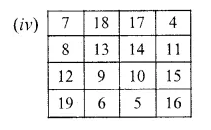
In each row/column, the sum = 46
Question 8.
Solution:
(i) The sum of two odd numbers is an odd number (F)
As sum of two odd numbers is alway an even number
(ii) The sum of two even number is an even number (T)
(iii) The sum of an even number and an odd number is an odd number (T)
Question 1.
Solution:
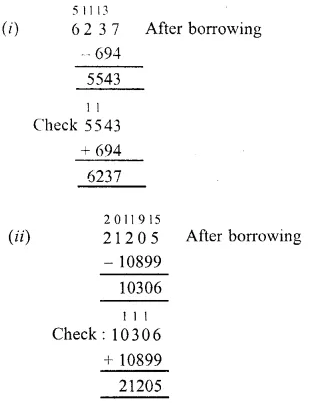
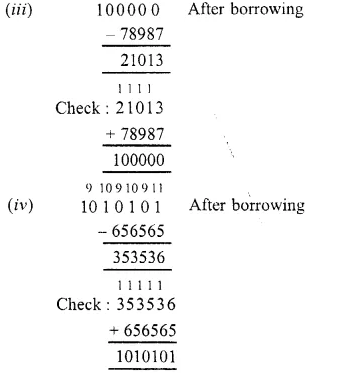
Question 2.
Solution:
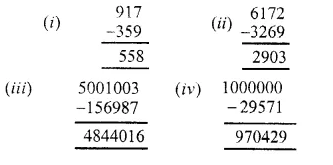
Question 3.
Solution:
(i) 463 – 9
= 464 – 1 – 9
= 464 – 10
= 454
(ii) 5632 – 99
= 5632 – 100 + 1
= 5633 – 100
= 5533
(iii) 8640 – 999
= 8640 – 1000 + 1
= 8641 – 1000
= 7641
(iv) 13006 – 9999
= 13006 – 10000 + 1
= 13007 – 10000
= 12007
Question 4.
Solution:
Smallest number of 7-digits = 1000000
Largest number of 4-digits = 9999
Required difference = (1000000 – 9999)
= 990001
Question 5.
Solution:
Deposit in the beginning = Rs. 136000
Next day withdrew = Rs. 73129
Amount left in the bank account = Rs. 136000 – 73129
= Rs. 62871
Question 6.
Solution:
Amount withdrawn from the bank = Rs. 1,00,000
Cost of TV set = Rs. 38750
Cost of refrigerator = Rs. 23890
Cost of jewellery = Rs. 35560
Total amount spent on her purchase = Rs. (38750 + 23890 + 35560)
= Rs. 98200
Amount left with her – Rs. 1,00,000 – Rs. 98200
= Rs. 1800
Question 7.
Solution:
Population of a town = 110500
Increase in 1 year = 3608
Persons left or died = 8973
The population at the end of year = 110500 + 3608 – 8973
= 114108 – 8973
= 105135
Question 8.
Solution:
(i) We have n + 4 = 9
n = 9 – 4 = 5
n = 5
(ii) n + 35 = 101
Subtracting 35 from both sides
n + 35 – 35 = 101 – 35
=> n = 66
n = 66
(iii) n – 18 = 39
Adding 18 to both sides
n – 18 + 18 = 39 + 18
=> n = 57
n = 57
(iv) n – 20568 = 21403 Adding 20568 to both sides
n – 20568 + 20568 = 21403 + 20568
n = 41971
Ex 3D Solutions
Question 1.
Solution:
(i) 246 x 1 = 246
(By multiplicative property of 1)
(ii) 1369 x 0 = 0
(By multiplicative property of 0)
(iii) 593 x 188 = 188 x 593
(By commutative law of multiplication)
(iv) 286 x 753 = 753 x 286
(By commutative law of multiplication)
(v) 38 x (91 x 37) = 91 x (38 x 37)
(By associative law of multiplication)
(vi) 13 x 100 x 1000 = 1300000
(vii) 59 x 66 + 59 x 34 = 59 x (66 + 34)
(By distributive law of multiplication)
(vii) 68 x 95 = 68 x 100 – 68 x 5
Question 2.
Solution:
(i) Commutative law of multiplication
(ii) Closure property
(iii) Associative law of multiplication
(iv) Multiplicative property of 1
(v) Multiplicative property of 0
(vi) Distributive law of multiplication over addition in whole numbers
(vii) Distributive law of multiplication over subtraction in whole numbers
Question 3.
Solution:
Using the law of distribution over addition and subtraction
(i) 647 x 13 + 647 x 7
= 647 x (13 + 7)
= 647 x 20
= 12940
(ii) 8759 x 94 + 8759 x 6
= 8759 x (94 + 6)
= 8759 x 100
= 875900
(iii) 7459 x 999 + 7459
= 7459 x 999 + 7459 x 1
= 7459 x (999 + 1)
= 7459 x 1000
= 7459000
(iv) 9870 x 561 – 9870 x 461
= 9870 x (561 – 461)
= 9870 x 100
= 987000
(v) 569 x 17 + 569 x 13 + 569 x 70
= 569 x (17 + 13 + 70)
= 569 x 100
= 56900
(vi) 16825 x 16825 – 16825 x 6825
= 16825 x (16825 – 6825)
= 16825 x 10000
= 168250000
Question 4.
Solution:
(i) 2 x 1658 x 50 = 1658 x (2 x 50) (Associative law of multiplication)
= 1658 x 100
= 165800
(ii) 4 x 927 x 25 = 927 x (4 x 25) (Associative law of multiplication)
= 927 x 100
= 92700
(iii) 625 x 20 x 8 x 50
(By associative law of multiplication)
(625 x 8) x (20 x 50)
= 5000 x 1000
= 5000000
(iv) 574 x (625 x 16)
= 574 x 10000
= 5740000
(v) 250 x 60 x 50 x 8
= (250 x 8) x (60 x 50)
(By associative law)
= 2000 x 3000
= 6000000
(vi) 8 x 125 x 40 x 25
= (8 x 125) x (40 x 25)
= 1000 x 1000
= 1000000
Question 5.
Solution:
Using distributive law of multiplication over addition or subtraction,
(i) 740 x 105
= 740 x (100 + 5)
= 740 x 100 + 740 x 5
= 74000 + 3700
= 77700
(ii) 245 x 1008
= 245 x (1000 + 8)
= 245 x 1000 + 245 x 8
= 245000 + 1960
= 246960
(iii) 947 x 96
= 947 x (100 – 4)
= 947 x 100 – 947 x 4
= 94700 – 3788
= 90912
(iv) 996 x 367
= 367 x (1000 – 4)
= 367 x 1000 – 367 x 4
= 367000 – 1468
= 365532
(v) 472 x 1097
= 472 x (1100 – 3)
= 472 x 1100 – 472 x 3
= 519200 – 1416
= 517784
(vi) 580 x 64
= 580 x (60 + 4)
= 580 x 60 + 580 x 4
= 34800 + 2320
= 37120
(vii) 439 x 997
= 437 x (1000 – 3)
= 439 x 1000 – 439 x 3
= 439000 – 1317
= 437683
(viii) 1553 x 198
= 1553 x (200 – 2)
= 1553 x 200 – 1553 x 2
= 310600 – 3106
= 307494
Question 6.
Solution:
(i) 3576 x 9 = 3576 x (10 – 1)
= 3576 x 10 – 3576 x 1
= 35760 – 3576
= 32184
(ii) 847 x 99 = 84 x (100 – 1)
= 847 x 100 – 847 x 1
= 84700 – 847
= 83853
(iii) 2437 x 999 = 2437 x (1000 – 1)
= 2437 x 1000 – 2437 x 1
= 2437000 – 2437
= 2434563
Question 7.
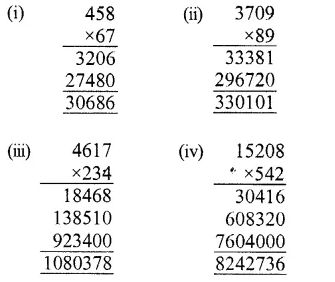
Solution:
Question 8.
Solution:
Largest 3-digit number = 999
Largest 5-digit number = 99999
Required product = 99999 x 999
= 99999 x (1000 – 1)
= 99999 x 1000-99999 x 1
= 99999000 – 99999
= 9,98,99,001
Question 9.
Solution:
Speed of car = 75 km per hour
In 1 hour, distance covered by a car = 75 km
.’. In 98 hours, distance will be covered = 75 x 98
= 75 x (100 – 2)
= 75 x 100 – 75 x 2
= 7500 – 150
= 7350 km
Question 10.
Solution:
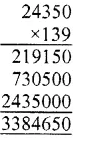
Cost of 1 set of VCR = Rs. 24350
Cost of 139 sets of VCR = Rs. 24350 x 139
= Rs. 3384650
Question 11.
Solution:
Cost of 1 house = Rs. 450000
Cost of 197 houses = Rs. 450000 x 197
= Rs. 450000 x (200 – 3)
= Rs. (450000 x 200 – 450000 x 3)
= Rs. (90000000 – 1350000)
= Rs. 88650000
Question 12.
Solution:
Cost of each chair = Rs. 1065
Cost of 50 chairs = Rs. 1065 x 50
= Rs. 53250
Cost of each blackboard = Rs. 1645
Cost of 30 blackboards = Rs. 1645 x 30
= Rs. 49350
Total cost of 50 chairs and 30 blackboards = Rs. 53250 + 49350
= Rs. 102600
Question 13.
Solution:
Number of students in 1 section = 45
Number of students in 6 sections = 45 x 6 = 270
Monthly charges of 1 student = Rs. 1650
Total monthly incomes from the class VI = Rs. 270 x 1650
= Rs. (300 – 30) x 1650
= Rs. (1650 x 300 – 1650 x 30)
= Rs. (495000 – 49500)
= Rs. 445500
Question 14.
Solution:
Since the product of two whole numbers is zero
.’. From multiplicative property of zero, we conclude that one of the whole numbers is zero.
Question 15.
Solution:
(i) Sum of two odd numbers is an even number.
(ii) Product of two odd numbers is an odd number.
(iii) a x a = a => a = 1 as 1 x 1 = 1
Ex 3E Solutions
Question 1.
Solution:
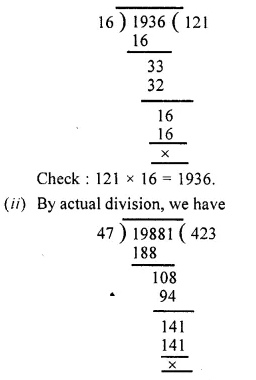
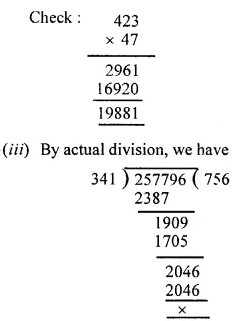
(i) By actual division, we have
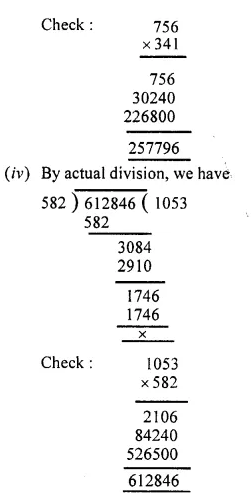
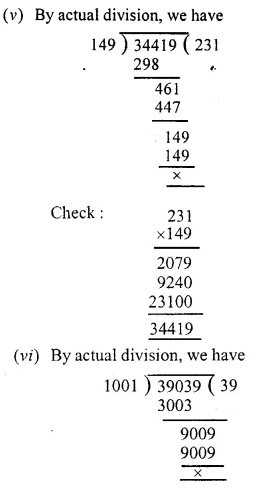
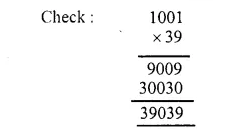
Question 2.
Solution:
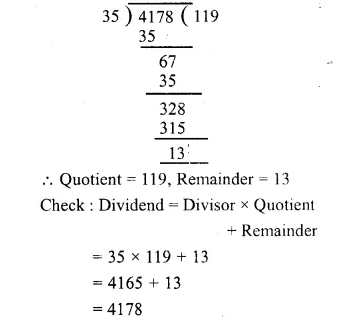
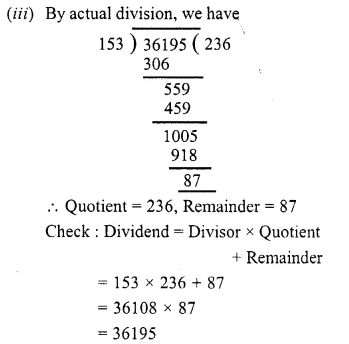
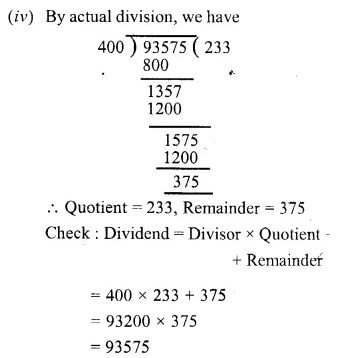
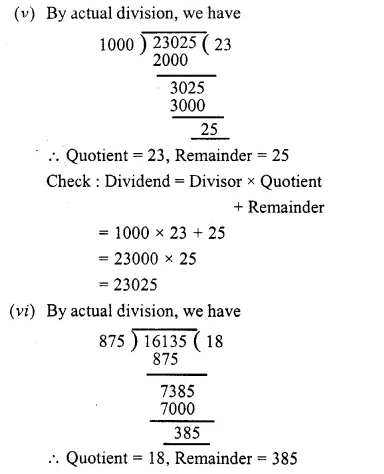
(i) By actual division, we have
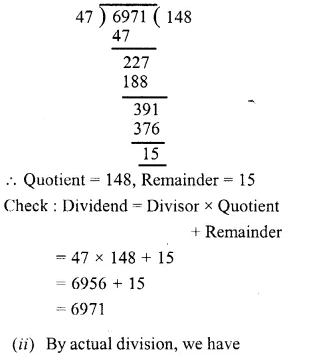
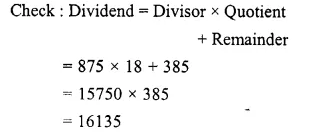
Question 3.
Solution:
(i) We know that any number (non-zero) divided by 1 gives the number itself
65007 ÷ 1 = 65007
(ii) We know that 0 divided by any natural number gives 0
0 ÷ 879 = 0
(iii) 981 + 5720 ÷ 10 = 981 + (5720 ÷ 10)
= 981 + 572
= 1553
(iv) 1507 – 625 ÷ 25 = 1507 – (625 ÷ 25)
= 1507 – 25
= 1482
(v) 32277 ÷ (648 – 39)
= 32277 ÷ 609
32277 ÷ (648 – 39) = 53
(vi) 1573 ÷ 1573 – 1573 ÷ 1573
= (1573 ÷ 1573) – (1573 ÷ 1573)
= 1 – 1
= 0
Question 4.
Solution:
We have n ÷ n = n
let n = 1, 1 ÷ 1 = 1
1 = 1
which is true
∴ Hence 1 is the required whole number.
Question 5.
Solution:
Product of two numbers = 504347
One number = 317
Other number = 504347 ÷ 317
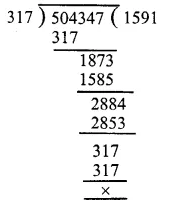
∴ Other number = 1591
Question 6.
Solution:
Here Dividend = 59761, Quotient = 189
∴ Remainder = 37
We know that Dividend = Divisor x Quotient + Remainder
59761 = Divisor x 189 + 37
59761 – 37 = Divisor x 189
59724 = Divisor x 189
Divisor x 189 = 59724
∴ Divisor = 59724 ÷ 189
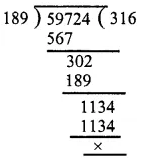
∴ Divisor = 59724 ÷ 189 = 316
Question 7.
Solution:
Here dividend = 55390,
Divisor = 299 and Remainder = 75
By division algorithm, we have
Dividend = Quotient x Divisor + Remainder
55390 = Quotient x 299 + 75
55390 – 75 = Quotient x 299
55315 = Quotient x 299
Quotient x 299 = 55315
Quotient = 55315 ÷ 299
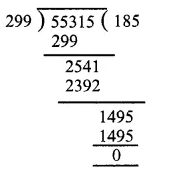
∴ Required quotient = 185
Question 8.
Solution:
On dividing 13601 by 87, we have
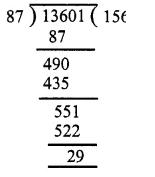
It is clear that if we subtract 29 from 13601, the resulting number will be exactly divisible by 87.
∴ The required least number = 29.
Question 9.
Solution:
Here dividend = 1056, Divisor = 23
By actual division, we have
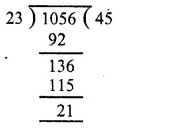
It is clear that if we add 2 to 21, it will become 23 which is divisible by 23.
∴ Required least number = 2.
Question 10.
Solution:
Greatest 4-digit number = 9999
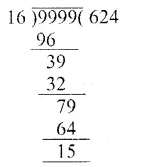
On, dividing by 16, we get remainder as 15
∴ The required largest 4-digit number = 9999 – 15
= 9984
Question 11.
Solution:
Largest number of 5-digits = 99999
On dividing 99999 by 653, we have
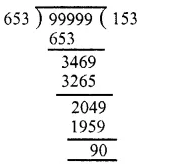
∴ Quotient = 153, Remainder = 90
Check : By division algorithm Dividend = Divisor x Quotient + Remainder
= 653 x 153 + 90
= 99909 + 90
= 99999
Question 12.
Solution:
The least 6-digit number = 100000
On dividing 100000 by 83, we have
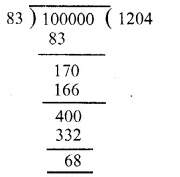
It is clear that if we add 15 to 68, it will become 83 which is divisible by 83.
∴ Required least 6-digit number = 100000 + 15
= 100015
Question 13.
Solution:
Cost of 1 dozen bananas = Rs. 29
Bananas can be purchase in Rs. 1392
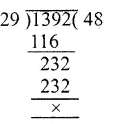
1392 ÷ 29
= 48 dozens
Question 14.
Solution:
Total number of trees = 19625
Total number of rows = 157
Number of trees in each row = 19625 ÷ 157
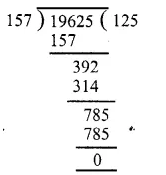
∴ Number of trees in each row = 125
Question 15.
Solution:
Total population of the town = 517530
Since there is one educated person out of 15
Total number of educated persons in the town = 517530 ÷ 15
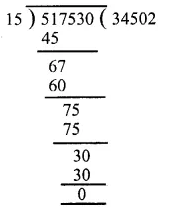
∴ Total number of educated persons in the town = 34502.
Question 16.
Solution:
Cost of 23 colour TV sets = Rs. 570055
Cost of 1 colour TV set
∴ Cost of 1 color TV set
= Rs. 570055 ÷ 23
= Rs. 24785
Ex 3F Solutions
Objective questions
Mark against the correct answer in each of the following :
Question 1.
Solution:
The smallest whole number is 0 (b)
Question 2.
Solution:
The least 4-digit number = 1000
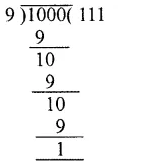
On dividing 1000 by 9, we get
Remainder = 1
Least 4-digit number which is
Divisible by 9 = 1000 – 1 + 9
= 1000 + 8
= 1008 (d)
Question 3.
Solution:
The largest 6-digit number = 999999
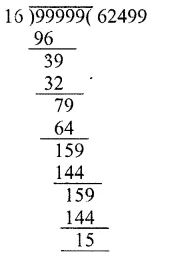
On dividing by 16, we get
Remainder =15
The greatest 6-digit number divisible by 16
= 999999 – 15
= 999984 (c)
Question 4.
Solution:
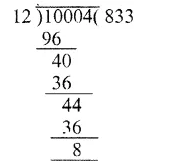
On dividing 10004 by 12, we get remainder = 8
8 is to be subtracted from 10004 (c)
Question 5.
Solution:
On dividing 10056 by 23 We get remainder =12
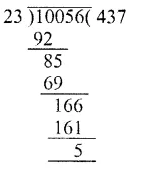
The least number to be added = 23 – 5
= 18 (b)
Question 6.
Solution:
On dividing 457 by 11
We get remainder = 6
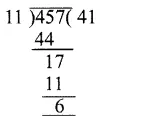
Which is greater than half of 11
The number nearest to 457 which is divisible 11 will be = 457 – 6 + 11
= 457 + 5
= 462 (d)
Question 7.
Solution:
Whole number between 1018 and 1203 are 1019 to 1202 are 1202 – 1018
= 184 (c)
Question 8.
Solution:
Divisor = 46
Quotient =11
Remainder =15
Number = Divisor x Quotient + Remainder
= 46 x 11 + 15
= 506 + 15
= 521 (b)
Question 9.
Solution:
Dividend = 199
Quotient =16
Remainder = 7
Divisor = 199−716 = 19216
= 12 (c)
Question 10.
Solution:
7589 – ? = 3434
Required number = 7589 – 3434
= 4155 (c)
Question 11.
Solution:
587 x 99 = 587 x (100 – 1)
= 587 x 100 – 587 x 1
= 58700 – 587
= 58113 (c)
Question 12.
Solution:
4 x 538 x 25 = 538 x 4 x 25
= 538 x 100
= 53800 (c)
Question 13.
Solution:
24679 x 92 + 24679 x 8
= 24679 x (92 + 8)
= 24679 x 100
= 2467900 (c)
Question 14.
Solution:
1625 x 1625 – 1625 x 625
= 1625 (1625 – 625)
= 1625 x 1000
= 1625000 (a)
Question 15.
Solution:
1568 x 185 – 1568 x 85
= 1568 (185 – 85)
= 1568 x 100
= 156800 (c)
Question 16.
Solution:
888 + 111 + 555 = 111 x ?
= 11 (8 + 7 + 5)
= 111 x 20 (c)
Question 17.
Solution:
The sum of two odd number is an even number (b)
Question 18.
Solution:
The product of two odd numbers is an odd number (a)
Question 19.
Solution:
If a is a whole number such that
a + a = a, then a = 0
as 0 + 0 = 0
None of these (d)
Question 20.
Solution:
The predecessor of 10000 is 10000 – 1
= 9999 (b)
Question 21.
Solution:
The successor of 1001 is 1001 + 1
= 1002 (b)
Question 22.
Solution:
The smallest even whole number is 2 (b)
RS Aggarwal Solutions for Class 6 Maths Chapter 3: Download PDF
RS Aggarwal Solutions for Class 6 Maths Chapter 3–Whole Numbers
Download PDF: RS Aggarwal Solutions for Class 6 Maths Chapter 3–Whole Numbers PDF
Chapterwise RS Aggarwal Solutions for Class 6 Maths :
- Chapter 1–Number System
- Chapter 2–Factors and Multiples
- Chapter 3–Whole Numbers
- Chapter 4–Integers
- Chapter 5–Fractions
- Chapter 6–Simplification
- Chapter 7–Decimals
- Chapter 8–Algebraic Expressions
- Chapter 9–Linear Equations in One Variable
- Chapter 10–Ratio, Proportion and Unitary Method
- Chapter 11–Line Segment, Ray and Line
- Chapter 12–Parallel Lines
- Chapter 13–Angles and Their Measurement
- Chapter 14–Constructions (Using Ruler and a Pairs of Compasses)
- Chapter 15–Polygons
- Chapter 16–Triangles
- Chapter 17–Quadrilaterals
- Chapter 18–Circles
- Chapter 19–Three-Dimensional Shapes
- Chapter 20–Two-Dimensional Reflection Symmetry (Linear Symmetry)
- Chapter 21–Concept of Perimeter and Area
- Chapter 22–Data Handling
- Chapter 23–Pictograph
- Chapter 24–Bar Graph
About RS Aggarwal Class 6 Book
Investing in an R.S. Aggarwal book will never be of waste since you can use the book to prepare for various competitive exams as well. RS Aggarwal is one of the most prominent books with an endless number of problems. R.S. Aggarwal's book very neatly explains every derivation, formula, and question in a very consolidated manner. It has tonnes of examples, practice questions, and solutions even for the NCERT questions.
He was born on January 2, 1946 in a village of Delhi. He graduated from Kirori Mal College, University of Delhi. After completing his M.Sc. in Mathematics in 1969, he joined N.A.S. College, Meerut, as a lecturer. In 1976, he was awarded a fellowship for 3 years and joined the University of Delhi for his Ph.D. Thereafter, he was promoted as a reader in N.A.S. College, Meerut. In 1999, he joined M.M.H. College, Ghaziabad, as a reader and took voluntary retirement in 2003. He has authored more than 75 titles ranging from Nursery to M. Sc. He has also written books for competitive examinations right from the clerical grade to the I.A.S. level.
FAQs
Why must I refer to the RS Aggarwal textbook?
RS Aggarwal is one of the most important reference books for high school grades and is recommended to every high school student. The book covers every single topic in detail. It goes in-depth and covers every single aspect of all the mathematics topics and covers both theory and problem-solving. The book is true of great help for every high school student. Solving a majority of the questions from the book can help a lot in understanding topics in detail and in a manner that is very simple to understand. Hence, as a high school student, you must definitely dwell your hands on RS Aggarwal!
Why should you refer to RS Aggarwal textbook solutions on Indcareer?
RS Aggarwal is a book that contains a few of the hardest questions of high school mathematics. Solving them and teaching students how to solve questions of such high difficulty is not the job of any neophyte. For solving such difficult questions and more importantly, teaching the problem-solving methodology to students, an expert teacher is mandatory!
Does IndCareer cover RS Aggarwal Textbook solutions for Class 6-12?
RS Aggarwal is available for grades 6 to 12 and hence our expert teachers have formulated detailed solutions for all the questions of each edition of the textbook. On our website, you'll be able to find solutions to the RS Aggarwal textbook right from Class 6 to Class 12. You can head to the website and download these solutions for free. All the solutions are available in PDF format and are free to download!