

Class 6: Maths Chapter 2 solutions. Complete Class 6 Maths Chapter 2 Notes.
Contents
RS Aggarwal Solutions for Class 6 Maths Chapter 2–Factors and Multiples
RS Aggarwal 6th Maths Chapter 2, Class 6 Maths Chapter 2 solutions
Ex 2A Solutions
Question 1.
Solution:
(i) A factor of a number is an exact divisor of that number.
Examples : 1. 2 is a factor of 8
2. 5 is a factor of 15
3. 9 is a factor of 27
4. 4 is a factor of 20
5. 3 is a factor of 12.
(ii) Multiple. A number is said to be a multiple of any of its factors.
Examples : 1. 15 is a multiple of 3
2. 8 is a multiple of 4
3. 10 is a multiple of 2
4. 25 is a multiple of 5
5.18 is a multiple of 9.
Question 2.
Solution:
(i) We know that
20 = 1 x 20, 20 = 2 x 10, 20 = 4 x 5
which shows that the numbers 1, 2, 4, 5, 10, 20 exactly divide 20.
1, 2, 4, 5, 10 and 20 are all factors of 20
(ii) We know that
36 = 1 x 36, 36 = 2 x 18, 36 = 3 x 12, 36 = 4 x 9, 36 = 6 x 6
This shows that each of the numbers 1, 2, 3, 4, 6, 9, 12, 18, 36 exactly divides 36.
1, 2, 3, 4, 6, 9, 12, 18, 36 are the factors of 36.
(iii) We know that
60 = 1 x 60, 60 = 2 x 30, 60 = 3 x 20, 60 = 4 x 15, 60 = 5 x 12, 60 = 6 x 10
This shows that each of the numbers 1, 2, 3, 4, 5, 6, 10, 12, 15, 20, 30, 60 exactly divides 60.
1, 2, 3, 4, 5, 6, 10, 12, 15, 20, 30, 60 are all the factors of 60.
(iv) We know that
75 = 1 x 73, 75 = 3 x 25, 75 = 5 x 15
This shows that each of the numbers 1, 3, 5, 15, 25, 75 exactly divides 75.
1, 3, 5, 15, 25, 75 are all the factors of 75.
Question 3.
Solution:
(i) First five multiples of 17 are :
17 x 1 = 17
17 x 2 = 34
17 x 3 = 51
17 x 4 = 68
17 x 5 = 85
(ii) First five multiples of 23 are :
23 x 1 = 23
23 x 2 = 46
23 x 3 = 69
23 x 4 = 92
23 x 5 = 115
(iii) First five multiples of 65 are :
65 x 1 = 65
65 x 2 = 130
65 x 3 = 195
65 x 4 = 260
65 x 5 = 325
(iv) First five multiples of 70 are :
70 x 1 = 70
70 x 2 = 140
70 x 3 = 210
70 x 4 = 280
70 x 5 = 350
Question 4.
Solution:
(i) 32 is a multiple of 2, so it is an even number.
(ii) 37 is not a multiple of 2, so it is an odd number.
(iii) 50 is a multiple of 2, so it is an even number.
(iv) 58 is a multiple of 2, so it is an even number.
(v) 69 is not a multiple of 2, so it is an odd number.
(vi) 144 is a multiple of 2, so it is an even number.
(vii) 321 is not a multiple of 2, so it is an odd number.
(viii) 253 is not a multiple of 2, so it is an odd number.
Question 5.
Solution:
Prime Numbers. Each of the numbers which has exactly two factors, namely 1 and itself, is called a prime number.
Examples. The numbers 2, 3, 5, 7, 11, 13, 17, 19, 23, 29 are all prime numbers.
Question 6.
Solution:
(i) Prime numbers between 10 and 40 are: 11, 13, 17, 19, 23, 29, 31, 37.
(ii) Prime numbers between 80 and 100 are : 83, 89, 97.
(iii) Prime numbers between 40 and 80 are : 41, 43, 47, 53, 59, 61, 67, 71, 73, 79
(iv) Prime numbers between 30 and 40 are : 31, 37.
Question 7.
Solution:
(i) 2 is the smallest prime number.
(ii) 2 is the only even prime number.
(iii) 3 is the smallest odd prime number.
Question 8.
Solution:
(i) We know that
87 = 1 x 87, 87 = 3 x 29
This shows that 1, 3, 29, 87 are the factors of 87.
The number 87 is not a prime number as it has more than 2 factors.
(ii) We have 89 = 1 x 89
The number 89 is a prime number as it has only 2 factors.
(iii) We have 63 = 1 x 63, 63 = 3 x 21,
63 = 7 x 9
This shows that the number 63 has more than 2 factors namely 1, 3, 7, 9, 21,63. So, it is not a prime number.
(iv) We have 91 = 1 x 91, 91 = 7 x 13 This shows that the number 91 has more than 2 factors namely 1, 7, 13, 91.
So, it is not a prime number.
Question 9.
Solution:
From the Sieve of Eratosthenes, we see that the seven consecutive numbers are 90, 91, 92, 93, 94, 95 and 96
Question 10.
Solution:
(i) There is no counting number having no factor at all.
(ii) The number 1 has exactly one factor.
(iii) The numbers between 1 and 100 having exactly three factors are : 4, 9, 25, 49.
Question 11.
Solution:
Composite Numbers. Numbers having more than two factors are called composite numbers. A composite number can be an odd number. The smallest odd composite number is 9.
Question 12.
Solution:
Twin-primes. Two consecutive odd prime numbers are known as twin- primes.
The prime numbers between 50 and 100 are:
53, 59, 61, 67, 71, 73, 79, 83, 89, 97
From above pairs of twin-primes are (59, 61), (71, 73)
Question 13.
Solution:
Co-primes. Two numbers are said to
be co-prime if they do not have a common factor.
Examples. Five pairs of co-primes are:
(i) 2, 3
(ii) 3, 4
(iii) 4, 5
(iv) 8, 15
(v) 9, 16
Co-primes are not always prime.
Illustration. In the pair (3, 4) of co-primes, 3 is a prime number whereas 4 is a composite number.
Question 14.
Solution:
(i) 36 = 7 + 29
(ii) 42 = 5 + 37
(iii) 84= 17 + 67
(iv) 98 = 19 + 79
Question 15.
Solution:
(i) 31 = 5 + 7 + 19
(ii) 35 = 5 + 7 + 23
(iii) 49 = 3 + 5 + 41
(iv) 63 = 7+ 13 +43
Question 16.
Solution:
(i) 36 = 17 + 19
(ii) 84 = 41 + 43
(iii) 120 = 59 + 61
(iv) 144 = 71+73
Question 17.
Solution:
(i) to (iv). None of the given statements is true.
Ex 2B Solutions
Question 1.
Solution:
(i) The given number = 2650
Digit at unit’s place = 0
It is divisible by 2.
(ii) The given number = 69435
Digit at unit’s place = 5
It is not divisible by 2.
(iii) The given number = 59628
Digit at unit’s place = 8
It is divisible by 2.
(iv) The given number = 789403
Digit at unit’s place = 3
It is not divisible by 2.
(v) The given number = 357986
Digit at unit’s place = 6
It is divisible by 2.
(vi) The given number = 367314
Digit at unit’s place = 4
It is divisible by 2.
Question 2.
Solution:
(i) The given number = 733
Sum of its digits = 7 + 3 + 3 = 13,
which is not divisible by 3.
∴ 733 is not divisible by 3.
(ii) The given number = 10038
Sum of its digits = 1 + 0 + 0 + 3 + 8 = 12,
which is divisible by 3
∴ 10038 is divisible by 3.
(iii) The given number = 20701
Sum of its digits = 2 + 0 + 7 + 0 + 1 = 10,
which is not divisible by 3
∴ 20701 is not divisible by 3.
(iv) The given number = 524781
Sum of its digits = 5 + 2 + 4 + 7 + 8 + 1 = 27,
which is divisible by 3
∴ 524781 is divisible by 3.
(v) The given number = 79124
Sum of its digits = 7 + 9 + 1 + 2 + 4 = 23,
which is not divisible by 3
∴ 79124 is not divisible by 3.
(vi) The given number = 872645
Sum of its digits = 8 + 7 + 2 + 6 + 4 + 5 = 32,
which is not divisible by 3
∴ 872645 is not divisible by 3.
Question 3.
Solution:
(i) The given number = 618
The number formed by ten’s and unit’s digits is 18, which is not divisible by 4.
∴ 618 is not divisible by 4.
(ii) The given number = 2314
The number formed by ten’s and unit’s digits is 14, which is not divisible by 4.
∴ 2314 is not divisible by 4.
(iii) The given number = 63712
The number formed by ten’s and unit’s digits is 12, which is divisible by 4
∴ 63712 is divisible by 4.
(iv) The given number = 35056
The number formed by ten’s and unit’s digits is 56, which is divisible by 4.
∴ 35056 is divisible by 4.
(v) The given number = 946126
The number formed by ten’s and unit’s digits is 26, which is not divisible by 4.
∴ 946126 is not divisible by 4.
(vi) The given number = 810524
The number formed by ten’s and unit’s digits is 24, which is divisible by 4.
∴ 810524 is divisible by 4.
Question 4.
Solution:
We know that a number is divisible by 5 if its ones digit is 0 or 5
(i) 4965, (ii) 23590 (iv) 723405 and (vi) 438750 are divisible by 5
Question 5.
Solution:
(i) The given number = 2070
Its unit’s digit = 0
So, it is divisible by 2
Sum of its digits = 2 + 0 + 7 + 0 = 9,
which is divisible by 3
∴ The given number is divisible by 3.
So, 2070 is divisible by both 2 and 3.
Hence it is divisible by 6.
(ii) The given number = 46523
Its unit’s digit = 3
So, it is not divisible by 2
Hence 46523 is not divisible by 6.
(iii) The given number = 71232
Its unit’s digit = 2
So, it is divisible by 2
Sum of its digits = 7 + 1 + 2 + 3 + 2
= 15, which is divisible by 3
∴ 71232 is divisible by both 2 and 3
Hence it is divisible by 6.
(iv) The given number = 934706
Its unit’s digit = 6 So,
it is divisible by 2
Sum of its digits = 9 + 3 + 4 + 7 + 0 + 6 = 29,
which is not divisible by 3
Hence 934706 is not divisible by 6.
(v) The given number = 251780
Its unit’s digit = 0
So, it is divisible by 2
Sum of its digits = 2 + 5 + 1 + 7 + 8 + 0 = 23,
which is not divisible by 3
251780 is not divisible 6
(vi) 872536 is not divisible by 6 as sum of its digits is 8 + 7 + 2 + 5 + 3 + 6 = 31 which is not divisible by 3
Question 6.
Solution:
We know that a number is divisible by 7 if the difference between twice the ones digit and the number formed by the other digits is either 0 or a multiple of 7
(i) 826, 6 x 2 = 12 and 82
Difference between 82 and 12 = 70
Which is divisible by 7
∴ 826 is divisible by 7
(ii) In 117, 7 x 2 = 14, 11
Difference between 14 and 11 = 14 – 11 = 3
Which is not divisible by 7
∴ 117 is not divisible by 7
(iii) In 2345, 5 x 2 = 10 and 234
Difference between 234 – 10 = 224
which is divisible by 7
∴ 2345 is divisible by 7
(iv) In 6021, 1 x 2 = 2, and 602
Difference between 602 and 2 = 600
which is not divisible by 7
∴ 6021 is not divisible by 7
(v) In 14126, 6 x 2 = 12 and 1412
Difference between 1412 – 12 = 1400
which 8 is divisible by 7
∴ 14126 is divisible by 7
(vi) In 25368, 8 x 2 = 16 and 2536
Difference between 2536 and 16 = 2520
which is divisible by 7
∴ 25368 is divisible by 7
Question 7.
Solution:
(i) The given number = 9364
The number formed by hundred’s, ten’s and unit’s digits is 364, which is not divisible by 8.
∴ 9364 is not divisible by 8.
(ii) The given number = 2138
The number formed by hundred’s, ten’s and unit’s digits is 138, which is not divisible by 8.
∴ 2138 is not divisible by 8.
(iii) The given number = 36792
The number formed by hundred’s, ten’s and unit’s digits is 792, which is divisible by 8.
∴ 36792 is divisible by 8.
(iv) The given number = 901674
The number formed by hundred’s, ten’s and unit’s digits is 674, which is not divisible by 8.
∴ 901674 is not divisible by 8.
(v) The given number = 136976
The number formed by hundred’s, ten’s and unit’s digits is 976, which is divisible by 8.
∴ 136976 is divisible by 8.
(vi) The given number = 1790184
The number formed by hundred’s, ten’s and unit’s digits is 184, which is divisible by 8.
∴ 1790184 is divisible by 8.
Question 8.
Solution:
We know that a number is divisible by 9, if the sum of its digits is divisible by 9
(i) In 2358
Sum of digits : 2 + 3 + 5 + 8 = 18
which is divisible by 9
∴ 2358 is divisible by 9
(ii) In 3333
Sum of digits 3 + 3 + 3 + 3 = 12
which is not divisible by 9
∴ 3333 is not divisible by 9
(iii) In 98712
Sum of digits = 9 + 8 + 7 + 1 + 2 = 27
Which is divisible by 9
∴ 98712 is divisible by 9
(iv) In 257106
Sum of digits = 2 + 5 + 7 + 1 + 0 + 6 = 21
which is not divisible by 9
∴ 257106 is not divisible by 9
(v) In 647514
Sum of digits = 6 + 4 + 7 + 5 + 1 + 4 = 27
which is divisible by 9
∴ 647514 is divisible by 9
(v) In 326999
Sum of digits = 3 + 2 + 6 + 9 + 9 + 9 = 38
which is not divisible by 9
∴ 326999 is divisible by 9
Question 9.
Solution:
We know that a number is divisible by 10 if its ones digit is 0
∴(i) 5790 is divisible by 10
Question 10.
Solution:
(i) The given number = 4334
Sum of its digits in odd places = 4 + 3 =7
Sum of its digits in even places = 3 + 4 = 7
Difference of the two sums = 7 – 7 = 0
∴4334 is divisible by 11.
(ii) The given number = 83721
Sum of its digits in odd places = 1 + 7 + 8 = 16
Sum of its digits in even places = 2 + 3 = 5
Difference of the two sums = 16 – 5 = 11,
which is multiple of 11.
∴ 83721 is divisible by 11.
(iii) The given number = 66311
Sum of its digits in odd places = 1 + 3 + 6 = 10
Sum of its digits in even places = 1 + 6 = 7
Difference of the two sums = 10 – 7 = 3,
which is not a multiple of 11.
∴ 66311 is not divisible by 11.
(iv) The given number = 137269
Sum of its digits in odd places = 9 + 2 + 3 = 14
Sum of its digits in even places = 6 + 7 + 1 = 14
Difference of the two sums = 14 – 14 = 0
∴ 137269 is divisible by 11.
(v) The given number = 901351
Sum of its digits in odd places = 1 + 3 + 0 = 4
Sum of its digits in even places = 5 + 1 + 9 = 15
Difference of the two sums = 15 – 4 = 11,
which is a multiple of 11.
∴ 901351 is divisible by 11.
(vi) The given number = 8790322
Sum of its digits in odd places = 2 + 3 + 9 + 8 = 22
Sum of its digits in even places = 2 + 0 + 7 = 9
Difference of the two sums = 22 – 9 = 13,
which is not a multiple of 11.
∴ 8790322 is not divisible by 11.
Question 11.
Solution:
(i) The given number = 27*4
Sum of its digits = 2 + 7 + 4 = 13
The number next to 13 which is divisible by 3 is 15.
∴ Required smallest number = 15 – 13
= 2.
(ii) The given number = 53*46
Sum of the given digits = 5 + 3 + 4 + 6 = 18,
which is divisible by 3.
∴ Required smallest number = 0.
(iii) The given number = 8*711
Sum of the given digits = 8 + 7 + 1 + 1 = 17
The number next to 17,
which is divisible by 3 is 18.
∴ Required smallest number =18 – 17 = 1
(iv) The given number = 62*35
Sum of the given digits = 6 + 2 + 3 + 5 = 16
The number next to 16,
which is divisible by 3 is 18.
∴ Required smallest number =18 – 16 = 2
(v) The given number = 234*17
Sum of the given digits = 2 + 3+ 4 + 1 + 7 = 17
The number next to 17, which is divisible by 3 is 18.
Required smallest number = 18 – 17 = 1.
(vi) The given number = 6* 1054
Sum of the given digits = 6 + 1+ 0 + 5 + 4 = 16
The number next to 16,
which is divisible by 3 is 18.
Required smallest number = 18 – 16 = 2.
Question 12.
Solution:
(i) The given number = 65*5
Sum of its given digits = 6 + 5 + 5 = 16
The number next to 16, which is divisible by 9 is 18.
∴ Required smallest number =18 – 16 = 2
(ii) The given number = 2*135
Sum of its given digits = 2 + 1 + 3 + 5
The number next to 11, which is divisible by 9 is 18.
∴ Required smallest number = 18 – 11 =7.
(iii) The given number = 6702*
Sum of its given digits = 6 + 7 + 0 + 2 = 15
The number next to 15, which is divisible by 9 is 18.
∴ Required smallest number = 18 – 15 = 3
(iv) The given number = 91*67
Sum of its given digits = 9 + 1 + 6 + 7 =23
The number next to 23, which is divisible by 9 is 27.
∴ Required smallest number = 27 – 23 = 4.
(v) The given number = 6678*1
Sum of its given digits= 6 + 6 + 7 + 8 + 1 = 28
The number next to 28, which is divisible by 9 is 36.
∴ Required smallest number = 36 – 28 = 8.
(vi) The given number = 835*86
Sum of its given digits = 8 + 3 + 5 + 8 + 6 = 30
The number next to 30, which is divisible by 9 is 36.
∴ Required smallest number = 36 – 30 = 6.
Question 13.
Solution:
(i) The given number = 26*5
Sum of its digits is odd places = 5 + 6 = 11
Sum of its digits in even places = * + 2
Difference of the two sums = 11 – (* + 2)
The given number will be divisible by 11 if the difference of the two sums = 0.
∴ 11 – (* + 2) = 0
11 = * + 2
11 – 2 = *
9 = *
Required smallest number = 9.
(ii) The given number = 39*43
Sum of its digits in odd places
=3 + * + 3 = * + 6
Sum of its digits in even places = 4 + 9 = 13
Difference of the two sums = * + 6 – 13 = * – 7
The given number will be divisible by 11, if the difference of the two sums = 0.
∴ * – 7 = 0
* = 7
∴ Required smallest number = 7.
(iii) The given number = 86*72
Sum of its digits in odd places
= 2 + * + 8 = * + 10
Sum of its digits in even places = 7 + 6 = 13
Difference of the two sums = * + 10 – 13 = * – 3
The given number will be divisible by 11, if the difference of the two sums = 0.
∴ * – 3 = 0
* = 3
∴ Required smallest number = 3.
(iv) The given number = 467*91
Sum of its digits in odd places = 1 + * + 6 = * + 7
Sum of its digits in even places = 9 + 7 + 4 = 20
Difference of the two sums
= 20 – (* + 7)
= 20 – * – 7 = 13 – *
Clearly the difference of the two sums will be multiple of 11 if 13 – * = 11
∴ 13 – 11 = *
2 = *
* = 2 .
∴ Required smallest number = 2.
(v) The given number = 1723*4
Sum of its digits in odd places = 4 + 3 + 7 = 14
Sum of its digits in even places = * + 2 + 1 = * + 3
Difference cf the two sums = * + 3 – 14 = * – 11
The given number will be divisible by 11,if *- 11 is a multiple of 11,which is possible if * = 0.
Required smallest number = 0.
(vi) The given number = 9*8071
Sum of its digits in odd places = 1 + 0 + * = 1 + *
Sum of its digits in even places = 7 + 8 + 9 = 24
Difference of the two sums = 24 – 1 – * = 23 – *
∴ The given number will be divisible by 11, if 23 – * is a multiple of 11, which is possible if * = 1.
∴ Required smallest number = 1.
Question 14.
Solution:
(i) The given number = 10000001
Sum of its digits in odd places
= 1 + 0 + 0 + 0 = 1
Sum of its digits in even places = 0 + 0 + 0 + 1 = 1
Difference of the two sums = 1 – 1 = 0
∴ The number 10000001 is divisible by 11.
(ii) The given number = 19083625
Sum of its digits in odd places
= 5 + 6 + 8 + 9 = 28
Sum of its digits in even places = 2 + 3 +0 + 1 = 6
Difference of the two sums = 28 – 6 = 22,
which is divisible by 11.
∴ The number 19083625 is divisible by 11.
(iii) The given number = 2134563
Sum of its digits
= 2 + 1 + 3 + 4 + 5 + 6 + 3 = 24,
which is not divisible by 9.
∴ The number 2134563 is not divisible by 9.
(iv) The given number = 10001001
Sum of its digits
= 1 + 0 + 0 + 0 + 1 + 0 + 0 + 1 = 3,
which is divisible by 3.
∴ The number 10001001 is divisible by 3.
(v) The given number = 10203574
The number formed by its ten Is and unit’s digits is 74, which is not divisible by 4.
The number 10203574 is not divisible by 4.
(vi) The given number = 12030624
The number formed by its hundred’s, ten’s and unit’s digits = 624,
which is divisible by 8.
∴ The number 12030624 is divisible by
Question 15.
Solution:
103, 137, 179, 277, 331, 397 are prime numbers.
Question 16.
Solution:
(i) 154
(ii) 612
(iii) 5112, 3816 etc.
(iv) 3426, 5142 etc.
Question 17.
Solution:
(i) False
(ii) True
(iii) False
(iv) True
(v) False
(vi) True
(vii) True
(viii) True
Ex 2C Solutions
Give the prime factorization of each of the following numbers.
Question 1.
Solution:
We have

∴12 = 2 x 2 x 3 = 22 x 3.
Question 2.
Solution:
We have

∴18 = 2 x 3 x 3 = 2 x 32
Question 3.
Solution:
We have

∴ 48 = 2 x 2 x 2 x 2 x 3
= 24 x 3.
Question 4.
Solution:
We have
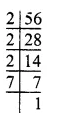
∴ 56 = 2 x 2 x 2 x 7
= 23 x 7.
Question 5.
Solution:
We have
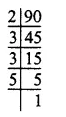
∴ 90 = 2 x 3 x 3 x 5
= 2 x 32 x 5.
Question 6.
Solution:
We have
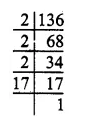
136 = 2 x 2 x 2 x 17
= 23 x 17.
Question 7.
Solution:
We have
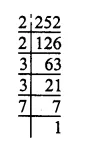
∴ 252 = 2 x 2 x 3 x 3 x 7
= 22 x 32 x 7.
Question 8.
Solution:
We have
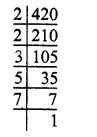
∴ 420 = 2 x 2 x 3 x 5 x 7
= 22 x 3 x 5 x 7.
Question 9.
Solution:
We have

∴ 637 = 7 x 7 x 13
= 72 x 13.
Question 10.
Solution:
We have
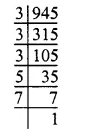
∴ 945 = 3 x 3 x 3 x 5 x 7
= 33 x 5 x 7.
Question 11.
Solution:
We have
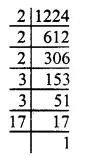
∴ 1224 = 2 x 2 x 2 x 3 x 3 x 17
= 23 x 32 x 17.
Question 12.
Solution:
We have
∴ 1323 = 3 x 3 x 3 x 7 x 7
= 33 x 72
Question 13.
Solution:
We have
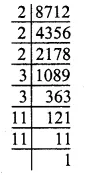
∴ 8712 = 2 x 2 x 2 x 3 x 3 x 11 x 11
= 23 x 32 x 112.
Question 14.
Solution:
We have
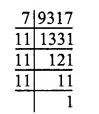
∴9317 = 7 x 11 x 11 x 11
= 7 x 113
Question 15.
Solution:
We have
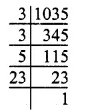
∴ 1035 = 3 x 3 x 5 x 23
= 32 x 5 x 23
Question 16.
Solution:
We have
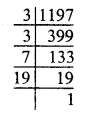
∴ 1197 = 3 x 3 x 7 x 19
= 32 x 7 x 19
Question 17.
Solution:
We have
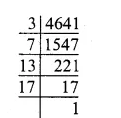
∴ 4641 = 3 x 7 x 13 x 17.
Question 18.
Solution:
We have
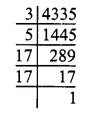
∴ 4335 = 3 x 5 x 17 x 17
= 3 x 5 x 172
Question 19.
Solution:
We have
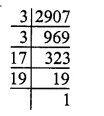
∴ 2907 = 3 x 3 x 17 x 19
= 32 x 17 x 19.
Question 20.
Solution:
We have
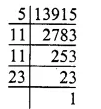
∴ 13915 = 5 x 11 x 11 x 23 = 5 x 112 x 23
Ex 2D Solutions
Find the H.C.F. of the numbers in each of the following, using the prime factorization method :
Question 1.
Solution:
We have
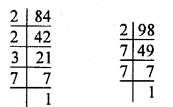
84 = 2 x 2 x 3 x 7
= 22 x 3 x 7
98 = 2 x 7 x 7 = 2 x 72
∴H.C.F. =2 x 7 = 14.
Question 2.
Solution:
We have
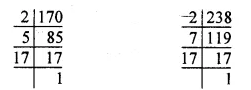
So, 170 = 2 x 5 x 17
238 = 2 x 7 x 17
∴ H.C.F. of 170 and 238 = 2 x 17 = 34
Question 3.
Solution:
We have
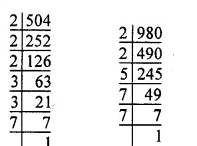
So, 504 = 2 x 2 x 2 x 3 x 3 x 7 = 23 x 32 x 7
980 = 2 x 2 x 5 x 7 x 7 = 22 x 5 x 72
∴ H.C.F. of 504 and 980 = 22 x 7
= 4 x 7 = 28.
Question 4.
Solution:
We have
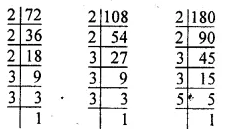
So, 72 = 2 x 2 x 2 x 3 x 3 = 23 x 32
108 = 2 x 2 x 3 x 3 x 3 = 22 x 33
180 = 2 x 2 x 3 x 3 x 5 = 22 x 32 x 5
∴ H.C.F. of 72, 108,
180 = 22 x 32
= 4 x 9 = 36
Question 5.
Solution:
We have
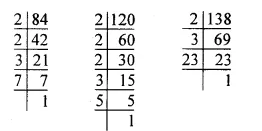
84 = 2 x 2 x 3 x 7 = 22 x 3 x 7
120 = 2 x 2 x 2 x 3 x 5 = 23 x 3 x 5
138 = 2 x 3 x 23
∴ H.C.F. of 84, 120 and 138 = 2 x 3 = 6
Question 6.
Solution:
We have
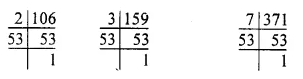
106 = 2 x 53
159 = 3 x 53
371 = 7 x 53
∴ H.C.F. of 106, 159, 371 = 53
Question 7.
Solution:
We have
272 = 2 x 2 x 2 x 2 x 17 = 24 x 17
425 = 5 x 5 x 17
= 52 x 17
∴ H.C.F. of 272 and 425 = 17.
Question 8.
Solution:
We have
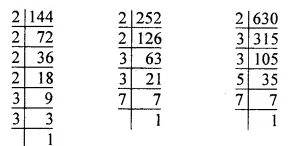
So, 144 = 2 x 2 x 2 x 2 x 3 x 3 = 24 x 32
252 = 2 x 2 x 3 x 3 x 7 = 22 x 32 x 7
630 = 2 x 3 x 3 x 5 x 7 = 2 x 32 x 5 x 7
∴ H.C.F. of 144, 252 and 630 = 2 x 32
= 2 x 9 = 18.
Question 9.
Solution:
We have
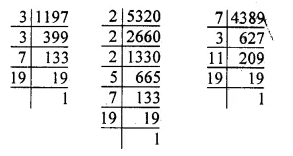
So, 1197 = 3 x 3 x 7 x 19 = 32 x 7 x 19
5320 = 2 x 2 x 2 x 5 x 7 x 19 = 23 x 5 x 7 x 19
4389 = 7 x 3 x 11 x 19
∴ H.C.F. of 1197, 5320,
4389 = 7 x 19 = 133.
Find the H.C.F. of the numbers in each of the following using division method:
Question 10.
Solution:
By division method, we have :
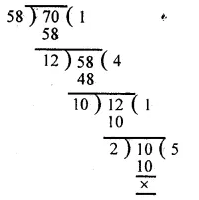
∴ H.C.F. of 58 and 70 = 2.
Question 11.
Solution:
By division method, we have
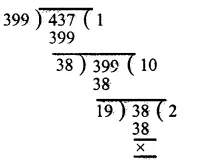
∴ H.C.F. of 399 and 437 = 19
Question 12.
Solution:
By division method, we have
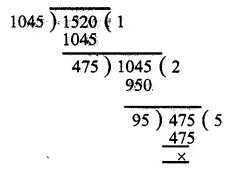
∴ H.C.F. of 1045 and 1520 = 95.
Question 13.
Solution:
By division method, we have
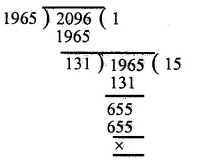
∴ H.C.F. of 1965 and 2096 = 131
Question 14.
Solution:
By division method, we have
∴ H.C.F. of 2241 and 2324 = 83.
Question 15.
Solution:
First, we find the H.C.F. of 658 and 940
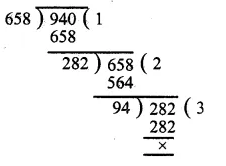
∴ H.C.F. of 658 and 940 is 94.
Now, we find the H.C.F. of 94 and 1128.
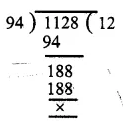
∴ H.C.F. of 94 and 1128 = 94
Hence, H.C.F. of 658, 940 and 1128 = 94.
Question 16.
Solution:
First, we find the H.C.F. of 754 and 1508
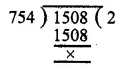
∴ H.C.F. of 754 and 1508 is 754
Now, we find the H.C.F. of 754 and 1972
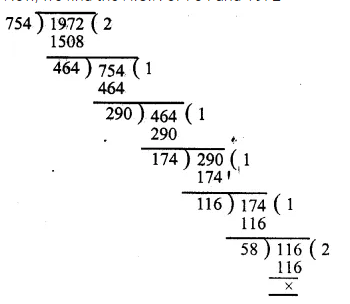
∴ H.C.F. of 754 and 1972 = 58
Hence, the H.C.F. of 754,1508 and 1972 = 58.
Question 17.
Solution:
First, we find the H.C.F. of 391 and 425
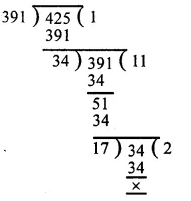
∴ H.C.F. of 391 and 425 is 17.
Now, we find the H.C.F. of 17 and 527
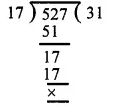
∴ H.C.F. of 17 and 527 is 17 Hence, H.C.F. of 391, 425 and 527 = 17.
Question 18.
Solution:
First, we find the H.C.F. of 1794 and 2346
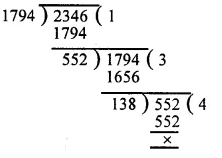
H.C.F. of 1794 and 2346 is 138.
Now, we find the H.C.F. of 138 and 4761
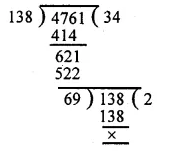
∴ H.C.F. of 138 and 4761 is 69.
Hence, the H.C.F. of 1794, 2346 and 4761 = 69.
Show that the following pairs are co-primes :
Question 19.
Solution:
First, we find the H.C.F. of 59, 97.
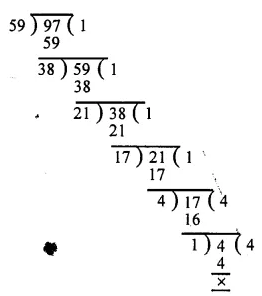
∴H.C.F. of 59 and 97 is 1.
Hence 59 and 97 are co-prime.
Question 20.
Solution:
First, we find the H.C.F. of 161 and 192.

∴ H.C.F. of 161 and 192 is 1.
Hence 161 and 192 are co-prime.
Question 21.
Solution:
First, we find the H.C.F. of 343 and 432
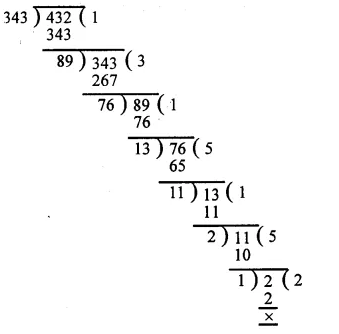
∴ H.C.F. of 343 and 432 is 1.
Hence 343 and 432 are co-prime.
Question 22.
Solution:
First, we find the H.C.F. of 512 and 945.
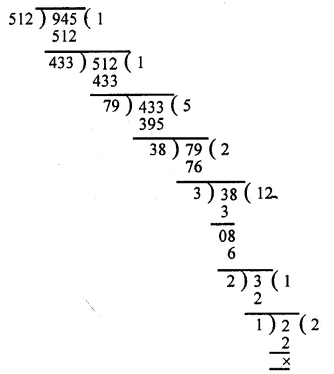
∴ H.C.F. of 512 and 945 is 1.
Hence 512 and 945 are co-prime.
Question 23.
Solution:
First, we find the H.C.F. of 385 and 621
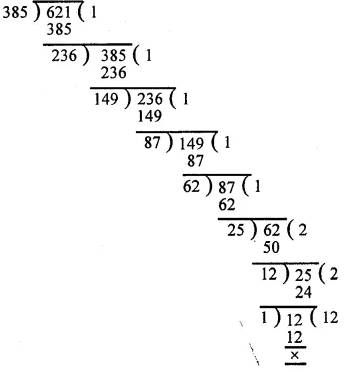
∴ H.C.F. of 385 and 621 is 1.
Hence the numbers 385 and 621 are co-prime
Question 24.
Solution:
First, we find the H.C.F. of 847 and 1014.
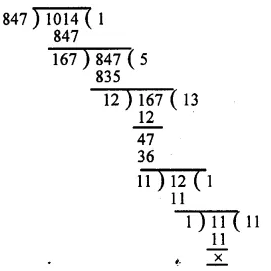
∴ H.C.F. of 847 and 1014 is 1.
Hence 847 and 1014 are co-prime.
Question 25.
Solution:
Clearly, we have to find the greatest number which divides (615 – 6) and (963 – 6) exactly.
So, the required number = H.C.F. of 615 – 6 = 609 and 963 – 6 = 957
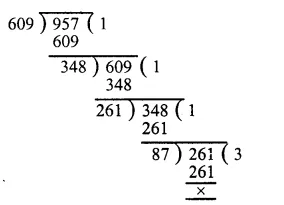
The required greatest number = 87.
Question 26.
Solution:
Clearly, we have to find the greatest number which divides 2011 – 9 = 2002 and 2623 – 5 = 2618.
So, the required greatest number = H.C.F. of 2002 and 2618
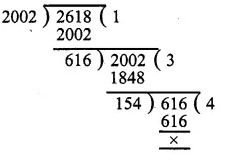
∴ Required greatest number = 154.
Question 27.
Solution:
Clearly, we have to find the greatest number which divides (445 4), (572 – 5) and (699 – 6). So, the required number = H.C.F. of 441, 567 and 693. First we find the H.C.F. of 441 and 567
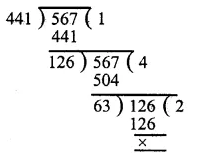
∴ H.C.F. of 441 and 567 is 63
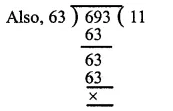
So H.C.F. of 63 and 693 is 63
Hence the required number = 63.
Question 28.
Solution:
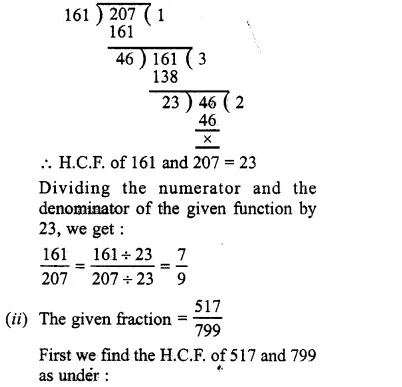
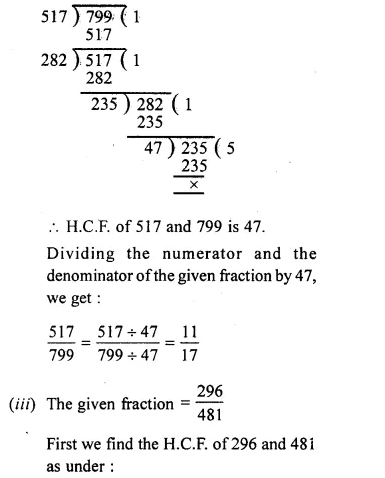
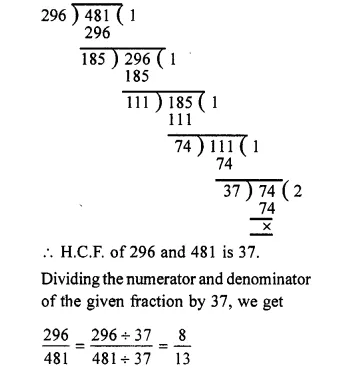
(i) The given fraction = 161207
First we find the H.C.F. of 161 and 207
Question 29.
Solution:
Lengths of three pieces of timber = 42 metres, 49 metres, 63 metres Greatest possible length of each plank = H.C.F. of 42 metres, 49 metres and 63 metres
First we find the H.C.F. of 42 and 49
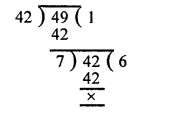
∴ H.C.F. of 42 and 49 = 7
Now we find the H.C.F. of 7 and 63

So, the H.C.F. of 7 and 63 is 7
∴ H.C.F. of 42 metres, 49 metres of 63 metres = 7 metres
Hence required possible length of each plank = 7 metres.
Question 30.
Solution:
Quantity of milk in three different containers = 403 L, 434 L and 465 L Clearly, the maximum capacity of the required container = H.C.F. of 403 L, 434 L, 465 L, we have
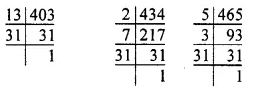
∴ 403 = 13 x 31
434 = 2 x 7 x 31
465 = 5 x 3 x 31
So the H.C.F. of 403 L, 434 L and 465 L = 31 L
Maximum capacity of the required container = 31 L.
Question 31.
Solution:
The given fruits = 527 apples, 646 pears and 748 oranges
Clearly, the greatest number of fruits in each heap = H.C.F. of 527, 646 and 748 we have
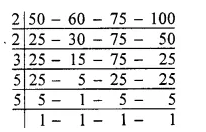
∴ 527 = 17 x 31
646 = 2 x 17 x 19
748 = 2 x 2 x 11 x 17
So, the H.C.F. of 527, 646 and 748 = 17
∴ Required number of fruits in each heap = 17
Total number of fruits = 527 + 646 + 748 = 1921
Number of heaps = Total number of fruits Number of fruits in one heap
= 192117
=113
Question 32.
Solution:
The given lengths are :
7 metres = 7 x 100 cm
= 700 cm 3 metres 85 cm
= (3 x 100 + 85) cm
= 385 cm
12 metres 95 cm = (12 x 100 + 95) cm
= 1295 cm
Clearly, the length of the required longest tape = H.C.F. of 700 cm, 385 cm and 1295 cm
We have
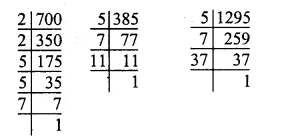
So, 700 = 2 x 2 x 5 x 5 x 7
= 22 x 52 x 7
385 = 5 x 7 x 11
1295 = 5 x 7 x 37
∴ H.C.F. of 700, 385 and 1295 = 5 x 7 = 35
∴ The required length of the longest tape
= 35 cm.
Question 33.
Solution:
Length of the courtyard = 18 m 72 cm = (18 x 100 + 72) cm = 1872 cm
Breadth of the courtyard = 13 m 20 cm = (13 x 100 + 20) cm = 1320 cm
Greatest side of each of the square tiles = H.C.F. of 1872 cm and 1320 cm
Now
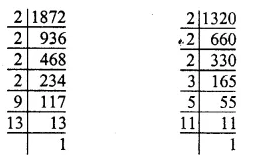
1872 = 2 x 2 x 2 x 2 x 9 x 13
= 24 x 32 x 13
1320 = 2 x 2 x 2 x 3 x 5 x 11
= 23 x 3 x 5 x 11
So, the H.C.F. of 1872 and 1320
= 23 x 3 = 8 x 3 = 24
Greatest side of the square tile = 24 cm
Now Area of the courtyard = Length x Breadth = 1872 x 1320 cm2
Area of one square tile = Side x Side
= 24 x 24 cm2
∴ Least possible number of such tiles
= AreaofthecourtyardAreaofthetile
= 1872×132024×24
= 78 x 55
= 4290
Question 34.
Solution:
Let the two prime numbers be 13 and 17, we find the H.C.F. of 13 and 17 as under
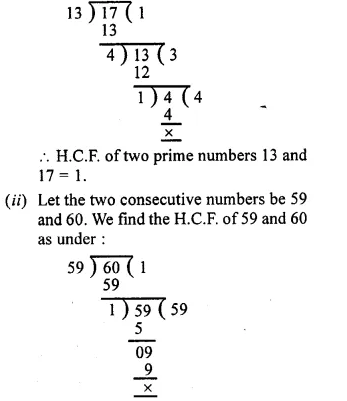
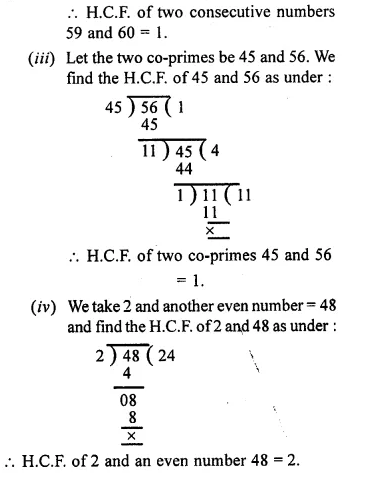
Ex 2E Solutions
Find the L.C.M. of the numbers given below:
Question 1.
Solution:
We have
42 = 2 x 3 x 7
63 = 3 x 3 x 7
= 32 x 7
∴ L.C.M. of 42 and 63 = 2 x 32 x 7
= 2 x 9 x 7
= 18 x 7
= 126
Question 2.
Solution:
We have
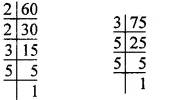
So, 60 = 2 x 2 x 3 x 5
= 22 x 3 x 5
75 = 3 x 5 x 5 = 3 x 52
∴L.C.M. of 60 and 75 = 22 x 3 x 52
= 4 x 3 x 25
= 4 x 75 = 300
Question 3.
Solution:
We have
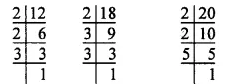
So, 12 = 2 x 2 x 3 = 22 x 3
18 = 2 x 3 x 3 = 2 x 32
20 = 2 x 2 x 5 = 22 x 5
∴L.C.M. of 12, 18 and 20 = 22 x 32 x 5
=4 x 9 x 5
= 20 x 9
= 180
Question 4.
Solution:
We have
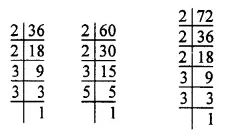
36 = 2 x 2 x 3 x 3 = 22 x 32
60 = 2 x 2 x 3 x 5 = 22 x 3 x 5
72 = 2 x 2 x 2 x 3 x 3 = 23 x 32
∴ L.C.M. of 36, 60 and 72 = 23 x 32 x 5
=8 x 9 x 5
= 40 x 9
= 360
Question 5.
Solution:
We have
36 = 2 x 2 x 3 x 3 = 22 x 32
40 = 2 x 2 x 2 x 5 = 23 x 5
126 = 2 x 3 x 3 x 7 = 2 x 32 x 7
∴ L.C.M. of 36, 40 and 126 .
= 23 x 32 x 5 x 7
= 8 x 9 x 5 x 7
= 72 x 35
= 2520h
Question 6.
Solution:
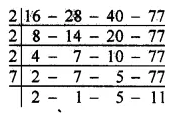
∴ L.C.M. of given numbers
= 2 x 2 x 2 x 7 x 2 x 5 x 11
= 8 x 14 x 55
= 112 x 55 = 6160
Question 7.
Solution:
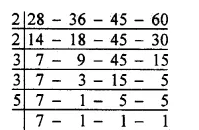
∴L.C.M. of given numbers = 2 x 2 x 3 x 3 x 5 x 7
= 36 x 35
= 1260
Question 8.
Solution:
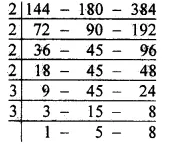
∴L.C.M. of given numbers
= 2 x 2 x 2 x 2 x 3 x 3 x 5 x 8
= 16 x 9 x 40
= 144 x 40
= 5760
Question 9.
Solution:
∴L.C.M. of given numbers = 2 x 2 x 2 x 2 x 2 x 3 x 3 x 2 x 3
= 32 x 54
= 1728
Find the H.C.F. and L.C.M. of :
Question 10.
Solution:
First we find the H.C.F. of the given numbers as under :
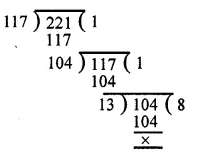
∴ H.C.F. of 117 and 221 = 13
Now L.C.M. = productofnumberstheirH.C.F
= 117×22113
= 9 x 221 = 1989
∴ H.C.F. = 13 and L.C.M. = 1989
Question 11.
Solution:
First we find the H.C.F. of 234 and 572 as under :
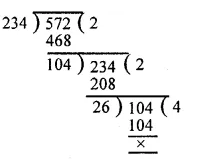
H.C.F. of 234 and 572 = 26
Now L.C.M. = product of numbers their H.C.F
= 234×57226
= 9 x 572
= 5148
Question 12.
Solution:
First we find the H.C.F. of 693 and 1078 as under :
H.C.F. of 693 and 1078 = 77 Product of numbers
Now L.C.M. = productofnumberstheirH.C.F
= 693×107877
= 9 x 1078
= 9702
H.C.F. = 77 and L.C.M. = 9702
Question 13.
Solution:
First we find the H.C.F. of 145 and 232 as under :
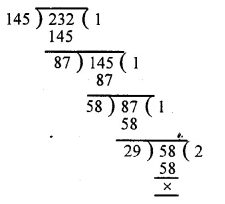
H.C.F. of 145 and 232 = 29
Now L.C.M. = product of numbers their H.C.F
= 145×23229
= 5 x 232 = 1160
H.C.F. = 29 and L.C.M. = 1160
Question 14.
Solution:
First we find the H.C.F. of 861 and 1353 as under :
H.C.F. of 861 and 1353 = 123
Now L.C.M. = productofnumberstheirH.C.F
= 861×1353123
= 7 x 1353 = 9471
H.C.F. = 123 and L.C.M. = 9471
Question 15.
Solution:
First we find the H.C.F. of 2923 and 3239 as under :
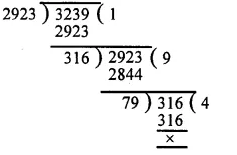
H.C.F. of 2923 and 3239 = 79
Now L.C.M. = productofnumberstheirH.C.F
= 2923×323979
= 37 x 3239= 119843
H.C.F. = 79 and L.C.M. = 119843
Question 16.
Solution:
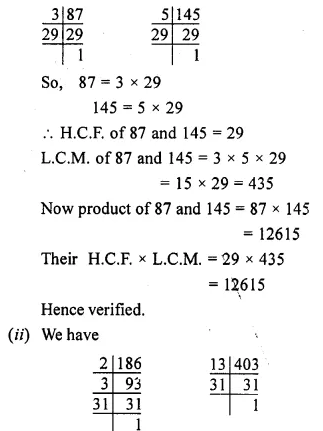
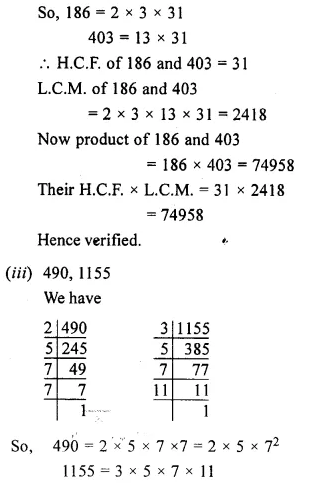
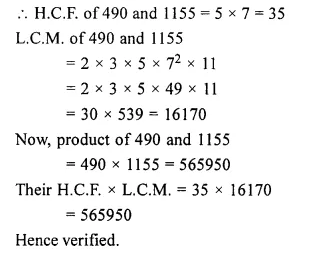
We have
Question 17.
Solution:
We know that
L.C.M = product of the number their H.C.F
= 216012
= 180
Question 18.
Solution:
We know that
L.C.M = product of the number their H.C.F
= 2560320
= 8
Question 19.
Solution:
We know that
One number x The other number
= H.C.F. x L.C.M.
.’. The other number
= H.C.F×L.C.MOnenumber
= 145×2175725
= 21755
= 435
Required number = 435
Question 20.
Solution:
We know that
One number x The other number
= H.C.F. x L.C.M.
The other number
= H.C.F×L.C.MOnenumber
= 131×8253917
= 82537
Required number = 1179
Question 21.
Solution:
Required least number = L.C.M. of 15, 20, 24, 32 and 36
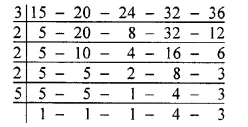
L.C.M. = 3 x 2 x 2 x 2 x 5 x 4 x 3
= 24 x 60
= 1440
Hence, required least number = 1440
Question 22.
Solution:
Clearly, required least number = (L.C.M. of the given numbers + 9)
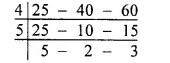
L.C.M. of the given numbers
= 4 x 5 x 5 x 2 x 3
= 600
Required least number
= 600 + 9
= 609
Question 23.
Solution:
First we find the L.C.M. of the given numbers as under :
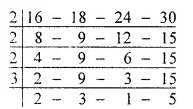
L.C.M of the given numbers = 2 x 2 x 2 x 3 x 2 x 3 x 5
= 24 x 30 = 720
Now least number of five digits = 10000 Dividing 10000 by 720, we get
Clearly if we add 80 to 640, it will become 720 which is exactly divisible by 720.
Required least number of five digits = 10000 + 80 = 10080
Question 24.
Solution:
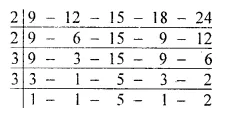
The greatest number of five digits exactly divisible by the given numbers = The greatest number of five digits exactly divisible by the L.C.M. of given numbers.
Now
L.C.M. of given numbers
= 2 x 2 x 3 x 3 x 5 x 2 = 360
Now greatest number of five digits = 99999
Dividing 99999 by 360, we get
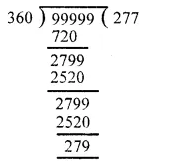
Required greatest number of five digits
= 99999 – 279
= 99720
Question 25.
Solution:
Three bells will again toll together after an interval of time which is exactly divisible by 9, 12, 15 minutes.
Required time = L.C.M. of 9, 12, 15 minutes
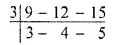
L.C.M. of 9, 12, 15 minutes = 3 x 3 x 4 x 5 minutes
= 9 x 20 minutes
= 180 minutes
Required time = 180 minutes
= 18060
= 3 hours
Question 26.
Solution:
Required distance = L.C.M. of 36 cm, 48 cm and 54 cm
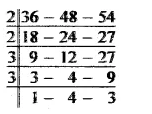
L.C.M. of 36 cm, 48 cm. 54 cm
= 2 x 2 x 3 x 3 x 4 x 3 cm
= 36 x 12 cm
= 432 cm
= 4 m 32 cm
Required distance = 4 m 32 cm
Question 27.
Solution:
Required time = L.C.M. of 48 seconds, 72 seconds and 108 seconds
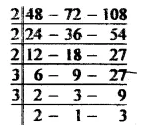
L.C.M. of 48 sec., 72 sec. and 108 sec.
= 2 x 2 x 2 x 3 x 3 x 2 x 3 sec.
= 24 x 18 sec.
= 432 sec.
Required time = 432 sec.
= 43260
= 7 m in 12 sec
Question 28.
Solution:
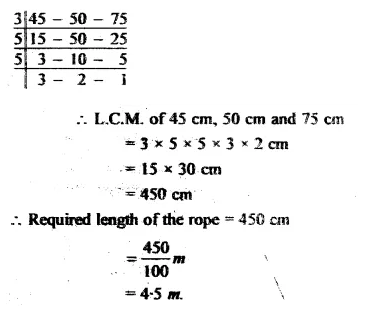
Lengths of three rods = 45 cm, 50 cm and 75 cm
Required least length of the rope = L.C.M. of 45 cm, 50 cm, 75 cm
We have
Question 29.
Solution:
The time after which both the devices will beep together = L.C.M. of 15 minutes and 20 minutes
Now,

L.C.M. of 15 minutes and 20 minutes
= 5 x 3 x 4
= 60 minutes
= 1 hour
Both the devices will beep together after 1 hour from 6 a.m.
Required time = 6 + 1
= 7 a.m.
Question 30.
Solution:
The circumferences of four wheels = 50 cm, 60 cm, 75 cm and 100 cm
Required least distance = L.C.M. of 50 cm, 60 cm, 75 cm and 100 cm Now,
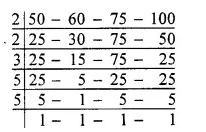
L.C.M. of 50 cm, 60 cm, 75 cm, 100 cm
= 2 x 2 x 3 x 5 x 5 cm
= 300 cm = 3 m
Required least distance = 3 m.
Ex 2F Solutions
Objective Questions
Tick the correct answer in each of the following :
Question 1.
Solution:
(c) Because sum of its digits is 8 + 3 + 4 + 7 + 9 + 5 + 6 + 0 = 42 which is divisible by 3.
Question 2.
Solution:
(a) Because sum of its digits is 8 + 5 + 7 + 6 + 9 + 0 + 1 = 36 which is divisible by 9.
Question 3.
Solution:
(d) Because the number formed by tens and ones digits is divisible by 4 i.e. 32 ÷ 4 = 8.
Question 4.
Solution:
(b) Because the number formed by hundred, tens and ones digits is divisible by 8 i.e. 176 ÷ 8 = 22.
Question 5.
Solution:
(a) Because its one digit is divisible by 2 and sum of its digits is 8 + 7 + 9 + 0 + 4 + 3 + 2 = 33,
which is divisible by 3. Hence it is divisible by 6.
Question 6.
Solution:
(c) Because the difference of the sums of its odd places digits and of its even places digits is (2 + 2 + 2 + 2) – (2 + 2 + 2 + 2) i.e. 8 – 8 = 0, which is zero and is divisible by 11.
Question 7.
Solution:
(d) Because 97 has no factors other than 1 and itself.
Question 8.
Solution:
(c) Because 179 has no factors other than 1 and itself.
Question 9.
Solution:
(c) Because 263 has no factors other than 1 and itself.
Question 10.
Solution:
(a), (b) Because the common factors of 9 and 10 are none but 1.
Question 11.
Solution:
(c) Because 32 has factors which are 2, 2, 2, 2, 2.
Question 12.
Solution:
(d) Because 18 is the highest common factor of 144 and 198.
Question 13.
Solution:
(a) Because 12 is the highest common factors of these numbers 144, 180 and 192.
Question 14.
Solution:
(b) Because 161 and 192 have no common factor other than 1, i.e., HCF of 161 and 192 is 1.
Question 15.
Solution:
(d) Because HCF of 289 and 391 is 289
and 289÷17391÷17 = 1723
Question 16.
Solution:
(d) Because dividing 134 and 167 by 33 remainder is 2 in each case.
Question 17.
Solution:
(c) Because 360 is the least multiple of 24, 36 and 40.
Question 18.
Solution:
(d) Because 540 is the least multiple of 12, 15, 20 and 27
Question 19.
Solution:
(c) Because 1263 – 3 = 1260 is divisible by 14, 28, 36 and 45.
Question 20.
Solution:
(c) Because HCF of two co-prime number is always 1.
Question 21.
Solution:
(c) Because HCF of a and b, two co-primes is 1.
LCM = a x b = ab.
Question 22.
Solution:
(c) Because LCM of two numbers = Product of these number ÷ their HCF i.e 2160 ÷ 12 = 180.
Question 23.
Solution:
(b) Because second number
= LCM×HCF1stnumber
i.e., 145×2175725
= 435
Question 24.
Solution:
(c) Because LCM of 15, 20, 24. 32 and 36 = 1440.
Question 25.
Solution:
(d) Because LCM of 9, 12, 15 is 180. 180
180 minutes = 18060
= 3 hours.
RS Aggarwal Solutions for Class 6 Maths Chapter 2: Download PDF
RS Aggarwal Solutions for Class 6 Maths Chapter 2–Factors and Multiples
Download PDF: RS Aggarwal Solutions for Class 6 Maths Chapter 2–Factors and Multiples PDF
Chapterwise RS Aggarwal Solutions for Class 6 Maths :
- Chapter 1–Number System
- Chapter 2–Factors and Multiples
- Chapter 3–Whole Numbers
- Chapter 4–Integers
- Chapter 5–Fractions
- Chapter 6–Simplification
- Chapter 7–Decimals
- Chapter 8–Algebraic Expressions
- Chapter 9–Linear Equations in One Variable
- Chapter 10–Ratio, Proportion and Unitary Method
- Chapter 11–Line Segment, Ray and Line
- Chapter 12–Parallel Lines
- Chapter 13–Angles and Their Measurement
- Chapter 14–Constructions (Using Ruler and a Pairs of Compasses)
- Chapter 15–Polygons
- Chapter 16–Triangles
- Chapter 17–Quadrilaterals
- Chapter 18–Circles
- Chapter 19–Three-Dimensional Shapes
- Chapter 20–Two-Dimensional Reflection Symmetry (Linear Symmetry)
- Chapter 21–Concept of Perimeter and Area
- Chapter 22–Data Handling
- Chapter 23–Pictograph
- Chapter 24–Bar Graph
About RS Aggarwal Class 6 Book
Investing in an R.S. Aggarwal book will never be of waste since you can use the book to prepare for various competitive exams as well. RS Aggarwal is one of the most prominent books with an endless number of problems. R.S. Aggarwal’s book very neatly explains every derivation, formula, and question in a very consolidated manner. It has tonnes of examples, practice questions, and solutions even for the NCERT questions.
He was born on January 2, 1946 in a village of Delhi. He graduated from Kirori Mal College, University of Delhi. After completing his M.Sc. in Mathematics in 1969, he joined N.A.S. College, Meerut, as a lecturer. In 1976, he was awarded a fellowship for 3 years and joined the University of Delhi for his Ph.D. Thereafter, he was promoted as a reader in N.A.S. College, Meerut. In 1999, he joined M.M.H. College, Ghaziabad, as a reader and took voluntary retirement in 2003. He has authored more than 75 titles ranging from Nursery to M. Sc. He has also written books for competitive examinations right from the clerical grade to the I.A.S. level.
FAQs
Why must I refer to the RS Aggarwal textbook?
RS Aggarwal is one of the most important reference books for high school grades and is recommended to every high school student. The book covers every single topic in detail. It goes in-depth and covers every single aspect of all the mathematics topics and covers both theory and problem-solving. The book is true of great help for every high school student. Solving a majority of the questions from the book can help a lot in understanding topics in detail and in a manner that is very simple to understand. Hence, as a high school student, you must definitely dwell your hands on RS Aggarwal!
Why should you refer to RS Aggarwal textbook solutions on Indcareer?
RS Aggarwal is a book that contains a few of the hardest questions of high school mathematics. Solving them and teaching students how to solve questions of such high difficulty is not the job of any neophyte. For solving such difficult questions and more importantly, teaching the problem-solving methodology to students, an expert teacher is mandatory!
Does IndCareer cover RS Aggarwal Textbook solutions for Class 6-12?
RS Aggarwal is available for grades 6 to 12 and hence our expert teachers have formulated detailed solutions for all the questions of each edition of the textbook. On our website, you’ll be able to find solutions to the RS Aggarwal textbook right from Class 6 to Class 12. You can head to the website and download these solutions for free. All the solutions are available in PDF format and are free to download!