

Class 6: Maths Chapter 8 solutions. Complete Class 6 Maths Chapter 8 Notes.
Contents
RS Aggarwal Solutions for Class 6 Maths Chapter 8–Algebraic Expressions
RS Aggarwal 6th Maths Chapter 8, Class 6 Maths Chapter 8 solutions
Ex 8A Solutions
Question 1.
Solution:
(i) x + 12
(ii) y – 7
(iii) a – b
(iv) (x + y) + xy
(v) 13x (a + b)
(vi) 7y + 5x
(vii) x+y5
(viii) 4 – x
(ix) xy−2
(x) x2
(xi) 2x + y
(xii) y2 + 3x
(xiii) x – 2y
(xiv) y3 – x3
(xv) x8×y
Question 2.
Solution:
Marks scored in English = 80
Marks scored in Hindi = x
∴ Total score in the two subjects = 80 + x
Question 3.
Solution:
We can write :
(i) b × b × b ×….15 times = 615
(ii) y × y × y ×…..20 times = y20
(iii) 14 × a × a × a × a × b × b × b= 14a4 b3
(iv) 6 × x × x × y × y = 6x2y2
(v) 3 × z × z × z × y × y × x= 3z3y2x
Question 4.
Solution:
We can write :
(i) x2y4 = x × x × y × y × y × y
(ii) 6y5 = 6 × y × y × y × y × y
(iii) 9xy2z = 9 × x × y × y × z
(iv) 10a3b3c3 = 10 × a × a × a × b × b × b × c × c × c
Ex 8B Solutions
Question 1.
Solution:
(i) Substituting a = 2 and b = 3 in the , given expression, we get :
a + b = 2 + 3 = 5
(ii) Substituting a = 2 and b = 3 in the given expression, we get :
a2 + ab = (2)2 + 2 x 3
= 4 + 6 = 10
(iii) Substituting a = 2 and b = 3 in the given expression, we get :
ab – a2 = 2 x 3 – (2)2
= 6 – 4 = 2
(iv) Substituting a = 2 and b = 3 in the given expression, we get :
2a – 3b = 2 x 2 – 3 x 3
= 4 – 9 = – 5
(v) Substituting a = 2 and b = 3 in the given expression, we get :
5a2 – 2ab = 5 x (2)2 – 2 x 2 x 3
= 5 x 4 – 4 x 3
= 20 – 12 = 8
(vi) Substituting a = 2 and b = 3 in the given expression, we get :
a3 – b3 = (2)3 – (3)3 = 2 x 2 x 2 – 3 x 3 x 3
= 8 – 27 = – 19
Question 2.
Solution:
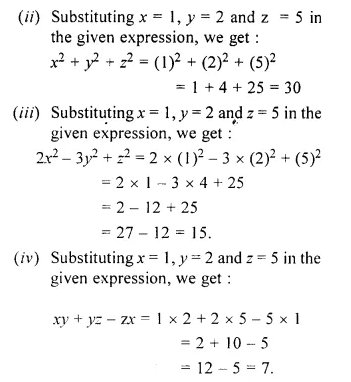
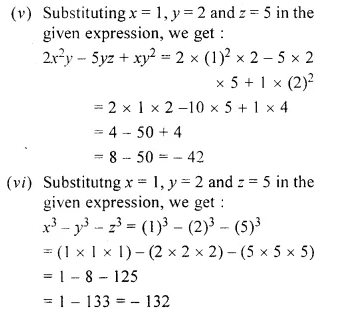
(i) Substituting x = 1, y = 2 and z = 5 in the given expression, we get :
3x – 2y + 4z = 3 x 1 – 2 x 2 + 4 x 5
= 3 – 4 + 20 = 23 – 4 = 19
Question 3.
Solution:
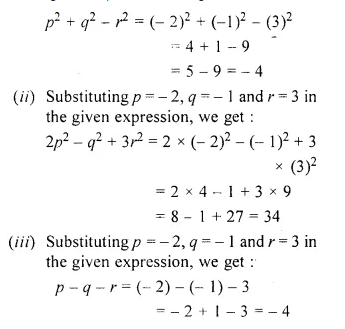
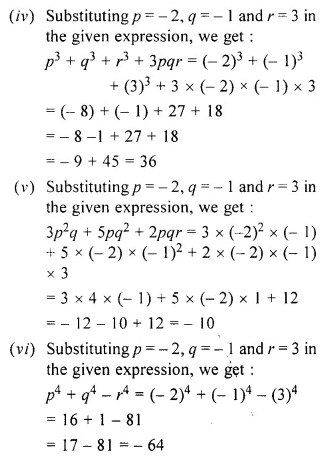
(i) Substituting p = – 2, q = – 1 and r = 3
in the given expression, we get :
Question 4.
Solution:
(i) The coefficient of x in 13x is 13
(ii) The coefficient of y in – 5y is – 5
(iii) The coefficient of a in 6ab is 6b
(iv) The coefficient of z in – 7xz is – 7x
(v) The coefficient of p in – 2pqr is – 2qr
(vi) The coefficient of y2 in 8xy2z is 8xz
(vii) The coefficient of x3 in x3 is 1
(viii) The coefficient of x2 in – x2 is -1
Question 5.
Solution:
(i) The numerical coefficient of ab is 1
(ii) The numerical coefficient of – 6bc is – 6
(iii) The numerical coefficient of 7xyz is 7
(iv) The numerical coefficient of – 2x3y2z is – 2.
Question 6.
Solution:
(i) The constant term is 8
(ii) The constant term is – 9
(iii) The constant term is 35
(iv) The constant term is –83
Question 7.
Solution:
(i) The given expression contains only one term, so it is monimial.
(ii) The given expression contains only two terms, so it is binomial.
(iii) The given expression contains only one term, so it is monomial.
(iv) The given expression contains three terms, so it is trinomial.
(v) The given expression contains three terms, so it is trinomial.
(vi) The given expression contains only one term, so it is monomial.
(vii) The given expression contains four terms, so it is none of monomial, binomial and trinomial.
(viii) The given expression contains only one term so it is monomial.
(ix) The given expression contains two terms, so it is binomial.
Question 8.
Solution:
(i) The terms of the given expression 4x5 – 6y4 + 7x2y – 9 are :
4x5, – 6y4, 7x2y, – 9
(ii) The terms of the given expression 9x3 – 5z4 + 7x3y – xyz are :
9x3, – 5z4, 7x3y, – xyz.
Question 9.
Solution:
(i) We have : a2, b2, – 2a2, c2, 4a
Here like terms are a2, – 2a2
(ii) We have : 3x, 4xy, – yz, 12 zy
Here like terms are – yz, 12 zy
(iii) We have : – 2xy2, x2y, 5y2x, x2z
Here like terms are – 2xy2, 5y2x
(iv) We have :
abc, ab2c, acb2, c2ab, b2ac, a2bc, cab2
Here like terms are ab2c, acb2, b2ac, cab2.
Ex 8C Solutions
Question 1.
Solution:
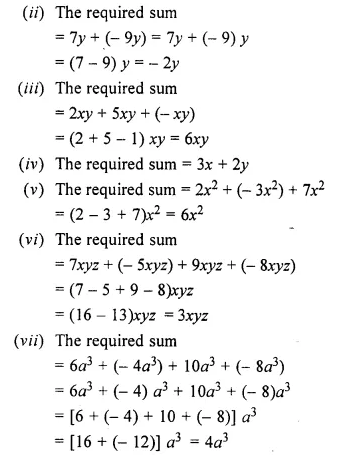
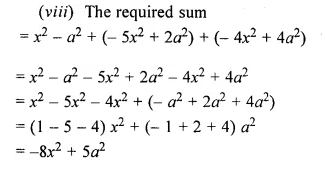
(i) The required sum
= 3x + 7x
= (3 + 7) x
= 10x
Question 2.
Solution:
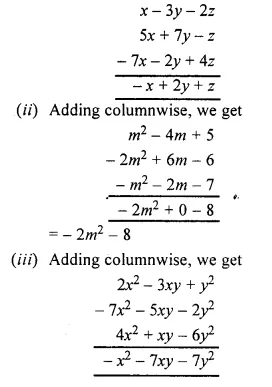
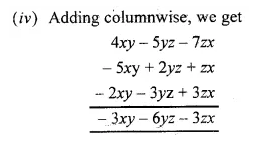
(i) Adding columnwise,
we get
Question 3.
Solution:
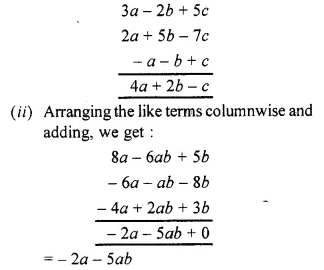
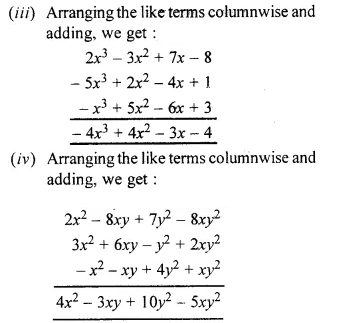
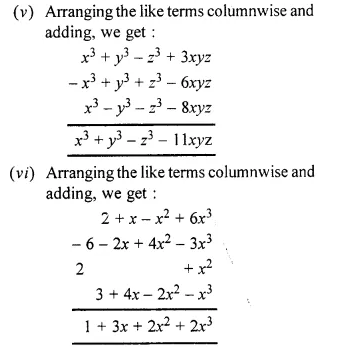
(i) Arranging the like terms column wise and adding, we get :
Question 4.
Solution:
(i) We have :
2x – 5x = (2 – 5)x = – 3x
(ii) We have :
6x – y – (- xy) = 6xy + xy = 7xy
(iii) We have : 5b – 3a
(iv) We have : 9y – ( – 7x) = 9y + 7x
(v) We have : – 7x2 – 10x2 = ( – 7 – 10)x2
= – 17x2
(vi) We have : b2 – a2 – (a2 – b2)
= b2 – a2 – a2 + b2
= b2 + b2 – a2 – a2
= (1 + 1) b2 + ( – 1 – 1) a2
= 2b2 – 2a2
Question 5.
Solution:
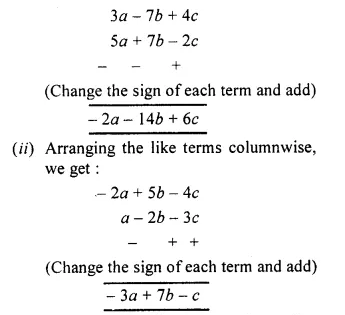
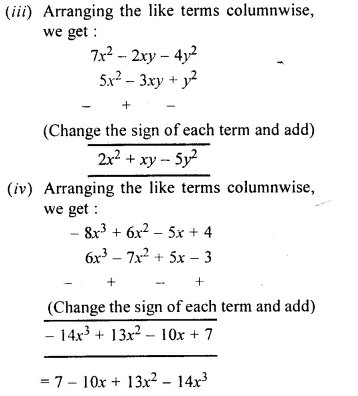
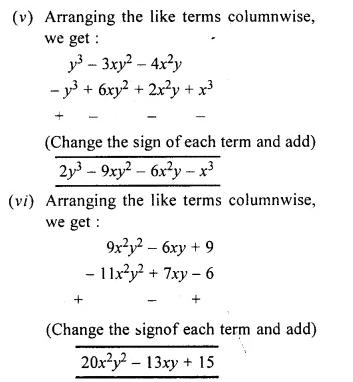
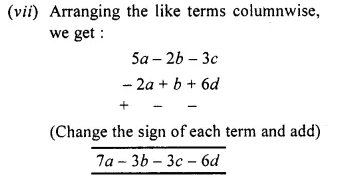
(i) Arranging the like terms column wise, we get :
Question 6.
Solution:
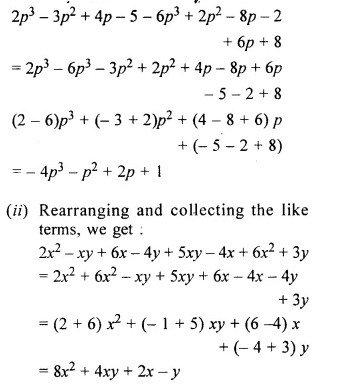
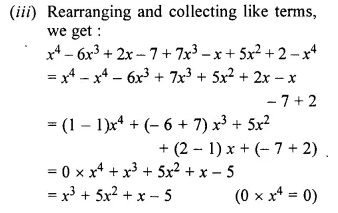
(i) Rearranging and collecting the like terms, we get :
Question 7.
Solution:
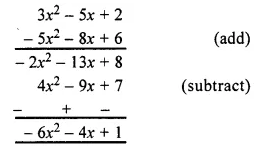
We have:
Question 8.
Solution:
We have :
A = 7x2 + 5xy – 9y2
B = – 4x2 + xy + 5y2
C = 4y2 – 3x2 – 6xy
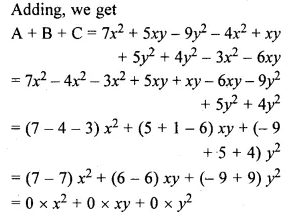
= 0+0+0 = 0
Hence the result
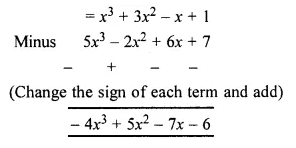
Question 9.
Solution:
Required expression
Question 10.
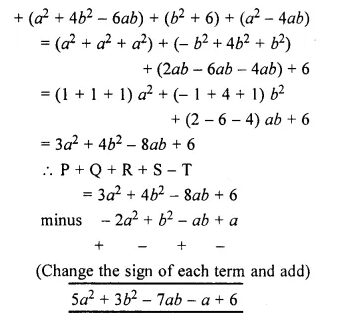
Solution:
Substituting the values of P, Q, R and S, we have :
P + Q + R + S = (a2 – b2 + 2ab)
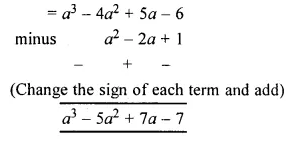
Question 11.
Solution:
Required expression
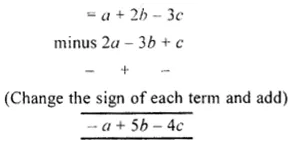
Question 12.
Solution:
Required expression
Question 13.
Solution:
Required expression
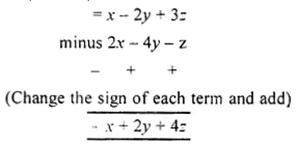
Question 14.
Solution:
Required expression
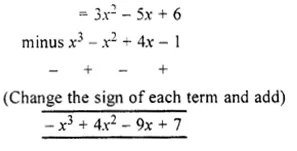
Question 15.
Solution:
Sum of 5x – 4y + 6z and – 8x + y – 2z
= 5x – 4y + 6z – 8x + y – 2z
= 5x – 8x – 4y + y + 6z – 2z
= – 3x – 3y + 4z
Sum of 12x – y + 3z and – 3x + 5y – 8z
= 12x – y + 3z – 3x + 5y – 8z
= 12x – 3x – y + 5y + 3z – 8z
= 9x + 4y – 5z
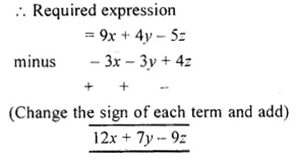
Question 16.
Solution:
Required expression
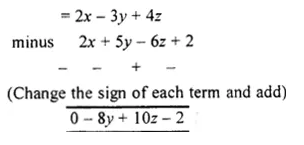
Question 17.
Solution:
Required expression
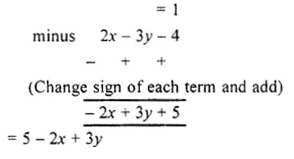
Ex 8D Solutions
Simplify :
Question 1.
Solution:
We have : a – (b – 2a)
= a – b + 2a
= a + 2a – b
= (1 + 2) a – b
= 3a – b.
Question 2.
Solution:
We have : 4x – (3y – x + 2z)
= 4x – 3y + x – 2z
= 4x + x – 2y – 2z
= 5x – 3y – 2z
Question 3.
Solution:
We have :
(a2 + b2 + 2ab) – (a2 + b2 – 2ab)
= a2 + b2 + 2ab – a2 – b2 + 2ab
= a2 – a2 + b2 – b2 + 2ab + 2ab
= 0 + 0 + (2 + 2) ab
= 4 ab
Question 4.
Solution:
We have :
– 3 (a + b) + 4 (2a – 3b) – (2a – b)
= – 3a – 3b + 8a – 12b – 2a + b
= – 3a + 8a – 2a – 3b – 12b + b
= ( – 3 + 8 – 2) a + ( – 3 – 12 + 1) b
= 3a – 14 b.
Question 5.
Solution:
We have :
– 4x2 + {(2x2 – 3) – (4 – 3x2)}
= – 4x2 + {2x2 – 3 – 4 + 3x2}
[removing grouping symbol]
= – 4x2 + {5x2 – 7)
= – 4x2 + 5x2 – 7
(removing grouping symbol {})
= x2 – 7
Question 6.
Solution:
We have :
– 2 (x2 – y2 + xy) – 3 (x2 + y2 – xy)
= – 2x2 + 2y2 – 2xy – 3x2 – 3y2 + 3xy
= – 2x2 – 3x2 + 2y2 – 3y2 – 2xy + 3xy
= ( – 2 – 3)x2 + (2 – 3) y2 + ( – 2 + 3)xy
= – 5x2 – y2 + xy
Question 7.
Solution:
a – [2b – {3a – (2b – 3c)}]
= a – [2b – {3a – 2b + 3c}]
[removing grouping symbol( )]
= a – [2b – 3a + 2b – 3c]
(removing grouping symbol {})
= a – [4b – 3a – 3c]
= a – 4b + 3a + 3c
(removing grouping symbol [ ])
= 4a – 4b + 3c
Question 8.
Solution:
Removing the innermost grouping symbol ( ) first, then { } and then [ ], we have :
– x + [5y – {x – (5y – 2x)}]
= – x + [5y – {x – 5y + 2x}]
= – x + [5y – {3x – 5y}]
= – x + [5y – 3x + 5y]
= – x + [ 10y – 3x]
= – x + 10y – 3x
= – x – 3x + 10y
= – 4x + 10y
Question 9.
Solution:
Removing the innermost grouping symbol ( ) first, then { } and then [ ], we have :
86 – [15x – 7 (6x – 9) – 2 {10x – 5(2 – 3x)}]
= 86 – [15x – 42x + 63 – 2 {10x – 10 + 15x}
= 86 – [ 15x – 42x + 63 – 2 {25x – 10}]
= 86 – [15x – 42x + 63 – 50x + 20]
= 86 – 15x + 42x – 63 + 50x – 20
= (86 – 63 – 20) – 15x + 42x + 50x
= (86 – 83) + (- 15 + 42 + 50) x
= 3 + 77x
Question 10.
Solution:
Removing the innermost grouping ‘ symbol () first, then { } and then [ ], we have :
12x – [3x3 + 5x2 – {7x2 – (4 – 3x – x3) + 6x3} – 3x]
= 12x – [3x3 – 5x2 – {7x2 – 4 + 3x + x3 + 6x3} – 3x]
= 12x – [3x3 + 5x2 – {7x2 – 4 + 3x + 7x3} – 3x]
= 12x – [3x3 + 5x2 – 7x2 + 4 – 3x – 7x3 – 3x]
= 12x – [3x3 – 7x3 + 5x2 – 7x2 + 4 – 3x – 3x]
= 12x – [ – 4x3 + 2x2 + 4 – 6x]
= 12x + 4x3 + 2x2 – 4 + 6x
= 12x + 6x + 4x3 + 2x2 – 4
= 18x + 4x3 + 2x2 – 4
= 4x3 + 2x2 + 18x – 4
Question 11.
Solution:
Removing the innermost grouping symbol ( ) first, then { } and then [ ], we have
5a – [a2 – {2a (1 – a + 4a2) – 3a (a2 – 5a – 3)}] – 8a
= 5a – [a2 – {2a – 2a2 + 8a3 – 3a3 + 15a2 + 9a}] – 8a
= 5a – [a2 – {2a + 9a – 2a2 + 15a2 + 8a3 – 3a3}] – 8a
= 5a – [a2 – {11a + 13a2 + 5a3}] – 8a
= 5a – [a2 – 11a – 13a2 – 5a3] – 8a
= 5a – a2 + 11a + 13a2 + 5a3 – 8a
= 5a + 11a – 8a – a2 + 13a2 + 5a3
= 8a + 12a2 + 5a3
= 5a3 + 12a2 + 8a.
Question 12.
Solution:
Removing the innermost grouping symbol ( ) first, then { } and then [ ], we have :
3 – [x – {2y – (5x + y – 3) + 2x2} – (x2 – 3y)]
= 3 – [x – {2y – 5x – y + 3 + 2x2} – x2 + 3y]
= 3 – [x – {y – 5x + 3 + 2x2} – x2 + 3y]
= 3 – [x – y + 5x – 3 – 2x2 – x2 + 3y]
= 3 – [6x + 2y – 3 – 3x2]
= 3 – 6x – 2y + 3 + 3x2
= 6 – 6x – 2y + 3x2
Question 13.
Solution:
Removing the innermost grouping symbol ( ) first, then { } and then [ ], we have :
xy – [yz – zx – {yx – (3y – xz} – (xy – zy)}]
= xy – [yz – zx – {yx – 3y + xz – xy + zy}]
= xv – [yz – zx – {- 3y + xz + zy}]
= xy – [yz – zx + 3y – xz – zy]
= xy – [ – 2xz + 3y]
= xy + 2xz – 3y
Question 14.
Solution:
Removing the innermost grouping symbol ( ) first, then { } and then [ ], we have
2a – 3b – [3a – 2b – {a – c – (a – 2b)}]
= 2a – 3b – [3a – 2b – {a – c – a + 2b}]
= 2a – 3b – [3a – 2b – { – c + 2b}]
= 2a – 3b – [3a – 2b + c – 2b]
= 2a – 3b – 3a + 2b – c + 2b
= 2a – 3a – 3b + 2b + 2b – c
= – a + b – c
Question 15.
Solution:
Removing the innermost grouping symbol () first, then { } and ten [ ], we have:
– a – [a + {a + b – 2a – (a – 2b)} – b]
= – a – [a + {a + b – 2a – a + 2b} – b]
= – a – [a + { – 2a + 3b} – b]
= – a – [a – 2a + 3b – b]
= – a – a + 2a – 3b + b
= – 2a + 2a – 2b
= – 2 b
Question 16.
Solution:
Removing the innermost grouping symbol ‘—’ first, then ( ), then { } and then [ ], we have
2a – [4b – {4a – (3b – 2a+2b¯¯¯¯¯¯¯¯¯¯¯¯¯¯¯¯)}]
= 2a – [4b – {4a – (3b – 2a – 2b)}]
= 2a – [4b – {4a – (b – 2a)}]
= 2a – [4b – {4a – b + 2a}]
= 2a – [4b – {6a – b}]
= 2a – [4b – 6a + b]
= 2a – [5b – 6a]
= 2a – 5b + 6a
= 8a – 5b.
Question 17.
Solution:
Removing the innermost grouping < symbol ( ) first, then { } and then [ ], we have :
5x – [4y – {7x – (3z – 2y) + 4z – 3(x + 3y – 2z)}]
= 5x – [4y – {7x – 3z + 2y + 4z – 3x – 9y + 6z}]
= 5x – [4y – {4x + 7z – 7y}]
= 5x – [4y – 4x – 7z + 7y]
= 5x – [11y – 4x – 7z]
= 5x – 11y + 4x + 7z
= 9x – 11y + 7z
RS Aggarwal Solutions for Class 6 Maths Chapter 8: Download PDF
RS Aggarwal Solutions for Class 6 Maths Chapter 8–Algebraic Expressions
Download PDF: RS Aggarwal Solutions for Class 6 Maths Chapter 8–Algebraic Expressions PDF
Chapterwise RS Aggarwal Solutions for Class 6 Maths :
- Chapter 1–Number System
- Chapter 2–Factors and Multiples
- Chapter 3–Whole Numbers
- Chapter 4–Integers
- Chapter 5–Fractions
- Chapter 6–Simplification
- Chapter 7–Decimals
- Chapter 8–Algebraic Expressions
- Chapter 9–Linear Equations in One Variable
- Chapter 10–Ratio, Proportion and Unitary Method
- Chapter 11–Line Segment, Ray and Line
- Chapter 12–Parallel Lines
- Chapter 13–Angles and Their Measurement
- Chapter 14–Constructions (Using Ruler and a Pairs of Compasses)
- Chapter 15–Polygons
- Chapter 16–Triangles
- Chapter 17–Quadrilaterals
- Chapter 18–Circles
- Chapter 19–Three-Dimensional Shapes
- Chapter 20–Two-Dimensional Reflection Symmetry (Linear Symmetry)
- Chapter 21–Concept of Perimeter and Area
- Chapter 22–Data Handling
- Chapter 23–Pictograph
- Chapter 24–Bar Graph
About RS Aggarwal Class 6 Book
Investing in an R.S. Aggarwal book will never be of waste since you can use the book to prepare for various competitive exams as well. RS Aggarwal is one of the most prominent books with an endless number of problems. R.S. Aggarwal’s book very neatly explains every derivation, formula, and question in a very consolidated manner. It has tonnes of examples, practice questions, and solutions even for the NCERT questions.
He was born on January 2, 1946 in a village of Delhi. He graduated from Kirori Mal College, University of Delhi. After completing his M.Sc. in Mathematics in 1969, he joined N.A.S. College, Meerut, as a lecturer. In 1976, he was awarded a fellowship for 3 years and joined the University of Delhi for his Ph.D. Thereafter, he was promoted as a reader in N.A.S. College, Meerut. In 1999, he joined M.M.H. College, Ghaziabad, as a reader and took voluntary retirement in 2003. He has authored more than 75 titles ranging from Nursery to M. Sc. He has also written books for competitive examinations right from the clerical grade to the I.A.S. level.
FAQs
Why must I refer to the RS Aggarwal textbook?
RS Aggarwal is one of the most important reference books for high school grades and is recommended to every high school student. The book covers every single topic in detail. It goes in-depth and covers every single aspect of all the mathematics topics and covers both theory and problem-solving. The book is true of great help for every high school student. Solving a majority of the questions from the book can help a lot in understanding topics in detail and in a manner that is very simple to understand. Hence, as a high school student, you must definitely dwell your hands on RS Aggarwal!
Why should you refer to RS Aggarwal textbook solutions on Indcareer?
RS Aggarwal is a book that contains a few of the hardest questions of high school mathematics. Solving them and teaching students how to solve questions of such high difficulty is not the job of any neophyte. For solving such difficult questions and more importantly, teaching the problem-solving methodology to students, an expert teacher is mandatory!
Does IndCareer cover RS Aggarwal Textbook solutions for Class 6-12?
RS Aggarwal is available for grades 6 to 12 and hence our expert teachers have formulated detailed solutions for all the questions of each edition of the textbook. On our website, you’ll be able to find solutions to the RS Aggarwal textbook right from Class 6 to Class 12. You can head to the website and download these solutions for free. All the solutions are available in PDF format and are free to download!