
Class 8: Maths Chapter 15 solutions. Complete Class 8 Maths Chapter 15 Notes.
ML Aggarwal Solutions for Class 8 Maths Chapter 15- Circle
ML Aggarwal 8th Maths Chapter 15, Class 8 Maths Chapter 15 solutions
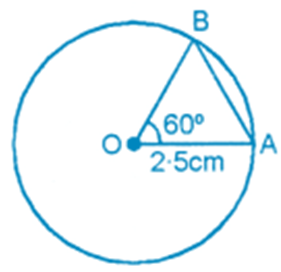
1. Draw a circle with centre O and radius 2.5 cm. Draw two radii OA and OB such that ∠AOB = 600. Measure the length of the chord AB.
Solution:
1. Draw a circle, taking centre as O and radius equal to 2.5 cm
2. Join OA, where A is any point on the circle
3. Draw ∠AOB equal to 600
4. Now, join AB and on measuring we get, AB = 2.5 cm
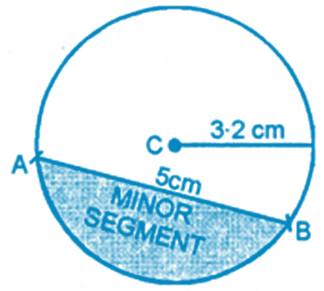
2. Draw a circle of radius 3.2 cm. Draw a chord AB of this circle such that AB = 5 cm. Shade the minor segment of the circle.
Solution:
1. Draw a circle, taking centre as O and radius = 3.2 cm
2. Take a point A on the circle
3. Taking A as centre and radius = 5 cm, draw an arc to meet the circle at point B
4. Now, join AB and shade the minor segment of the circle
3. Find the length of the tangent drawn to a circle of radius 3 cm, from a point at a distance 5 cm from the centre.
Solution:
Draw a circle, taking C as centre and radius CT = 3 cm
Let PT be the tangent, drawn from point P to a circle with centre C
Let CP = 5 cm
CT = 3 cm (given)
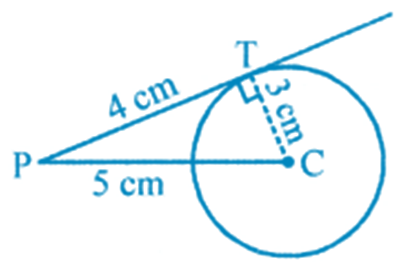
∠CTP = 900 (since radius is perpendicular to tangent)
From △CPT,
CP2 = PT2 + CT2 (By Pythagoras theorem)
(5)2 = PT2 + (3)2
We get,
PT2 = 25 – 9
PT2 = 16
PT = √16
We get,
PT = 4
Therefore, length of tangent = 4 cm
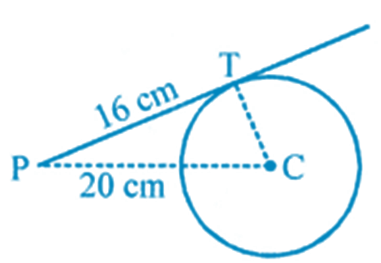
4. In the adjoining figure, PT is a tangent to the circle with centre C. Given CP = 20 cm and PT = 16 cm, find the radius of the circle.
Solution:
We know that,
Radius is always perpendicular to tangent
i.e, CT ⊥ PT
Therefore,
△CPT is a right angled triangle, where CP = hypotenuse
In right angled triangle,
By Pythagoras theorem, we get,
CP2 = PT2 + CT2
CT2 = CP2 – PT2
CT2 = (20)2 – (16)2
We get,
CT2 = 400 – 256
CT2 = 144
CT = √144
We get,
CT = 12 cm
Therefore, radius of circle = 12 cm
5. In each of the following figure, O is the centre of the circle. Find the size of each lettered angle:

Solution:
(i) In the given figure,
AB is the diameter and O is the centre of the circle
Given ∠CAB = 320
∠ABD = 500
∠C = 900 (angles in the semicircle)
By angle sum property of triangle, we get,
∠C + ∠CAB + ∠ABC = 1800
900 + ∠CAB + ∠x = 1800
900 + 320 + ∠x = 1800
320 + ∠x = 1800 – 900
We get,
∠x = 900 – 320
∠x = 580
Similarly,
In right angled triangle ADB,
By angle sum property of triangle, we get,
∠ABD + ∠D + ∠BAD = 1800
500 + 900 + ∠BAD = 1800
500 + 900 + ∠y = 1800
∠y = 1800 – 1400
We get,
∠y = 400
(ii) In the figure,
AC is the diameter of circle with centre O
∠DAC = 370
AD || BC
∠ACB = ∠DAC (Alternate angles)
Hence,
x = 370
In △ABC,
∠B = 900 (Angle in a semicircle)
By angle sum property of triangle, we get,
∠x + ∠y + ∠B = 1800
370 + ∠y + 900 = 1800
∠y = 1800 – 1270
We get,
∠y = 530
(iii) In the figure,
AC is the diameter of the circle with center as O
BA = BC
Hence,
∠BAC = ∠BCA (angles of isosceles triangle)
But ∠ABC = 900 (angles in a semicircle)
In triangle ABC,
By angle sum property of triangle, we get,
∠BAC + ∠ABC + ∠BCA = 1800
∠BAC + ∠BCA = 1800 – 900
∠x + ∠x = 900
∠2x =900
We get,
∠x = 450
(iv) In the figure,
AC is the diameter of the circle, with centre as O,
∠ACD = 1220
∠ACB + ∠ACD = 1800 (Linear pair)
∠ACB + 1220 = 1800
∠ACB = 1800 – 1220
We get,
∠ACB = 580
In △ABC,
∠ABC = 900 (Angles in a semicircle)
By angle sum property of triangle, we get,
∠ABC + ∠BCA + ∠ACB = 1800
900 + x + 580 = 1800
x = 1800 – 1480
We get,
x = 320
(v) In the figure,
AC is the diameter of the circle, with centre as O,
OD || CB and ∠CAB = 400
In △ABC,
∠B = 900 (Angle in a semicircle)
By angle sum property of triangle, we get,
∠BCA + ∠ABC + ∠BAC = 1800
∠BCA + ∠BAC + 900 = 1800
∠BCA + ∠BAC = 1800 – 900
∠BCA + ∠BAC = 900
x + 400 = 900
x = 900 – 400
We get,
x = 500
∵ OD || CB
Hence,
∠AOD = ∠BCA (corresponding angles)
∠AOD = 500
But ∠AOD + ∠DOC = 1800 (Linear pair)
500 + y = 1800
y = 1800 – 500
We get,
y = 1300
Therefore, x = 500 and y = 1300
(vi) In the figure,
AC is the diameter of the circle with centre as O
BA = BC = CD
In △ABC,
∠ABC = 900 (Angle in a semicircle)
By angle sum property of triangle, we get,
∠BAC + ∠BCA + ∠ABC = 1800
∠BAC + ∠BCA + 900 = 1800
∠BAC + ∠BCA = 900
But given that, BA = BC
Therefore, ∠BAC = ∠BCA = x
x + x = 900
2x = 900
x = 450
In △BCD,
BC = CD
Hence,
∠CBD = ∠CDB = y and
Exterior ∠ACB = Sum of interior opposite angles
∠ACB = ∠CBD + ∠CDB
x = y + y
Therefore,
2y = x = 450
y = 450 / 2
y = 22.50 or
y = ( )0
)0
(vii) In the figure,
AB is the diameter of circle with centre O
ST is the tangent at point B
∠ASB = 650
In △ABS
∵ TS is the tangent and OB is the radius
OB is perpendicular to ST or
∠ABS = 900
But in △ASB,
∠BAC + ∠ASB + ∠ABS = 1800
x + 650 + 900 = 1800
x + 1550 = 1800
x = 1800 – 1550
We get,
x = 250
Therefore, x = 250
(viii) In the figure,
AB is the diameter of the circle with centre O
ST is the tangent to the circle at point B
AB = BS
Hence,
ST is the tangent and OB is the radius
OB ⊥ ST or ∠OBS = 900
In △ABS,
∠BAS + ∠BSA + ∠ABS = 1800
By angle sum property of triangle
∠BAS + ∠BSA + 900 = 1800
∠BAS + ∠BSA = 900
x + y = 900
∵ AB = BS
Hence,
x = y
Therefore, x = y = 900 / 2 = 450
(ix) In the figure,
RS is the diameter of the circle with centre as O
SR is produced to Q
QT is the tangent to the circle at point P
OP is joined
∠Q = 360
QT is the tangent and OP is the radius of the circle
Hence,
OP is perpendicular to QT
∠OPQ = 900
In △OPQ,
By angle sum property of triangle, we get,
∠OQP + ∠POQ + ∠OPQ = 1800
∠OQP + ∠POQ + 900 = 1800
Hence,
∠OQP + ∠POQ = 900
360 + x = 900
x = 900 – 360
We get,
x = 540
In △OPS,
OP = OS (Radii of the circle)
Hence,
∠OPS = ∠OSP = y and
Exterior angle ∠POQ = ∠OPS + ∠OSP
x = y + y
x = 2y = 540
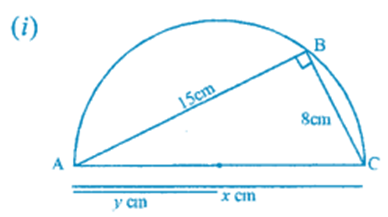
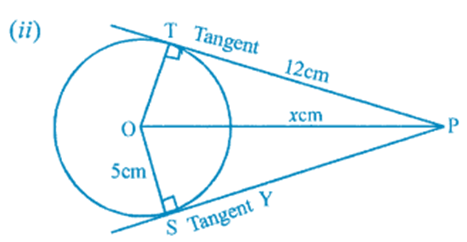
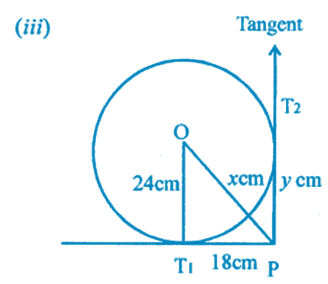
6. In each of the following figures, O is the centre of the circle. Find the values of x and
y.
Solution:
(i) Given
O is the centre of the circle
AB = 15 cm,
BC = 8 cm
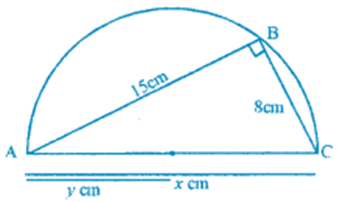
∠ABC = 900 (Angles in a semicircle)
By Pythagoras Theorem,
AC2 = AB2 + BC2
AC2 = (15)2 + (8)2
AC2 = 225 + 64
AC2 = 289
AC2 = (17)2
AC = 17 cm
x = 17 cm
y = 1 / 2
(Since AC is the diameter and AO is the radius of the circle)
= 1 / 2 × 17
= 17 / 2 cm
= 8.5 cm
(ii) O is the centre of the circle
PT and PS are the tangents to the circle from point P
OS and OT are the radii of the circle
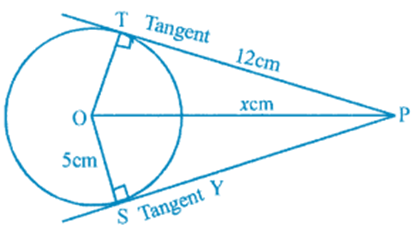
Hence, ∠OSP = ∠OTP = 900
OS = OT = 5 cm and
PT = PS = 12 cm
Now,
In right angled triangle OTP,
By Pythagoras Theorem
OP2 = OT2 + PT2
= (5)2 + (12)2
= 25 + 144
= 169
We get,
OP2 = (13)2
Therefore, OP = 13 cm
i.e, x = 13 cm
Since PS = PT = 12 cm
Therefore,
y = 12 cm
(iii) O is the centre of the circle
OT1 is the radius of the circle
PT1 and PT2 are the tangents of the circle from point P
OT1 = 24 cm and PT1 = 18 cm
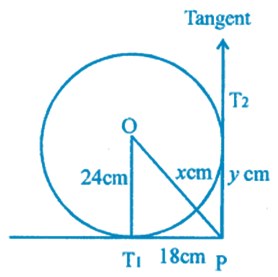
Here,
OT1 is the radius and PT1 is the tangent,
Hence,
OT1 ⊥ PT1
Now,
In right angled triangle OPT,
By Pythagoras Theorem
OP2 = OT12 + PT12
OP2 = (24)2 + (18)2
OP2 = 576 + 324
We get,
OP2 = 900
OP2 = (30)2
OP = 30 cm
x = 30 cm
Since, PT1 and PT2 are the tangents from point P
Therefore,
PT1 = PT2 = 18 cm
i.e, y = 18 cm
Download PDF
ML Aggarwal Solutions for Class 8 Maths Chapter 15- Circle
Download PDF: ML Aggarwal Solutions for Class 8 Maths Chapter 15- Circle PDF
Chapterwise ML Aggarwal Solutions for Class 8 Maths :
- Chapter 1- Rational Numbers
- Chapter 2- Exponents and Powers
- Chapter 3- Squares and Square Roots
- Chapter 4- Cubes and Cube Roots
- Chapter 5- Playing with Numbers
- Chapter 6- Operation On Sets Venn Diagram
- Chapter 7- Percentage
- Chapter 8- Simple and Compound Interest
- Chapter 9- Direct and Inverse Variation
- Chapter 10- Algebraic Expressions and Identities
- Chapter 11- Factorisation
- Chapter 12- Linear Equations and Inequalities in One Variable
- Chapter 13- Understanding Quadrilaterals
- Chapter 14- Constructions of Quadrilaterals
- Chapter 15- Circle
- Chapter 16- Symmetry Reflection and Rotation
- Chapter 17- Visualising Solid Shapes
- Chapter 18- Mensuration
- Chapter 19- Data Handling
About ML Aggarwal
M. L. Aggarwal, is an Indian mechanical engineer, educator. His achievements include research in solutions of industrial problems related to fatigue design. Recipient Best Paper award, Manipal Institute of Technology, 2004. Member of TSTE.