

Class 8: Maths Chapter 10 solutions. Complete Class 8 Maths Chapter 10 Notes.
Contents
ML Aggarwal Solutions for Class 8 Maths Chapter 10- Algebraic Expressions and Identities
ML Aggarwal 8th Maths Chapter 10, Class 8 Maths Chapter 10 solutions
Exercise 10.1
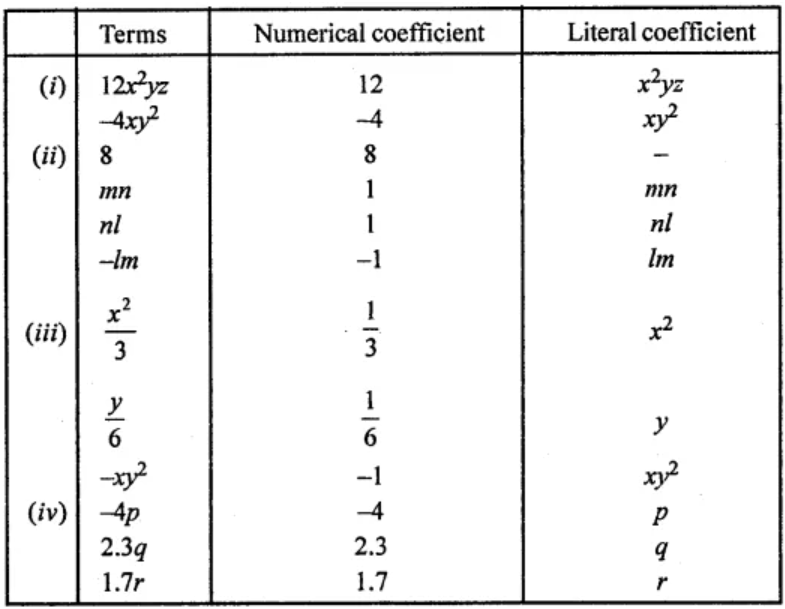
1. Identify the terms, their numerical as well as literal coefficients in each of the following expressions:
(i) 12x2yz – 4xy2
(ii) 8 + mn + nl – lm
(iii) x2/3 + y/6 – xy2
(iv) -4p + 2.3q + 1.7r
Solution:
2. Identify monomials, binomials, and trinomials from the following algebraic expressions :
(i) 5p × q × r2
(ii) 3x2 + y ÷ 2z
(iii) -3 + 7x2
(iv) (5a2 – 3b2 + c)/2
(v) 7x5 – 3x/y
(vi) 5p ÷ 3q – 3p2 × q2
Solution:
(i) 5p × q × r2 = 5pqr2
As this algebraic expression has only one term, its therefore a monomial.
(ii) 3x2 + y ÷ 2z = 3x2/2z + y/2z
As this algebraic expression has two terms, its therefore a binomial.
(iii) -3 + 7x2
As this algebraic expression has two terms, its therefore a binomial.
(iv)
As this algebraic expression has three terms, its therefore a trinomial.
(v) 7x5 – 3x/y
As this algebraic expression has two terms, its therefore a binomial.
(vi) 5p ÷ 3q – 3p2 × q2 = 5p/3q – 3p2q2
As this algebraic expression has two terms, its therefore a binomial.
3. Identify which of the following expressions are polynomials. If so, write their degrees.
(i) 2/5x4 – √3x2 + 5x – 1
(ii) 7x3 – 3/x2 + √5
(iii) 4a3b2 – 3ab4 + 5ab + 2/3
(iv) 2x2y – 3/xy + 5y3 + √3
Solution:
(i) It is a polynomial and the degree of this expression is 4.
(ii) It is not a polynomial.
(iii) It is a polynomial and the degree of this expression is 5.
(iv) It is not a polynomial.
4. Add the following expressions:
(i) ab – bv, bv – ca, ca – ab
(ii) 5p2q2 + 4pq + 7, 3 + 9pq – 2p2q
(iii) l2 + m2 + n2, lm + mn, mn + nl, nl + lm
(iv) 4x3 – 7x2 + 9, 3x2 – 5x + 4, 7x3 – 11x + 1, 6x2 – 13x
Solution:
(i) ab – bc, bc – ca, ca – ab
On adding the expressions, we have
⇒ ab – bc + bc – ca + ca – ab = 0
(ii) 5p2q2 + 4pq + 7,3 + 9pq – 2p2q2
On adding the expressions, we have
= 5p2q2 + 4pq + 7 + 3 + 9pq – 2p2q2
= 5p2q2 – 2p2q2 + 4pq + 9pq + 7 + 3
= 3p2q2 + 13pq + 10
(iii) l2 + m2 + n2, lm + mn, mn + nl, nl + lm
On adding the expressions, we have
= l2 + m2 + n2 + lm + mn + mn + nl + nl + lm
= l2 + m2 + n2 + 2lm + 2mn + 2nl
(iv) 4x3 – 7x2 + 9, 3x2 – 5x + 4, 7x3 – 11x + 1, 6x2 – 13x
On adding the expressions, we have
= 4x3 – 7x2 + 9 + 3x2 – 5x + 4 + 7x3 – 112 + 1 + 6x2 – 13x
= 4x2 + 7x3 – 7x2 + 3x2 + 6x2 – 5x – 11x – 13x + 9 + 4 + 1
= 11x3 – 2x2 – 29x + 14
5. Subtract:
(i) 8a + 3ab – 2b + 7 from 14a – 5ab + 7b – 5
(ii) 8xy + 4yz + 5zx from 12xy – 3yz – 4zx + 5xyz
(iii) 4p2q – 3pq + 5pq2 – 8p + 7q -10 from 18 – 3p – 11q + 5pq – 2pq2 + 5p2q
Solution:
(i) Subtracting 8a + 3ab – 2b + 7 from 14a – 5ab + 7b – 5, we have
= (14a – 5ab + 7b – 5) – (8a + 3ab – 2b + 7)
= 14a – 5ab + 7b – 5 – 8a – 3ab + 2b – 7
= 6a – 8ab + 9ab – 12
(ii) Subtracting 8xy + 4yz + 5zx from 12xy – 3yz – 4zx + 5xyz, we have
= (12xy – 3yz – 4zx + 5xyz) – (8xy + 4yz + 5zx)
= 12xy – 3yz – 4zx + 5xyz – 8xy – 4yz – 5zx
= 4xy – 7yz – 9zx + 5xyz
(iii) Subtracting 4p2q – 3pq + 5pq2 – 8p + 7q – 10 from 18 – 3p – 11q + 5pq – 2pq2 + 5p2q, we have
= (18 – 3p – 11q + 5pq – 2pq2 + 5p2q) – (4p2q – 3pq + 5pq2 – 8p + 7q – 10)
= 18 – 3p – 11q + 5pq – 2pq2 + 5p2q – 7p2q + 3pq – 5pq2 + 8p – 7q + 10
= 28 + 5p – 78q + 8pq – 7pq2 + p2q
6. Subtract the sum of 3x2 + 5xy + 7y2 + 3 and 2x2 – 4xy – 3y2 + 7 from 9x2 – 8xy + 11y2
Solution:
First, adding 3x2 + 5xy + 7y2 + 3 and 2x2 – 4xy – 3y2 + 7, we have
= 3x2 + 5xy + 7y2 + 3 + 2x2 – 4xy – 3y2 + 7
= 5x2 + xy + 4y2 + 10
Now,
Subtracting 5x2 + xy + 4y2 + 10 from 9x2 – 8xy + 11y2
= (9x2 – 8xy + 11y2) – (5x2 + xy + 4y2 + 10)
= 9x2 – 8xy + 11y2 – 5x2 – xy – 4y2 – 10
= 4x2 – 9xy + 7y2 – 10
7. What must be subtracted from 3a2 – 5ab – 2b2 – 3 to get 5a2 – 7ab – 3b2 + 3a?
Solution:
From the question, its understood that we have to subtract 5a2 – 7ab – 3b2 + 3a from 3a2 – 5ab – 2b2 – 3
= 3a2 – 5ab – 2b2 – 3 – (5a2 – 7ab – 3b2 + 3a)
= 3a2 – 5ab – 2b2 – 3 – 5a2 + 7ab + 3b2 – 3a
= -2a2 + 2ab + b2 – 3a – 3
8. The perimeter of a triangle is 7p2 – 5p + 11 and two of its sides are p2 + 2p – 1 and 3p2 – 6p + 3. Find the third side of the triangle.
Solution:
Given,
Perimeter of a triangle = 7p2 – 5p + 11
And, two of its sides are p2 + 2p – 1 and 3p2 – 6p + 3
We know that,
Perimeter of a triangle = Sum of three sides of triangle
⇒ 7p2 – 5p + 11 = (p2 + 2p – 1) + (3p2 – 6p + 3) + (Third side of triangle)
7p2 – 5p + 11 = (4p2 – 4p + 2) + (Third side of triangle)
⇒ Third side of triangle = (7p2 – 5p + 11) – (4p2 – 4p + 2)
= (7p2 – 4p2) + (- 5p + 4p) + (11 – 2)
= 3p2 – p + 9
Thus, the third side of the triangle is 3p2 – p + 9.
Exercise 10.2
1. Find the product of:
(i) 4x3 and -3xy
(ii) 2xyz and 0
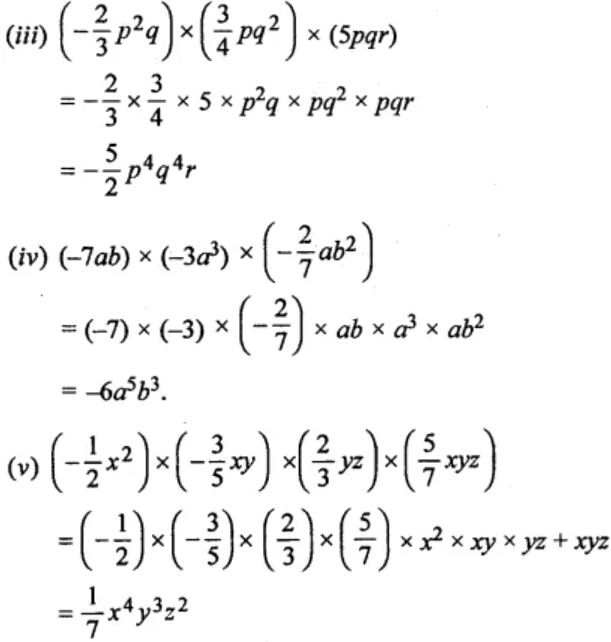
(iii) –(2/3)p2q, (3/4)pq2 and 5pqr
(iv) -7ab, -3a3 and –(2/7)ab2
(v) –½x2 – (3/5)xy, (2/3)yz and (5/7)xyz
Solution:
Product of:
(i) 4x3 and -3xy = 4x3 × (-3xy) = -12x3+1 y = -12x4y
(ii) 2xyz and 0 = 2xyz × 0 = 0
2. Multiply:
(i) (3x – 5y + 7z) by – 3xyz
(ii) (2p2 – 3pq + 5q2 + 5) by – 2pq
(iii) (2/3a2b – 4/5ab2 + 2/7ab + 3) by 35ab
(iv) (4x2 – 10xy + 7y2 – 8x + 4y + 3) by 3xy
Solution:
(i) – 3xyz × (3x – 5y + 7z)
= (- 3xyz) × 3x + (- 3xyz) × (- 5y) + (- 3xyz) × (7z)
= – 9x2yz + 15xyz2 – 21xyz2
(ii) -2pq × (2p2 – 3pq + 5q2 + 5)
= (-2pq) × 2p2 + (-2pq) × (-3pq) + (- 2pq) × (5q2) + (-2pq) × 5
= -4p3q + 6p2q2 – 10pq3 – 10pq
(iii) by 35ab
= (2/3)a2b × 35ab – (4/5)ab2 × 35ab + (2/7)ab × 35ab + 3 × 35ab
= (70/3)a3b2 – 28a2b3 + 10a2b2 + 105ab
(iv) (4x2 – 10xy + 7y2 – 8x + 4y + 3) by 3xy
= 4x2 × 3xy – 10xy × 3xy + 7y2 × 3xy – 8x × 3xy + 4y × 3xy + 3 × 3xy
= 12x3y – 30x2y2 + 21xy3 – 24x2y + 12xy2 + 9xy
3. Find the areas of rectangles with the following pairs of monomials as their lengths and breadths respectively:
(i) (p2q, pq2)
(ii) (5xy, 7xy2)
Solution:
(i) Given, sides of a rectangle are p2q and pq2
Hence,
Area = p2q × pq2 = p2+1 × q2+1 = p3q3
(ii) Given, sides are 5xy and 7xy2
Hence,
Area = 5xy × 7xy2 = 35x1+1 × y1+2 = 35x2y3
4. Find the volume of rectangular boxes with the following length, breadth and height respectively:
(i) 5ab, 3a2b, 7a4b2
(ii) 2pq, 4q2, 8rp
Solution:
Given are the length, breadth and height of a rectangular box:
(i) 5ab, 3a2b, 7a4b2
∴ Volume = Length × breadth × height
= 5ab × 3a2b × 7a4b2
= 5 × 3 × 7 × a1+2+4 × b1+1+2
= 105a7b4
(ii) 2pq, 4q2, 8rp
∴ Volume = Length × breadth × height
= 2pq × 4q2 × 8rp
= 2 × 4 × 8 × p1+1 × q1+2 × r
= 64p2q3r
5. Simplify the following expressions and evaluate them as directed:
(i) x2(3 – 2x + x2) for x = 1; x = -1; x = 2/3 and x = –1/2
(ii) 5xy(3x + 4y – 7) – 3y(xy – x2 + 9) – 8 for x = 2, y = -1
Solution:
(i) x2(3 – 2x + x2)
For x = 1; x = -1; x = 2/3 and x = –1/2
x2(3 – 2x + x2) = 3x2 – 2x3 + x4
(a) For x = 1
3x2 – 2x3 + x4 = 3(1)2 – 2(1 )3 + (1)4
= 3 × 1 – 2 × 1 + l
= 3 – 2 + 1 = 2
(b) For x = -1
3x2 – 2x3 + x4 = 3(-1)2 – 2(-1)3 + (-1)4
= 3 × 1 – 2 × (-1) + 1
= 3 + 2 + 1 = 6
(c) For x = 2/3
3x2 – 2x3 + x4 = 3(2/3)2 – 2(2/3)3 + (2/3)4
= 3 × (4/9) – 2 × (8/27) + (16/81)
= (4/3) – (16/27) + (16/81)
= (108 – 48 + 16)/81
= (124 – 48)/81
= 76/81
(d) For x = -1/2
3x2 – 2x3 + x4 = 3(-1/2)2 – 2(-1/2)3 + (-1/2)4
= 3 × (1/4) – 2 × (-1/8) + (1/16)
= (3/4) + ¼ + (1/16)
= (12 + 4 + 1)/16
= 17/16
(ii) 5xy(3x + 4y – 7) – 3y(xy – x2 + 9) – 8
= 15x2y + 20xy2 – 35xy – 3xy2 + 3 x2y – 21y – 8
= 18x2y + 17xy2 – 35xy – 27y – 8
When x = 2, y = -1, we have
= 18(2)2 × (-1) + 17(2) (-1)2 – 35(2) (-1) – 27(-1) – 8
= 18 × 4 × (-1) + 17 × 2 × 1 – 35 × 2 × (-1) – 27 × (-1) – 8
= -74 + 34 + 70 + 27 – 8
= 131 – 80 = 51
6. Add the following:
(i) 4p(2 – p2) and 8p3 – 3p
(ii) 7xy(8x + 2y – 3) and 4xy2(3y – 7x + 8)
Solution:
Adding,
(i) 4p(2 – p2) and 8p3 – 3p
= 8p – 4p3 + 8p3 – 3p
= 5p + 4p3
= 4p3 + 5p
(ii) 7xy(8x + 2y – 3) and 4xy2(3y – 7x + 8)
= 56x2y + 14xy2 – 21xy + 12xy3 – 28x2y2 + 32xy2
= 12xy3 – 28x2y2 + 56x2y +46xy2 – 21xy
7. Subtract:
(i) 6x(x – y + z)- 3y(x + y – z) from 2z(-x + y + z)
(ii) 7xy(x2 -2xy + 3y2) – 8x(x2y – 4xy + 7xy2) from 3y(4x2y – 5xy + 8xy2)
Solution:
Subtracting,
(i) 6x(x – y + z) – 3y(x + y – z) from 2z(-x + y + z)
⇒ 6x2 – 6xy + 6xz – 3xy – 3y2 + 3yz from – 2xz + 2yz + 2z2
= (-2xz + 2yz + 2z2) – (6x2 – 6xy + 6xz – 3xy – 3y2 + 3yz)
= – 2xz + 2yz + 2z2 – 6x2 + 6xy – 6xz + 3xy + 3y2 – 3yz
= 9xy – yz – 8zx – 6x2 + 3y2 + 2z2
(ii) 7xy(x2 – 2xy + 3y2) – 8x(x2y – 4xy + 7xy2) from 3y(4x2y – 5xy + 8xy2)
⇒ 7x3y – 14x2y2 + 21xy3 – 8x3y + 32x2y – 56x2y2 from 12x2y2 – 15xy2 + 24xy3
= (12x2y2 – 15xy2 + 24xy3) – (7x3y – 14x2y2 + 21xy3 – 8x3y + 32x2y – 56x2y2
= 12x2y2 – 15xy2 + 24xy3 – 7x3y + 14x2y2 – 12xy3 + 8x3y – 32x2y + 56x2y2
= 82x2y2 + 3xy3 + x3y – 15xy2 – 32x2y
Exercise 10.3
1. Multiply:
(i) (5x – 2) by (3x + 4)
(ii) (ax + b) by (cx + d)
(iii) (4p – 7) by (2 – 3p)
(iv) (2x2 + 3) by (3x – 5)
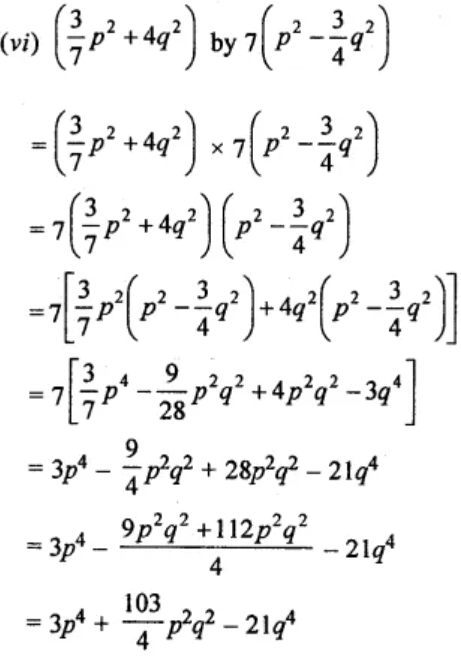
(v) (1.5a – 2.5b) by (1.5a + 2.56)
(vi)
Solution:
(i) (5x – 2) by (3x + 4)
= (5x – 2) × (3x + 4)
= 5x (3x + 4) – 2 (3x + 4)
= 15x2 + 20x – 6x – 8
= 15x2+ 14x – 8
(ii) (ax + b) by (cx + d)
= (ax + b) × (cx + d)
= ax (cx + d) + b (cx + d)
= acx2 + adx + bcx + bd
(iii) (4p – 7) by (2 – 3p)
= (4p – 7) × (2 – 3p)
= 4p(2 – 3p) -7(2 – 3p)
= 8p – 12p2 – 14 + 21p
= 29p – 12p2 – 14
(iv) (2x2 + 3) by (3x – 5)
= (2x2 + 3) (3x – 5)
= 2x2(3x – 5) + 3(3x – 5)
= 6x3 – 10x2 + 9x – 15
(v) (1.5a – 2.5b) by (1.5a + 2.5b)
= (1.5a – 2.5b) (1.5a + 2.5b)
= 1.5a(1.5 + 2.5b) – 2.5b(1.5a + 2.5b)
= 2.25a2 + 3.75ab – 3.75a6 – 6.25b2
= 2.25a2 – 6.25b2
2. Multiply:
(i) (x – 2y + 3) by (x + 2y)
(ii) (3 – 5x + 2x2) by (4x – 5)
Solution:
(i) (x – 2y + 3) by (x + 2y)
= (x – 2y + 3) × (x + 2y)
= x (x + 2y) – 2y(x + 2y) + 3 (x + 2y)
= x2 + 2xy – 2xy – 4y2 + 3x + 6y
= x2 – 4y2 + 3x + 6y
(ii) (3 – 5x + 2x2) by (4x – 5)
= (4x – 5) (3 – 5x + 2x2)
= 4x(3 – 5x + 2x2) – 5(3 – 5x + 2x2)
= 12x – 20x2 + 8x3 – 15 + 25x – 10x2
= 8x3 – 30x2 + 37x – 15
3. Multiply:
(i) (3x2 – 2x – 1) by (2x2 + x – 5)
(ii) (2 – 3y – 5y2) by (2y – 1 + 3y2)
Solution:
(i) (3x2 – 2x – 1) by (2x2 + x – 5)
= (3x2 – 2x – 1) (2x2 + x – 5)
= 3x2(2x2 + x – 5) – 2x(2x2 + x – 5) -1(2x2 + x – 5)
= 6x4 + 3x3 – 15x2 – 4x3 – 2x2 + 10x – 2x2 – x + 5
= 6x4 – x3 – 19x2 + 9x + 5
(ii) (2 – 3y – 5y2) by (2y- 1 + 3y2)
= (2 – 3y – 5y2) × (2y- 1 + 3y2)
= 2(2y – 1 + 3y2 ) – 3y (2y – 1 + 3y2) -5y2(2y – 1 + 3y2)
= 4y – 2 + 6y2 – 6y2 + 3y – 9y3 – 10y3 + 5y2 – 15y4
= -15y4 – 19y3 + 5y2 + 7y – 2
4. Simplify:
(i) (x2 + 3) (x – 3) + 9
(ii) (x + 3) (x – 3) (x + 4) (x – 4)
(iii) (x + 5) (x + 6) (x + 7)
(iv) (p + q – 2r) (2p – q + r) – 4qr
(v) (p + q) (r + s) + (p – q)(r – s) – 2(pr + qs)
(vi) (x + y + z) (x – y + z) + (x + y – z) (-x + y + z) – 4zx
Solution:
(i) (x2 + 3) (x – 3) + 9
= x2 (x – 3) + 3(x – 3) + 9
= x2 – 3x2 + 3x – 9 + 9
= x3 – 3x2 + 3x
(ii) (x + 3) (x – 3) (x + 4) (x – 4)
= {(x + 3) (x – 3)} × {(x + 4) (x – 4)}
= {x (x – 3) + 3 (x – 3)} {x (x – 4) + 4 (x – 4)}
= (x2 – 3x + 3x – 9) {x2 – 4x + 4x – 16}
= (x2 – 9) (x2 – 16)
= x2 (x2 – 16) – 9 (x2 – 16)
= x4 – 16x2 – 9x2 + 144
= x4 – 25x2 + 144
(iii) (x + 5) (x + 6) (x + 7)
= {(x + 5) × (x + 6)} (x + 7)
= (x2 + 6x + 5x + 30) (x + 7)
= (x2 + 11x + 30) (x + 7)
= x(x2+ 11x + 30) + 7(x2+ 11x + 30)
= x3 + 11x2 + 30x + 7x2 + 77x + 210
= x3 + 18x2 + 107x + 210
(iv) (p + q – 2r)(2p – q + r) – 4qr
= p(2p – q + r) + q(2p – q + r) – 2r(2p – q + r) – 4qr
= 2p2 – pq + pr + 2pq – q2 + qr – 4pr + 2qr – 2r2 – 4qr
= 2p2 – q2 – 2r2 + pq – 3pr – 2qr
(v) (p + q)(r + s) + (p – q) (r – s) – 2(pr + qs)
= (pr + ps + qr + qs) + (pr – ps – qr + qs) – 2pr – 2qs
= 0
(vi) (x + y + z)(x – y + z) + (x + y – z)(-x + y + z) – 4zx
= x2 – xy + xz + xy – y2 + yz + xz – yz + z2 – x2 + xy + xz
– xy + x2 + yx + xz – yz – z2 – 4zx
= 0
5. If two adjacent sides of a rectangle are 5x2 + 25xy + 4y2 and 2x2 – 2xy + 3y2, find its area.
Solution:
Given,
The adjacent sides of a rectangle are 5x2 + 25xy + 4y2 and 2x2 – 2xy + 3y2
So,
Area of rectangle = Product of two adjacent sides
= (5x2 + 25xy + 4y2) (2x2 – 2xy + 3y2)
= 10x4– 10x3y+ 15x2y2 + 50x3y – 50x2y2 + 75xy3 + 8x2y2 – 8xy3 + 12y4
= 10x4 + 40x3y – 27x2y2 + 67xy3 + 12y4
Thus,
The area of the rectangle is 10x4 + 40x3y – 27x2y2 + 67xy3 + 12y4.
Exercise 10.4
1. Divide:
(i) – 39pq2r5 by – 24p3q3r
(ii) –3/4 a2b3 by 6/7 a3b2
Solution:
(i) – 39pq2r5 (÷) – 24p3q3r
= – 39pq2r5/ – 24p3q3r

2. Divide:
(i) 9x4 – 8x3 – 12x + 3 by 3x
(ii) 14p2q3 – 32p3q2 + 15pq2 – 22p + 18q by – 2p2q.
Solution:
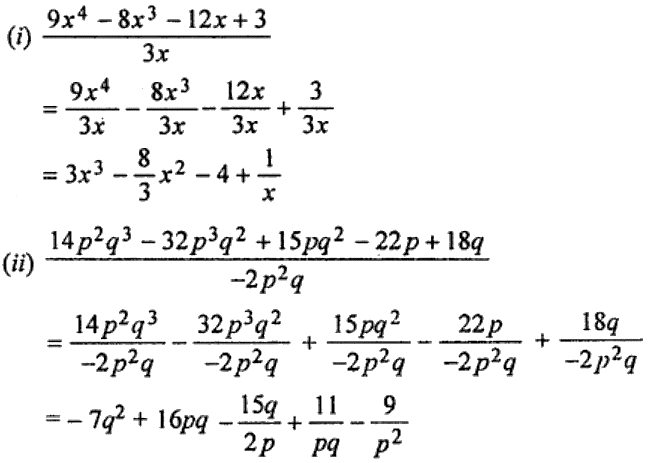
3. Divide:
(i) 6x2 + 13x + 5 by 2x + 1
(ii) 1 + y3 by 1 + y
(iii) 5 + x – 2x2 by x + 1
(iv) x3 – 6x2 + 12x – 8 by x – 2
Solution:
(i) 6x2 + 13x + 5 ÷ 2x + 1
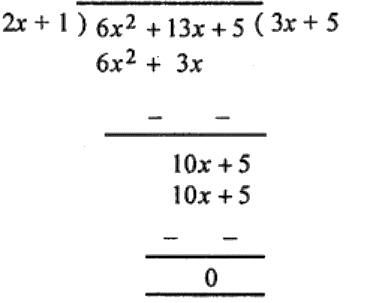
∴ Quotient = 3x + 5 and remainder = 0
(ii) 1 + y3 ÷ 1 + y

∴ Quotient = y2 – y + 1 and remainder = 0
(iii) On arranging the terms of dividend in descending order of powers of x and then dividing, we get
– 2x2 + x + 5 ÷ x + 1
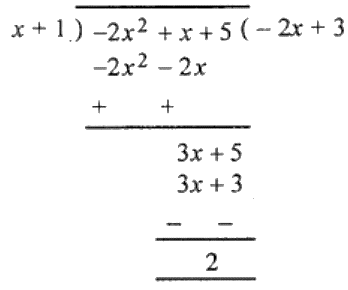
∴ Quotient = – 2x + 3 and remainder = 2
(iv) x3 – 6x2 + 12x – 8 ÷ x – 2
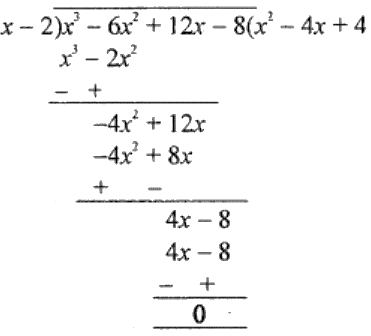
∴ Quotient = x2 – 4x + 4 and remainder = 0
4. Divide:
(i) 6x3 + x2 – 26x – 25 by 3x – 7
(ii) m3 – 6m2 + 7 by m – 1
Solution:
(i) 6x3 + x2 – 26x – 25 ÷ 3x – 7

∴ Quotient = 2x2 + 5x + 3 and remainder = – 4
(ii) m3 – 6m2 + 7 ÷ m – 1

∴ Quotient = m2 – 5m – 5 and remainder = 2.
5. Divide:
(i) a3 + 2a2 + 2a + 1 by a2 + a + 1
(ii) 12x3 – 17x2 + 26x – 18 by 3x2 – 2x + 5
Solution:
(i) a3 + 2a2 + 2a + 1 ÷ a2 + a + 1
∴ Quotient = a + 1 and remainder = 0.
(ii) 12x3 – 17x2 + 26x – 18 ÷ 3x2 – 2x + 5
∴ Quotient = 4x – 3 and remainder = -3
6. If the area of a rectangle is 8x2 – 45y2 + 18xy and one of its sides is 4x + 15y, find the length of adjacent side.
Solution:
Given,
Area of rectangle = 8x2 – 45y2 + 18xy
And, one side = 4x + 15y
∴ Second (adjacent) side = Area of rectangle/ One side
= 8x2 – 45y2 + 18xy ÷ 4x + 15y
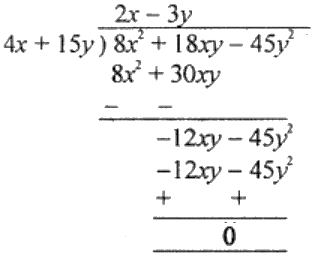
Thus, length of the adjacent side is 2x – 3y.
Exercise 10.5
1. Using suitable identities, find the following products:
(i) (3x + 5) (3x + 5)
(ii) (9y – 5) (9y – 5)
(iii) (4x + 11y) (4x – 11y)
(iv) (3m/2 + 2n/3) (3m/2 – 2n/3)
(v) (2/a + 5/b) (2a + 5/b)
(vi) (p2/2 + 2/q2) (p2/2 – 2/q2)
Solution:
(i) (3x + 5) (3x + 5)
= (3x + 5)2
= (3x)2 + 2 × 3x × 5 + (5)2 [Using, (a + b)2 = a2 + 2ab + b2]
= 9x2 + 30x + 25
(ii) (9y – 5) (9y – 5)
= (9y – 5)2
= (9y)2 – 2 × 9y × 5 + (5)2 [Using, (a – b)2 = a2 – 2ab + b2]
= 81y2 – 90y + 25
(iii) (4x + 11y)(4x – 11y)
= (4x)2 – (11y)2
= 16x2 – 121y2 [Using, (a + b)(a – b) = a2 – b2]
(iv) (3m/2 + 2n/3) (3m/2 – 2n/3)
= (3m/2)2 – (2n/3)2
= 9m2/4 – 4n2/9 [Using, (a + b)(a – b) = a2 – b2]
(v) (2/a + 5/b) (2a + 5/b)
= (2/a + 5/b)2
= (2/a)2 + 2(2/a)(5/b) + (5/b)2 [Using, (a + b)2 = a2 + 2ab + b2]
= 4/a2 + 20a/b + 25/b2
(vi) (p2/2 + 2/q2) (p2/2 – 2/q2)
= (p2/2)2 – (2/q2)2 [Using, (a + b)(a – b) = a2 – b2]
= p4/4 – 4/q4
2. Using the identities, evaluate the following:
(i) 812
(ii) 972
(iii) 1052
(iv) 9972
(v) 6.12
(vi) 496 × 504
(vii) 20.5 × 19.5
(viii) 9.62
Solution:
(i) (81)2 = (80 + 1)2
= (80)2 + 2 × 80 × 1 + (1)2 [Using, (a + b)2 = a2 + 2ab + b2]
= 6400 + 160+ 1
= 6561
(ii) (97)2 = (100 – 3)2
= (100)2 – 2 × 100 × 3 + (3)2 [Using, (a – b)2 = a2 – 2ab + b2]
= 10000 – 600 + 9
= 10009 – 600
= 9409
(ii) (105)2 = (100 + 5)2
= (100)2 + 2 × 100 × 5 + (5)2 [Using, (a + b)2 = a2 + 2ab + b2]
= 10000+ 1000 + 25
= 11025
(iv) (997)2 = (1000 – 3)2
= (1000)2 – 2 × 1000 × 3 + (3)2 [Using, (a – b)2 = a2 – 2ab + b2]
= 1000000 – 6000 + 9
= 1000009 – 6000
= 994009
(v) (6.1)2 = (6 + 0.1)2
= (6)2 + 2 × 6 × 0.1 +(0.1)2 [Using, (a + b)2 = a2 + 2ab + b2]
= 36 + 1.2 + 0.01
= 37.21
(vi) 496 × 504
= (500 – 4) (500 + 4) [Using, (a + b) (a – b) = a2 – b2]
= (500)2 – (4)2
= 250000 – 16
= 249984
(vii) 20.5 × 19.5
= (20 + 0.5) (20 – 0.5) [Using, (a + b) (a – b) = a2 – b2]
= (20)2 – (0.5)2
= 400 – 0.25
= 399.75
(viii) (9.6)2 = (10 – 0.4)2
= (10)2 – 2 × 10 × 0.4 + (0.4)2 [Using, (a – b)2 = a2 – 2ab + b2]
= 100 – 8.0 + 0.16
= 92.16
3. Find the following squares, using the identities:
(i) (pq + 5r)2 (ii) (5a/2 – 3b/5)2
(iii) (√2a + √3b)2 (iv) (2x/3y – 3y/2x)2
Solution:
(i) (pq + 5r)2
= (pq)2 + 2 × pq × 5r + (5r)2 [Using, (a + b)2 = a2 + 2ab + b2]
= p2q2 + 10pqr + 25r2
(ii) (5a/2 – 3b/5)2
= (5a/2)2 – 2 × (5a/2) × (-3b/5) + (3b/5)2 [Using, (a – b)2 = a2 – 2ab + b2]
= 25a2/4 – 3ab + 9b2/25
(iii) (√2a + √3b)2
= (√2a)2 + 2 × √2a × √3b + (√3b)2 [Using, (a + b)2 = a2 + 2ab + b2]
= 2a2 + 2√6ab + 3b2
(iv) (2x/3y – 3y/2x)2
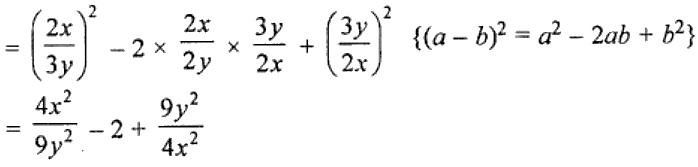
4. Using the identity, (x + a) (x + b) = x2 + (a + b)x + ab, find the following products:
(i) (x + 7) (x + 3)
(ii) (3x + 4) (3x – 5)
(iii) (p2 + 2q) (p2 – 3q)
(iv) (abc + 3) (abc – 5)
Solution:
(i) (x + 7) (x + 3)
= (x)2 + (7 + 3)x + 7 × 3
= x2 + 10x + 21
(ii) (3x + 4) (3x – 5)
= (3x)2 + (4 – 5) (3x) + 4 × (-5)
= 9x2 – 3x – 20
(iii) (P2 + 2q)(p2 – 3q)
= (p2)2 + (2q – 3q)p2 + 2q × (-3q)
= p4 – p2q – 6pq
(iv) (abc + 3) (abc – 5)
= (abc)2 + (3 – 5)abc + 3 × (-5)
= a2b2c2 – 2abc – 15
5. Using the identity, (x + a) (x + b) = x2 + (a + b)x + ab, evaluate the following:
(i) 203 × 204
(ii) 8.2 × 8.7
(iii) 107 × 93
Solution:
(i) 203 × 204
= (200 + 3) (200 + 4)
= (200)2 + (3 + 4) × 200 + 3 × 4
= 40000 + 1400 + 12
= 41412
(ii) 8.2 × 8.7
= (8 + 0.2) (8 + 0.7)
= (8)2 + (0.2 + 0.7) × 8 + 0.2 × 0.7
= 64 + 8 × (0.9) + 0.14
= 64 + 7.2 + 0.14
= 71.34
(iii) 107 × 93
= (100 + 7) (100 – 7)
= (100)2 + (7 – 7) × 100 + 7 × (-7)
= 10000 + 0 – 49
= 9951
6. Using the identity a2 – b2 = (a + b) (a – b), find
(i) 532 – 472
(ii) (2.05)2 – (0.95)2
(iii) (14.3)2 – (5.7)2
Solution:
(i) 532 – 472
= (50 + 3) (50 – 3)
= (50)2 – (3)2
= 2500 – 9
= 2491
(ii) (2.05)2 – (0.95)2
= (2.05 + 0.95) (2.05 – 0.95)
= 3 × 1.10
= 3.3
(iii) (14.3)2 – (5.7)2
= (14.3 + 5.7) (14.3 – 5.7)
= 20 × 8.6
= 172
7. Simplify the following:
(i) (2x + 5y)2 + (2x – 5y)2
(ii) (7a/2 – 5b/2)2 – (5a/2 – 7b/2)2
(iii) (p2 – q2r)2 + 2p2q2r
Solution:
(i) (2x + 5y)2 + (2x – 5y)2 [Using, (a ± b)2 = a2 ± 2ab + b2]
= (2x)2 + 2 × 2x × 5y + (5y)2 + (2x)2 – 2 × 2x × 5y + (5y)2
= 4x2 + 20xy + 25y2 + 4x2 – 20xy + 25y2
= 8x2 + 50y2
(ii) (7a/2 – 5b/2)2 – (5a/2 – 7b/2)2
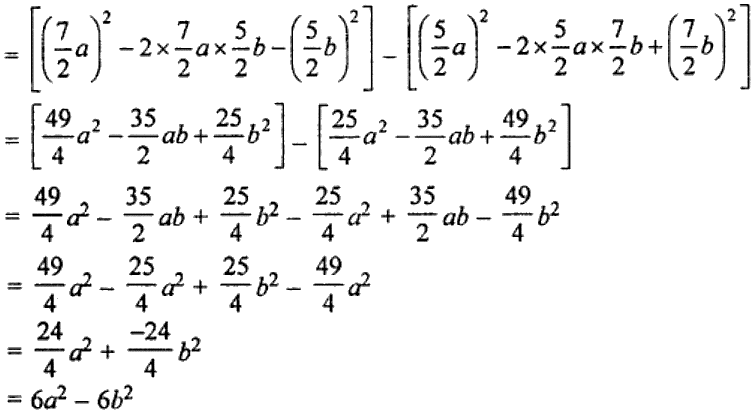
(iii) (p2 – q2r)2 + 2p2q2r [Using, (a – b)2 = a2 – 2ab + b2]
= (p2)2 – 2 × p2 × q2r + (q2r)2 + 2p2q2r
= p4 – 2p2q + q4r2 + 2p2q2r
= p4 + q4r2
8. Show that:
(i) (4x + 7y)2 – (4x – 7y)2 = 112xy
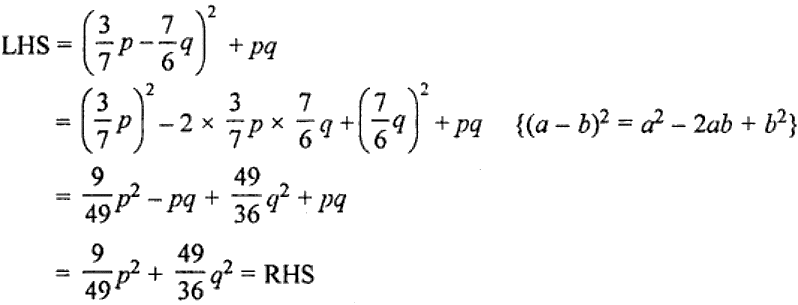
(ii) (3p/7 – 7q/6)2 + pq = 9p2/49 + 49q2/36
(iii) (p – q)(p + q) + (q – r)(q + r) + (r – p) (r + p) = 0
Solution:
(i) Taking LHS, we have
LHS = (4x + 7y)2 – (4x – 7y)2 [Using, (a ± b)2 = a2 ± 2ab + b2]
= [(4x)2 + 2 × 4x × 7y + (7y)2] – [(4x)2 – 2 × 4x + 7y + (7y)2]
= (16x2 + 56xy + 49y2) – (16x2 – 56xy + 49y2)
= l6x2 + 56xy + 49y2 – 16x2 + 56xy – 49y2
= 112xy = RHS
(ii) Taking LHS, we have
(iii) Taking LHS, we have
LHS = (p – q) (p + q) + (q – r) (q + r) + (r – p)(r + p)
= p2 – q2 + q2 – r2 + r2 – p2 [Using, (a + b) (a – b) = a2 – b2]
= 0 = RHS
9. If x + 1/x = 2, evaluate:
(i) x2 + 1/x2 (ii) x4 + 1/x4
Solution:
(i) We have, x + 1/x = 2
On squaring on both sides, we get
(x + 1/x)2 = 22
x2 + 2 × x × 1/x + 1/x2 = 4
x2 + 2 + 1/x2 = 4
x2 + 1/x2 = 4 – 2
Thus,
x2 + 1/x2 = 2
(ii) Again squaring, we get
(x2 + 1/x2)2 = 22
x4 + 2 × x2 × 1/x2 + 1/x4 = 4
x4 + 2 + 1/x4 = 4
x4 + 1/x4 = 4 – 2
Thus,
x4 + 1/x4 = 2
10. If x – 1/x = 7, evaluate:
(i) x2 + 1/x2 (ii) x4 + 1/x4
Solution:
We have, x – 1/x = 7
On squaring on both sides, we get
(x – 1/x)2 = 72
x2 – 2 × x2 × 1/x2 + 1/x2 = 49
x2 – 2 + 1/x2 = 49
x2 + 1/x2 = 49 + 2
Thus,
x2 + 1/x2 = 51
(ii) Again squaring, we get
(x2 + 1/x2)2 = 512
x4 + 1/x4 + 2 × x2 × 1/x2 = 2601
x4 + 1/x4 + 2 = 2601
x4 + 1/x4 = 2601 – 2
Thus,
x4 + 1/x4 = 2599
11. If x2 + 1/x2 = 23, evaluate:
(i) x + 1/x (ii) x – 1/x
Solution:
We have, x2 + 1/x2 = 23
(i) (x + 1/x)2 = x2 + 1/x2 + 2
= 23 + 2
= 25
Taking square root on both sides, we get
(x + 1/x) = ±5
Thus, x + 1/x = 5 or -5
(ii) (x – 1/x)2 = x2 + 1/x2 – 2
= 23 – 2
= 21
Taking square root on both sides, we get
(x + 1/x) = ±√21
Thus, x + 1/x = √21 or -√21
12. If a + b = 9 and ab = 10, find the value of a2 + b2.
Solution:
Given,
a + b = 9 and ab = 10
Now, squaring a + b = 9 on both sides, we have
(a + b)2 = (9)
a2 + b2 + 2ab = 81
a2 + b2 + 2 × 10 = 81
a2 + b2 + 20 = 81
a2 + b2 = 81 – 20 = 61
∴ a2 + b2 = 61
13. If a – b = 6 and a2 + b2 = 42, find the value of
Solution:
Given
a – b = 6 and a2 + b2 = 42
a – b = 6
Now, squaring a – b = 6 on both sides, we have
(a – b)2 = (6)2
a2 + b2 – 2ab = 36
42 – 2ab = 36
2ab = 42 – 36 = 6
ab = 6/2 = 3
∴ ab = 3
14. If a2 + b2 = 41 and ab = 4, find the values of
(i) a + b
(ii) a – b
Solution:
Given, a2 + b2 = 41 and ab = 4
(i) (a + b)2 = a2 + b2 + 2ab
= 41 + 2 × 4
= 41 + 8
= 49
∴ a + b = ±7
(ii) (a – b)2 = a2 + b2 – 2ab
= 41 – 2 × 4
= 41 – 8
= 33
∴ a – b = ±√33
Check Your Progress
1. Add the following expressions:
(i) -5x2y + 3xy2 – 7xy + 8, 12x2y – 5xy2 + 3xy – 2
(ii) 9xy + 3yz – 5zx, 4yz + 9zx – 5y, -5xz + 2x – 5xy
Solution:
(i) (-5x2y + 3xy2 – 7xy + 8) + (12x2y – 5xy2 + 3xy – 2)
= 7x2y – 2xy2 – 4xy + 6
(ii) (9xy + 3yz – 5zx) + (4yz + 9zx – 5y, -5xz + 2x – 5xy)
= 4xy + 7yz – zx + 2x – 5y
2. Subtract:
(i) 5a + 3b + 11c – 2 from 3a + 5b – 9c + 3
(ii) 10x2 – 8y2 + 5y – 3 from 8x2 – 5xy + 2y2 + 5x – 3y
Solution:
(i) 5a – 3b + 11c – 2 from 3a + 5b – 9c + 3
= (3a + 5b – 9c + 3) – (5a – 3b + 11c – 2)
= 3a + 5b – 9c + 3 – 5a + 3b – 11c + 2
= -2a + 8b – 20c + 5
(ii) 10x2 – 8y2 + 5y – 3 from 8x2 – 5xy + 2y2 + 5x – 3y
= (8x2 – 5xy + 2y2 + 5x – 3y) – (10x2 – 8y2 + 5y – 3)
= 8x2 – 5xy + 2y2 + 5x – 3y – 10x2 + 8y2 – 5y + 3
= – 2x2 – 5xy + 10y2 + 5x – 8y – 3
3. What must be added to 5x2 – 3x + 1 to get 3x3 – 7x2 + 8?
Solution:
From the question, the required expression is
= (3x3 – 7x2 + 8) – (5x2 – 3x + 1)
= 3x3 – 7x2 + 8 – 5x2 + 3x – 1
= 3x3 – 12x2 + 3x + 7
4. Find the product of
(i) 3x2y and -4xy2
(ii) –(4/5)xy, (5/7)yz and –(14/9)zx
Solution:
Product of:
(i) 3x2y and -4xy2
= 3x2 × (-4xy2)
= -12x2+1 y1+2
= 12x3y3
(ii) –(4/5)xy, (5/7)yz and –(14/9)zx
= –(4/5)xy × (5/7)yz × –(14/9)zx
= –(4/5) × (5/7) × –(14/9) x2y2z2
= (8/9)x2y2z2
5. Multiply:
(i) (3pq – 4p2 + 5q2 + 7) by -7pq
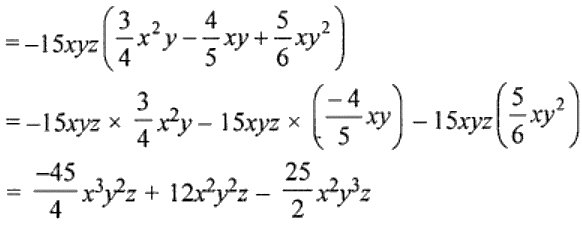
(ii) (3/4x2y – 4/5xy + 5/6xy2) by – 15xyz
Solution:
(i) (3pq – 4p2 + 5q2 + 7) × (-7pq)
= -7pq × 3pq – 7pq × (-4p2) + (-7pq) (5q2) – 7pq × 7
= -21p2q2 + 28p3q – 35pq3 – 49pq
(ii) (3/4x2y – 4/5xy + 5/6xy2) × (– 15xyz)
6. Multiply:
(i) (5x2 + 4x – 2) by (3 – x – 4x2)
(ii) (7x2 + 12xy – 9y2) by (3x2 – 5xy + 3y2)
Solution:
(i) (5x2 + 4x – 2) × (3 – x – 4x2)
= 5x2(3 – x – 4x2) + 4x(3 – x – 4x2) – 2(3x – x – 4x2)
= 15x2 – 5x3 – 20x4 + 12x – 4x2 – 16x3 – 6x + 2x + 8x2
= -20x4 – 21x3 + 19x2 + 14x – 6
(ii) (7x2 + 12xy – 9y2) x (3x2 – 5xy + 3y2)
= 7x2(3x2 – 5xy + 3y2) + 12xy(3x2 – 5xy + 3y2) – 9y2(3x2 – 5xy + 3y2)
= 21x4 – 35x3y + 21x2y2 + 36x3y – 60x2y2 + 36xy3 – 27x2y2 + 45xy3 – 27y4
= 21x4 + x3y + 81xy3 – 66x2y2 – 27y4
7. Simplify the following expressions and evaluate them as directed:
(i) (3ab – 2a2 + 5b2) x (2b2 – 5ab + 3a2) + 8a3b – 7b4 for a = 1, b = -1
(ii) (1.7x – 2.5y) (2y + 3x + 4) – 7.8x2 – 10y for x = 0, y = 1.
Solution:
(i) (3ab – 2a2 + 5b2) × (2b2 – 5ab + 3a2) + 8a3b – 7b4
= 3ab(2b2 – 5ab + 3a2) – 2a2(2b2 – 5ab + 3a2) + 5b2(2b2 – 5ab + 3a2) + 8a3b – 7b4
= 6ab32 – 15a2b2 + 9a3b – 4a2b2 + 10a3b – 6a4 + 10b4 – 25ab3 + 15a2b2 + 8a3b – 7b4
= 27a3b – 4a2b2 – 19ab3 – 6a4 + 3b4
Putting, a = 1 and b = (-1)
= 27(1 )3 (-1) – 4(1)2 (-1)2 – 19 (1) (-1)3 – 6(1)4 + 3(-1)4
= -27 – 4 + 19 – 6 + 3
= -37 + 22
= -15
(ii) (1.7x – 2.5y) (2y + 3x + 4) – 7.8x2 – 10y
1.7x(2y + 3x + 4) – 2.5y(2y + 3x + 4) – 7.8x2 – 10y
= 3.4xy + 5.1x2 + 6.8x – 5y2 – 7.5xy – 10y – 7.8x2 – 10y
= -2.7x2 – 4.1xy – 5y2 + 6.8x – 20y
Putting, x = 0 and y = 1
= -2.7 × 0 – 4.1 × 0 × 1 – 5(1)2 + 6.8 × 0 – 20 × 1
= 0 + 0 – 5 + 0 – 20
= -25
8. Carry out the following divisions:
(i) 66pq2r3 ÷ 11qr2
(ii) (x3 + 2x2 + 3x) ÷ 2x
Solution:
(i) 66pq2r3/ 11qr2
= 6pq2-1r3-2
= 6pqr
(ii) (x3 + 2x2 + 3x)/ 2x
= x3/2x + 2x2/2x + 3x/2x
= ½ x2 + x + 3/2
9. Divide 10x4 – 19x3 + 17x2 + 15x – 42 by 2x2 – 3x + 5.
Solution:
(10x4 – 19x3 + 17x2 + 15x – 42) ÷ (2x2 – 3x + 5)
Performing long division, we have
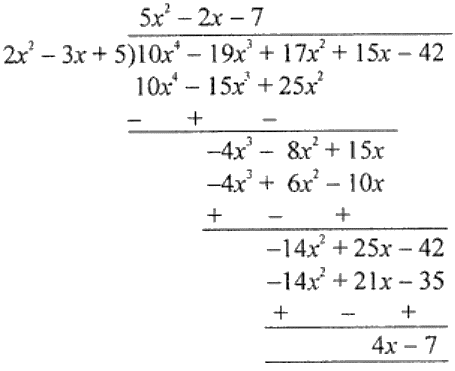
Thus, Quotient = 5x2 – 2x – 7 and Remainder = 4x – 7
10. Using identities, find the following products:
(i) (3x + 4y) (3x + 4y)
(ii) (5a/2 – b) (5a/2 – b)
(iii) (3.5m – 1.5n) (3.5m + 1.5n)
(iv) (7xy – 2) (7xy + 7)
Solution:
(i) (3x + 4y) (3x + 4y)
= (3x + 4y)2
= (3x)2 + 2 × 3x × 4y + (4y)2 [Using, (a + b)2 = a2 + 2ab + b2]
= 9x2 + 24xy + 16y2
(ii) (5a/2 – b) (5a/2 – b)
= (5a/2 – b)2
= (5a/2)2 + 2 × 5a/2 × (-b) + (b)2 [Using, (a – b)2 = a2 – 2ab + b2]
= 25a2/4 – 5ab + b2
(iii) (3.5m – 1.5n) (3.5m + 1.5n)
= (3.5m)2 – (1.5n)2 [Using, (a – b)(a + b) = a2 – b2]
= 12.25m2 – 2.25n2
(iv) (7xy – 2)(7xy + 7)
= (7xy)2 + (-2 + 7) × (7xy) + (-2) × 7 [Using, (x + a)(x + b) = x2 + (a + b)x + ab]
= 49x2y2 + 35xy – 14
11. Using suitable identities, evaluate the following:
(i) 1052
(ii) 972
(iii) 201 × 199
(iv) 872 – 132
(v) 105 × 107
Solution:
(i) (105)2 = (100 + 5)2
= (100)2 + 2 × 100 × 5 + (5)2 [Using, (a + b)2 = a2 + 2ab + b2]
= 10000 + 1000 + 25
= 11025
(ii) (97)2 = (100 – 3)2
= (100)2 – 2 × 100 × 3 + (3)2 [Using, (a – b)2 = a2 – 2ab + b2]
= 10000 – 600 + 9
= 10009 – 600
= 9409
(iii) 201 × 199 = (200 + 1) (200 – 1)
= (200)2 – (1)2 [Using, (a + b) (a – b) = a2 – b2]
= 40000 – 1
= 39999
(iv) 872 – 132
= (87 + 13) (87- 13) [Using, a2 – b2 = (a + b)(a – b)]
= 100 × 74
= 7400
(v) 105 × 107
= (100 + 5) (100 + 7)
= (100)2 + (5 + 7) × 100 + 5 × 7 [Using, (x + a)(x – b) = x2 + (a + b)x + ab]
= 10000 + 1200 + 35
= 11235
12. Prove that following:
(i) (a + b)2 – (a – b)2 + 4ab
(ii) (2a + 3b)2 + (2a – 3b)2 = 8a2 + 18b2
Solution:
(i) Taking the RHS, we have
RHS = (a – b)2 + 4ab
= a2– 2ab + b2 + 4ab
= a2 + 2ab + b2
= (a + b)2 = L.H.S.
(ii) Taking the LHS, we have
LHS = (2a + 3b)2 + (1a – 3b)2
= (2a)2 + 2 × 2a × 3b + (3b)2 + (2a)2 – 2 × 2a × 3b + (3b)2
= 4a2 + 12ab + 9b2 + 4a2 – 12ab + 9b2
= 8a2 + 18b2 = RHS
13. If x + 1/x = 5, evaluate
(i) x2 + 1/x2 (ii) x4 + 1/x4
Solution:
(i) We have, x + 1/x = 5
On squaring on both sides, we get
(x + 1/x)2 = 52
x2 + 1/x2 + 2 × x × 1/x = 25
x2 + 2 + 1/x2 = 25
x2 + 1/x2 = 25 – 2
Hence, x2 + 1/x2 = 23
(ii) Again, squaring x2 + 1/x2 = 23 on both sides, we get
(x2 + 1/x2)2 = 232
x4 + 1/x4 + 2 × x4 × 1/x4 = 529
x4 + 1/x4 + 2 = 529
x4+ 1/x4 = 529 – 2
Hence,
x4 + 1/x4 = 527
14. If a + b = 5 and a2 + b2 = 13, find ab.
Solution:
Given,
a + b = 5 and a2 + b2 = 13
On squaring a + b = 5 both sides, we get
(a + b)2 = (5)2
a2 + b2 + 2ab = 25
13 + 2ab = 25 ⇒ 2ab = 25 – 13 = 12
⇒ ab = 12/2 = 6
∴ ab = 6
Download PDF
ML Aggarwal Solutions for Class 8 Maths Chapter 10- Algebraic Expressions and Identities
Chapterwise ML Aggarwal Solutions for Class 8 Maths :
- Chapter 1- Rational Numbers
- Chapter 2- Exponents and Powers
- Chapter 3- Squares and Square Roots
- Chapter 4- Cubes and Cube Roots
- Chapter 5- Playing with Numbers
- Chapter 6- Operation On Sets Venn Diagram
- Chapter 7- Percentage
- Chapter 8- Simple and Compound Interest
- Chapter 9- Direct and Inverse Variation
- Chapter 10- Algebraic Expressions and Identities
- Chapter 11- Factorisation
- Chapter 12- Linear Equations and Inequalities in One Variable
- Chapter 13- Understanding Quadrilaterals
- Chapter 14- Constructions of Quadrilaterals
- Chapter 15- Circle
- Chapter 16- Symmetry Reflection and Rotation
- Chapter 17- Visualising Solid Shapes
- Chapter 18- Mensuration
- Chapter 19- Data Handling
About ML Aggarwal
M. L. Aggarwal, is an Indian mechanical engineer, educator. His achievements include research in solutions of industrial problems related to fatigue design. Recipient Best Paper award, Manipal Institute of Technology, 2004. Member of TSTE.