
Class 8: Maths Chapter 17 solutions. Complete Class 8 Maths Chapter 17 Notes.
ML Aggarwal Solutions for Class 8 Maths Chapter 17- Visualising Solid Shapes
ML Aggarwal 8th Maths Chapter 17, Class 8 Maths Chapter 17 solutions
Exercise 17.1
1. Match the objects with their shapes:
| Picture (object) | Shape | |
| A tent |  | A triangular field adjoining a square field. |
| A tin | 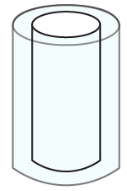 | A hemispherical shell. |
| A bowl | 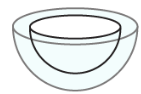 | Two rectangular cross paths inside a rectangular park. |
| An agricultural field | 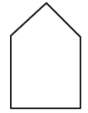 | A hemisphere surmounted on a cone. |
| A groove | 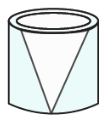 | A circular path around a circular ground. |
| A toy | 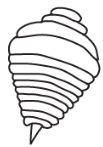 | A cylindrical shell. |
| A circular park |  | A cone surmounted on a cylinder. |
| A cross path | 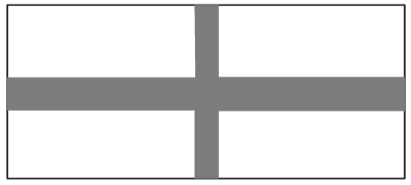 | A cone taken out of a cylinder. |
Solution:
(i) A tent – (g)
A cone surmounted on a cylinder.
(ii) A tin – (f)
A cylindrical shell.
(iii) A bowl – (b)
A hemispherical shell.
(iv) An agricultural field – (a)
A triangular field adjoining a square field.
(v) A groove – (h)
A cone taken out of a cylinder.
(vi) A toy – (d)
A hemisphere surmounted on a cone.
(vii) A circular park – (e)
A circular path around a circular ground.
(viii) A cross path – (c)
Two rectangular cross paths inside a rectangular park.
2. For each of the given solid, the two views are given. Match for each solid the corresponding front and top views.
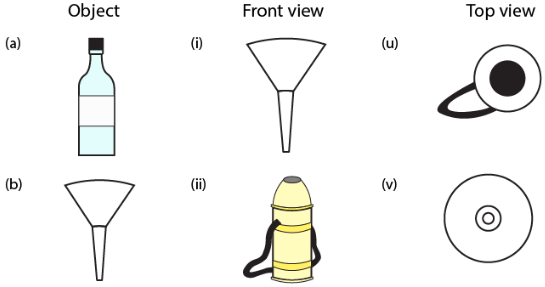
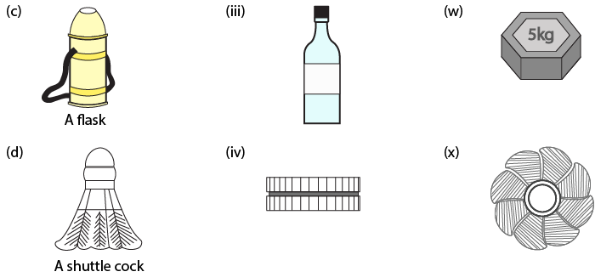
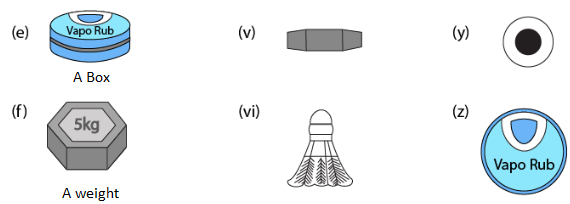
Solution:
| Object | Front View | Top View |
| A bottle | (iii) | (y) |
| A funnel | (i) | (v) |
| A flash | (ii) | (u) |
| A shuttle cock | (vi) | (x) |
| A box | (iv) | (z) |
| A weight | (v) | (w) |
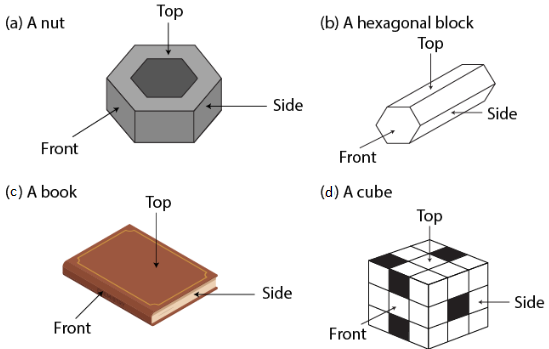
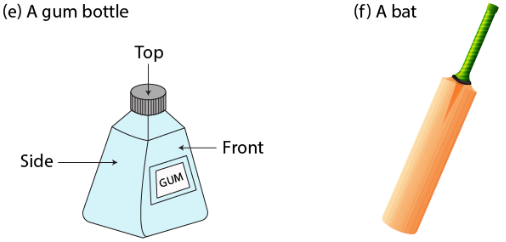
3. For the given solid, identify the front, side and top views and write it in the space provided.
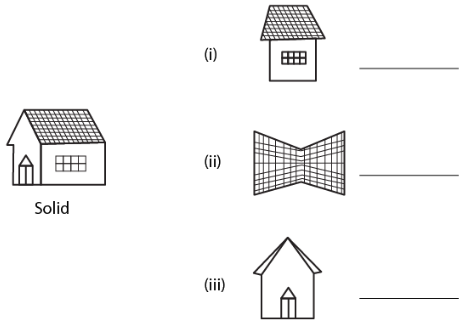
Solution:

4. For each of the given solid, the three views are given. Identify for each solid the corresponding top, front and side views.
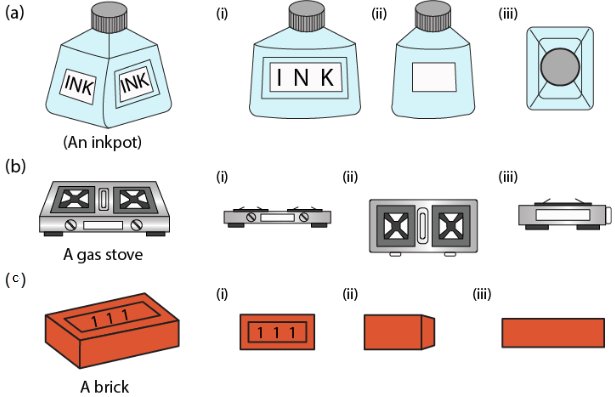
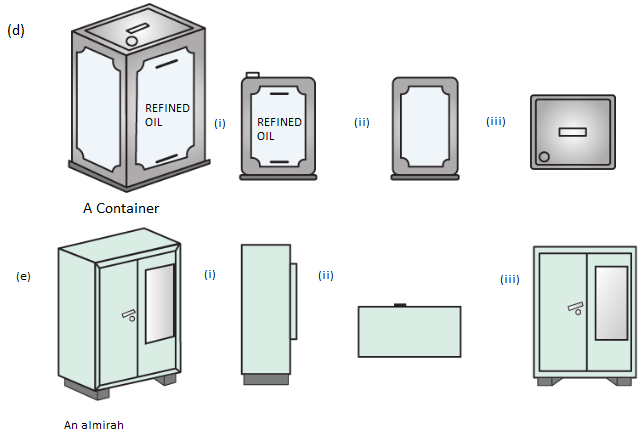
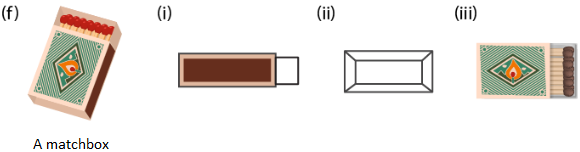
Solution:
Object Different Views
(a) An inkpot
(i) Front
(ii) Side
(iii) Top
(b) A gas stove
(i) Front
(ii) Top
(iii) Side
(c) A brick
(i) Top
(ii) Front
(iii) Side
(d) A container
(i) Front
(ii) Side
(iii) Top
(e) Almirah
(i) Side
(ii) Top
(iii) Front
(f) A matchbox
(i) Side
(ii) Front
(iii) Top
5. For each given solid, identify the top view, front view and side view.
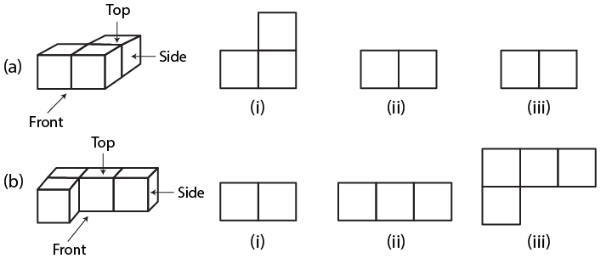
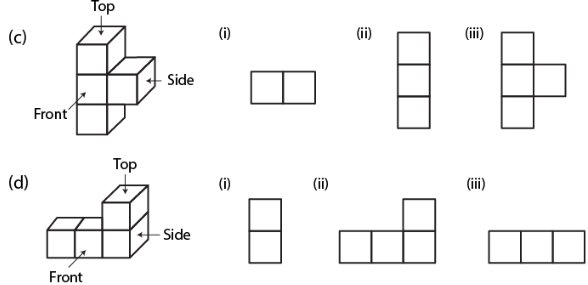
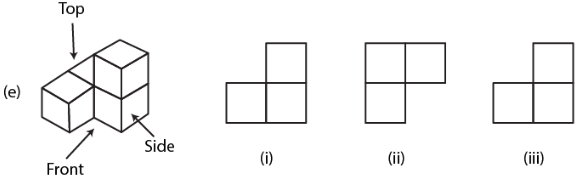
Solution:
(a)
(i) Top view
(ii) Side view
(iii) Front view
(b)
(i) Side view
(ii) Front view
(iii) Top view
(c)
(i) Top view
(ii) Side view
(iii) Front view
(d)
(i) Side view
(ii) Front view
(iii) Top view
(e)
(i) Front view
(ii) Top view
(iii) Side view
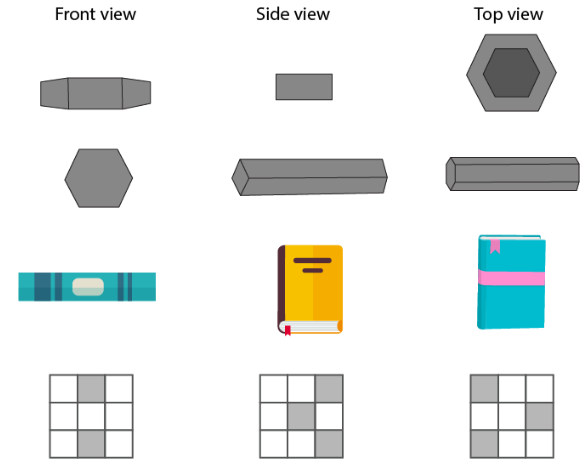
6. Draw the front view, side view and top view of the given objects:
Solution:

Exercise 17.2
1. Can a polyhedron have for its faces
(i) 3 triangles?
(ii) 4 triangles?
(iii) a square and four triangles?
Solution:
(i) No
(ii) Yes
(iii) Yes
2. Which are prisms among the following?

Solution:
(i) and (iv) are the only prisms.
3. Verify Euler’s formula for these solids:

Solution:
| Faces | Vertices | Edges | F + V = E + 2 | |
| (i) | 7 | 10 | 15 | 7 + 10 = 15 + 217 = 17 |
| (ii) | 9 | 5 | 12 | 9 + 5 = 12 + 214 = 14 |
| (iii) | 7 | 7 | 12 | 7 + 7 = 12 + 214 = 14 |
| (iv) | 9 | 9 | 16 | 9 + 9 = 16 + 218 = 18 |
4. Can a polyhedron have 15 faces, 30 edges and 20 vertices?
Solution:
We know that
F + V = E + 2
Substituting the values
15 + 20 = 35 and 30 + 2 = 32
Here
35 ≠ 32
Therefore, a polyhedron cannot have 15 faces, 30 edges and 20 vertices.
5. If a polyhedron has 8 faces and 8 vertices, find the number of edges.
Solution:
We know that
A polyhedron has 8 faces and 8 vertices.
Here
No. of edges = F + V – 2
Substituting the values
= 8 + 8 – 2
= 14
6. If a polyhedron has 7 faces and 10 vertices, find the number of edges.
Solution:
We know that
A polyhedron has 7 faces and 10 vertices
Here
No. of edges = F + V – 2
Substituting the values
= 7 + 10 – 2
= 15
7. Write the number of faces, vertices and edges in
(i) an octagonal prism
(ii) decagonal pyramid.
Solution:
| No. of faces | No. of vertices | No. of edges | |
| (i) an octagonal prism | 10 | 16 | 24 |
| (ii) decagonal pyramid | 11 | 11 | 20 |
8. Using Euler’s formula, complete the following table:
| Faces | Vertices | Edges | |
| (i) | 6 | – | 12 |
| (ii) | – | 5 | 8 |
| (iii) | 14 | 24 | – |
| (iv) | – | 16 | 30 |
| (v) | 16 | – | 42 |
| (vi) | 19 | 19 | – |
Solution:
| Faces | Vertices | Edges | F + V = E + 2 | |
| (i) | 6 | 8 | 12 | 12 + 2 = 146 + 8 = 14 |
| (ii) | 5 | 5 | 8 | 8 + 2 = 105 + 5 = 10 |
| (iii) | 14 | 24 | 36 | 14 + 24 = 3838 – 2 = 36 |
| (iv) | 16 | 16 | 30 | 30 + 2 = 3216 + 16 = 32 |
| (v) | 16 | 28 | 42 | 42 + 2 = 4416 + 28 = 44 |
| (vi) | 19 | 19 | 36 | 19 + 19 = 382 + 36 = 38 |
Download PDF
ML Aggarwal Solutions for Class 8 Maths Chapter 17- Visualising Solid Shapes
Download PDF: ML Aggarwal Solutions for Class 8 Maths Chapter 17- Visualising Solid Shapes PDF
Chapterwise ML Aggarwal Solutions for Class 8 Maths :
- Chapter 1- Rational Numbers
- Chapter 2- Exponents and Powers
- Chapter 3- Squares and Square Roots
- Chapter 4- Cubes and Cube Roots
- Chapter 5- Playing with Numbers
- Chapter 6- Operation On Sets Venn Diagram
- Chapter 7- Percentage
- Chapter 8- Simple and Compound Interest
- Chapter 9- Direct and Inverse Variation
- Chapter 10- Algebraic Expressions and Identities
- Chapter 11- Factorisation
- Chapter 12- Linear Equations and Inequalities in One Variable
- Chapter 13- Understanding Quadrilaterals
- Chapter 14- Constructions of Quadrilaterals
- Chapter 15- Circle
- Chapter 16- Symmetry Reflection and Rotation
- Chapter 17- Visualising Solid Shapes
- Chapter 18- Mensuration
- Chapter 19- Data Handling
About ML Aggarwal
M. L. Aggarwal, is an Indian mechanical engineer, educator. His achievements include research in solutions of industrial problems related to fatigue design. Recipient Best Paper award, Manipal Institute of Technology, 2004. Member of TSTE.