
Class 8: Maths Chapter 15 solutions. Complete Class 8 Maths Chapter 15 Notes.
Maharashtra Board Solutions Class 8-Maths (Practice Set 15.1): Chapter 15- Area
Maharashtra Board 8th Maths Chapter 15, Class 8 Maths Chapter 15 solutions
Question 1.
If base of a parallelogram is 18 cm and its height is 11 cm, find its area.
Solution:
Given, base = 18 cm, height = 11 cm
Area of a parallelogram = base × height
= 18 × 11
= 198 sq.cm
∴ Area of the parallelogram is 198 sq.cm.
Question 2.
If area of a parallelogram is 29.6 sq. cm and its base is 8 cm, find its height.
Solution:
Given, area of a parallelogram = 29.6 sq.cm,
base = 8 cm
Area of a parallelogram = base × height
∴ 29.6 = 8 × height
∴ height = 29.68 = 3.7 cm
∴ Height of the parallelogram is 3.7 cm.
Question 3.
Area of a parallelogram is 83.2 sq.cm. If its height is 6.4 cm, find the length of its base.
Solution:
Given, area of a parallelogram = 83.2 sq.cm, height = 6.4 cm
Area of a parallelogram = base × height
∴ 83.2 = base × 6.4
∴ base = 83.26.4 = 13 cm
∴ The length of the base of the parallelogram is 13 cm.
Intext Questions and Activities
Question 1.
Draw a big enough parallelogram ABCD on a paper as shown in the figure.
Draw perpendicular AE on side BC.
Cut the right angled ∆AEB. Join it with the remaining part of ₹ABCD as shown in the figure.
The new figure formed is a rectangle.
The rectangle is formed from the parallelogram.
So, areas of both the figures are equal.
Base of parallelogram is one side (length) of the rectangle and its height is the other side (breadth) of the rectangle.
∴ Area of a parallelogram = base × height (Textbook pg. no.94)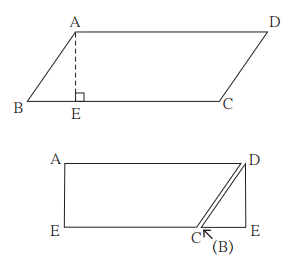
Solution:
Draw a big enough parallelogram ABCD on a paper as shown in the figure.
Draw perpendicular AE on side BC.
Cut the right angled ∆AEB. Join it with the remaining part of ₹ABCD as shown in the figure.
The new figure formed is a rectangle.
The rectangle is formed from the parallelogram.
So, areas of both the figures are equal.
Base of parallelogram is one side (length) of the rectangle and its height is the other side (breadth) of the rectangle.
∴ Area of a parallelogram = Area of a rectangle = length × breadth = base × height
Download PDF
Maharashtra Board Solutions Class 8-Maths (Practice Set 15.1): Chapter 15- Area
Download PDF: Maharashtra Board Solutions Class 8-Maths (Practice Set 15.1): Chapter 15- Area PDF
Chapterwise Maharashtra Board Solutions Class 8 Maths :
- Chapter 1- Rational and Irrational Numbers (Practice Set 1.1)
- Chapter 1- Rational and Irrational Numbers (Practice Set 1.2)
- Chapter 1- Rational and Irrational Numbers (Practice Set 1.3)
- Chapter 1- Rational and Irrational Numbers (Practice Set 1.4)
- Chapter 2- Parallel Lines and Transversals (Practice Set 2.1)
- Chapter 2- Parallel Lines and Transversals (Practice Set 2.2)
- Chapter 2- Parallel Lines and Transversals (Practice Set 2.3)
- Chapter 3- Indices and Cube Root (Practice Set 3.1)
- Chapter 3- Indices and Cube Root (Practice Set 3.2)
- Chapter 3- Indices and Cube Root (Practice Set 3.3)
- Chapter 4- Altitudes and Medians of a Triangle (Practice Set 4.1)
- Chapter 5- Expansion Formulae (Practice Set 5.1)
- Chapter 5- Expansion Formulae (Practice Set 5.2)
- Chapter 5- Expansion Formulae (Practice Set 5.3)
- Chapter 5- Expansion Formulae (Practice Set 5.4)
- Chapter 6- Factorisation of Algebraic Expressions (Practice Set 6.1)
- Chapter 6- Factorisation of Algebraic Expressions (Practice Set 6.2)
- Chapter 6- Factorisation of Algebraic Expressions (Practice Set 6.3)
- Chapter 6- Factorisation of Algebraic Expressions (Practice Set 6.4)
- Chapter 7- Variation (Practice Set 7.1)
- Chapter 7- Variation (Practice Set 7.2)
- Chapter 7- Variation (Practice Set 7.3)
- Chapter 8- Quadrilateral: Constructions and Types (Practice Set 8.1)
- Chapter 8- Quadrilateral: Constructions and Types (Practice Set 8.2)
- Chapter 8- Quadrilateral: Constructions and Types (Practice Set 8.3)
- Chapter 9- Discount and Commission (Practice Set 9.1)
- Chapter 9- Discount and Commission (Practice Set 9.2)
- Chapter 10- Division of Polynomials (Practice Set 10.1)
- Chapter 10- Discount and Commission (Practice Set 10.2)
- Chapter 11- Statistics (Practice Set 11.1)
- Chapter 11- Statistics (Practice Set 11.2)
- Chapter 11- Statistics (Practice Set 11.3)
- Chapter 12- Equations in One Variable (Practice Set 12.1)
- Chapter 12- Equations in One Variable (Practice Set 12.2)
- Chapter 13- Congruence of Triangles (Practice Set 13.1)
- Chapter 13- Congruence of Triangles (Practice Set 13.2)
- Chapter 14- Compound Interest (Practice Set 14.1)
- Chapter 14- Compound Interest (Practice Set 14.2)
- Chapter 15- Area (Practice Set 15.1)
- Chapter 15- Area (Practice Set 15.2)
- Chapter 15- Area (Practice Set 15.3)
- Chapter 15- Area (Practice Set 15.4)
- Chapter 15- Area (Practice Set 15.5)
- Chapter 15- Area (Practice Set 15.6)
- Chapter 16- Surface Area and Volume (Practice Set 16.1)
- Chapter 16- Surface Area and Volume (Practice Set 16.2)
- Chapter 16- Surface Area and Volume (Practice Set 16.3)
- Chapter 17- Factorisation of Algebraic Expressions (Practice Set 17.1)
- Chapter 17- Factorisation of Algebraic Expressions (Practice Set 17.2)