
Class 8: Maths Chapter 1 solutions. Complete Class 8 Maths Chapter 1 Notes.
Maharashtra Board Solutions Class 8-Maths (Practice Set 1.1): Chapter 1- Rational and Irrational Numbers
Maharashtra Board 8th Maths Chapter 1, Class 8 Maths Chapter 1 solutions
Question 1.
Compare the following numbers.
i. 7, -2
ii. 0, −95
iii. 87, 0
iv. −54,14
v. 4029,14129
vi. −1720,−1320
vii. 1512,716
viii. −258,−94
ix. 1215,35
x. −711,−34
Solution:
i. 7, -2
If a and b are positive numbers such that a < b, then -a > -b.
Since, 2 < 7 ∴ -2 > -7
ii. 0, −95
On a number line, −95 is to the left of zero.
∴ 0 > −95
iii. 87, 0
On a number line, zero is to the left of 87 .
∴ 87 > 0
iv. −54,14
We know that, a negative number is always less than a positive number.
∴ −54<14
v. 4029,14129
Here, the denominators of the given numbers are the same.
Since, 40 < 141
∴ 4029<14129
vi. −1720,−1320
Here, the denominators of the given numbers are the same.
Since, 17 < 13
∴ -17 < -13
∴ −1720<−1320
vii. 1512,716
Here, the denominators of the given numbers are not the same.
LCM of 12 and 16 = 48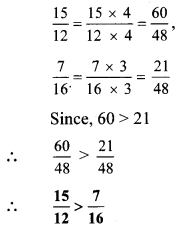
Alternate method:
15 × 16 = 240
12 × 7 = 84
Since, 240 > 84
∴ 15 × 16 > 12 × 7
viii. −258,−94
Here, the denominators of the given numbers are not the same.
LCM of 8 and 4 = 8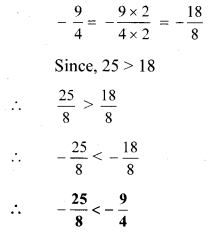
ix. 1215,35
Here, the denominators of the given numbers are not the same.
LCM of 15 and 5 = 15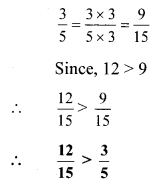
x. −711,−34
Here, the denominators of the given numbers are not the same.
LCM of 11 and 4 = 44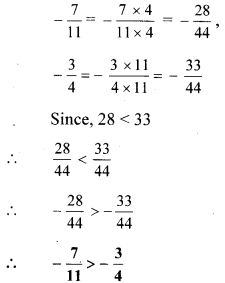
Maharashtra Board Class 8 Maths Solutions Chapter 1 Rational and Irrational Numbers Practice Set 1.2 Questions and Activities
Question 1.
Verify the following comparisons using a number line. (Textbook pg. no, .3)
i. 2 < 3 but – 2 > – 3
ii. 54<74 but −54<−74
Solution:
We know that, on a number line the number to the left is smaller than the other.
∴ 2 < 3 and -3 < -2
i.e. 2 < 3 and -2 > -3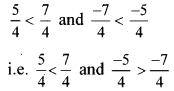
Download PDF
Maharashtra Board Solutions Class 8-Maths (Practice Set 1.2): Chapter 1- Rational and Irrational Numbers
Chapterwise Maharashtra Board Solutions Class 8 Maths :
- Chapter 1- Rational and Irrational Numbers (Practice Set 1.1)
- Chapter 1- Rational and Irrational Numbers (Practice Set 1.2)
- Chapter 1- Rational and Irrational Numbers (Practice Set 1.3)
- Chapter 1- Rational and Irrational Numbers (Practice Set 1.4)
- Chapter 2- Parallel Lines and Transversals (Practice Set 2.1)
- Chapter 2- Parallel Lines and Transversals (Practice Set 2.2)
- Chapter 2- Parallel Lines and Transversals (Practice Set 2.3)
- Chapter 3- Indices and Cube Root (Practice Set 3.1)
- Chapter 3- Indices and Cube Root (Practice Set 3.2)
- Chapter 3- Indices and Cube Root (Practice Set 3.3)
- Chapter 4- Altitudes and Medians of a Triangle (Practice Set 4.1)
- Chapter 5- Expansion Formulae (Practice Set 5.1)
- Chapter 5- Expansion Formulae (Practice Set 5.2)
- Chapter 5- Expansion Formulae (Practice Set 5.3)
- Chapter 5- Expansion Formulae (Practice Set 5.4)
- Chapter 6- Factorisation of Algebraic Expressions (Practice Set 6.1)
- Chapter 6- Factorisation of Algebraic Expressions (Practice Set 6.2)
- Chapter 6- Factorisation of Algebraic Expressions (Practice Set 6.3)
- Chapter 6- Factorisation of Algebraic Expressions (Practice Set 6.4)
- Chapter 7- Variation (Practice Set 7.1)
- Chapter 7- Variation (Practice Set 7.2)
- Chapter 7- Variation (Practice Set 7.3)
- Chapter 8- Quadrilateral: Constructions and Types (Practice Set 8.1)
- Chapter 8- Quadrilateral: Constructions and Types (Practice Set 8.2)
- Chapter 8- Quadrilateral: Constructions and Types (Practice Set 8.3)
- Chapter 9- Discount and Commission (Practice Set 9.1)
- Chapter 9- Discount and Commission (Practice Set 9.2)
- Chapter 10- Division of Polynomials (Practice Set 10.1)
- Chapter 10- Discount and Commission (Practice Set 10.2)
- Chapter 11- Statistics (Practice Set 11.1)
- Chapter 11- Statistics (Practice Set 11.2)
- Chapter 11- Statistics (Practice Set 11.3)
- Chapter 12- Equations in One Variable (Practice Set 12.1)
- Chapter 12- Equations in One Variable (Practice Set 12.2)
- Chapter 13- Congruence of Triangles (Practice Set 13.1)
- Chapter 13- Congruence of Triangles (Practice Set 13.2)
- Chapter 14- Compound Interest (Practice Set 14.1)
- Chapter 14- Compound Interest (Practice Set 14.2)
- Chapter 15- Area (Practice Set 15.1)
- Chapter 15- Area (Practice Set 15.2)
- Chapter 15- Area (Practice Set 15.3)
- Chapter 15- Area (Practice Set 15.4)
- Chapter 15- Area (Practice Set 15.5)
- Chapter 15- Area (Practice Set 15.6)
- Chapter 16- Surface Area and Volume (Practice Set 16.1)
- Chapter 16- Surface Area and Volume (Practice Set 16.2)
- Chapter 16- Surface Area and Volume (Practice Set 16.3)
- Chapter 17- Factorisation of Algebraic Expressions (Practice Set 17.1)
- Chapter 17- Factorisation of Algebraic Expressions (Practice Set 17.2)