

Class 8: Maths Chapter 2 solutions. Complete Class 8 Maths Chapter 2 Notes.
Contents
Maharashtra Board Solutions Class 8-Maths (Practice Set 2.2): Chapter 2- Parallel Lines and Transversals
Maharashtra Board 8th Maths Chapter 2, Class 8 Maths Chapter 2 solutions
Question 1.
Choose the correct alternative.
i. In the given figure, if line m || line n and line p is a transversal, then find x.
(A) 135°
(B) 90°
(C) 45°
(D) 40°
Solution:
(C) 45°
Hint: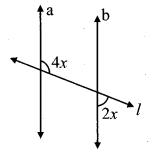
line m || line n and line p is a transversal.
∴ m∠BFG + m∠FGD = 180°
…[Interior angles]
∴ 3x + x = 180°
∴ 4x = 180°
∴ x = 1804
∴ x = 45°
ii. In the given figure, if line a || line b and line l is a transversal, then find x.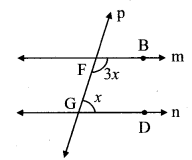
(A) 90°
(B) 60°
(C) 45°
(D) 30°
Solution:
(D) 30°
Hint: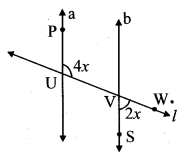
line a || line b and line l is a transversal.
∴ m∠UVS = m∠PUV
…[Alternate angles]
= 4x
m∠UVS + m∠WVS = 180°
… [Angles in a linear pair]
∴ 4x + 2x = 180°
∴ 6x = 180°
∴ x = 1806
∴ x = 30°
Question 2.
In the given figure, line p || line q. Line t and line s are transversals. Find measure of ∠x and ∠y using the measures of angles given in the figure.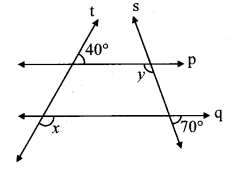
Solution: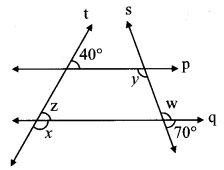
i. Consider ∠z as shown in figure.
line p || line q and line t is a transversal.
∴ m∠z = 40° …(i) [Corresponding angles]
m∠x + m∠z = 180° …[Angles in a linear pair]
∴ m∠x + 40o = 180° …[From(i)]
∴ m∠x= 180° – 40°
∴ m∠x = 140°
ii. Consider ∠w as shown in the figure.
m∠w + 70° = 180° …[Angles in a linear pair]
∴ m∠w = 180° – 70°
∴ m∠w = 110° …(ii)
line p || line q and line s is a transversal.
∴ m∠y = m∠w …[Alternate angles]
∴ m∠y =110° …[From (ii)]
∴ m∠x = 140°, m∠y = 110°
Question 3.
In the given figure, line p || line q, line l || line m. Find measures of ∠a, ∠b and ∠c, using the measures of given angles. Justify your answers.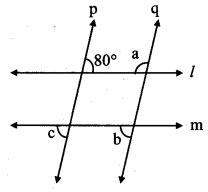
Solution:
i. line p || line q and line l is a transversal.
∴ m∠a + 80° = 180° …[Interior angles]
∴ m∠a= 180° – 80°
∴ m∠a= 100°
ii. line l || line m and line p is a transversal.
∴ m∠c = 80° …(i) [Exterior alternate angles]
iii. line p || line q and line m is a transversal.
∴ m∠b = m∠c … [Corresponding angles]
m∠b = 80° …[From (i)]
∴ m∠a = 100°, m∠b = 80°, m∠c = 80°
Question 4.
In the given figure, line a || line b, line l is a transversal. Find the measures of ∠x, ∠y, ∠z using the given information.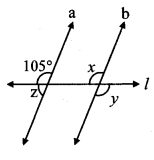
Solution:
line a || line b and line l is a transversal.
∴ m∠x = 105° …(i) [Corresponding angles]
ii. m∠y = m∠x … [Vertically opposite angles]
∴ m∠y = 105° …[From (i)]
iii. m∠z + 105° = 180° …[Angles in a linear pair]
∴ m∠z = 180°- 105°
∴ m∠z = 75°
∴ m∠x = 105°, m∠y = 105°, m∠z = 75°
Question 5.
In the given figure, line p || line l || line q. Find ∠x with the help of the measures given in the figure.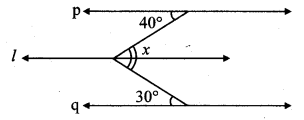
Solution: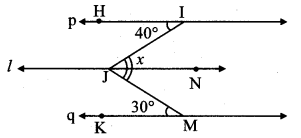
line p || line l and line IJ is a transversal.
m∠IJN = m∠JIH … [Alternate angles]
∴ m∠IJN = 40° …(i)
line l || line q and line MJ is a transversal.
m∠MJN = m∠JMK … [Alternate angles]
∴ m∠MJN = 30° …(ii)
Now, m∠x = m∠IJN + m∠MJN
…[Angle addition property]
= 40° + 30° …[From (i) and (ii)]
∴ m∠x = 70°
Intext Questions and Activities
Question 1.
When two parallel lines are intersected by a transversal eight angles are formed. If the measure of one of these eight angles is given, can we find measures of remaining seven angles? (Textbook pg, no. 9)
Solution:
Yes, we can find the measures of the remaining angles.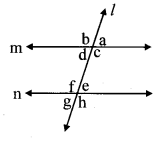
In the given figure, line m || line n and line l is a transversal.
m∠a = 60°(say) …(i)
i. m∠a + m∠b = 180° …[Angles in a linear pair]
∴ 60° + m∠b =180° … [From (i)]
∴ m∠b = 180° – 60°
∴ m∠b = 120° …(ii)
ii. m∠c = m∠b …[Vertically opposite angles]
∴ m∠c = 120° .. .(iii) [From (ii)]
iii. m∠d = m∠a …[Vertically opposite angles]
∴ m∠d = 60° …(iv) [From (i)]
iv. m∠e = m∠d …[Alternate angles]
∴ m∠e = 60° … [From (iv)]
v. m∠f = m∠c …[Alternate angles]
∴ m∠f = 120° …[From (iii)]
vi. m∠g = m∠d …[Corresponding angles]
∴ m∠g = 60° … [From (iv)]
vii. m∠h = m∠c … [Corresponding angles]
∴ m∠h = 120° …[From (iii)]
Question 2.
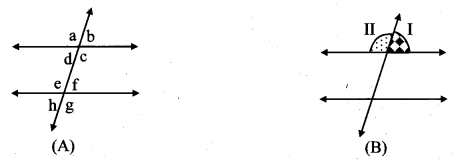
As shown in the figure (A), draw two parallel lines and their transversal on a paper. Draw a copy of the figure on another blank sheet using a trace paper, as shown in the figure (B). Colour part Land part II with different colours. Cut out the two parts with a pair of scissors. Place, part I and part II on each angle in the figure A and answer the following questions. (Textbook pg. no. 9)
- Which angles coincide with part I?
- Which angles coincide with part II?
Solution:
- ∠d, ∠f and ∠h coincide with part I.
- ∠c, ∠e and ∠g coincide with part II.
Download PDF
Maharashtra Board Solutions Class 8-Maths (Practice Set 2.2): Chapter 2- Parallel Lines and Transversals
Chapterwise Maharashtra Board Solutions Class 8 Maths :
- Chapter 1- Rational and Irrational Numbers (Practice Set 1.1)
- Chapter 1- Rational and Irrational Numbers (Practice Set 1.2)
- Chapter 1- Rational and Irrational Numbers (Practice Set 1.3)
- Chapter 1- Rational and Irrational Numbers (Practice Set 1.4)
- Chapter 2- Parallel Lines and Transversals (Practice Set 2.1)
- Chapter 2- Parallel Lines and Transversals (Practice Set 2.2)
- Chapter 2- Parallel Lines and Transversals (Practice Set 2.3)
- Chapter 3- Indices and Cube Root (Practice Set 3.1)
- Chapter 3- Indices and Cube Root (Practice Set 3.2)
- Chapter 3- Indices and Cube Root (Practice Set 3.3)
- Chapter 4- Altitudes and Medians of a Triangle (Practice Set 4.1)
- Chapter 5- Expansion Formulae (Practice Set 5.1)
- Chapter 5- Expansion Formulae (Practice Set 5.2)
- Chapter 5- Expansion Formulae (Practice Set 5.3)
- Chapter 5- Expansion Formulae (Practice Set 5.4)
- Chapter 6- Factorisation of Algebraic Expressions (Practice Set 6.1)
- Chapter 6- Factorisation of Algebraic Expressions (Practice Set 6.2)
- Chapter 6- Factorisation of Algebraic Expressions (Practice Set 6.3)
- Chapter 6- Factorisation of Algebraic Expressions (Practice Set 6.4)
- Chapter 7- Variation (Practice Set 7.1)
- Chapter 7- Variation (Practice Set 7.2)
- Chapter 7- Variation (Practice Set 7.3)
- Chapter 8- Quadrilateral: Constructions and Types (Practice Set 8.1)
- Chapter 8- Quadrilateral: Constructions and Types (Practice Set 8.2)
- Chapter 8- Quadrilateral: Constructions and Types (Practice Set 8.3)
- Chapter 9- Discount and Commission (Practice Set 9.1)
- Chapter 9- Discount and Commission (Practice Set 9.2)
- Chapter 10- Division of Polynomials (Practice Set 10.1)
- Chapter 10- Discount and Commission (Practice Set 10.2)
- Chapter 11- Statistics (Practice Set 11.1)
- Chapter 11- Statistics (Practice Set 11.2)
- Chapter 11- Statistics (Practice Set 11.3)
- Chapter 12- Equations in One Variable (Practice Set 12.1)
- Chapter 12- Equations in One Variable (Practice Set 12.2)
- Chapter 13- Congruence of Triangles (Practice Set 13.1)
- Chapter 13- Congruence of Triangles (Practice Set 13.2)
- Chapter 14- Compound Interest (Practice Set 14.1)
- Chapter 14- Compound Interest (Practice Set 14.2)
- Chapter 15- Area (Practice Set 15.1)
- Chapter 15- Area (Practice Set 15.2)
- Chapter 15- Area (Practice Set 15.3)
- Chapter 15- Area (Practice Set 15.4)
- Chapter 15- Area (Practice Set 15.5)
- Chapter 15- Area (Practice Set 15.6)
- Chapter 16- Surface Area and Volume (Practice Set 16.1)
- Chapter 16- Surface Area and Volume (Practice Set 16.2)
- Chapter 16- Surface Area and Volume (Practice Set 16.3)
- Chapter 17- Factorisation of Algebraic Expressions (Practice Set 17.1)
- Chapter 17- Factorisation of Algebraic Expressions (Practice Set 17.2)
FAQs
You can download the Maharashtra State Board Books from the eBalbharti official website, i.e. cart.ebalbharati.in or from this article.
Students can get the Maharashtra Books for primary, secondary, and senior secondary classes from here. You can view or download the Maharashtra State Board Books from this page or from the official website for free of cost. Students can follow the detailed steps below to visit the official website and download the e-books for all subjects or a specific subject in different mediums.
Step 1: Visit the official website ebalbharati.in
Step 2: On the top of the screen, select “Download PDF textbooks”
Step 3: From the “Classes” section, select your class.
Step 4: From “Medium”, select the medium suitable to you.
Step 5: All Maharashtra board books for your class will now be displayed on the right side.
Step 6: Click on the “Download” option to download the PDF book.
As of now, the MSCERT and Balbharti are responsible for the syllabus and textbooks of Classes 1 to 8, while Classes 9 and 10 are under the Maharashtra State Board of Secondary and Higher Secondary Education (MSBSHSE).
The Maharashtra State Board of Secondary & Higher Secondary Education, conducts the HSC and SSC Examinations in the state of Maharashtra through its nine Divisional Boards located at Pune, Mumbai, Aurangabad, Nasik, Kolhapur, Amravati, Latur, Nagpur and Ratnagiri.
About Maharashtra State Board (MSBSHSE)
The Maharashtra State Board of Secondary and Higher Secondary Education or MSBSHSE (Marathi: महाराष्ट्र राज्य माध्यमिक आणि उच्च माध्यमिक शिक्षण मंडळ), is an autonomous and statutory body established in 1965. The board was amended in the year 1977 under the provisions of the Maharashtra Act No. 41 of 1965.
The Maharashtra State Board of Secondary & Higher Secondary Education (MSBSHSE), Pune is an independent body of the Maharashtra Government. There are more than 1.4 million students that appear in the examination every year. The Maha State Board conducts the board examination twice a year. This board conducts the examination for SSC and HSC.
The Maharashtra government established the Maharashtra State Bureau of Textbook Production and Curriculum Research, also commonly referred to as Ebalbharati, in 1967 to take up the responsibility of providing quality textbooks to students from all classes studying under the Maharashtra State Board. MSBHSE prepares and updates the curriculum to provide holistic development for students. It is designed to tackle the difficulty in understanding the concepts with simple language with simple illustrations. Every year around 10 lakh students are enrolled in schools that are affiliated with the Maharashtra State Board.