
Class 8: Chemistry Chapter 4 solutions. Complete Class 8 Chemistry Chapter 4 Notes.
Selina Class 8 ICSE Solutions Chemistry : Chapter 4- Atomic Structure
Selina 8th Chemistry Chapter 4, Class 8 Chemistry Chapter 4 solutions
Question 1.
Fill in the blanks.
(a) Dalton said that atoms could not be divided
(b) An ion which has a positive charge is called a cation
(c) The outermost shell of an atom is known as valence shell
(d) The nucleus of an atom is very hard and dense.
(e) Neutrons are neutral particles having a mass equal to that of protons.
(f) Isotopes are the atoms of an element having the same atomic number but a different mass number.
Question 2.
Write ‘true’ or ‘false’ for the following statements:
(a) An atom, on the whole, has a positive charge.
False
(b) The maximum number of electrons in the first shell can be 8.
False
(c) The central pad of the atom is called the nucleus.
True.
Question 3.
Give the following a suitable word/phrase.
(a) The sub-atomic particle with a negative charge and negligible mass.
Solution: Neutron
(b) Protons and neutrons present in the nucleus.
Solution: Mass number
(c) The electrons present in the outermost shell.
Solution: Valency
(d) Arrangement of electrons in the shells of an atom.
Solution: Orbits or Valence shells
(e) The number of protons present in the nucleus of an atom.
Solution: Atomic number
(f) The sum of the number of protons and neutrons of an atom.
Solution: Mass number
(g) Atoms of the same element with same atomic number but a different mass number.
Solution: Isotopes
(h) The smallest unit of an element which takes part in a chemical reaction.
Solution: Atom
Question 4.
Multiple Choice Questions
(a) The outermost shell of an atom is known as
1. valency
2. valence electrons
3. nucleus
4. valence shell
Answer: 2. valence electrons
(b) The number of valence electrons present in magnesium is
1. two
2. three
3. four
4. five
Answer: 1. two
(c) The subatomic particle with a negative charge is
1. proton
2. neutron
3. electron
4. nucleon
Answer: 3. electron
(d) If the atomic number of an atom is 17 and the mass number is 35 then the number of neutrons will be
1. 35
2. 17
3. 18
4. 52
Answer: 3. 18
(e) The number of electrons in an atom is equal to the number of
1. protons in a neutral atom
2. neutrons in a neutral atom
3. nucleons in a neutral atom
4. none of the above
Answer: 1. protons in a neutral atom
(f) The sum of the number of protons and the number of neutrons present in the nucleus of an atom is called its
1. mass number
2. atomic number
3. number of electrons
4. all of the above
Answer: 1. mass number
Question 5.
Name three fundamental particles of the atom. Give the symbol with charge, on each particle.
Solution:
The fundamental particles of the atom are electrons, protons and neutrons.
| Particle | Symbol | Charge |
| Electron | e_ | -1 or -1.602×10⁻¹⁹ c. where-1 represent its one unit negative electrical charge |
| Proton | p+ | +1 or 1.602×10⁻¹⁹ c.where1 represents one unite +ve electrical charge. |
| Neutron | n0 | 0 |
Question 6.
Define the following terms:
(a) Atomic number
(b) Mass number
(c) Nucleons
(d) Valence shell
Solution:
(a) Atomic number: The number of protons present in an atom is known as Atomic number. It is denoted by Z. Example: An atom of oxygen contains 8 protons. Therefore its atomic number is 8.
(b) Mass number: The sum of the number of protons and neutrons present in the nucleus of an atom is known as the Mass number and it is denoted by A.
I.e. Mass number = Number of protons + Number of neutrons.
(c) Nucleons: The protons and neutrons collectively are known as nucleons.
(d) Valence Shell: The outermost shell of an atom is known as its valence shell.
Question 7.
Mention briefly the salient features of Dalton’s atomic theory (five points).
Solution:
Salient features of Dalton’s atomic theory:
1. The matter has very small and indivisible particles called atoms, it can neither be created nor be destroyed.
2. The atoms of an element are alike in all aspects i.e. size, mass, density, chemical properties but they differ from the atoms of other elements.
3. Atoms of an element combine in small numbers to form molecules of the element.
4. Atoms of one element combine with atoms of another element in a simple number ratio to form molecules of compounds.
5. Atoms are the smallest units of matter that can take part in a chemical reaction during which the only rearrangement of atoms takes place.
Question 8.
(a) What are the two main features of Rutherford’s atomic model?
(b) State its one drawback.
Solution:
(a) According to Rutherford’s model, an atom consists of
- The centrally located nucleus
- The outer circular orbits
A positively charged mass is located centrally called nucleus. The entire mass of the atom is concentrated in it. It is the densest part of the atom. Its size is very small as compared to the atom as a whole.
Electrons revolve in circular orbits in the space available around the nucleus. An atom is electrically neutral i.e., the number of protons and electrons present in an atom are equal.
(b) The stability of the atom could not be explained by Rutherford’s atomic model as it is like a solar system, the sun is at the centre and the planets revolve around it, in an atom the electrons revolve around the centrally located nucleus containing protons.
Question 9.
What are the observations of the experiment done by Rutherford in order to determine the structure of an atom?
Solution:
Following were the observations made by Rutherford:
- Most of the alpha particle passed straight through the foil without any deflection from their path.
- Only a small fraction of alpha particles were deflected from their actual path by small angles.
- Only a few particles bounced back.
Question 10.
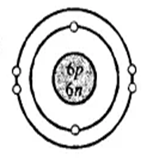
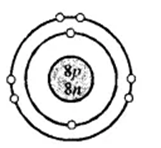
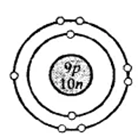
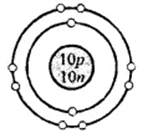
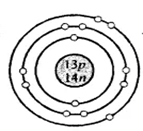
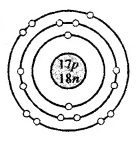
State the mass number, the atomic number of neutrons and electronic configuration of the following atoms.
Also, draw atomic diagrams for them.
Solution:
| Name of elements | Atomic number | Atomic mass | No. of proton | No. of electrons | No. of neutrons | Electronic configuration |
| 6 | 12 | 6 | 6 | 6 | 2,4 | |
| 8 | 16 | 8 | 8 | 8 | 2,6 | |
| 9 | 19 | 9 | 9 | 10 | 2,7 | |
| 10 | 20 | 10 | 10 | 10 | 2,8 | |
| 13 | 27 | 13 | 13 | 14 | 2,8,3 | |
| 17 | 35 | 17 | 17 | 18 | 2,8,7 |
Carbon –
Oxygen –
Fluorine –
Neon –
Aluminium –
Chlorine –
Download PDF
Selina Class 8 ICSE Solutions Chemistry : Chapter 1- Matter
Download PDF: Selina Class 8 ICSE Solutions Chemistry : Chapter 1- Matter PDF
Chapterwise Selina Publishers ICSE Solutions for Class 8 Chemistry :
- Chapter 1- Matter
- Chapter 2- Physical and Chemical Changes
- Chapter 3- Elements, Compounds and Mixtures
- Chapter 4- Atomic Structure
- Chapter 5- Language of Chemistry Solutions
- Chapter 6- Chemical Reactions Solutions
- Chapter 7- Hydrogen Solutions
- Chapter 8- Water Solutions
- Chapter 9- Carbon and Its Compounds
About Selina Publishers ICSE
Selina Publishers has been serving the students since 1976 and is one of the quality ICSE school textbooks publication houses. Mathematics and Science books for classes 6-10 form the core of our business, apart from certain English and Hindi literature as well as a few primary books. All these books are based upon the syllabus published by the Council for the I.C.S.E. Examinations, New Delhi. The textbooks are composed by a panel of subject experts and vetted by teachers practising in ICSE schools all over the country. Continuous efforts are made in complying with the standards and ensuring lucidity and clarity in content, which makes them stand tall in the industry.