
Class 8: Chemistry Chapter 1 solutions. Complete Class 8 Chemistry Chapter 1 Notes.
Selina Class 8 ICSE Solutions Chemistry : Chapter 1- Matter
Selina 8th Chemistry Chapter 1, Class 8 Chemistry Chapter 1 solutions
Question 1.
Define:
(a) Matter
Solution:
(a) The matter is anything that occupies space, has mass and can be perceived by our senses.
Example: Air, Book.
(b) An intermolecular force of attraction
Solution:
(b) Due to intermolecular force of attraction, the molecules of matter are always in motion and attract each other with a force due to which they are held together.
Question 2.
What are the three states of matter? Define each of them with two examples.
Solution:
The three states of matter are:
Solids, liquids and gases
- Solids – A solid has a standard volume and shape. Example- wood, stone, iron, ice etc.
- Liquid – A liquid has a definite volume but not a definite shape. Example- water, juice, milk, oil, etc.
- Gases – A gas neither has definite shape nor a definite volume. Example- air, hydrogen, oxygen, water vapour etc.
Question 3.
Define interconversion of states of matter. What are the two factors responsible for the change of states of matter?
Solution:
A process in which things changes from one state to another and get back to the original state, without any change in its chemical composition is called interconversion state of matter.
Two factors responsible for the change of state of matter are: change in
- Temperature
- Pressure
Question 4.
State the main postulates of the kinetic theory of matter.
Solution:
The main postulates of the theory are:
1. The matter is made up of very small particles.
2. The constituent particles of a kind of matter are identical in all respects.
3. These particles have space or gaps between them which is known as interparticular or intermolecular space.
4. There exists a force of attraction between the particles of matter which holds them together. This force of attraction is known as interparticular or intermolecular force of attraction.
5. Particles of matter are always in a state of random motion and possess kinetic energy, which increases with increase in temperature and vice-versa.
Question 5.
What happens to water if
(a) It is kept in a deep freezer
(b) It is heated
Explain the phenomenon of change of state of water.
Solution:
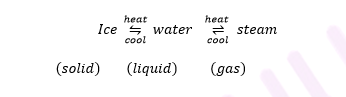
(a) When water is placed in a deep freezer, it is cooled and changed into ice at 0°C ice.
Water Ice (0oC)
(b Water on heating changes into steam at 100oC
Water steam (100oC)
The phenomenon of change of state of water: In ordinary conditions, water is in the liquid state but when it is placed in a deep freezer, it changes into ice at 0°C and when ice is kept at room temperature again changes back into liquid water.
Likewise, when heating water, it changes into steam at 100°C, which on cooling changes back into liquid water. But there is no change in the chemical composition of water. When its state changes from liquid to solid or liquid to the gaseous state.
Question 6.
(a) State the law of conversation of mass.
(b) What do you observe when barium chloride solution is mixed with a sodium sulphate solution?
Solution:
(a) “Matter can neither be created nor be destroyed in a chemical reaction”. But we can change it from one form to another.
It can also be stated as, “In a chemical reaction, the total mass of the reactants is equal to the total mass of the products”.
(b)
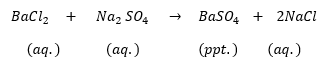
We can observe that a white insoluble solid (precipitate of barium sulphate) is formed along with a solution of sodium chloride. Then, wait for ten minutes for the reaction to be completed and the solid formed to settle down and then weigh the content again. Finally, note the reading.
We will observe that the total mass of the apparatus + reactants = total mass of apparatus + products. Hence the law of conservation of mass is verified.
Question 7.
Give reasons:
(a) A gas can fill the whole vessel in which it is enclosed.
(b) Solids cannot be compressed.
(c) Liquids can flow.
(d) When magnesium is burnt in air, there is an increase in mass after the reaction.
Solution:
(a) Because, in gases, the molecules are free to move. They are not stuck to each other and the intermolecular force of attraction is least in the gases. So the gas almost filled the whole vessel in which it is enclosed.
(b) In solids, particles are closely packed. The intermolecular space is almost zero due to a strong force of attraction. Therefore the molecules are not free to move, which makes them hard and rigid. So solids cannot be compressed.
(c) Due to the weaker intermolecular forces in liquids, the particles are not closely packed and hence there is large intermolecular space. So molecules in liquids can move randomly and hence liquids can flow easily.
(d) When magnesium ribbon is burnt in air, a white solid, magnesium oxide is formed. The mass of magnesium is more than the mass of magnesium oxide. This is because the mass of oxygen used is not taken. If that is considered, the total mass of the reactants and the products are found to be almost equal.
2Mg + O2 → 2MgO
(Magnesium) (Air) (Magnesium oxide)
Question 8.
Fill in the blanks:
(a) The change of a solid into a liquid is called melting or fusion.
(b) The process in which a solid directly changes into a gas is called sublimation.
(c) The change of water vapour into water is called condensation.
(d) The temperature at which a liquid starts changing into its vapour state is evaporation or vaporisation.
Question 9.
Give two examples for each of the following:
(a) The substances which sublime.
(b) The substances which do not change their state on heating.
Solution:
(a) Camphor, iodine, naphthalene, dry ice (solid carbon dioxide), etc.
(b) Gases do not change their state on heating. For example, O2.
Question 10.
Define:
(a) Diffusion.
(b) Brownian motion.
Solution:
(a) Diffusion: The motion of their particles causes the intermixing of two or more substances in order to get a uniform mixture is called ‘diffusion’:
(b) Brownian motion: The haphazard, random motion of suspended particles on the surface of a liquid or in the air is called ‘Brownian motion’.
Download PDF
Selina Class 8 ICSE Solutions Chemistry : Chapter 1- Matter
Download PDF: Selina Class 8 ICSE Solutions Chemistry : Chapter 1- Matter PDF
Chapterwise Selina Publishers ICSE Solutions for Class 8 Chemistry :
- Chapter 1- Matter
- Chapter 2- Physical and Chemical Changes
- Chapter 3- Elements, Compounds and Mixtures
- Chapter 4- Atomic Structure
- Chapter 5- Language of Chemistry Solutions
- Chapter 6- Chemical Reactions Solutions
- Chapter 7- Hydrogen Solutions
- Chapter 8- Water Solutions
- Chapter 9- Carbon and Its Compounds
About Selina Publishers ICSE
Selina Publishers has been serving the students since 1976 and is one of the quality ICSE school textbooks publication houses. Mathematics and Science books for classes 6-10 form the core of our business, apart from certain English and Hindi literature as well as a few primary books. All these books are based upon the syllabus published by the Council for the I.C.S.E. Examinations, New Delhi. The textbooks are composed by a panel of subject experts and vetted by teachers practising in ICSE schools all over the country. Continuous efforts are made in complying with the standards and ensuring lucidity and clarity in content, which makes them stand tall in the industry.