
Class 11: Biology Chapter 14 solutions. Complete Class 11 Biology Chapter 14 Notes.
NCERT Solutions for 11th Class Biology: Chapter 14-Respiration in Plants
NCERT 11th Biology Chapter 14, class 11 Biology chapter 14 solutions
Page No: 238
Exercises
1. Differentiate between
(a) Respiration and Combustion
(b) Glycolysis and Krebs’cycle
(c) Aerobic respiration and Fermentation
Answer
(a) Respiration and Combustion
| Respiration | Combustion |
| It is a biochemical process. | It is a physiochemical process. |
| It occurs inside the cells. | It does not occur inside cells. |
| It is a biologically-controlled process. | It is an uncontrolled process. |
| No light is produced | Light may be produced |
| ATP is generated. | ATP is not generated. |
| Enzymes are required | Enzymes are not required |
(b) Glycolysis and Krebs’cycle
| Glycolysis | Krebs’cycle |
| The breakdown of glucose to pyruvic acid is called glycolysis. | The further processing of pyruvic acid through aerobic route is called Krebs’ cycle. |
| It is a linear pathway. | It is a cyclic pathway. |
| It occurs in the cell cytoplasm. | It occurs in the mitochondrial matrix. |
| It occurs in all living beings. | It occurs in aerobic respiration. |
| It generates 2 NADH2 and 2 ATP molecules on the breakdown of one glucose molecule. | It produces 6 NADH2, 2 FADH2, and 2 ATP molecules on the breakdown of two acetyl-CoA molecules. |
| No carbon dioxide evolved | Carbon dioxide evolved |
(c) Aerobic respiration and Fermentation
| Aerobic respiration | Fermentation |
| The complete oxidation of organic substances in the presence of oxygen. | The incomplete oxidation of glucose in the absence of oxygen. |
| It occurs in the cytoplasm and mitochondria | It occurs in the cytoplasm |
| The end products are carbon dioxide and water | The end products are ethyl alcohol and carbon dioxide |
| Complete oxidation of the respiratory substrate takes place | Incomplete oxidation of the respiratory substrate takes place |
| About 36 ATP molecules are produced | Only 2 ATP molecules are produced |
2. What are respiratory substrates? Name the most common respiratory substrate.
Answer
A compound which is oxidized during respiration is called respiratory substrate. Glucose is the most common respiratory substrate.
3. Give the schematic representation of glycolysis?
Answer
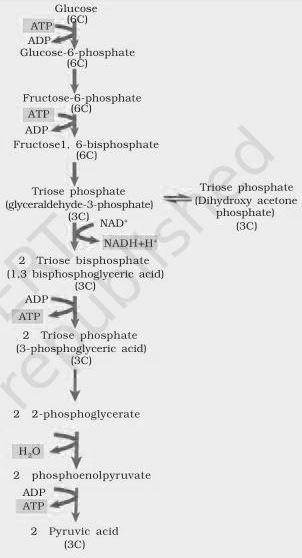
4. What are the main steps in aerobic respiration? Where does it take place?
Answer
The main steps in aerobic respiration and places of their occurrence are:
→ Glycolytic breakdown of glucose in to pyruvic acid in cytoplasm.
→ Krebs cycle in matrix of mitochondria
→ Electron transport system in inner mitochondrial membrane
→ Oxidative phosphorylation in the inner mitochondrial membrane.
5. Give the schematic representation of an overall view of Krebs cycle.
Answer
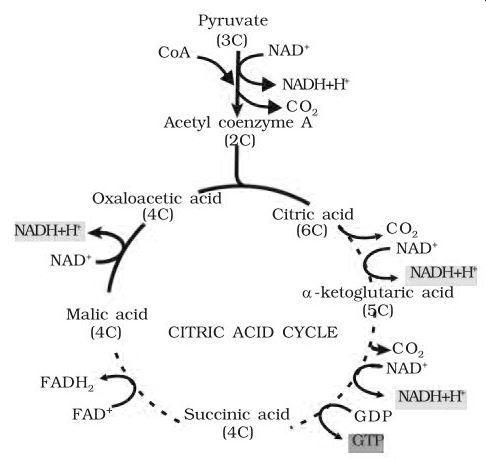
NCERT 11th Biology Chapter 14, class 11 Biology chapter 14 solutions
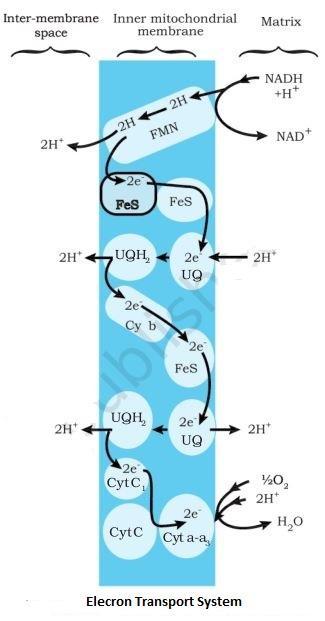
6. Explain ETS.
Answer
The metabolic pathway through which the electron passes from one carrier to another is called the electron transport system (ETS). It is located in the inner mitochondrial membrane. Electrons from NADH produced in the mitochondrial matrix during citric acid cycle are oxidised by an NADH dehydrogenase (complex I), and electrons are then transferred to ubiquinone located within the inner membrane. Ubiquinone also receives reducing equivalents via FADH2 (complex II) that is generated during oxidation of succinate in the citric acid cycle. The reduced ubiquinone (ubiquinol) is then oxidised with the transfer of electrons to cytochrome c via cytochrome bc 1 complex (complex III). The cytochrome c acts as a mobile carrier between complex III and cytochrome c oxidase complex, containing cytochrome a and a3, along with copper centres (complex IV).
During the transfer of electrons from each complex, the process is accompanied by the production of ATP from ADP and inorganic phosphate by the action ATP synthase (complex V). The amount of ATP produced depends on the molecule, which has been oxidized. 2 ATP molecules are produced by the oxidation of one molecule of NADH. One molecule of FADH2, on oxidation, gives 3 ATP molecules.
7. Distinguish between the following:
(a) Aerobic respiration and Anaerobic respiration
(b) Glycolysis and Fermentation
(c) Glycolysis and Citric acid Cycle
Answer
(a) Aerobic respiration and Anaerobic respiration
| Aerobic respiration | Anaerobic respiration |
| It takes place in the presence of oxygen. | It takes place in the absence of oxygen. |
| It occurs in cytoplasm and mitochondria. | It occurs in cytoplasm |
| The end products of aerobic respiration are carbon dioxide and water. | The end products of fermentation are ethyl alcohol and carbon-dioxide. |
| Complete oxidation of respiratory substrate takes place. | Incomplete oxidation of respiratory substrate takes place. |
| 36-38 ATP molecules are produced. | Only 2 ATP molecules are produced. |
(b) Glycolysis and Fermentation
| Glycolysis occurs during aerobic and anaerobic respiration. | Fermentation is a type of anaerobic respiration. |
| The end products of aerobic respiration is pyruvic acid | The end products of aerobic respiration is ethanol or lactic acid |
(c) Glycolysis and Citric acid Cycle
| Glycolysis | Citric acid Cycle |
| It is a linear pathway. | It is a cyclic pathway. |
| It occurs in the cell cytoplasm. | It occurs in the mitochondrial matrix. |
| It occurs in all living beings. | It occurs in aerobic respiration. |
| It generates 2 NADH2 and 2 ATP molecules on the breakdown of one glucose molecule. | It generates 6 NADH2, 2 FADH2, and 2 ATP molecules on the breakdown of two acetyl-CoA molecules. |
8. What are the assumptions made during the calculation of net gain of ATP?
Answer
The following assumptions are made during the calculation of net gain of ATP:
• There is a sequential, orderly pathway functioning, with one substrate forming the next and with glycolysis, TCA cycle and ETS pathway following one after another.
• The NADH synthesised in glycolysis is transferred into the mitochondria and undergoes oxidative phosphorylation.
• None of the intermediates in the pathway are utilised to synthesise any other compound.
• Only glucose is being respired – no other alternative substrates are entering in the pathway at any of the intermediary stages.
9. Discuss "The respiratory pathway is an amphibolic pathway."
Answer
The breaking down process occurring within the organism is known as catabolic process and the synthesis process is known as anabolism. The respiratory pathway involves both the catabolic and anabolic process, so it is referred as amphibolic pathway.
NCERT 11th Biology Chapter 14, class 11 Biology chapter 14 solutions
10. Define RQ. What is its value for fats?
Answer
The ratio of the volume of CO2 evolved to the volume of O2 consumed in respiration is called the respiratory quotient (RQ). The RQ for carbohydrates is 1. The RQ for fat and protein is less than 1.
For example: Calculations for a fatty acid, tripalmitin
2(C5H98O6) + 145O2 → 102 CO2 + 98 H2O
RQ = Volume of CO2 evolved/Volume of O2 consumed
= 102 CO2/145O2 = 0.7
NCERT 11th Biology Chapter 14, class 11 Biology chapter 14 solutions
11. What is oxidative phosphorylation?
Answer
The generation of ATP from ADP during electron transport system by utilizing the energy obtained during oxidative reaction is called oxidative phosphorylation.
12. What is the significance of step-wise release of energy in respiration?
Answer
The significance of step-wise release of energy in respiration are:
→ It facilitates the utilization of the relatively higher proportion of the energy in ATP synthesis.
→ The activities of enzymes for the different steps may be enhanced or inhibited by specific compounds. This provides a mean of controlling the rate of the pathway and the energy output according to the need of the cell.
→ The same pathway may be utilized for forming intermediates used in the synthesis of other biomolecules like amino acids.
NCERT 11th Biology Chapter 14
NCERT Solutions for 11th Class Biology: Chapter 14: Download PDF
NCERT Solutions for 11th Class Biology: Chapter 14-Respiration in Plants
Download PDF: NCERT Solutions for 11th Class Biology: Chapter 14-Respiration in Plants PDF
Chapterwise NCERT Solutions for Class 11 Biology:
- Chapter 1: The Living World
- Chapter 2: Biological Classification
- Chapter 3: Plant Kingdom
- Chapter 4: Animal Kingdom
- Chapter 5: Morphology of Flowering Plants
- Chapter 6: Anatomy of Flowering Plants
- Chapter 7: Structural Organisation in Animals
- Chapter 8: Cell-The Unit of Life
- Chapter 9: Biomolecules
- Chapter 10: Cell Cycle and Cell Division
- Chapter 11: Transport in Plants
- Chapter 12: Mineral Nutrition
- Chapter 13: Photosynthesis in Higher Plants
- Chapter 14: Respiration in Plants
- Chapter 15: Plant - Growth and Development
- Chapter 16: Digestion and Absorption
- Chapter 17: Breathing and Exchange of Gases
- Chapter 18: Body Fluids and Circulation
- Chapter 19: Excretory Products and Their Elimination
- Chapter 20: Locomotion and Movement
- Chapter 21: Neural Control and Coordination
- Chapter 22: Chemical Coordination and Integration
About NCERT
The National Council of Educational Research and Training is an autonomous organization of the Government of India which was established in 1961 as a literary, scientific, and charitable Society under the Societies Registration Act. Its headquarters are located at Sri Aurbindo Marg in New Delhi. Visit the Official NCERT website to learn more.