
Class 11: Biology Chapter 13 solutions. Complete Class 11 Biology Chapter 13 Notes.
NCERT Solutions for 11th Class Biology: Chapter 13-Photosynthesis in Higher Plants
NCERT 11th Biology Chapter 13, class 11 Biology chapter 13 solutions
Page No: 224
Exercises
1. By looking at a plant externally can you tell whether a plant is C3 or C4? Why and how?
Answer
We can't tell whether a plant is C3 or C4by looking at a plant externally. However, plants which which are adapted to dry climates follow the C4 pathway. Unlike C3 plants, the leaves of C4 plants have a special anatomy but this difference can only be observed at the cellular level.
2. By looking at which internal structure of a plant can you tell whether a plant is C3 or C4? Explain.
Answer
As leaves of C4 plants have a special anatomy called Kranz anatomy. This makes them different from C3 plants. Special cells, known as bundle-sheath cells, surround the vascular bundles. These cells have a large number of chloroplasts. They are thick-walled and have no intercellular spaces. Therefore, we can tell whether a plant is C3 or C4 through internal structure.
3. Even though a very few cells in a C4 plant carry out the biosynthetic - Calvin pathway, yet they are highly productive. Can you discuss why?
Answer
In C4 plants photorespiration does not occur because they have a mechanism that increases the concentration of CO2 at the enzyme site. This takes place when the C4 acid from the mesophyll is broken down in the bundle sheath cells to release CO2 that results in increasing the intracellular concentration of CO2. In turn, this ensures that the RuBisCO functions as a carboxylase minimising the oxygenase activity. Thus, the photosynthesis rate increases and make C4 plants more productive.
4. RuBisCo is an enzyme that acts both as a carboxylase and oxygenase. Why do you think RuBisCo carries out more carboxylation in C4 plants?
Answer
The enzyme RuBisCo is absent from the mesophyll cells of C4 plants. It is present in the bundle-sheath cells surrounding the vascular bundles. In C4 plants, the Calvin cycle occurs in the bundle-sheath cells. The primary CO2 acceptor in the mesophyll cells is phosphoenol pyruvate -a three-carbon compound. It is converted into the four-carbon compound oxaloacetic acid (OAA). OAA is further converted into malic acid. Malic acid is transported to the bundle-sheath cells, where it undergoes decarboxylation and CO2 fixation occurs by the Calvin cycle. This prevents the enzyme RuBisCo from acting as an oxygenase.
NCERT 11th Biology Chapter 13, class 11 Biology chapter 13 solutions
5. Suppose there were plants that had a high concentration of Chlorophyll b, but lacked chlorophyll a, would it carry out photosynthesis? Then why do plants have chlorophyll b and other accessory pigments?
Answer
If there were complete absence of chlorophyll a in a plant, it would not carry out photosynthetic activity at all because chlorophyll a is the chief pigment associated with photosynthesis as it traps light. Other accessory pigments like chlorophyll b, santhophylls and carotenoids are equally essential as they also absorb light and transfer energy to chlorophyll a. They also enable a wider range of wavelength of incoming light to be utilised for photosynthesis and protect chlorophyll a from photo- oxidation.
6. Why is the colour of a leaf kept in the dark frequently yellow, or pale green? Which pigment do you think is more stable?
Answer
Chlorophyll or green pigment is unable to absorb energy in the absence of light therefore loses its stability. Thus, the colour of leaf changes to yellow or pale green. This shows that Carotenoids and Xanthophyll pigments are more stable.
NCERT 11th Biology Chapter 13, class 11 Biology chapter 13 solutions
7. Look at leaves of the same plant on the shady side and compare it with the leaves on the sunny side. Or, compare the potted plants kept in the sunlight with those in the shade. Which of them has leaves that are darker green? Why?
Answer
The plants placed in light will have darker leaves as compared to leaves of a plant placed in shade. As leaves in shade get lesser light for photosynthesis so they perform lesser photosynthesis as compared to the leaves or plants kept in sunlight. To increase the rate of photosynthesis, the leaves present in shade have more chlorophyll pigments. This increase in chlorophyll content increases the amount of light absorbed by the leaves, which in turn increases the rate of photosynthesis which makes the leaves or plants in shade greener than the leaves or plants kept in the sun.
8. Figure 13.10 shows the effect of light on the rate of photosynthesis. Based on the graph, answer the following questions:
(a) At which point/s (A, B or C) in the curve is light a limiting factor?
(b) What could be the limiting factor/s in region A?
(c) What do C and D represent on the curve?
Answer
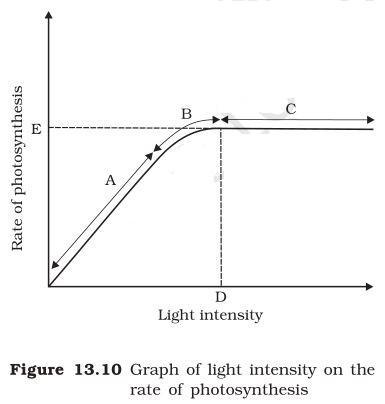
(a) At point A
(b) Light is a limiting factor also, water, temperature, and the concentration of carbon dioxide could also be limiting factors in the region A.
(c) C represents the stage beyond which light is not a limiting factor. D represents the stage beyond which intensity of light has no effect on the rate of photosynthesis.
NCERT 11th Biology Chapter 13, class 11 Biology chapter 13 solutions
9. Give comparison between the following:
(a) C3 and C4 pathways
(b) Cyclic and non-cyclic photophosphorylation
(c) Anatomy of leaf in C3 and C4 plants
Answer
| C3 pathways | C4 pathways |
| The primary acceptor of CO2 is RUBP - a five-carbon compound. | The primary acceptor of CO2 is phosphoenol pyruvate - a three-carbon compound. |
| The first stable product is 3 phosphoglycerate. | The first stable product is oxaloacetic acid. |
| It occurs only in the mesophyll cells of the leaves. | It occurs in the mesophyll and bundle-sheath cells of the leaves. |
| It is a slower process of carbon fixation and photo-respiratory losses are high. | It is a faster process of carbon fixation and photo-respiratory losses are low. |
(b) Cyclic and non-cyclic photophosphorylation
| Cyclic photophosphorylation | Non-cyclic photophosphorylation |
| It occurs only in photosystem I. | It occurs both in photosystems I and II. |
| It involves only the synthesis of ATP. | It involves the synthesis of ATP and NADPH2. |
| In this process, photolysis of water does not occur. Therefore, oxygen is not produced. | In this process, photolysis of water takes place and oxygen is liberated. |
| In this process, electrons move in a closed circle. | In this process, electrons do not move in a closed circle. |
(c) Anatomy of leaf in C3 and C4 plants
| Anatomy of leaf in C3 | Anatomy of leaf in C4 |
| Bundle-sheath cells are absent | Bundle-sheath cells are present |
| RuBisCo is present in the mesophyll cells | RuBisCo is present in the bundle-sheath cells. |
| The first stable compound produced is 3-phosphoglycerate - a three-carbon compound. | The first stable compound produced is oxaloacetic acid - a four-carbon compound. |
| Photorespiration occurs | Photorespiration does not occur |
NCERT 11th Biology Chapter 13, class 11 Biology chapter 13 solutions
NCERT Solutions for 11th Class Biology: Chapter 13: Download PDF
NCERT Solutions for 11th Class Biology: Chapter 13-Photosynthesis in Higher Plants
Download PDF: NCERT Solutions for 11th Class Biology: Chapter 13-Photosynthesis in Higher Plants PDF
Chapterwise NCERT Solutions for Class 11 Biology:
- Chapter 1: The Living World
- Chapter 2: Biological Classification
- Chapter 3: Plant Kingdom
- Chapter 4: Animal Kingdom
- Chapter 5: Morphology of Flowering Plants
- Chapter 6: Anatomy of Flowering Plants
- Chapter 7: Structural Organisation in Animals
- Chapter 8: Cell-The Unit of Life
- Chapter 9: Biomolecules
- Chapter 10: Cell Cycle and Cell Division
- Chapter 11: Transport in Plants
- Chapter 12: Mineral Nutrition
- Chapter 13: Photosynthesis in Higher Plants
- Chapter 14: Respiration in Plants
- Chapter 15: Plant - Growth and Development
- Chapter 16: Digestion and Absorption
- Chapter 17: Breathing and Exchange of Gases
- Chapter 18: Body Fluids and Circulation
- Chapter 19: Excretory Products and Their Elimination
- Chapter 20: Locomotion and Movement
- Chapter 21: Neural Control and Coordination
- Chapter 22: Chemical Coordination and Integration
About NCERT
The National Council of Educational Research and Training is an autonomous organization of the Government of India which was established in 1961 as a literary, scientific, and charitable Society under the Societies Registration Act. Its headquarters are located at Sri Aurbindo Marg in New Delhi. Visit the Official NCERT website to learn more.