
Class 7: Maths Chapter 12 solutions. Complete Class 7 Maths Chapter 12 Notes.
ML Aggarwal Solutions for Class 7 Maths Chapter 12- Congruence of Triangles
ML Aggarwal 7th Maths Chapter 12, Class 7 Maths Chapter 12 solutions
Exercise
1. If ΔABC and ΔDEF are congruent under the correspondence ABC ↔ FED, write all the corresponding congruent parts of the triangles.
Solution:
Given, ΔABC and ΔDEF are congruent under the correspondence,
ABC ↔ FED
Hence,
∠A ↔ ∠F, ∠B ↔ ∠E, ∠C ↔ ∠D
AB ↔ FE, BC ↔ ED and AC ↔ FD
2. If ΔDEF = ΔBCA, then write the part(s) of ΔBCA that correspond to
(i) ∠E
(ii) EF
(iii) ∠F
(iv) DF
Solution:
If ΔDEF = ΔBCA, then
(i) ∠E ↔ ∠C
(ii) EF ↔ CA
(iii) ∠F ↔ ∠A
(iv) DF ↔ BA
3. In the figure given below, the lengths of the sides of the triangles are indicated. By using SSS congruency rule, state which pairs of triangles are congruent. In the case of congruent triangles, write the result in symbolic form:
Solution:
(i) In the given figure,
In ΔABC and ΔPQR, it’s seen that
AB ↔ PQ, BC ↔ PR, and AC ↔ QR
So, Δs are congruent
Hence, ΔABC ≅ ΔQPR
(ii) In the given figure,
In ΔABC and ΔPQR
AC ↔ PR, BC ↔ PQ
But, AB ≠ QR
Hence, Δs are not congruent.
4. In the given figure, AB = 5 cm, AC = 5 cm, BD = 2.5 cm and CD = 2.5 cm
(i) State the three pairs of equal parts in ΔADB and ΔADC
(ii) Is ΔADB = ΔADC? Give reasons.
(iii) Is ∠B = ∠C? Why?
Solution:
In the given figure, we have
AB = 5 cm, AC = 5 cm, BD = 2.5 cm and CD = 2.5 cm
In ΔABD and ΔACD,
(i) AB = AC = 5 cm
BD = CD = 2.5 cm
AD = AD (Common Side)
(ii) Hence, ΔABD ≅ ΔACD (By SSS axiom)
(iii)As ΔABD ≅ ΔACD, by C.P.C.T
we have, ∠B = ∠C
5. In the given figure, AB = AC and D is the mid-point of BC.
(i) State the three pairs of equal parts in ΔADB and ΔADC.
(ii) Is ΔADB = ΔADC? Give reasons.
(iii) Is ∠B = ∠C? Why?
Solution:
(i) In ΔABC, we have
AB = AC
And, D is the mid-point of BC
BD = DC
Now, in ΔADB and ΔADC
AB = AC (Given)
AD = AD (Common)
BD = DC (D is mid-point of BC)
(ii) ΔADB ≅ ΔADC by SSS axiom
(iii) By c.p.c.t.,
∠B = ∠C
6. In the figure given below, the measures of some parts of the triangles are indicated. By using SAS rule of congruency, state which pairs of triangles are congruent. In the case of congruent triangles, write the result in symbolic form.
Solution:
(i) In ΔABC and ΔDEF, we have
AB = DE (Each = 2.5 cm)
AC = DF (Each = 2.8 cm)
But, ∠A ≠ ∠D (Have different measure)
Hence, ΔABC is not congruent to ΔDEF.
(ii) In ΔABC and ΔRPQ, we have
AC = RP (Each = 2.5 cm)
CB = PQ (Each = 3 cm)
∠C = ∠P (Each = 35°)
Hence,
ΔACB and ΔRPQ are congruent by SAS axiom of congruency.
(iii) In ΔDEF and ΔPQR, we have
FD = QP (Each = 3.5 cm)
FE = QR (Each = 3 cm)
∠F = ∠Q (Each 40°)
Hence, ΔDEF and ΔPQR are congruent by SAS axiom of congruency.
(iv) In ΔABC and ΔPRQ, we have
AB = PQ (Each = 4 cm)
BC = QR (Each = 3 cm)
But, included angles B and ∠Q are not equal
Hence, ΔABC and ΔPQR are not congruent to each other.
7. By applying SAS congruence rule, you want to establish that ΔPQR = ΔFED. If is given that PQ = EF and RP = DF. What additional information is needed to establish the congruence?
Solution:
In ΔPQR and ΔFED, we have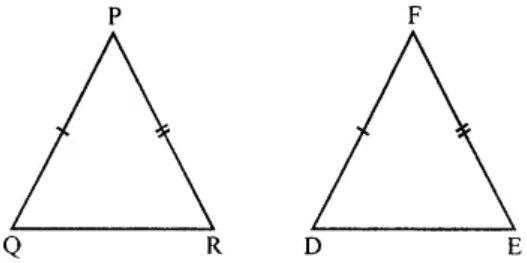
PQ = FE
RP = DF
Now, their included angles ∠P must be equal to ∠F for congruency.
Thus, ∠P = ∠F.
Download PDF
ML Aggarwal Solutions for Class 7 Maths Chapter 12- Congruence of Triangles
Download PDF: ML Aggarwal Solutions for Class 7 Maths Chapter 12- Congruence of Triangles PDF
Chapterwise ML Aggarwal Solutions for Class 7 Maths :
- Chapter 1- Integers
- Chapter 2- Fractions and Decimals
- Chapter 3- Rational Numbers
- Chapter 4- Exponents and Powers
- Chapter 5- Sets
- Chapter 6- Ratio and Proportion
- Chapter 7- Percentage and Its Applications
- Chapter 8- Algebraic Expressions
- Chapter 9- Linear Equations and Inequalitie
- Chapter 10- Lines and Angles
- Chapter 11- Triangles and its Properties
- Chapter 12- Congruence of Triangles
- Chapter 13- Practical Geometry
- Chapter 14- Symmetry
- Chapter 15- Visualising Solid Shapes
- Chapter 16- Perimeter and Area
- Chapter 17- Data Handling
About ML Aggarwal
M. L. Aggarwal, is an Indian mechanical engineer, educator. His achievements include research in solutions of industrial problems related to fatigue design. Recipient Best Paper award, Manipal Institute of Technology, 2004. Member of TSTE.