
Class 7: Maths Chapter 15 solutions. Complete Class 7 Maths Chapter 15 Notes.
ML Aggarwal Solutions for Class 7 Maths Chapter 15- Visualising Solid Shapes
ML Aggarwal 7th Maths Chapter 15, Class 7 Maths Chapter 15 solutions
1. Match the following shapes with their names:

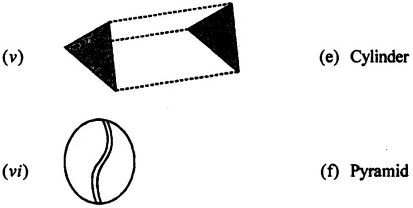
Solution:-
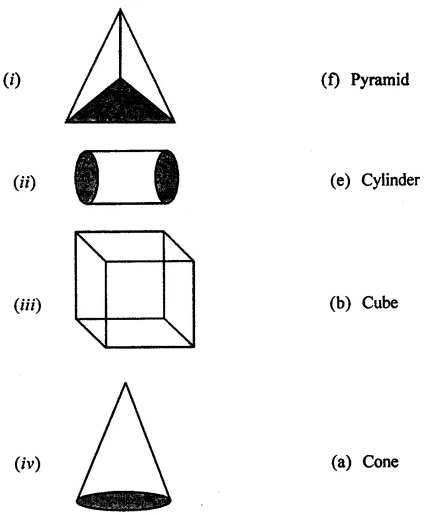
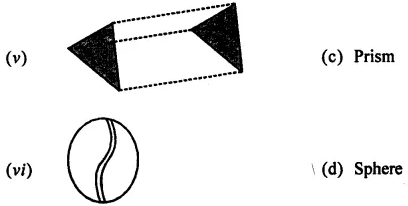
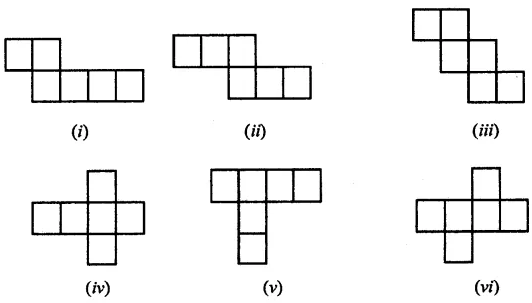
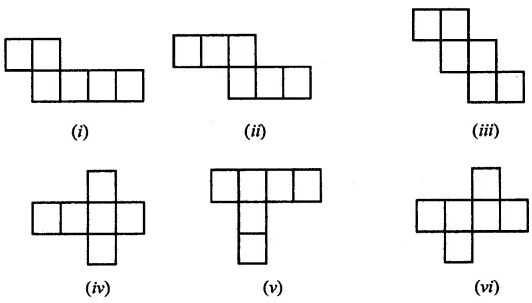
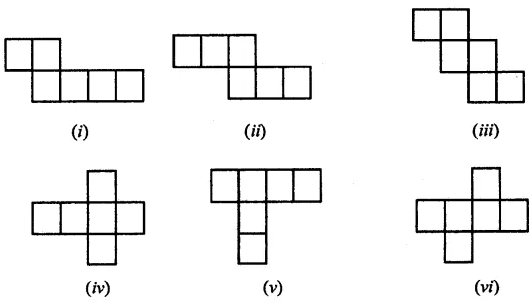
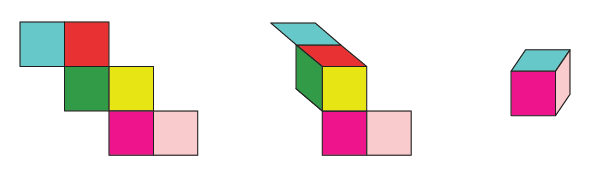
2. Identify the nets which can be folded to form a cube (cut out copies of the nets and try it)
(i)
Solution:-
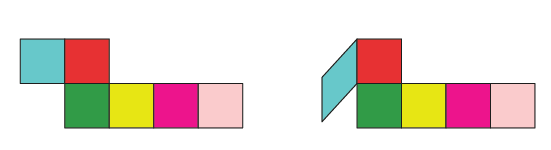
The given net cannot be folded as cube.
Because, it can be folded as below,
(ii)
Solution:-
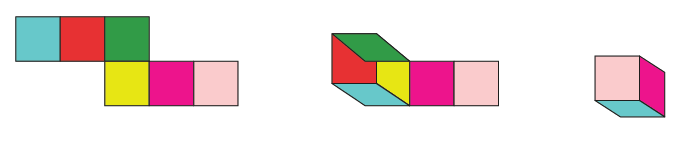
The given net can be folded as cube.
So, it can be folded as below,
(iii)
Solution:-
The given net can be folded as cube.
So, it can be folded as below,
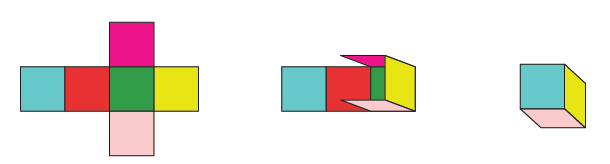
(iv)
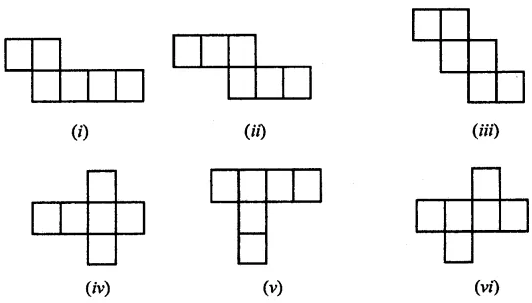
Solution:-
The given net can be folded as cube.
So, it can be folded as below,
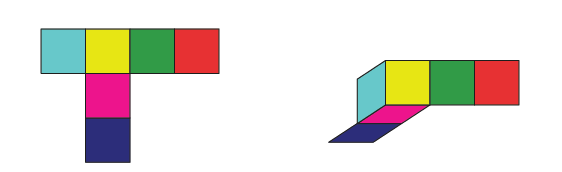
(v)
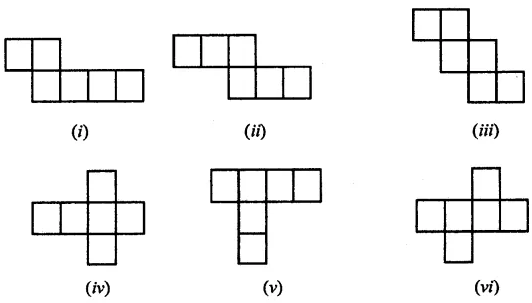
Solution:-
The given net cannot be folded as cube.
Because, it can be folded as below,
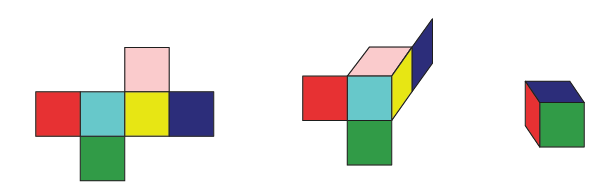
(vi)
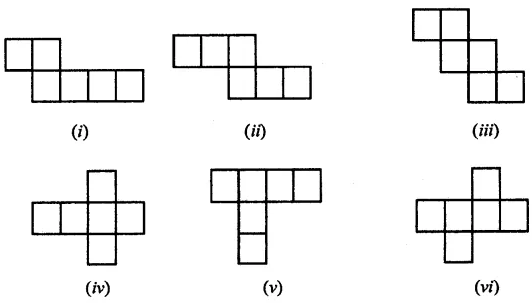
Solution:-
The given net can be folded as cube.
So, it can be folded as below,
3. Dice are cubes with dots on each face. Opposite faces of a die always have a total of seven dots on them.
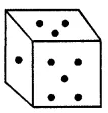
Here are two nets to make dice (cubes); the numbers inserted in each square indicate the number of dots in that box.
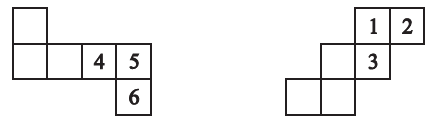
Insert suitable numbers in the blanks, remembering that the number on the opposite faces should total to 7.
Solution:-
(i)
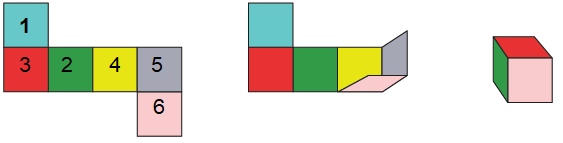
By observing the above figure the sum of the opposite faces is equal to 7.
So, the given net can be folded into a net of dice.
(ii)
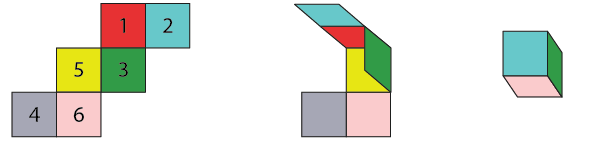
By observing the above figure the sum of the opposite faces is equal to 7.
So, the given net can be folded into a net of dice.
4. Can any of the following be a net for a die? If no, explain your answer.
(i)
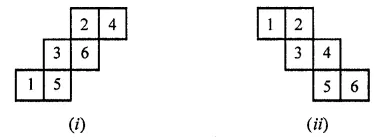
Solution:-
Yes
(ii)
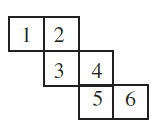
Solution:-
The given net is folded as dice is shown in figure below,
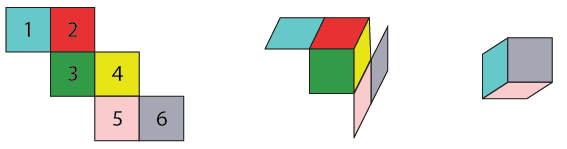
No, this cannot be a net for a die.
By observing the figure, we can say that, one pair of opposite face will have 1 and 4, another pair of opposite face will have 3 and 6 the sum of these two opposite faces are not equal to 7.
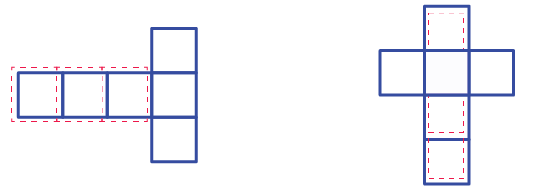
5. Here is an incomplete net for making a cube. Complete it in at least two different ways. Remember that a cube has six faces. How many are there in the net here? (You may use a squared paper for easy manipulation).
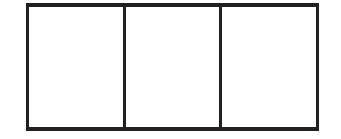
Solution:-
In the given net there are 3 faces and it can be completed as shown below,
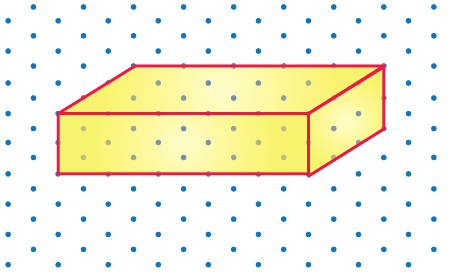
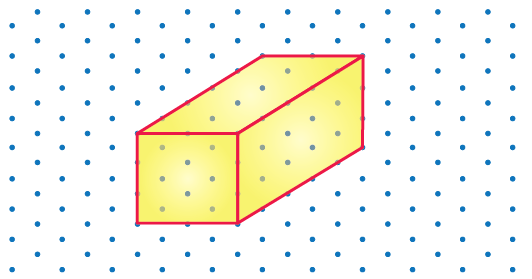
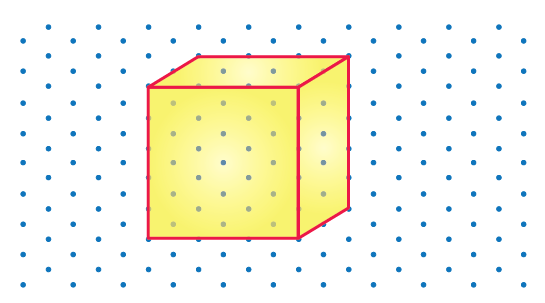
6. The dimensions of a cuboid are 5 cm, 3 cm, and 2 cm. Draw three different isometric sketches of this cuboid with height
(i) 2 cm
(ii) 3 cm
(iii) 5 cm
Solution:-
The three different isometric sketches of this cuboid is shown below,
(i) 2 cm
(ii) 3 cm
(iii) 5 cm
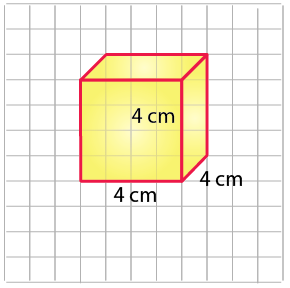
7. Give (i) an oblique sketch (ii) an isometric sketch for each of the following:
(a) A cube is with an edge 4 cm long.
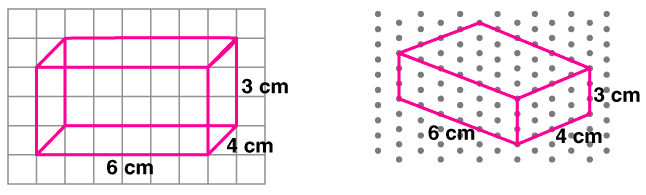
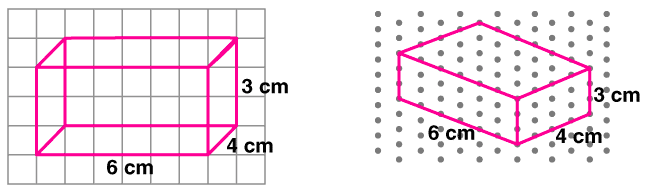
(b) A cuboid of length 6 cm, breadth 4 cm, and height 3 cm.
Solution:-
(a)
(i) Oblique sketch
(ii) Isometric sketch

(b) A cuboid of length 6 cm, breadth 4 cm, and height 3 cm.
(i) Oblique sketch
(ii) Isometric sketch
Download PDF
ML Aggarwal Solutions for Class 7 Maths Chapter 15- Visualising Solid Shapes
Download PDF: ML Aggarwal Solutions for Class 7 Maths Chapter 15- Visualising Solid Shapes PDF
Chapterwise ML Aggarwal Solutions for Class 7 Maths :
- Chapter 1- Integers
- Chapter 2- Fractions and Decimals
- Chapter 3- Rational Numbers
- Chapter 4- Exponents and Powers
- Chapter 5- Sets
- Chapter 6- Ratio and Proportion
- Chapter 7- Percentage and Its Applications
- Chapter 8- Algebraic Expressions
- Chapter 9- Linear Equations and Inequalitie
- Chapter 10- Lines and Angles
- Chapter 11- Triangles and its Properties
- Chapter 12- Congruence of Triangles
- Chapter 13- Practical Geometry
- Chapter 14- Symmetry
- Chapter 15- Visualising Solid Shapes
- Chapter 16- Perimeter and Area
- Chapter 17- Data Handling
About ML Aggarwal
M. L. Aggarwal, is an Indian mechanical engineer, educator. His achievements include research in solutions of industrial problems related to fatigue design. Recipient Best Paper award, Manipal Institute of Technology, 2004. Member of TSTE.