
Class 7: Maths Chapter 2 solutions. Complete Class 7 Maths Chapter 2 Notes.
ML Aggarwal Solutions for Class 7 Maths Chapter 2- Fractions and Decimals
ML Aggarwal 7th Maths Chapter 2, Class 7 Maths Chapter 2 solutions
1. What fraction of each of the following figure is shaded?
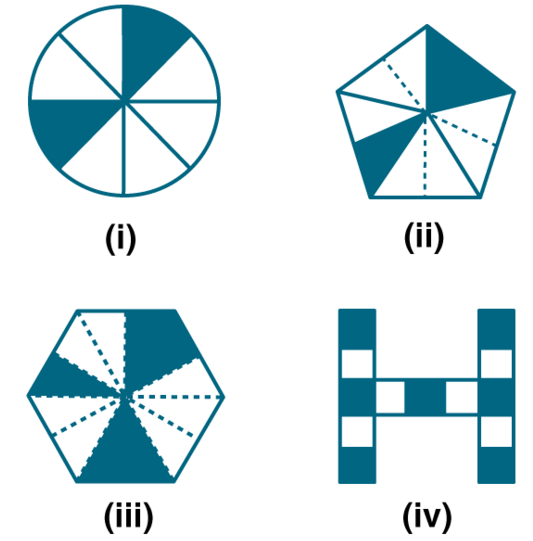
Solution:
(i) In the given figure, the shaded fraction is 2 / 8 = 1 / 4
(ii) In the given figure, the shaded fraction is 3 / 10
(iii) In the given figure, the shaded fraction is 5 / 12
(iv) In the given figure, the shaded fraction is 7 / 13
2. Evaluate the following:
(i) (4 / 3) + (7 / 8)
(ii)
(iii) (5 / 12) + (1 / 18) – (2 / 9)
Solution:
(i) (4 / 3) + (7 / 8)
L.C.M. of 3, 8 is 24, we get,
= (32 + 21) / 24
= 53 / 24
We get,
=
(ii)
This can be written as,
= (17 / 2) – (29 / 8)
L.C.M. of 2, 8 is 8, we get,
= (68 – 29) / 8
= 39 / 8
We get,
=
(iii) (5 / 12) + (1 / 18) – (2 / 9)
L.C.M. of 12, 18, 9 is 36, we get,
= (15 + 2 – 8) / 36
= (17 – 8) / 36
= 9 / 36
Dividing both numerator and denominator by 9, we get,
= (9 ÷ 9) / (36 ÷ 9)
We get,
= 1 / 4
3. Evaluate the following:
(i) 7 × (3 / 5)
(ii) 21 × (3 / 14)
(iii) × 8
(iv) 5 ×
Solution:
(i) 7 × (3 / 5)
On simplification, we get,
= 21 / 5
=
(ii) 21 × (3 / 14)
On further calculation, we get,
= 9 / 12
=
(iii) × 8
× 8
This can be written as,
= (17 / 5) × 8
On calculating further, we get,
= 136 / 5
=
(iv) 5 ×
This can be written as,
= 5 × (27 / 4)
= 135 / 4
We get,
=
4. Find the reciprocal of each of the following:
(i) 3 / 7
(ii) 13 / 9
(iii) 8
Solution:
(i) The reciprocal of 3 / 7 is 7 / 3
(ii) The reciprocal of 13 / 9 is 9 / 13
(iii) The reciprocal of 8 is 1 / 8
5. Write the following numbers in the expanded form:
(i) 20.03
(ii) 200.03
(iii) 2.034
Solution:
(i) 20.03
The expanded form of the given decimal is shown below,
= 2 × 10 + 0 × 1 + 0 × (1 / 10) + 3 × (1 / 100)
(ii) 200.03
The expanded form of the given decimal is shown below,
= 2 × 100 + 0 × 10 + 0 × 1 + 0 × (1 / 10) + 3 × (1 / 100)
(iii) 2.034
The expanded form of the given decimal is shown below,
= 2 × 1 + 0 × (1 / 10) + 3 × (1 / 100) + 4 × (1 / 1000)
6. Find the following:
(i) 2.7 × 4
(ii) 2.71 × 5
(iii) 2.5 × 0.3
(iv) 2.3 × 4.35
(v) 238.06 × 7.5
(vi) 0.79 × 32.4
(vii) 1.07 × 0.02
(viii) 10.05 × 1.05
Solution:
(i) 2.7 × 4
= (27 / 10) × 4
= 108 / 10
= 10.8
(ii) 2.71 × 5
On calculation, we get,
= (271 / 100) × 5
= 1355 / 100
We get,
= 13.55
(iii) 2.5 × 0.3
On further calculation, we get,
= (25 / 10) × (3 / 10)
= 75 / 100
We get,
= 0.75
(iv) 2.3 × 4.35
On further calculation, we get,
= (23 / 10) × (435 / 100)
=10005 / 1000
We get,
= 10.005
(v) 238.06 × 7.5
On simplification, we get,
= (23806 / 100) × (75 / 10)
23806
× 75
_____________
119030
1666420
______________
1785450
______________
= 1785450 / 1000
We get,
= 1785.45
(vi) 0.79 × 32.4
On further calculation, we get,
= (79 / 100) × (324 / 10)
324
× 79
__________
2916
22680
________________
25596
_________________
= 25596 / 1000
We get,
= 25.596
(vii) 1.07 × 0.02
On simplification, we get,
= (107 / 100) × (2 / 100)
= 214 / 10000
We get,
= 0.0214
(viii) 10.05 × 1.05
On calculating, we get,
= (1005 / 100) × (105 / 100)
1005
×105
_________
5025
100500
______________
105525
______________
= 105525 / 10000
We get,
= 10.5525
7. Simplify the following:
(i) (3 / 5) of +
(ii) (4 / 5) × – 2 × (3 / 5)
(iii) {(4 / 5) + 2}{3 – (2 / 3)}
Solution:
(i) (3 / 5) of +
+
This can be written as,
= (3 / 5) of (10 / 9) + (7 / 2)
= (3 / 5) × (10 / 9) + (7 / 2)
We get,
= (2 / 3) + (7 / 2)
L.C.M. of 3, 2 is 6, we get,
= (4 + 21) / 6
= 25 / 6
=
(ii) (4 / 5) × – 2 × (3 / 5)
This can be written as,
= (4 / 5) × (19 / 8) – 2 × (3 / 5)
We get,
= (19 / 10) – (6 / 5)
L.C.M. of 10, 5 is 10, we get,
= (19 – 12) / 10
We get,
= (7 / 10)
(iii) {(4 / 5) + 2}{3 – (2 / 3)}
On simplification, we get,
= {(4 + 10) / 5} × {(9 – 2) / 3}
= (14 / 5) × (7 / 3)
= (14 × 7) / (5 × 3)
We get,
= 98 / 15
=
Download PDF
ML Aggarwal Solutions for Class 7 Maths Chapter 2- Fractions and Decimals
Download PDF: ML Aggarwal Solutions for Class 7 Maths Chapter 2- Fractions and Decimals PDF
Chapterwise ML Aggarwal Solutions for Class 7 Maths :
- Chapter 1- Integers
- Chapter 2- Fractions and Decimals
- Chapter 3- Rational Numbers
- Chapter 4- Exponents and Powers
- Chapter 5- Sets
- Chapter 6- Ratio and Proportion
- Chapter 7- Percentage and Its Applications
- Chapter 8- Algebraic Expressions
- Chapter 9- Linear Equations and Inequalitie
- Chapter 10- Lines and Angles
- Chapter 11- Triangles and its Properties
- Chapter 12- Congruence of Triangles
- Chapter 13- Practical Geometry
- Chapter 14- Symmetry
- Chapter 15- Visualising Solid Shapes
- Chapter 16- Perimeter and Area
- Chapter 17- Data Handling
About ML Aggarwal
M. L. Aggarwal, is an Indian mechanical engineer, educator. His achievements include research in solutions of industrial problems related to fatigue design. Recipient Best Paper award, Manipal Institute of Technology, 2004. Member of TSTE.