
Class 5: English Chapter 33 solutions. Complete Class 5 English Chapter 33 Notes.
Maharashtra Board Solutions Class 5-English: Chapter 33- Rangoli
Maharashtra Board 5th English Chapter 33, Class 5 English Chapter 33 solutions
Questions and Answers
1. Guess the meaning of the following word.
Question 1.
Guess the meaning of the following word.
- pleasing
- finely
- magnificent
- coarse-grained
- beautify
- fragrant
Answer:
- pleasing – appealing and attractive
- finely – in a very skilled manner
- magnificent – beautiful and impressive
- coarse – grained – rough
- beautify – improve the appearance
- fragrant – having a sweet, pleasant smell
2. Answer the following questions.
Question 1.
What does ‘Rangaawali’ mean?
Answer:
The word ‘Rangaawali’ comprises of two words, ‘rang’ meaning colour and ‘aawali’ meaning a row or vine.
Question 2.
Where is Rangoli usually drawn?
Answer:
Rangoli is usually drawn in the courtyard or in front of the doorstep.
Question 3.
What is used to make Rangoli designs?
Amswer:
Rangoli designs are made using coarse-grained powders such as sand, marble dust, saw dust or rice grain powder.
Question 4.
What are the common Rangoli designs or motifs?
Answer:
Common Rangoli designs or motifs are based on nature, such as mango, creepers, lotus and other flowers, swans, peacocks, fish and other animals and so on. They also include geometrical patterns and shapes.
Question 5.
What different names is ‘Rangoli’ known by in different regions?
Answer:
‘Rangoli’ is known by different names in different parts of the country. It is known as ‘Chowkpurana’ in Uttar Pradesh, ‘Madana’ in Rajasthan, ‘Muggu’ in Andhra Pradesh, and as ‘Rangoli’ in Gujarat, Karnataka and Maharashtra. In Bengal it is known as ‘Alpanaa’ whereas in Bihar and Uttaranchal it is named ‘Aipanaa’. ‘Kolam’ is the name given to the art of Rangoli in southern parts of the country, mainly in the states of Kerala and Tamil Nadu.
3. Make a collection of Rangoli motifs and patterns.
Write about each motif or pattern in your own words –
it could just be a label or a description or some information or comment.
Question 1.
Make a collection of Rangoli motifs and patterns.
Write about each motif or pattern in your own words –
it could just be a label or a description or some information or comment.
Answer:
Do it yourself.
Additional Important Questions and Answers
Answer the following questions in one sentence
Question 1.
What is the most interesting feature of Rangoli?
Answer:
The most interesting feature of Rangoli is that it is drawn afresh everyday.
Question 2.
On which occasions are Rangoli designs made?
Answer:
On the occasion of feasts and festivals, Rangoli designs are made.
Question 3.
Why is it important to draw unbroken lines of even thickness while drawing Rangoli?
Answer:
It is important to draw unbroken lines of even thickness to maintain the beauty of the design.
Question 4.
Why is a special background for Rangoli with Geru or wet red ochre made?
Answer:
A special background for Rangoli with Geru or wet red ochre is made so that the white design stands out well.
Question 5.
Write any one thing we have witnessed in the art of Rangoli in the modern times?
Answer:
Today, i.e. in the modern times, both men and women, learn and practice the art of Rangoli, adding their innovative ideas to the traditional designs and motifs.
Activities :
Question 1.
Think of five occasions wherein we make Rangolis and complete the list :
Answer:
- Diwali
- Ganpati Festival
- Special functions in school
- Inauguration of a place
- Public celebrations
- To welcome guests.
Question 2.
Spot the names used in different parts of the country for Rangoli
Answer:
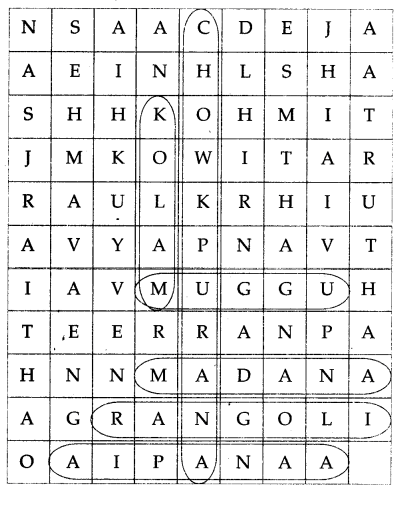
Language Study :
Question 1.
Give one word for:
- Creations which are beautiful and expressive
- A form of arrangement or decorative pattern
- A space enclosed by walls or building
- Repeated decorative image or design for forming a pattern
- Warm reception of people
Answer:
- art
- designs
- courtyard
- motifs
- hospitality
Question 2.
Match the meaning:
| Column ‘A’ | Column ‘B’ |
| 1. occasion | a. based on traditional practices. |
| 2. feast | b. day or period of celebration for religious purposes. |
| 3. festival | c. A special event |
| 4. customary | d. A large meal to celebrate an occasion |
Answer:
| Column ‘A’ | Column ‘B’ |
| 1. occasion | c. A special event |
| 2. feast | d. A large meal to celebrate an occasion |
| 3. festival | b. day or period of celebration for religious purposes. |
| 4. customary | a. based on traditional practices. |
Question 3.
Complete the table:
Answer:
| Positive | Comparative | Superlative |
| beautiful | more beautiful | most beautiful |
| interesting | more interesting | most interesting |
| important | more important | most important |
Do as directed :
Question 1.
Rangoli is one of the most beautiful and most pleasing art forms of India. (Pick out any tuo nouns)
Answer:
Rangoli, India
Question 2.
Just as you cleanse and adorn yourself every day, you clean your house and decorate it with a Rangoli everyday. (Pick out the verbs)
Answer:
cleanse, adorn, clean, decorate
Question 3.
Rangoli designs also include geometrical patterns and shapes Form a wh-question to get the underlined part as the answer.
Answer:
What does Rangoli designs also include?
Question 4.
The skill to do so comes with a lot of practice. (Pick out the articles)
Answer:
the, a
Question 5.
Previously, it was used mainly by women. (Pick out the adverbs)
Answer:
Previously, mainly
Question 6.
Some people use leaves and flowers to make Rangolis which are beautiful as well as fragrant. (Complete the sentence using (not only…but also)
Answer:
Some people use leaves and flowers to make Rangolis which are not only beautiful but also fragrant.
Question 7.
Give the noun forms of:
- pleasing
- decorate
- traditional
- include
Answer:
- pleasure
- decoration
- tradition
- inclusion
Question 8.
Give the verb forms of:
- beautiful
- practice
- different
- innovative
Answer:
- beautify
- practise
- differ
- innovate
Question 9.
Give the adjective forms of:
- ornament
- sand
- beauty
- decorate
Answer:
- ornamental
- sandy
- beautiful
- decorative
Reading Skills, Vocabulary and Grammar
Read the following extract and complete the activities.
Question 1.
Complete the analogy
1. Chowkpurana : Uttar Pradesh : ……..: Rajasthan
2. ………..: Andhra Pradesh :: Alpana : Bengal
Answer:
1. Madana
2. Muggu
Question 2.
What is the art form of Rangolian expression of?
Answer:
The art form of Rangoli is an expression of warm hospitality
Question 3.
What does drawing of Rangoli on the courtyard signify?
Answer:
Drawing of Rangoli on the courtyard signifies that people coming to the house are welcome inside.
Question 4.
What is customary, with reference to Rangoli, in the northern parts of India?
Answer:
In the northern parts of India, it is customary to make Rangoli designs with traditional wet colours.
Question 5.
What are Kolam designs made of ?
Answer:
Kolam designs are made of rice powder.
Question 6.
Pick out a word from the extract which means: based on traditional practices.
Answer:
Customary
Question 7.
Kolam is the name given to the art of Rangoli in southern parts of the country. (Separate the subject and predicate.)
Answer:
Subject : Kolam
Predicate : is the name given to the art of Rangoli in the Southern parts of the country.
Question 8.
Why should we keep the art of Rangoli alive? Give your views.
Answer:
Rangoli, a very creative and beautiful art, is an ancient art, a part of India’s rich cultural heritage. It is our duty to preserve and protect such art forms as it is of great value to us. We should keep it alive and pass it on to the future generations.
Writing Skills :
Question 1.
Your school is organizing a Rangoli workshop as a part of the cultural club activities. You are the cultural secretary. Draft the notice.
Answer:
RJK International School
Mumbai – 400001
Date: 5th Aug, 2015
Notice
The Cultural Club of RJK International School, ‘Sanskruti’ proudly presents the Rangoli Workshop, to be held in the school hall on 15th August, 2015. It will be conducted by our Art teacher Ms. Malini. Participants will be taught to create colourful and intricate designs of Rangoli. This workshop is only for the students of standard V. All the materials required will be provided by the school. Those interested should give their names to the class teacher latest by 10th August, 2015. For further details contact the undersigned at www.sanskruti.com
Sd / Cultural Secretary
Summary :
There are different art forms in India. Rangoli is one of its most beautiful and pleasing art forms. Rangoli is an art which involves making designs or patterns on the walls or the floors of the house. Rangoli is regularly drawn in the courtyard or in front of the doorstep of most Indian houses. This lesson takes us through various designs and motifs, patterns and shapes which the of Rangoli makes use of. Rangoli, an expression of warm hospitality occupies a special place in the festival of Deepawali or Diwali. This art is practised in different parts of our country and has different names. It is today used at the time of public celebrations which is spread over large area and even long distances. The author ends on an encouraging note asking us whether we would like to try this beautiful art form.
Meanings :
- comprises (u) – consists of
- feature (n) – characteristic or quality
- adorn (n) – to decorate
- magnificent (adj.) – beautiful and impressive
- traditional (adj.) – a long established practice
- motifs (n) – repeated decorative image or design for forming a pattern
- coarse (adj.) – rough
- customary (adj.) – based on traditional practices.
- hospitality (n) – warm reception of people
- signifies (o) – indicates or means
- nnovative (adj.) – new and novel
- pleasing – appealing and attractive
- beautify (o) – improve the appearance
- fragrant (adj) – having a sweet, pleasant smell.
Download PDF
Maharashtra Board Solutions Class 5-English: Chapter 33- Rangoli
Download PDF: Maharashtra Board Solutions Class 5-English: Chapter 33- Rangoli PDF
Chapterwise Maharashtra Board Solutions Class 5 English :
Unit 1
- Chapter 1- What a Bird Thought
- Chapter 2- Daydreams
- Chapter 3- Be a Good Listener
- Chapter 4- Strawberries
- Chapter 5- The Twelve Months
- Chapter 6- Announcements
- Chapter 7- Major Dhyan Chand
- Chapter 8- Peer Profile
Unit 2
- Chapter 9- The Triantiwontigongolope
- Chapter 10- Three Sacks of Rice
- Chapter 11- Be a Good Speaker
- Chapter 12- Count your Garden
- Chapter 13- The Adventures of Gulliver
- Chapter 14- A Lesson for All
- Chapter 15- Bird Bath
- Chapter 16- Write your own Story
Unit 3
- Chapter 17- On the Water
- Chapter 18- Weeds in the Garden
- Chapter 19- Be a Good Host and Guest
- Chapter 20- Only One Mother
- Chapter 21- The Journey to the Great Oz
- Chapter 22- A Book Review
- Chapter 23- Write your own Poem
- Chapter 24- Senses Alert
Unit 4