


Class 5: English Chapter 30 solutions. Complete Class 5 English Chapter 30 Notes.
Contents
Maharashtra Board Solutions Class 5-English: Chapter 30- Be a Netizen
Maharashtra Board 5th English Chapter 30, Class 5 English Chapter 30 solutions
Questions and Answers
1. List the words or phrases related with computers or the Internet.
Question 1.
List the words or phrases related with computers or the Internet.
Answer:
The list of words or phrases related with the computer or the Internet are:
| Internet | Websites | Text |
| Net | Address | Update |
| Network | World wide web (www) | online |
| System | Programs | |
| Log off | Search engines | Offline |
| Disconnect | Browsing | Chatting |
| Surfing | Copy | |
| Download | ||
| Address |
2. Answer the following questions in one sentence.
Question 1.
Have you ever seen or used a computer?
Answer:
Yes, I have seen and used a computer in my school.
Question 2.
What is the ‘Internet’?
Answer:
The ‘Internet’ or the net is a network of computers.
Question 3.
What is a website?
Answer:
‘Websites’ are places on the net where information is stored and made available.
Question 4.
What is the world wide web?
Answer:
Thousands of websites on the net together form the World Wide Web (www).
Question 5.
What are search engines?
Answer:
Special computer programs help us find the different websites on the World Wide Web, known as Search Engines.
Question 6.
What is meant by browsing or surfing?
Answer:
Looking at various websites in computers is known as ‘browsing’ or ‘surfing’.
Question 7.
What is meant by being ‘online’?
Answer:
Being ‘online’ means our computer is connected to the internet.
Question 8.
What is meant by being ‘offline’?
Answer:
Being ‘offline’ means we are not connected to the net.
Question 9.
What is ‘e-mail’ or electronic mail?
Answer:
The system of sending and receiving messages or mail on computers is known as ‘e-mail’ or electronic mail.
Question 10.
What is a password?
Answer:
A ‘password’ is a secret word or group of letters and/ or numbers which will allow a person to use or see the email account on typing it.
Question 11.
Who is a ‘netizen’?
Answer:
People who use the net are ‘netizens’.
Question 12.
Would you like to be a netizen?
Answer:
Yes, I would like to be a netizen and explore this ocean of information.
3. Draw a diagram to explain the idea of Internet.
Question 1.
Draw a diagram to explain the idea of Internet.
Answer:
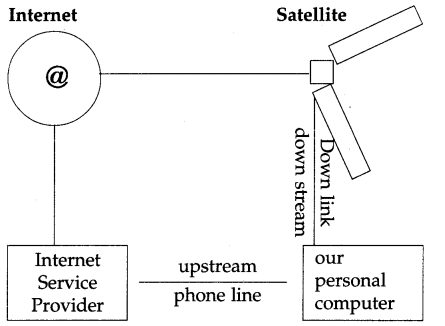
Glossary to understand the diagram:
- Satellite: A satellite is a wireless receiver or transmitter that is launched by a rocket and placed in orbit around the earth.
- Downlink: The communication going from a satellite to the ground is called a downlink.
- Uplink: The communication going from the ground to a satellite is called uplink.
4. Find a picture of a computer with the help of your teacher and label the different parts you see.
For example, monitor, screen, speakers, processor, mouse, mousepad, keyboard, etc.
Question 1.
Find a picture of a computer with the help of your teacher and label the different parts you see.
For example, monitor, screen, speakers, processor, mouse, mousepad, keyboard, etc.
Answer:
Do it yourself.
5. List all the pairs of antonyms you find in the passage.
Question 1.
List all the pairs of antonyms you find in the passage.
Answer:
- connected – disconnected
- online – offline
- send – receive
- sending – receiving
- different – same
6. WWW is a short form of World Wide Web.
Find ten other short forms related to ICT (Information and Communication Technology).
Question 1.
WWW is a short form of World Wide Web.
Find ten other short forms related to ICT (Information and Communication Technology).
Answer:
- CD: Computer Disks
- ROM: Read Only Memory
- RAM: Random Access Memory
- PPT: Power Point
- e-mail: Electronic mail
- IP: Internet Protocol
- EC: Electronic Commerce
- EDI: Electronic Data Interchange
- E-Market: Electronic Market
- VAN: Value Added Network
- E-map: Electronic map
7. Choose a word that has at least four letters in it. Imagine that it is a short form. Write the name /phrase /words it stands for.
For example, STEP : Sunday and Thursday Evening Programmes.
Question 1.
Choose a word that has at least four letters in it. Imagine that it is a short form. Write the name /phrase /words it stands for.
For example, STEP : Sunday and Thursday Evening Programmes.
Answer:
WITH: Walking Individually Towards Health
Important Questions and Answers
Question 1.
Complete the web diagram.

Answer:
text, pictures, images, sounds, speeches, music
Complete the following by choosing the correct alternative:
Question 1.
To log off the computer means to……………
(a) give instruction to your computer to get connected from the net.
(b) give instruction to your computer to get disconnected from the net.
(c) switch off the computer.
Answer:
(b) give instruction to your computer to get disconnected from the net.
Question 2.
To display information on the net………….
(a) you need an e-mail id.
(b) you need a website.
(c) you need a password.
Answer:
(b) you need a website.
Language Study :
Question 1.
Match the meanings of:
| 1. connected | a. organized |
| 2. systematic | b. linked |
| 3. gathered | c. unparalleled |
| 4. unique | d. collected |
Answer:
| 1. connected | b. linked |
| 2. systematic | a. organized |
| 3. gathered | d. collected |
| 4. unique | c. unparalleled |
Give one word for :
Question 1.
- To move from one site to another searching various topics on the internet
- Being connected to a network of computers –
- Exchange messages through computers with one or many users –
Answer:
- surfing
- online
- chatting
Do as directed :
Question 1.
- It is so large that millions of people around the world can use it at the same time. (Pick out the adjectives in the sentence)
- The internet is like an ocean of information. (Pick out the articles)
- Websites are places on the net. (Pick out the preposition)
- It is possible to change the text. (Rewrite the sentence beginning with, It is not)
Answer:
- Large, same: Adjective
- the, an
- on preposition.
- It is not impossible to change the text.
Complete the table.
Question 1.
Answer:
| Positive | Comparative | Superlative |
| 1. many | much | more |
| 2. small | smaller | smallest |
| 3. difficult | difficult more | difficult most |
| 4. Short | shorter | shortest |
| 5. amazing | more amazing | most amazing |
| 5. difficult | more difficult | most difficult |
Question 2.
Answer:
| Noun | Adjective | Verb |
| 1. Information | Informative | Inform |
| 2. picture | pictoral | picturise |
| 3. person | personal | personalize |
| 4. correctness | correct | correct |
Reading Skills, Vocabulary and Grammar
Read the following passage and answer the following.
Question 1.
Complete the following:
(a) The system of sending and receiving messages or mail on computers is known
(b) No two …………………….. are the same.
Answer:
(a) as e-mail or electronic mail.
(b) e-mail addresses
Question 2.
What information is conveyed through the extract?
Answer:
This extract conveys information about e-mail.
Question 3.
Write the full form of e-mail.
Answer:
The full form of e-mail is electronic mail.
Question 4.
What is an e-mail account compared to? What is the difference?
Answer:
An e-mail account is compared to our own letter box. The only difference is unlike our own letter box, we can use the e-mail letter box not only for receiving mail but also for sending it.
Question 5.
Give the noun form of:
1. Short
2. unique
Answer:
1. shortness
2. uniqueness
Question 6.
You can receive messages on this address and also send them. (Pick out the conjunction)
Answer:
Conjunction – and
Question 7.
How has e-mail changed the way we communicate? Give your views.
Answer:
Due to e-mail, the ways we send and receive messages have changed in a big way. Now we can do it without any waste of time. The messages have become shorter too, unlike those times when we would have lengthy conversations or write long letters.
Writing Skills :
Question 1.
Write an e-mail to your friends inviting him for your birthday.
Answer:
From : vinay@lycoscom
Sent: 18th July, 2015
To: [email protected]
CC: [email protected], [email protected]
Subject: Invitation for birthday.
Dear all,
It’s my birthday on 28th July, 2015. I cordially invite you to join my family and me in the celebrations at our residence and have a share in the joy.
The party begins at 6.00 p.m. The dress code is smart casuals. Blue is the colour of the day. Hoping to meet you at the party. Looking forward to having a great time.
Thanks,
Vinay
Summary :
‘Be a Netizen’ is an informative lesson about how computers, with its amazing features have brought about changes in the way we do things. It tells us about the internet network which is so large that millions of people around the world can use it at the same time. It also tells us how all the information is stored in places on the net called websites. It guides us how to browse or surf, that is visit various sites on the net. The lesson further elaborates about various terms related to internet like ‘update’ ‘online’, offline’ etc.
It also explains the ways to download information from the internet for later use and also how to send information on the net. The author shares information about e-mail, a system of sending and receiving messages or mails on computers. The author ends with a question. He says people who live in a city are citizens and people who use the net are netizens. He enquires whether we would like to be a netizen. Given the merits and advantages of computers and its uses, we should indeed become netizens.
Meanings :
- amazing (o) – causing surprise or wonder
- features (n) : qualities or characteristics
- log on (pher) – to go through the steps to begin the use of computers
- text (n) – printed words
- disconnected (v) – break the connection or link
- browsing (u) – to casually look through data in the internet
- surfing (o) – to move from one site to another searching various topics on the Internet
- update (u) – to change by including most recent technology
- online (adj) – being connected to a network of computer
- offline (adj) – not controlled or connected to computer or internet
- chatting (u) – exchange messages through computer with one or many users
- download (v) – to copy data from one computer system to another over the internet
- address (on net) (n) – The Internet address is used for sending and receiving mails
- e-mail (n) – electronic mail
- unique (adj) – extraordinary
- password (n) – a secret word or group of letters and/or numbers that provides access to our email account
- citizens (n) – people who live in a city
- netizen (n) – people who use the net
- programs (n) – systematic instructions given to the computer for desired results
Download PDF
Maharashtra Board Solutions Class 5-English: Chapter 30- Be a Netizen
Download PDF: Maharashtra Board Solutions Class 5-English: Chapter 30- Be a Netizen PDF
Chapterwise Maharashtra Board Solutions Class 5 English :
Unit 1
- Chapter 1- What a Bird Thought
- Chapter 2- Daydreams
- Chapter 3- Be a Good Listener
- Chapter 4- Strawberries
- Chapter 5- The Twelve Months
- Chapter 6- Announcements
- Chapter 7- Major Dhyan Chand
- Chapter 8- Peer Profile
Unit 2
- Chapter 9- The Triantiwontigongolope
- Chapter 10- Three Sacks of Rice
- Chapter 11- Be a Good Speaker
- Chapter 12- Count your Garden
- Chapter 13- The Adventures of Gulliver
- Chapter 14- A Lesson for All
- Chapter 15- Bird Bath
- Chapter 16- Write your own Story
Unit 3
- Chapter 17- On the Water
- Chapter 18- Weeds in the Garden
- Chapter 19- Be a Good Host and Guest
- Chapter 20- Only One Mother
- Chapter 21- The Journey to the Great Oz
- Chapter 22- A Book Review
- Chapter 23- Write your own Poem
- Chapter 24- Senses Alert
Unit 4
- Chapter 25- The Man in the Moon
- Chapter 26- Water in the Well
- Chapter 27- The Legend of Marathon
- Chapter 28- All about Money
- Chapter 29- A Lark
- Chapter 30- Be a Netizen
- Chapter 31- Give your Mind a Workout!
- Chapter 32- Helen Keller
- Chapter 33- Rangoli
FAQs
You can download the Maharashtra State Board Books from the eBalbharti official website, i.e. cart.ebalbharati.in or from this article.
Students can get the Maharashtra Books for primary, secondary, and senior secondary classes from here. You can view or download the Maharashtra State Board Books from this page or from the official website for free of cost. Students can follow the detailed steps below to visit the official website and download the e-books for all subjects or a specific subject in different mediums.
Step 1: Visit the official website ebalbharati.in
Step 2: On the top of the screen, select “Download PDF textbooks”
Step 3: From the “Classes” section, select your class.
Step 4: From “Medium”, select the medium suitable to you.
Step 5: All Maharashtra board books for your class will now be displayed on the right side.
Step 6: Click on the “Download” option to download the PDF book.
As of now, the MSCERT and Balbharti are responsible for the syllabus and textbooks of Classes 1 to 8, while Classes 9 and 10 are under the Maharashtra State Board of Secondary and Higher Secondary Education (MSBSHSE).
The Maharashtra State Board of Secondary & Higher Secondary Education, conducts the HSC and SSC Examinations in the state of Maharashtra through its nine Divisional Boards located at Pune, Mumbai, Aurangabad, Nasik, Kolhapur, Amravati, Latur, Nagpur and Ratnagiri.
About Maharashtra State Board (MSBSHSE)
The Maharashtra State Board of Secondary and Higher Secondary Education or MSBSHSE (Marathi: महाराष्ट्र राज्य माध्यमिक आणि उच्च माध्यमिक शिक्षण मंडळ), is an autonomous and statutory body established in 1965. The board was amended in the year 1977 under the provisions of the Maharashtra Act No. 41 of 1965.
The Maharashtra State Board of Secondary & Higher Secondary Education (MSBSHSE), Pune is an independent body of the Maharashtra Government. There are more than 1.4 million students that appear in the examination every year. The Maha State Board conducts the board examination twice a year. This board conducts the examination for SSC and HSC.
The Maharashtra government established the Maharashtra State Bureau of Textbook Production and Curriculum Research, also commonly referred to as Ebalbharati, in 1967 to take up the responsibility of providing quality textbooks to students from all classes studying under the Maharashtra State Board. MSBHSE prepares and updates the curriculum to provide holistic development for students. It is designed to tackle the difficulty in understanding the concepts with simple language with simple illustrations. Every year around 10 lakh students are enrolled in schools that are affiliated with the Maharashtra State Board.