
Class 11: History Chapter 16 solutions. Complete Class 11 History Chapter 16 Notes.
Maharashtra Board Solutions Class 11-History: Chapter 16- Swarajya to Empire (Maratha Period)
Class 11: History Chapter 16 solutions. Complete Class 11 History Chapter 16 Notes.
1A. Choose the correct alternative and complete sentences.
Question 1.
___________ is known as the Father of Indian Navy.
(a) Chhatrapati Shivaji Maharaj
(b) Chhatrapati Sambhaji Maharaj
(c) Chhatrapati Rajaram Maharaj
(d) Chhatrapati Shahu Maharaj
Answer:
(a) Chhatrapati Shivaji Maharaj
Question 2.
The Pathans from Afghanistan had settled in ___________ the province at the foothills of the Himalayas.
(a) Varanasi
(b) Mathura
(c) Ayodhya
(d) Delhi
Answer:
(c) Ayodhya
Question 3.
Chhatrapati Sambhaji Maharaj wrote the Sanskrit text ___________
(a) Nayikabhed
(b) Budhabhushan
(c) Nakhshikh
(d) Satasattka
Answer:
(b) Budhabhushan
1B. Find the incorrect pair from set B and write the correct ones.
Question 1.
| Set ‘A’ | Set ‘B’ |
| (a) Naik-Nimbalkar Wada | Vathar |
| (b) Nana Phadanvis Wada | Menavali |
| (c) Kalaram Temple | Jejuri |
| (d) Mohiniraj Temple | Nevase |
Answer:
(c) Kalaram Temple – Nashik
1C. Write the names.
Question 1.
He was the Chief of the intelligence network of Chh. Shivaji Maharaj
Answer:
Bahirji Naik
Question 2.
He assisted in the provincial affairs
Answer:
Subhedars/Deshadhikari
Question 3.
Leader of the Rohillas
Answer:
Najib Khan
2. Complete the concept map.
Question 1.
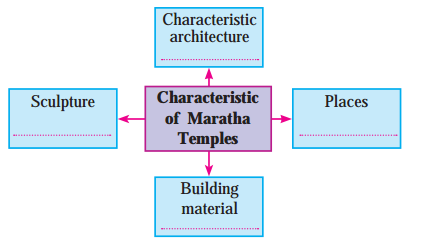
Answer:
3. Explain the statement with reasons.
Question 1.
Shahajiraje is known as the visionary of Swarajya.
Answer:
- Shahajiraje Bhosale was a prominent Sardar in the Nizamshahi kingdom. After the end of Nizamshahi’s rule, he accepted the rank of a Mansabdar in the Adilshahi court.
- Shahajiraje was valiant, courageous, wise, and well-versed in the science of statehood.
- He had successfully handled many Adilshahi expeditions in Maharashtra, Karnataka, and Tamil Nadu.
- The provinces of Pune, Supe, Shirwal, Indapur, and Chakan were given to Shahajiraje as Jahangir.
- He personally aspired to establish Swarajya. He is regarded as the visionary of Swarajya.
- The concept of Swarajya was visualized by Shahajiraje and it was turned into reality by Chh. Shivaji Maharaj.
- Chh. Shivaji Maharaj laid the foundation of Swarajya from the Mawal region. Several factors like the topography of Maharashtra, valour of the local Mawalas, the administrative and military experience gained by the Maratha sardars while working with Nizamshahi, and Adilshahi and above all these the able leadership of Chh. Shivaji Maharaj could make it possible.
Question 2.
Chhatrapati Shivaji Maharaj built the naval force.
Answer:
- In the year 1657 C.E., after conquering Kalyan and Bhiwandi, the boundaries of Swarajya extended up to the coastline.
- The British and the French were involved in the Salt trade. Chh. Shivaji Maharaj wanted to establish control over the sea waters.
- Chh. Shivaji Maharaj was the only king in medieval India who attempted to build a navy.
- He realized to check the activities of foreign traders so having a Navy was important.
- It was necessary for his military strategy also. During the second sack of Surat, Chh. Shivaji Maharaj brought those ships to the coast of Surat and loaded the huge booty on them acquired from Surat.
- It is apparent that Chh. Shivaji Maharaj wanted to establish complete control over the land as well as on the sea.
Question 3.
Chhatrapati Shivaji Maharaj charged heavy duty on the salt imported from the Portuguese territory.
Answer:
- Chhatrapati Shivaji Maharaj was keen on protecting the local industries.
- He protected the salt industry in Konkan. At that time, traders imported salt from the Portuguese territory and sold it in Swarajya.
- That affected the local trade in the Konkan areas.
- Chh. Shivaji Maharaj charged heavy duty on the salt imported into Swarajya from the Portuguese territory.
- The intention was that the salt imported from the Portuguese territory would then cost more and as a result, its import would be discouraged and the sale of the local salt would increase.
4. Write short notes.
Question 1.
Maratha Art:
Answer:
- Developments of Maratha miniature paintings can be seen through illustrations on the manuscripts such as pothis, pattachitra, and patrikas. For example, the wooden stands of pothis have pictures of Ganapati, Riddhi-Siddhi, Gopalkrishna in dark red, green, and yellow colours.
- Miniature paintings include human portraits and themes like ragamalas, talamala, processions, etc.
- Murals are found on the fagade of the Wadas, as well on the walls of reception areas (Diwankhana) and bedrooms.
- The 18th-century murals have survived till today at places like Naik-Nimbalkar Wada at Vathar, Rangamahal at Chandwad, Mayureshwar Mandir at Morgaon, Shiva Temple of Pandeshwar, and Matha at Benawadi.
- The main theme of murals is mythological stories. They include scenes from Ramayana, Mahabharata, and Puranas.
- The subjects of contemporary social life were also reflected in the paintings. The royal court, royal meetings, processions were also included in them.
Question 2.
Maratha Architecture:
Answer:
- Chh. Shivaji Maharaj built forts, the tradition of which was prevalent in the Deccan for three centuries.
- The Kasaba temple in Pune and Vitthal temple in Vitthalwadi were reconstructed by Veermata Jijabai.
- During the Peshwa period, the Maratha kingdom regained its prosperity and all forms of art and architecture received patronage.
- The construction of temples began on a large scale during the later Peshwa.
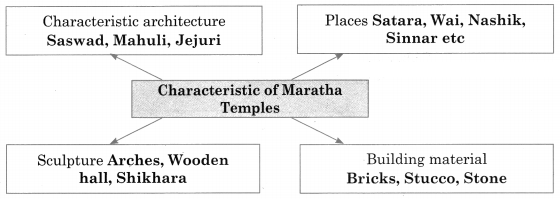
- Period. These temples are of three types. Examples of temple architecture of this period are found at Saswad, Mahuli, Jejuri, etc.
- These are huge in size. The plan of these temples is in star design, the foundation of the temple was multi-layered and was named accordingly.
- The shikhara is made in bricks and stucco method.
- The Kalaram, Goraram, and Sundarnarayan temples at Nasik and Mahadev temple at Trimbakeshwar, Mohiniraj temple at Nevasa is similar to the temples in Malwa and Rajasthan.
- These temples are constructed in stone. These temples are embellished extensively with sculptures.
- The third type of temple can be found at Pune, Satara, Wai, etc.
- It included arches, a wooden hall, and a sanctum sanctorum(gabhara). The Shikhara slopes inwards at the top.
- The stone ‘Deepamala’ is a remarkable feature of these temples. The stone deepamalas at Jejuri were built by Shahajiraje.
- The Chhatris (Samadhis) at various places are noteworthy.
Activity
Collect information about capable women in the medieval period and present it in class. Arrange a discussion on it.
Answer:
- In Indian history, we find only a few women actively participating in public affairs.
- In the Muslim period, Razia Sultan was the only woman who conducted the affairs of the government for a short time.
- And in later times, Rani of Jhansi rose into prominence during the revolt of 1857.
- During the Maratha period, there were women like Jijabai and Maharani Tarabai who performed public duties in the absence of their husbands.
Download PDF
Maharashtra Board Solutions Class 11-History: Chapter 16- Swarajya to Empire (Maratha Period)
Chapterwise Maharashtra Board Solutions Class 11 History :
- Chapter 1- First Farmers
- Chapter 2- First Cities of India
- Chapter 3- Chalcolithic Villages in India
- Chapter 4- Vedic Period
- Chapter 5- Janapadas and Republics
- Chapter 6- Second Urbanisation in India
- Chapter 7- India and Iran (Persia)
- Chapter 8- India During Mauryan Period
- Chapter 9- Post Mauryan India
- Chapter 10- Changing Times
- Chapter 11- Kingdoms in South India
- Chapter 12- India, Nations in the Northwest of the Indian Subcontinent and China
- Chapter 13- India, Sri Lanka and Southeast Asia
- Chapter 14- Delhi Sultanate, Vijayanagar and Bahamani Kingdom
- Chapter 15- India During Mughal Period
- Chapter 16- Swarajya to Empire (Maratha Period)