
Class 11: History Chapter 14 solutions. Complete Class 11 History Chapter 14 Notes.
Maharashtra Board Solutions Class 11-History: Chapter 14- Delhi Sultanate, Vijayanagar and Bahamani Kingdom
Class 11: History Chapter 14 solutions. Complete Class 11 History Chapter 14 Notes.
1A. Choose the correct alternative and write the complete sentences.
Question 1.
The royal poet in the court of Balban was _________________
(a) Al-Beruni
(b) Tuli
(c) Amir Khusrow
(d) Husen Shah Sharukhi.
Answer:
(c) Amir Khusrow
Question 2.
The first ruler who built the buildings in Indo-Islamic style of architecture was _________________
(a) Ferozshah Tughluq
(b) Qutubuddin Aibak
(c) Alauddin Khalji
(d) Akbar
Answer:
(b) Qutubuddin Aibak
1B. Find the incorrect pair from set B and write the correct ones.
Question 1.
| Set ‘A’ | Set ‘B’ |
| (a) Rajasthan | Chauhans |
| (b) Kanauj | Pratiharas |
| (c) Bundelkhand | Chandelas |
| (d) Tripuri | Paramaras |
Answer:
(d) Tripuri – Kalachuris
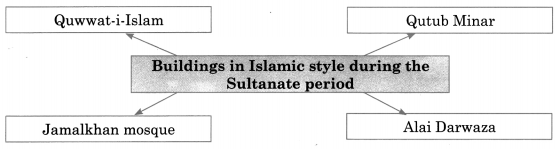
2. Complete the concept Maps.
Question 1.
Answer:
3. Explain the statements with reasons.
Question 1.
The Arab rule did not expand in India.
Answer:
- There was political instability in India in the 13th century and the Turkish invaders took advantage of this instability.
- Muhammad bin Qasim of the Ummayad dynasty attacked Sindh in the year 712 C.E.
- He conquered the entire region from Sindh to Multan. After Muhammad bin Qasim, the Arabs rule in India grew unstable.
Question 2.
The Rajput rulers had to accept defeat in front of the Turkish invaders.
Answer:
- In the 13th century, many petty rulers existed such as Chauhans of Rajasthan, Pratiharas, and Gadhwals (Rathod) of Kanauj, Chandellas of Bundelkhand, Parmars of Malwa, Kalachuris of Gorakhpur, Kalachuris of Tripuri (Madhya Pradesh), Chalukyas (Solanki) of Gujarat, Palas of Bengal, etc.
- They did resist the invasions of the Turks individually but they did not unite for it.
4. State your opinion.
Question 1.
The textile industry flourished during the Sultanate’s rule.
Answer:
- The textile industry flourished on large scale.
- Delhi, Agra, Lahore, Multan, Banaras, Patna, Khambayat, Burhanpur, Devgiri were the main centers of the textile industry during this period.
- The cotton cloth was exported on a large scale from Bengal to Gujarat.
- The textile exports included muslin, linen cloth, satin, and jari cloth.
- The textile dyeing industry gained importance. Golconda, Ahmedabad, Dhaka, etc. were the centers of this industry.
5. Write short notes.
Question 1.
Khyber Pass.
Answer:
- The Khyber Pass has proved to be very important in Indian history.
- During the ancient period, the trade between India and Central Asia was carried via. this pass.
- After the Persian Emperor Darius, Alexander came, to India, via. this pass and so did Mahmud Ghazni, Babur, Nadir Shah, and Ahmed Shah Abdali.
- The British built a railway line with its last destination at a place called ‘Jamrud’ near Peshawar in Pakistan, Jamrud in the doorway of Khyber Pass.
Question 2.
Coins during Sultanate period.
Answer:
- During the sultanate period, there were major changes in the coinage system.
- The names of the Khalifa and the Sultan were inscribed on the coins.
- Details regarding the year of issue, place of minting, etc. were inscribed on it in the Arabic script.
- ‘Tola’ came to be considered as a standard unit for the weight of the coin.
6. Answer the following questions with help of given points.
Question 1.
Write down the information about the invasion of Alauddin Khilji on Yadavas of Devgiri with the help of points given below.
(a) Reasons of invasion
(b) Invasion and events
(c) Effects of invasion
Answer:
(a) Reasons of invasion:
- Devgiri was a prosperous city in the South.
- King Ramadevarai Yadava was ruling over Devgiri.
- Alauddin attacked Devgiri in 1296 C.E.
- In face of the sudden attack, Ramadevarai took shelter in the fort of Devgiri (Daulatabad). Alauddin seized the fort and plundered the city.
- Alauddin conquered nearby provinces of Devgiri as well and collected a large booty as part of the treaty.
(b) Invasion and events:
- Ramadevarai, the ruler of Devgiri had stopped paying tribute to Alauddin for some time.
- So Alauddin sent his commander Malik Kafur to the South.
- There were political and economic reasons behind this campaign.
- The most important reason was to subdue the Yadavas and to collect tribute from them.
(c) Effects of invasion:
- Alauddin had increased his army in size.
- He was the first Sultan to set up a permanent standing army on a large scale.
- He devised new economic reforms for controlling market prices.
- These new measures created a heavy strain on the state treasury.
- It was also necessary to keep the newly increased army and its officers are busy by planning new campaigns.
Download PDF
Maharashtra Board Solutions Class 11-History: Chapter 14- Delhi Sultanate, Vijayanagar and Bahamani Kingdom
Chapterwise Maharashtra Board Solutions Class 11 History :
- Chapter 1- First Farmers
- Chapter 2- First Cities of India
- Chapter 3- Chalcolithic Villages in India
- Chapter 4- Vedic Period
- Chapter 5- Janapadas and Republics
- Chapter 6- Second Urbanisation in India
- Chapter 7- India and Iran (Persia)
- Chapter 8- India During Mauryan Period
- Chapter 9- Post Mauryan India
- Chapter 10- Changing Times
- Chapter 11- Kingdoms in South India
- Chapter 12- India, Nations in the Northwest of the Indian Subcontinent and China
- Chapter 13- India, Sri Lanka and Southeast Asia
- Chapter 14- Delhi Sultanate, Vijayanagar and Bahamani Kingdom
- Chapter 15- India During Mughal Period
- Chapter 16- Swarajya to Empire (Maratha Period)