
Class 10: Chemistry Chapter 11 solutions. Complete Class 10 Chemistry Chapter 11 Notes.
Selina Class 10 ICSE Solutions Chemistry : Chapter 11- Sulphuric Acid
Selina 10th Chemistry Chapter 11, Class 10 Chemistry Chapter 11 solutions
Exercise 1
Solution 1.
(a) Sulphuric acid is called King of Chemicals because there is no other manufactured compound which is used by such a large number of key industries.
(b) Sulphuric acid is referred to as Oil of vitriol as it was obtained as an oily viscous liquid by heating crystals of green vitriol.
Solution 2.
(a)Two balanced equations to obtain SO2 is:
(i) 4FeS2 + 11O2 → 2Fe2O3 +8SO2
(ii) S +O2 → SO2
(b) The conditions for the oxidation of SO2 are:
(i) The temperature should be as low as possible. The yield has been found to be maximum at about 4100C-450oC
(ii) High pressure (2 atm) is favoured because the product formed has less volume than reactant.
(iii) Excess of oxygen increases the production of sulphur trioxide.
(iv) Vanadium pentoxide or platinised asbestos is used as catalyst.
(c) Sulphuric acid is not obtained directly by reacting SO3 with water because the reaction is highly exothermic which produce the fine misty droplets of sulphuric acid that is not directly absorbed by water.
(d) The chemical used to dissolve SO3 is concentrated sulphuric acid. The product formed is oleum.
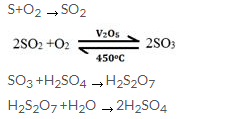
(e) Main reactions of this process are:
Solution 3.
Water is not added to concentrated acid since it is an exothermic reaction. If water is added to the acid, there is a sudden increase in temperature and the acid being in bulk tends to spurt out with serious consequences.
Solution 4.
Impurity of ARSENIC poisons the catalyst [i.e. deactivates the catalyst]. So, it must be removed before passing the mixture of SO2 air through the catalytic chamber.
Solution 5.
Balanced reactions are:
(a) Acidic nature:
(i) Dilute H2SO4 reacts with basic oxides to form sulphate and water.
2 NaOH + H2SO4 → Na2SO4 + 2H2O
(ii) CuO + H2SO4 → CuSO4 + H2O
(iii) It reacts with carbonate to produce CO2.
Na2CO3 + H2SO4 → Na2SO4 + H2O + CO2 ↑
(b) Oxidising agent:
H2SO4 → H2O +SO2 + [O]
Nascent oxygen oxidizes non-metals, metals and inorganic compounds.
For example,
Carbon to carbon dioxide
C+H2SO4 → CO2 +H2O +2SO2
Sulphur to sulphur dioxide
S +H2SO4 → 3SO2 +2H2O
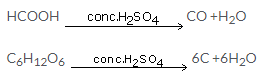
(c) Hygroscopic nature:
It has great affinity for water. It readily absorbs moisture from atmospheric air.
(d) Non-volatile nature:
It has a high boiling point (356oC) so it is considered to be non-volatile. Therefore, it is used for preparing volatile acids like hydrochloric acid, nitric acid from their salts by double decomposition reaction.
NaCl + H2SO4 → NaHSO4 + HCl
KCl + H2SO4 → KHSO4 + HCl
Solution 6.
(a) Bring a glass rod dipped in Ammonia solution near the mouth of each test tubes containing dil. Hel and dil. H2SO4each.
(b)
- Dilute sulphuric acid treated with zinc gives Hydrogen gas which bums with pop sound.
Concentrated H2SO4 gives SO2 gas with zinc and the gas turns Acidified potassium dichromate paper green. - Barium chloride solution gives white ppt. with dilute H2SO4, This white ppt. is insoluble in all acids.
Concentrated H2SO4 and NaCl mixture when heated gives dense white fumes if glass rod dipped in Ammonia solution is brought near it.
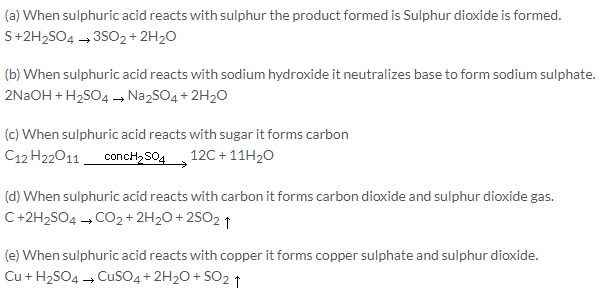
Solution 7.
Solution 8.
(a) Concentrated sulphuric acid is hygroscopic substance that absorbs moisture when exposed to air. Hence, it is stored in air tight bottles.
(b) Sulphuric acid is not a drying agent for H2S because it reacts with H2S to form sulphur.
H2SO4 + H2S → 2H2O + SO2 + S
(c) Concentrated sulphuric acid has high boiling point (356oC). So, it is considered to be non-volatile. Hence, it is used for preparing volatile acids like Hydrochloric acid and Nitric acids from their salts by double decomposition.
NaCl + H2SO4 → NaHSO4 + HCl
NaNO3 + H2SO4 → NaHSO4 + HNO3
Solution 9.
(a) Due to its reducing property. i.e, it is a non-volatile acid.
NaCl + H2SO4 → NaHSO4 + HCl
(c) Magnesium is present above hydrogen in the reactivity series so sulphuric acid is able to liberate hydrogen gas by reacting with magnesium strip.
Mg + H2SO4 → MgSO4 + H2
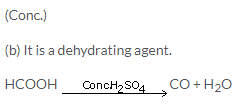
(d) Due to its oxidizing character
Cu +H2SO4 → CuSO4 +2H2O +SO2
(e) Due to its oxidizing property Hydrogen sulphide gas is passed through concentrated sulphuric acid to liberate sulphur dioxide and sulphur is formed.
H2S + H2SO4 → S + 2H2O + SO2
Solution 10.
The name of the salt of
(a) Hydrogen sulphites and Sulphites.
(b) Sulphate and bisulphate.
Solution 11.
(a) Two types of salts are formed when sulphuric acid reacts with NaOH because sulphuric acid is dibasic.
NaOH + H2SO4 → NaHSO4 + H2O
2NaOH + H2SO4 → Na2SO4 + 2H2O
(b) When hydrogen bromide reacts with sulphuric acid the bromine gas is obtained which produce red brown vapours.
2KBr + 3H2SO4 → 2KHSO4 + SO2 + Br2 ↑ + 2H2O
(c) A piece of wood becomes black when concentrated sulphuric acid is poured on it because it gives a mass of carbon.
(d) When sulphuric acid is added to sodium carbonate it liberates carbon dioxide which produces brisk effervescence.
Na2CO3 + H2SO4 → Na2SO4 + H2O + CO2 ↑
Solution 12.
| Column 1 Substance reacted with acid | Column 2 Dilute or concentrated acid | Column 3 Gas |
| Substance reacted with acid | Dilute or concentrated sulphuric acid | Gas |
| Zinc | Dilute sulphuric acid | Hydrogen |
| Calcium carbonate | Concentrated sulphuric acid | Carbon dioxide |
| Bleaching power CaOCl2 | Dilute sulphuric acid | only chlorine |
Solution 1 (2004).
Hydrogen sulphide (H2S) can be oxidized to sulphur.
Solution 1 (2006).
(a) The process used for the large-scale manufacture of sulphuric acid is Contact process.
(b) Sulphuric acid has great affinity for water. It readily removes element of water from other compound. Thus it acts as a dehydrating agent.
(c) Concentrated acid is non-volatile thus it is used for the preparation of volatile acids:
NaCl + H2SO4 → NaHSO4 + HCl
Concentrated acid act as an oxidizing agent:
C + 2H2SO4 → CO2 + 2H2O + 2SO2
Solution 1 (2007).
(i) B
(ii) D
(iii) C
(iv) A
(v) A
Solution 1 (2008).
(a) Concentrated sulphuric acid is non-volatile; hence it is used for the preparation of higher volatile acids.
(b) Due to its dehydrating nature sugar turns black in the presence of concentrated sulphuric acid.
Solution 2 (2004).
When sodium sulphide is added to solution of HCl, Hydrogen sulphide gas is produced. It has rotten egg like smell.
Solution 2 (2007).
(a) The acid formed when sulphur dioxide dissolves in water is sulphurous acid.
(b) Carbondioxide gas is released when sodium carbonate is added to solution of sulphur dioxide.
Solution 3 (2004).
(a) The catalyst which helps in the conversion of sulphur dioxide to sulphur trioxide in step C is Vanadium pentoxide.
(b) The two steps for the conversion of sulphur trioxide to sulphuric acid is:
(i) SO3 + H2SO4 → H2S2O7
(ii) H2S2O7 + H2O → 2H2SO4
(b) The substance that will liberate sulphur dioxide in step E is dilute H2SO4.
(c) The equation for the reaction by which sulphur dioxide is converted to sodium sulphite in step F is:
SO2 + 2NaOH → Na2SO3 + H2O
Or Na2O + SO2 → Na2SO3
Download PDF
Selina Class 10 ICSE Solutions Chemistry : Chapter 11- Sulphuric Acid
Download PDF: Selina Class 10 ICSE Solutions Chemistry : Chapter 11- Sulphuric Acid PDF
Chapterwise Selina Publishers ICSE Solutions for Class 10 Chemistry :
- Chapter 1- Periodic Table, Periodic Properties and Variations of Properties
- Chapter 2- Chemical Bonding
- Chapter 3- Acids, Bases and Salts
- Chapter 4- Analytical Chemistry: Uses of Ammonium Hydroxide And Sodium Hydroxide
- Chapter 5- Mole Concept and Stoichiometry
- Chapter 6- Electrolysis
- Chapter 7- Metallurgy
- Chapter 8- Study of Compounds - Hydrogen Chloride
- Chapter 9- Study of Compounds - Study of Compounds - Ammonia
- Chapter 10- Study of Compounds - Nitric Acid
- Chapter 11- Sulphuric Acid
- Chapter 12- Organic Chemistry
- Chapter 13- Practical Work
About Selina Publishers ICSE
Selina Publishers has been serving the students since 1976 and is one of the quality ICSE school textbooks publication house. Mathematics and Science books for classes 6-10 form the core of our business, apart from certain English and Hindi literature as well as a few primary books. All these books are based upon the syllabus published by the Council for the I.C.S.E. Examinations, New Delhi.Our textbooks are composed by a panel of subject experts and vetted by teachers practicing in ICSE schools all over the country. Our continuous efforts in complying with the standards and ensuring lucidity and clarity in content, makes us stand tall in the industry.