
Class 9: Maths Chapter 14 solutions. Complete Class 9 Maths Chapter 14 Notes.
RS Aggarwal Solutions for Class 9 Maths Chapter 14–Statistics
RS Aggarwal 9th Maths Chapter 14, Class 9 Maths Chapter 14 solutions
Ex 14A Solutions
Question 1.
Solution:
Statistics is a science which deals with the collection, presentation, analysis and interpretations of numerical data.
Question 2.
Solution:
(i) Numerical facts alone constitute data
(ii) Qualitative characteristics like intelligence, poverty etc. which cannot be measured, numerically, don’t form data.
(iii) Data are an aggregate of facts. A single observation does not form data.
(iv) Data collected for a definite purpose may not be suited for another purpose.
(v) Data is different experiments are comparable.
Question 3.
Solution:
(i) Primary data : The data collected by the investigator himself with a definite plan in mind are called primary data.
(ii) Secondary data : The data collected by some one other than the investigator are called secondary data. The primary data is more reliable and relevant.
Question 4.
Solution:
(i) Variate : Any character which is capable of taking several different values is called a variate or variable.
(ii) Class interval : Each group into which the raw data is condensed, is called a class interval
(iii) Class size : The difference between the true upper limit and the true lower limit of a class is called class size.
(iv) Class Mark : upperlimit+lowerlimit2 is called a class mark
(v) Class limits : Each class is bounded by two figures which are called class limits which are lower class limit and upper class limit.
(vi) True class limits : In exclusive form, the upper and lower limits of a class are respectively are the true upper limit and true lower limit but in inclusive form, the true lower limit of a class is obtained by subtracting O.S from lower limit of the class and for true limit, adding 0.5 to the upper limit.
(vii) Frequency of a class : The number of times an observation occurs in a class is called its frequency.
(viii) Cumulative frequency of a class : The cumulative frequency corresponding to a class is the sum of all frequencies upto and including that class.
Question 5.
Solution:
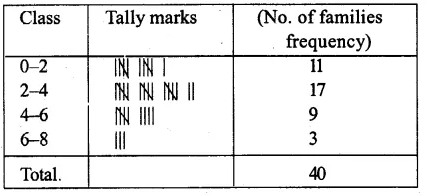
The given data can be represent in form of frequency table as given below:
Question 6.
Solution:
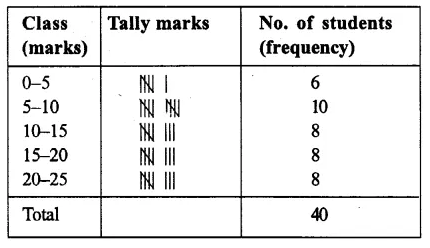
The frequency distribution table of the given data is given below :
Question 7.
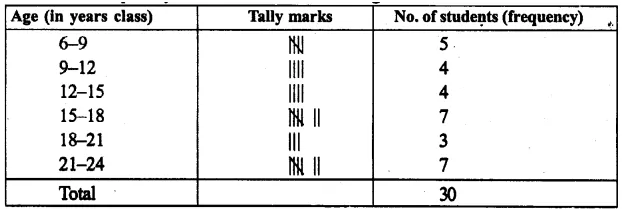
Solution:
The frequency distribution table of the
Question 8.
Solution:
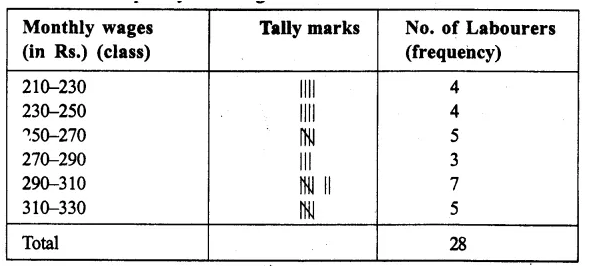
The frequency table is given below :
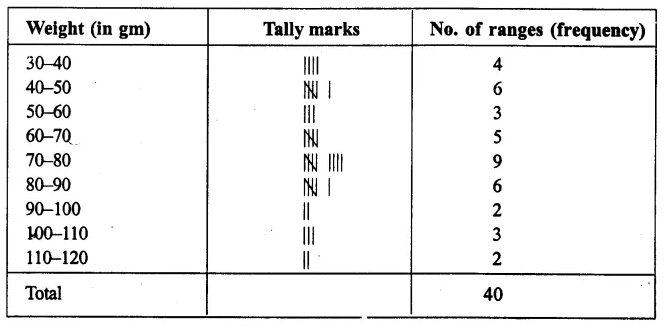
Question 9.
Solution:
The frequency table of given data is given below :
Question 10.
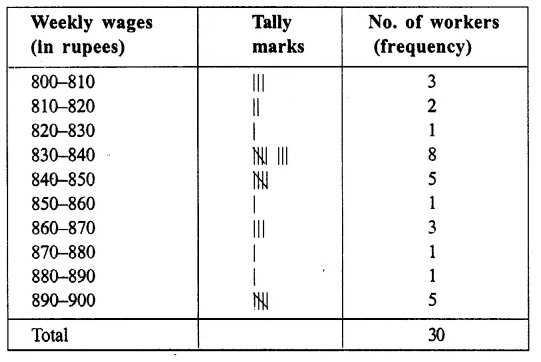
Solution:
The frequency distribution table of the given data in given below :
Question 11.
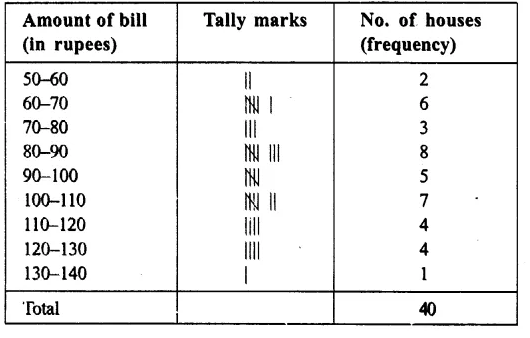
Solution:
The frequency table of the given data:
Question 12.
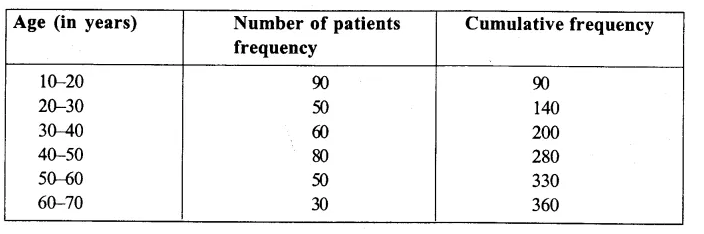
Solution:
The cumulative frequency of the given table is given below:
Question 13.
Solution:
The given table can be represented in a group frequency table in given below :

Question 14.
Solution:
Frequency table of the given cumulative frequency is given below :
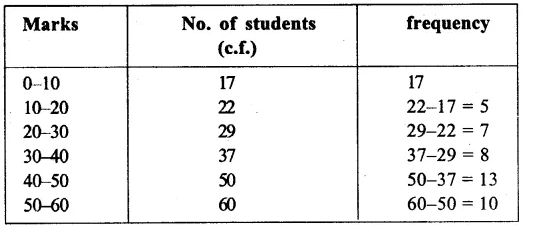
Question 15.
Solution:
A frequency table of the given cumulative frequency table is given below :
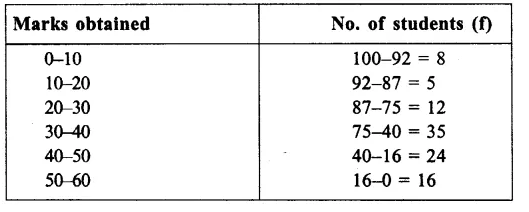
Ex 14B
Question 1.
Solution:
We shall take the game along x-axis and number of students along y-axis.
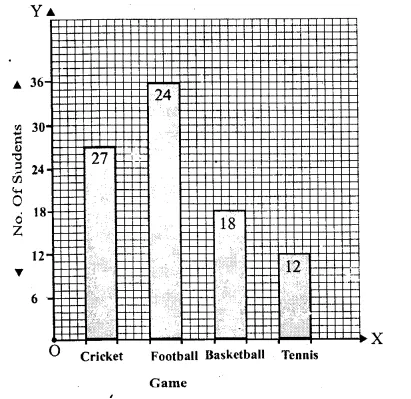
Question 2.
Solution:
We shall take the time on x-axis and temperature (in °C) on y-axis.
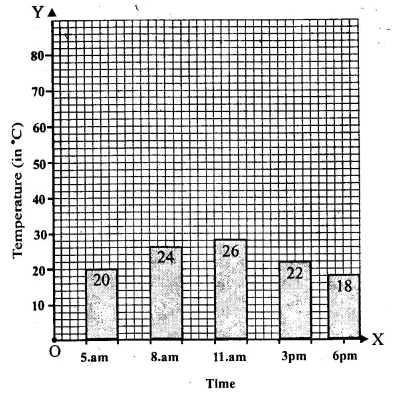
Question 3.
Solution:
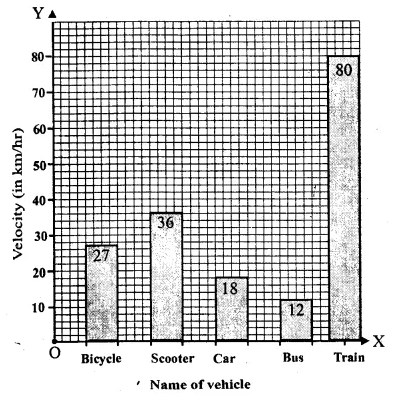
We shall take name of vehicle on x-axis and velocity (in km/hr) on y-axis
Question 4.
Solution:
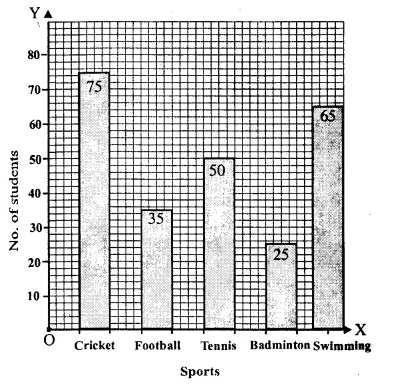
We shall take sports on x-axis and number of students on y-axis.
Question 5.
Solution:
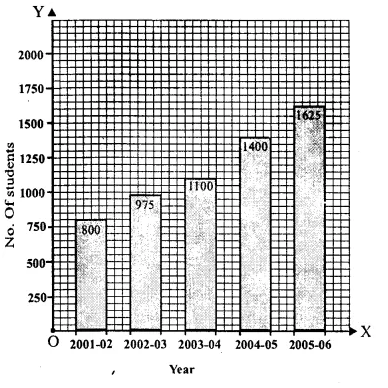
We shall take years on x-axis and number of students on y-axis.
Question 6.
Solution:
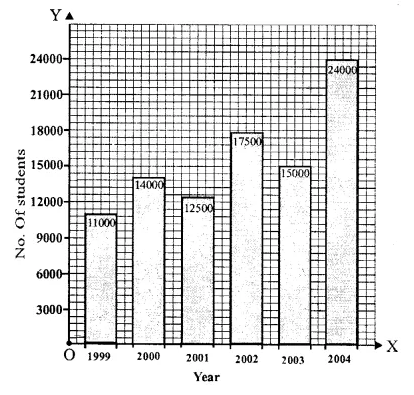
We shall take years on x-axis and number of students on y-axis.
Question 7.
Solution:
We shall take years on x-axis and number of students on y-axis.
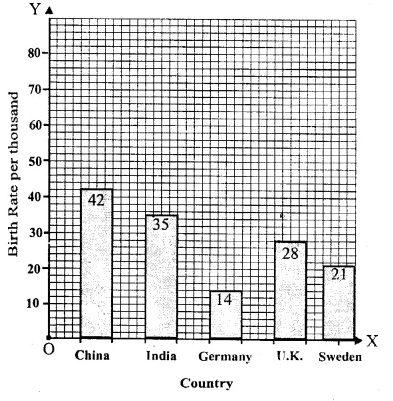
Question 8.
Solution:
We shall take years on x-axis and number of students on y-axis.
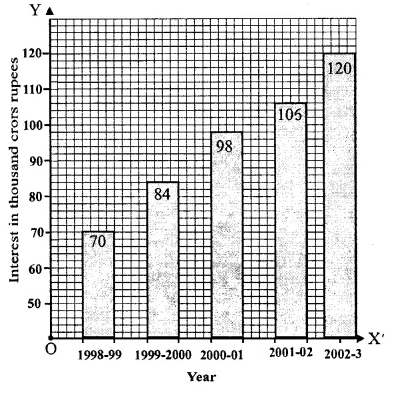
Question 9.
Solution:
We shall take years on x-axis and number of students on y-axis.
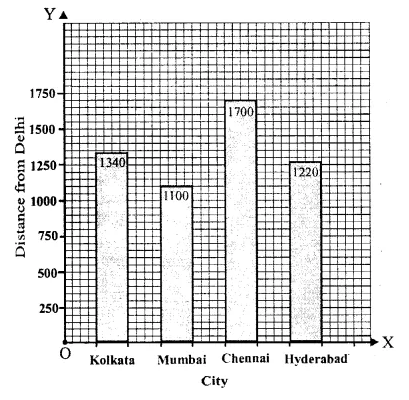
Question 10.
Solution:
We shall take years on x-axis and number of students on y-axis.
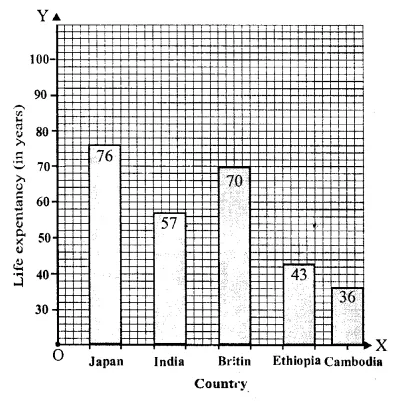
Question 11.
Solution:
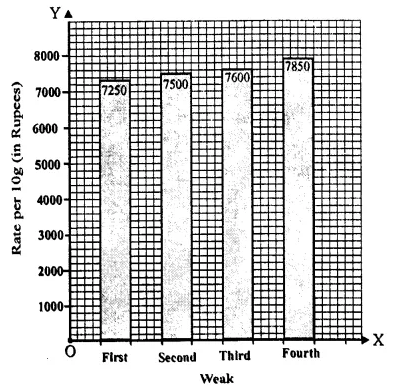
We shall take week on x-axis and Rate per 10g (in Rs.) on y-axis.
Question 12.
Solution:
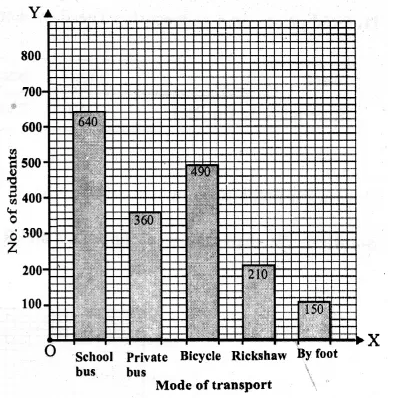
We shall take mode of transport on x-axis and number of students on y-axis.
Question 13.
Solution:
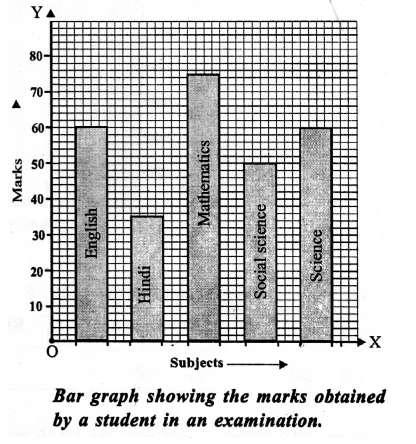
We see from the graph that
(i) It shows the marks obtained by a student in various subjects.
(ii) The student is very well in mathematics.
(iii) The student is very’ poor, in Hindi.
(iv) Average marks
= 60+35+75+50+605 (Here x = 5)
= 2805
= 56 marks
Ex 14C
Question 1.
Solution:
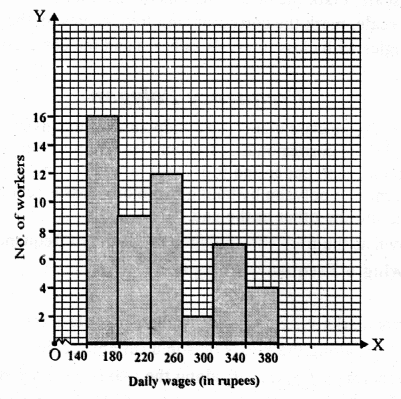
It is clear that the given frequency distribution is in exclusive form, we represent the daily wages (in rupees) along x-axis and no. of workers along y-axis. Then we construct rectangles with class intervals as bases and corresponding frequencies as heights as shown given below:
Question 2.
Solution:
We shall take daily earnings along x-axis and number of stores along y-axis. Then we construct rectangles with the given class intervals as bases and corresponding frequency as height as shown in the graph.
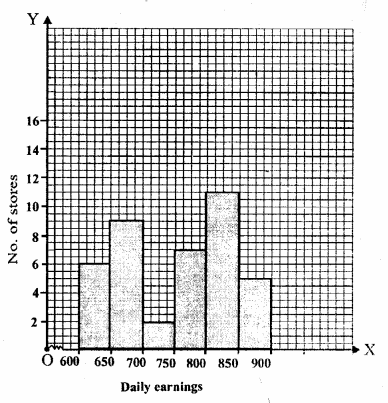
Question 3.
Solution:
We shall take heights along x-axis and number of students along y-axis. Then we shall complete the rectangles with the given class intervals as bases and frequency as height and complete the histogram as shown below :
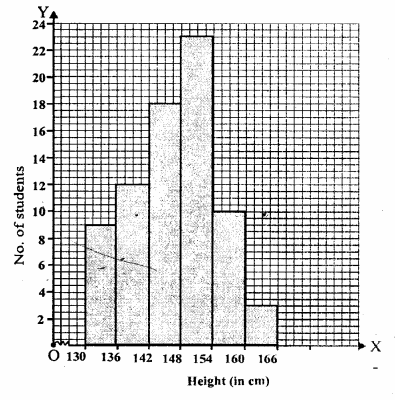
Question 4.
Solution:
We shall take class intervals along x-axis and frequency along y-axis Then we shall complete the rectangles with given class interval as bases and frequency as heights and complete the histogram as shown below.
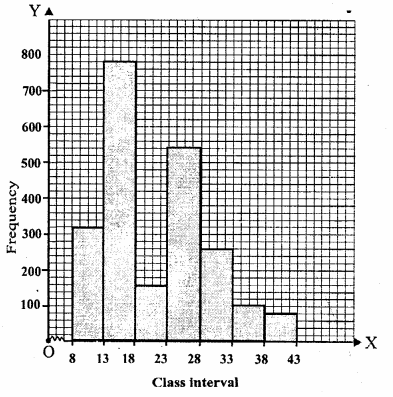
Question 5.
Solution:
The given frequency distribution is in inclusive form first we convert it into exclusive form at given below.
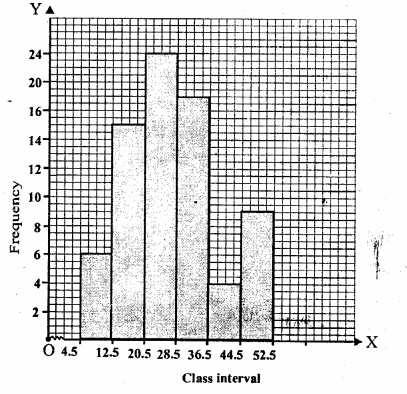

Now, we shall take class intervals along x-axis and frequency along y-axis and draw rectangles with class intervals as bases and frequency as heights and complete the histogram as shown.
Question 6.
Solution:

Question 7.
Solution:
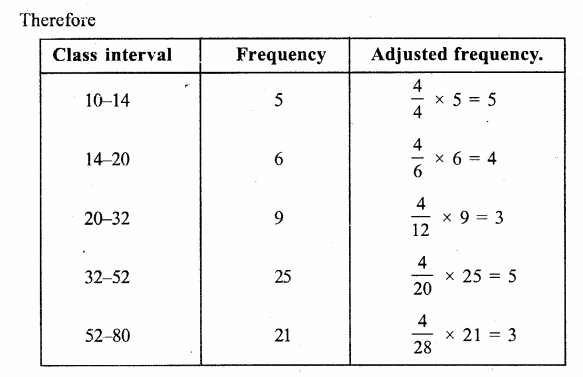
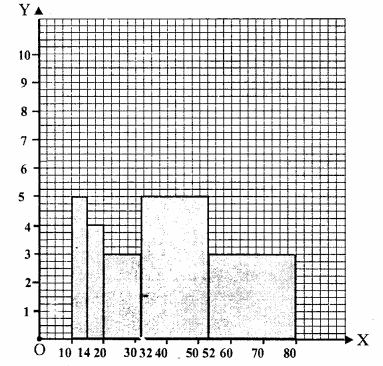
In the given distribution class intervals are different size. So, we shall calculate the adjusted frequency for each class. Here minimum class size is 4. We know that adjusted
frequency of the class is maxclasssizeclasssizeofthisclass x its frequency
Question 8.
Solution:
We shall take two imagined classes one 0-10 at the beginning with zero frequency a id other 70-80 at the end with zero frequency.
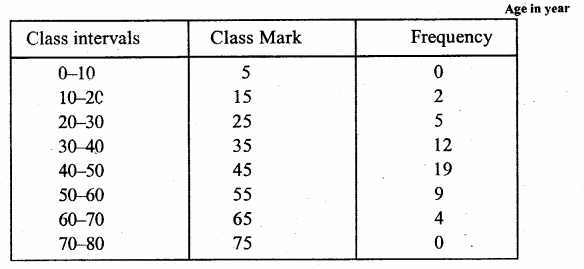
Now, plot the points” (5, 0), (15, 2), (25, 5), (35, 12), (45, 19), (55, 9), (65, 4), (75, 0) on the graph and join them its order to get a polygon as shown below.
Question 9.
Solution:
We take Age (in years) along x-axis and number of patients along y-axis. First we complete the histogram and them join the midpoints of their tops in order
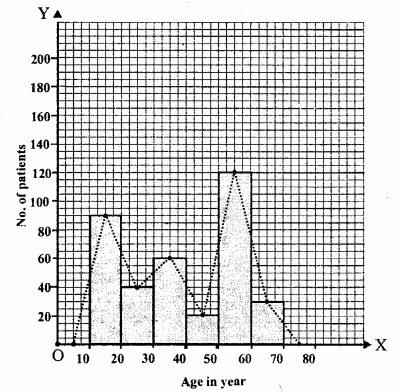
We also take two imagined classes. One 0-10 at the beginning and other 70-80 at the end and also join their midpoints to complete the polygon as shown.
Question 10.
Solution:
We take class intervals along x-axis and frequency along y-axis.
First we complete the histogram and then join the midpoints of the tops of adjacent rectangles in order. We shall take two imagined classes 15-20 at the beginning and 50-55 at the end.
We also join their midpoints to complete the polygon as shown

Question 11.
Solution:
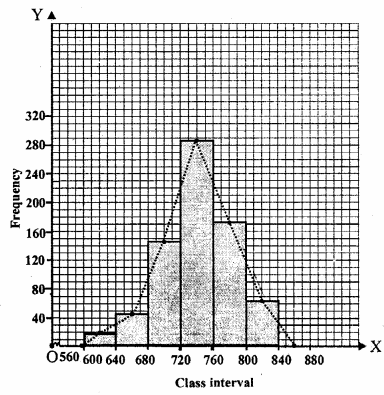
We represent class interval on x-axis and frequency on y-axis. First we construct the histogram and then join the midpoints of the tops of each rectangle by line segments. We shall take two imagined class i.e. 560-600 at the beginning and 840-900 at the end. Join their midpoints also to complete
Question 12.
Solution:
We will take the imagined class 11-0 at the beginning and 61-70 at the end. Each with frequency zero. Thus, we have,
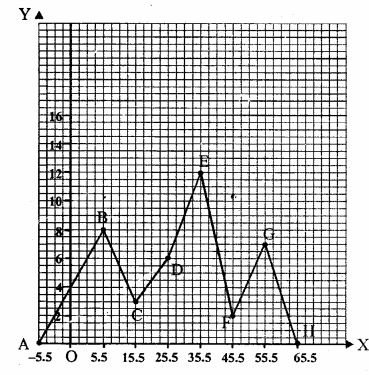
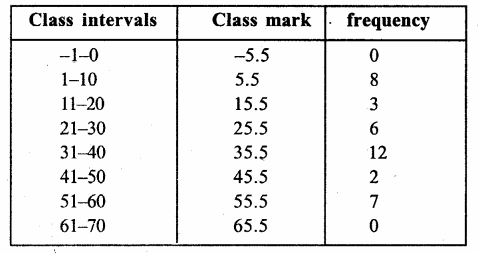
Now we will mark the points A (-5.5, 0), B(5.5, 8), C(15.5, 3) D(25.5, 6), E(35.5, 12), F(45.5, 2), G(55.5, 7) and H(65.5, 0) on the graph and join them in order to get the required frequency polygon.
Ex 14D
Question 1.
Solution:
(i) First eight natural numbers are 1, 2, 3, 4, 5, 6, 7, 8
∴ Mean = 1+2+3+4+5+6+7+88 = 368 = 92 = 4.5
(ii) First ten odd numbers are 1, 3, 5, 7, 9, 11, 13, 15, 17, 19
∴ Mean = 1+3+5+7+9+11+13+15+17+17910 = 10010 = 10
(iii) First five prime numbers are 2, 3, 5, 7, 11.
∴ Mean = 2+3+5+7+115 = 285 = 5.6
(iv) First six even numbers are 2, 4, 6, 8, 10, 12
∴ Mean = 2+4+6+8+10+1210 = 426 = 7
(v) First seven multiples of 5 are 5, 10, 15, 20, 25, 30, 35
∴ Mean = 5+10+15+20+25+30+357 = 1407 = 20
(vi) All the factors of 20 are, 1, 2, 4, 5, 10, 20
∴ Mean = 1+2+4+5+10+206 = 426 = 7
Question 2.
Solution:
No. of families (n) = 10
Sum of children (∑x1) = 2 + 4 + 3 + 4 + 2 + 0 + 3 + 5 + 1 + 6 = 30
∴ Mean (x¯¯¯)=∑x1n=3010=3
Question 3.
Solution:
Here number of days (n) = 7
Number of books (∑x1) = 105 + 216 + 322 + 167 + 273 + 405 + 346 = 1834
∴ Mean (x¯¯¯)=∑x1n=18647=262books
Question 4.
Solution:
Number of days (n) = 6
Sum of temperature (∑x) = 35.5 + 30.8 + 27.3 + 32.1 + 23.8 + 29.9 = 179.4°F
∴ Mean temperature = ∑xn=179.46=29.9°F
Question 5.
Solution:
Number of students (n) = 12
Sum of marks (∑x) = 64 + 36 + 47 + 23 + 0 + 19 + 81 + 93 + 72 + 35 + 3 + 1 = 474
= ∑x1n=47412 = 39.5
Question 6.
Solution:
Here, n = 6
and arithmetic mean =13
Total sum = 13 x 6 = 78.
But sum of 7 + 9+ 11 + 13 + 21=61
Value of x = 78 – 61 = 17
Hence x = 17 Ans.
Question 7.
Solution:
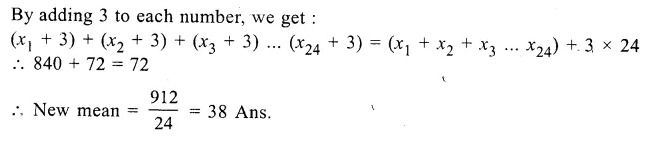
Let x1, x2, x3, … x24 be the 24 numbers
x1+x2+x3+…..+x2424=35
=> x1 + x2 + x3 +….+ x24 = 35 x 24
Question 8.
Solution:
Let x1 + x2 + x3……..x20 be the 20 numbers
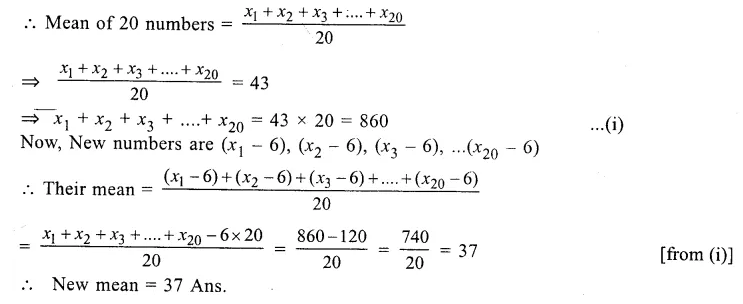
Question 9.
Solution:
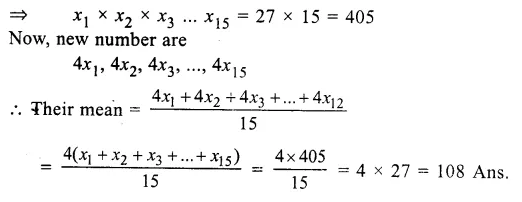
Let x1, x2, x3 … x15 be the numbers
Mean = x1+x2+x3+…..+x1515=27
Question 10.
Solution:
Let x1, x2, x3 … x12 be the numbers
Mean = x1+x2+x3+…..+x1212 = 40
=> x1+x2+x3+….+x12 = 40 X 12 =480
Now,new numbers are x18,x28,x38,..x128
Mean = x18+x28+x38+…..+x12812
= 18(x1+x2+x3+….x12)12
= 4808X12 = 5
Mean of new numbers =5
Question 11.
Solution:
Let x1, x2, x3,…..x20 are the numbers
Mean = x1+x2+x3+…x2020 = 18
=> x1 + x2 + x3 +….+ x20 = 18 X 20 =360

Question 12.
Solution:
Mean weight of 6 boys = 48 kg
Their total weight = 48 x 6 = 288 kg
Weights of 5 boys among them, are 51 kg, 45 kg, 49 kg, 46 kg and 44 kg
Sum of weight of 5 boys = (51 + 45 + 49 + 46 + 44) kg = 235 kg
Weight of 6th boy = 288 kg – 235 kg = 53 kg Ans.
Question 13.
Solution:
Mean of 50 students = 39
Total score = 39 x 50 = 1950
Now correct sum of scores = 1950 – Wrong item + Correct item= 1950 – 23 + 43
= 1950 + 20 = 1970
Correct mean = 197050 = 39.4 Ans.
Question 14.
Solution:
Mean of 100 items = 64
The sum of 100 items = 64 x 100 = 6400
New sum of 100 items = 6400 + 36 + 90 – 26 – 9 = 6526 – 35 = 6491,
Correct mean = 6491100 =64.91 = 64.91 Ans.
Question 15.
Solution:
Mean of 6 numbers = 23
Sum of 6 numbers = 23 x 6 = 138
Excluding one number, the mean of remaining 5 numbers = 20
Total of 5 numbers = 20 x 5 = 100
Excluded number = 138 – 100 = 38 Ans.
Ex 14E Solutions
Question 1.
Solution:
Mean marks of 7 students = 226
∴Total marks of 7 students = 226 x 1 = 1582
Marks obtained by 6 of them are 340, 180, 260, 56, 275 and 307
∴ Sum of marks of these 6 students = 340 + 180 + 260 + 56 + 275 + 307 = 1418
∴ Marks obtained by seventh student = 1582 – 1418 = 164 Ans.
Question 2.
Solution:
Mean weight of 34 students = 46.5 kg.
∴ Total weight of 34 students = 46.5 x 34 kg = 1581 kg
By including the weight of teacher, the mean weight of 35 persons = 500 g + 46.5 kg
= 46.5 + 0.5 = 47.0 kg
∴ Total weight = 47.0 x 35 = 1645 kg
∴ Weight of the teacher = (1645 – 1581) kg = 64 kg Ans
Question 3.
Solution:
Mean weight of 36 students = 41 kg
∴ Total weight of 36 students = 41 x 36 kg = 1476 kg
After leaving one student, number of students = 36 – 1 =35
Their new mean = 41.0 – 200g = (41.0 – 0.2) kg = 40.8 kg.
∴ Total weight of 35 students = 40.8 x 35 = 1428 kg
∴ Weight of leaving student = (1476 – 1428) kg = 48 kg Ans.
Question 4.
Solution:
Average weight of 39 students = 40 kg
∴ Total weight of 39 students = 40 x 39 = 1560 kg
By admitting of a new student, no. of students = 39 + 1 =40
and new mean = 40 kg – 200 g = 40 kg – 0.2 kg = 39.8 kg
∴Weight of 40 students = 39.8 x 40 kg = 1592 kg
∴Weight of new student = 1592 – 1560 kg = 32 kg Ans.
Question 5.
Solution:
Average salary of 20 workers = Rs. 7650
∴Their total salary = Rs. 7650 x 20 = Rs. 153000
By adding the salary of the manager, their mean salary = Rs. 8200
∴Their total salary = Rs. 8200 x 21 = Rs. 172200
∴Salary of the manager = Rs. 172200 – Rs. 153000 = Rs. 19200 Ans.
Question 6.
Solution:
Average wage of 10 persons = Rs. 9000
Their total wage = Rs. 9000 x 10 = Rs. 90000
Wage of one person among them = Rs. 8100
and wage of new member = Rs. 7200
∴ New total wage = Rs. (90000 – 8100 + 7200) = Rs. 89100
Their new mean wage = Rs.8910010 = Rs. 8910
Question 7.
Solution:
Mean consumption of petrol for 7 months of a year = 330 litres
Mean consumption of petrol for next 5 months = 270 litres
∴Total consumption for first 7 months = 7 x 330 = 2320 l
and total consumption for next 5 months = 5 x 270 = 1350 l
Total consumption for 7 + 5 = 12 months = 2310 + 1350 = 3660 l
Average consumption = 366012 = 305 liters per month.
Question 8.
Solution:
Total numbers of numbers = 25
Mean of 15 numbers = 18
∴Total of 15 numbers = 18 x 15 = 270
Mean of remaining 10 numbers = 13
∴Total = 13 x 10 = 130
and total of 25 numbers = 270 + 130 = 400
∴Mean = 40025 = 16 Ans.
Question 9.
Solution:
Mean weight of 60 students = 52.75 kg.
Total weight = 52.75 x 60 = 3165 kg
Mean of 25 out of them = 51 kg.
∴Their total weight = 51 x 25 = 1275 kg
∴ Total weight of remaining 60 – 25 = 35 students = 3165 – 1275 = 1890 kg 1890
Mean weight = 189035 = 54 kg Ans.
Question 10.
Solution:
Average increase of 10 oarsman = 1.5 kg.
∴ Total increased weight =1.5 x 10 = 15kg
Weight of out going oarsman = 58 kg .
∴ Weight of new oarsman = 58 + 15 = 73 kg Ans.
Question 11.
Solution:
Mean of 8 numbers = 35
∴Total of 8 numbers = 35 x 8 = 280
After excluding one number, mean of 7 numbers = 35 – 3 = 32
Total of 7 numbers = 32 x 7 = 224
Hence excluded number = 280 – 224 = 56 Ans.
Question 12.
Solution:
Mean of 150 items = 60
Total of 150 items = 60 x 150 = 9000
New total = 9000 + 152 + 88 – 52 – 8 = 9000 + 240 – 60 = 9180
∴New mean = 9180150 = 61.2 Ans.
Question 13.
Solution:
Mean of 31 results = 60
∴Total of 31 results = 60 x 31 = 1860
Mean of first 16 results = 58
∴Total of first 16 results = 58 x 16 = 928
and mean of last 16 results = 62
∴Total of last 16 results = 62 x 16 = 992
∴16th result = (928 + 992) – 1860 = 1920 – 1860 = 60 Ans.
Question 14.
Solution:
Mean of 11 numbers = 42
∴Total of 11 numbers = 42 x 11 = 462
Mean of first 6 numbers = 37
∴Total of first 6 numbers = 37 x 6 = 222
Mean of last 6 numbers = 46
∴Total of last 6 numbers = 46 x 6 = 276
∴6th number = (222 + 276) – 462 = 498 – 462 = 36 Ans.
Question 15.
Solution:
Mean weight of 25 students = 52 kg
∴ Total weight of 25 students = 52 x 25 = 1300 kg
Mean weight of first 13 students = 48 kg
∴ Total weight of first 13 students = 48 x 13 kg = 624 kg
Mean of last 13 students = 55 kg
∴Total of last 13 students = 55 x 13 kg = 715 kg
∴Weight of 13th student = (624 + 715) – 1300 = 1339 – 1300 = 39 kg Ans.
Question 16.
Solution:
Mean of 25 observations = 80
Total of 25 observations = 80 x 25 = 2000
Mean of another 55 observations = 60
∴ Total of these 55 observations = 60 x 55 = 3300
Total number of observations = 25 + 55 = 80
and total of 80 numbers = 2000 + 3300 = 5300
Mean of 80 observations = 530080 = 66.25 Ans.
Question 17.
Solution:
Marks in English = 36
Marks in Hindi = 44
Marks in Mathematics = 75
Marks in Science = x
∴Total number of marks in 4 subjects = 36 + 44 + 75 + x = 155 + x
Average marks in 4 subjects = 50
∴Total marks = 50 x 4 = 200
∴155 + x = 200
=> x = 200 – 155
=> x = 45
Hence, marks in Science = 45 Ans.
Question 18.
Solution:
Mean of monthly salary of 75 workers = Rs. 5680
Total salary of 75 workers = Rs. 5680 x 75 = Rs. 426000
Mean salary of 25 among them = Rs. 5400
Total of 25 workers = Rs. 5400 x 25 = Rs. 135000
Mean salary of 30 among them = Rs. 5700
∴Total of 30 among them = Rs. 5700 x 30 = Rs. 171000
∴ Total salary of 25 + 30 = 55 workers = Rs. 135000 + 171000 = Rs. 306000
∴Total salary of remaining 75 – 55 = 20 workers = Rs. 426000 – 306000 = Rs. 120000
∴ Mean of remaining 20 workers = Rs. 12000020 = Rs. 6000 Ans.
Question 19.
Solution:
Let distance between two places = 60 km
∴Time taken at the speed of 15 km/h = 6015 = 4 hours
and time taken at speed of 10 km/h for coming back = 6010 = 6 hours
Total the taken = 4 + 6 = 10
hours and distance covered = 60 + 60 = 120 km
∴Average speed = 12010 =12 km/hr.
Question 20.
Solution:
No. of total students = 50
No. of boys = 40
∴ No. of girls = 50 – 40 = 10
Average weight of class = 44kg
∴Total weight of 50 students = 44 x 50 = 2200 kg
Average weight of 10 girls = 40 kg
∴Total weight = 40 x 10 = 400 kg
Total weight of 40 boys = 2200 – 400 = 1800 kg
∴Average weight of 40 boys = 180040kg = 45 kg Ans.
Ex 14F
Question 1.
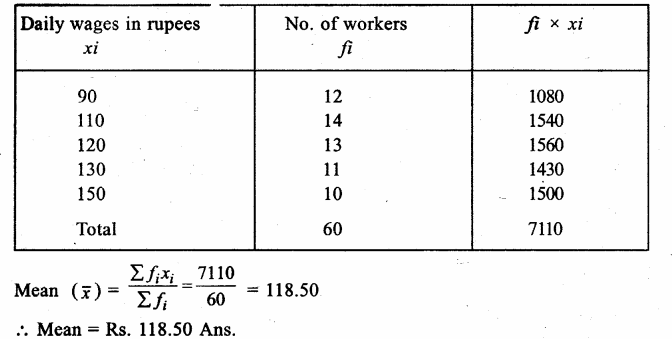
Solution:
Question 2.
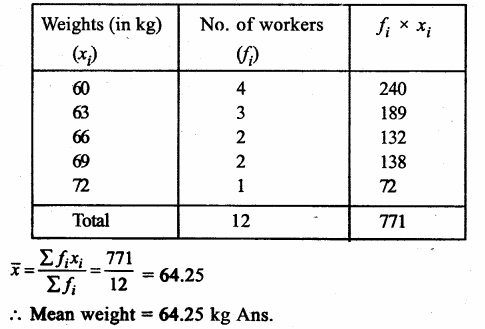
Solution:
Question 3.
Solution:
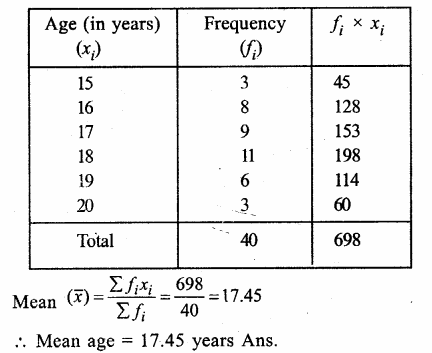
Question 4.
Solution:
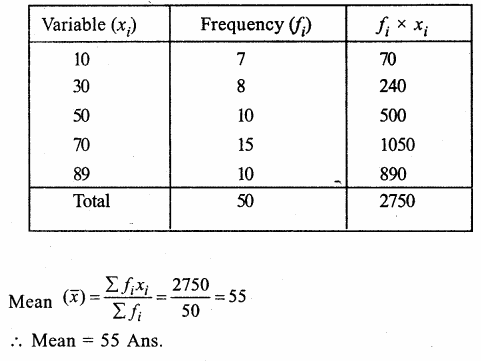
Question 5.
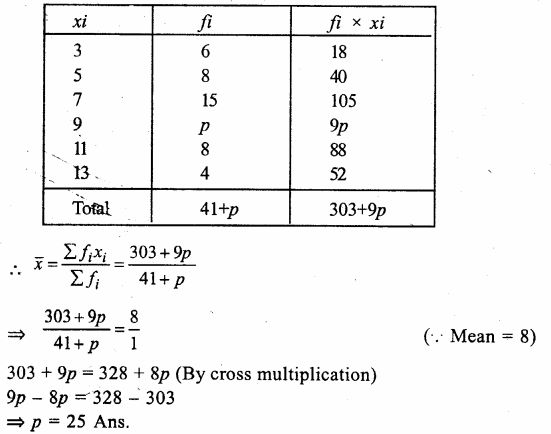
Solution:
Mean = 8
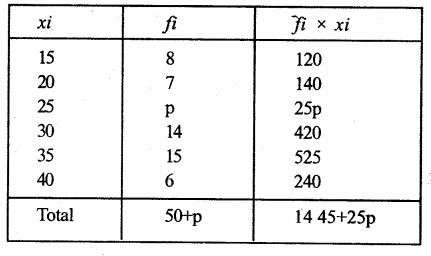
Question 6.
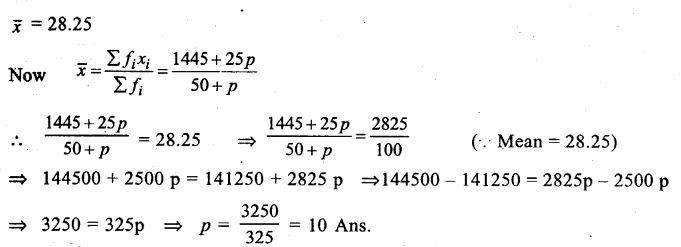
Solution:
Mean = 28.25
Question 7.
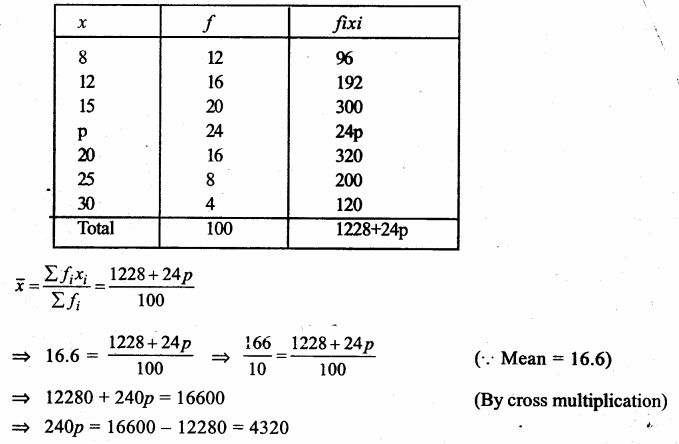
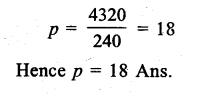
Solution:
Mean = 16.6
Question 8.
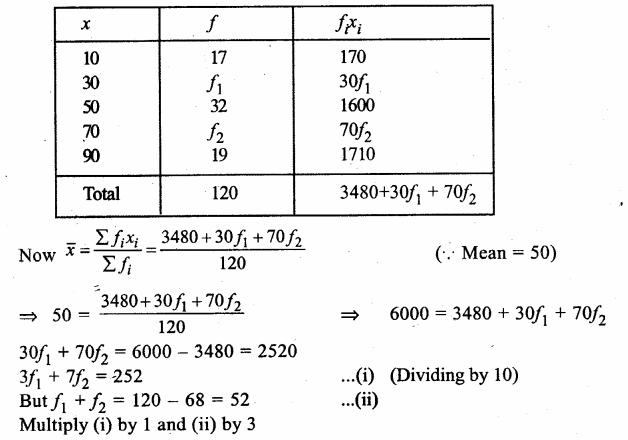
Solution:
Mean = 50
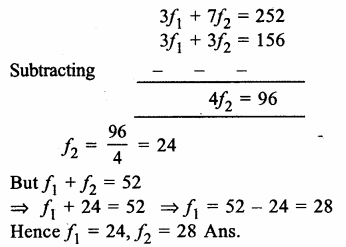
Question 9.
Solution:
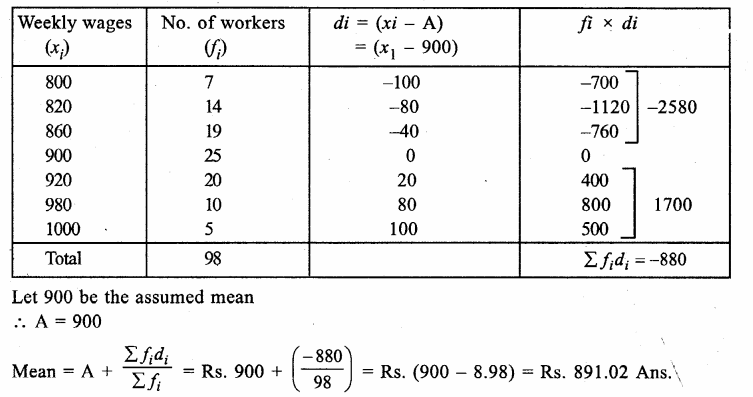
Question 10.
Solution:
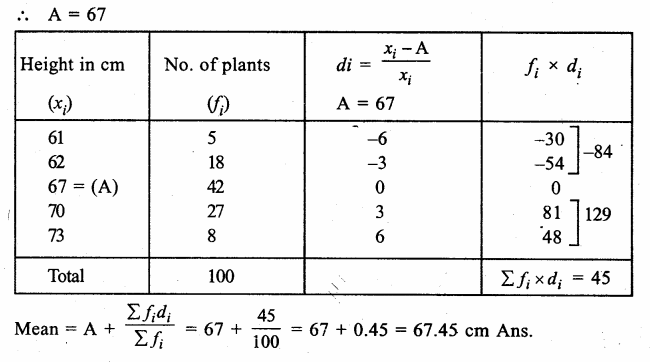
Let assumed mean = 67
Question 11.
Solution:
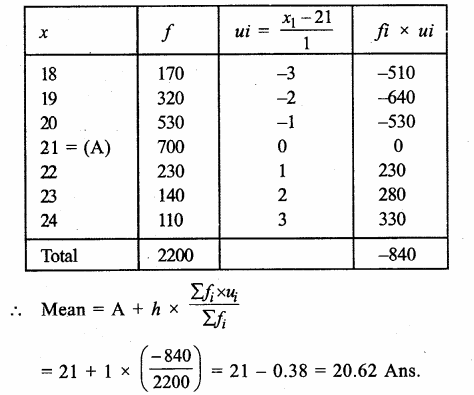
Here h = 1, Let assumed mean (A) = 21
Question 12.
Solution:
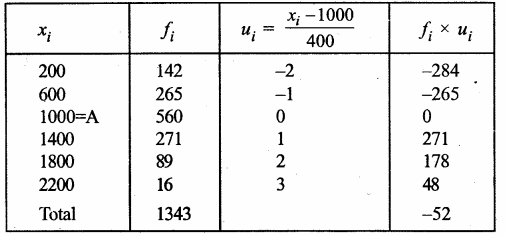
Here h = 400 and let assumed mean (A) = 1000

Ex 14G Solutions
Question 1.
Solution:
Arranging in ascending order, we get:
2,2,3,5,7,9,9,10,11
Here, number of terms is 9 which is odd.
∴ Median = n+12 th term = 9+12 th term = 5th term = 7 Ans.
(ii) Arranging in ascending order, we get: 6, 8, 9, 15, 16, 18, 21, 22, 25
Here, number of terms is 9 which is odd.
∴ Median = n+12 th term = 9+12 th term = 5th term = 16 Ans.
(iii) Arranging in ascending order, we get: 6, 8, 9, 13, 15, 16, 18, 20, 21, 22, 25
Here, number of terms is 11 which is odd.
∴ Median = 11+12 th term = 122 th term = 6th term = 16 Ans.
(iv) Arranging in ascending order, we get:
0, 1, 2, 2, 3, 4, 4, 5, 5, 7, 8, 9, 10
Here, number of terms is 13, which is odd.
Median = 13+12 th term = 142 th term = 7th term = 4 Ans.
Question 2.
Solution:
Arranging in ascending order, we get 9, 10, 17, 19, 21, 22, 32, 35
Here, number of terms is 8 which is even
∴Median = 12[82thterm+(82+1)thterm]
= 12 [4th term + 5th term] = 12 (19 + 21) = 12 x 40 = 20
(ii) Arranging in ascending order, we get:
29, 35, 51, 55, 60, 63, 72, 82, 85, 91
Here number of terms is 10 which is even
∴Median = 12[102thterm+(102+1)thterm]
= 12 (60 + 63) = 12 x 123 = 61.5 Ans.
(iii) Arranging in ascending order we get
3, 4, 9, 10, 12, 15, 17, 27, 47, 48, 75, 81
Here number of terms is 12 which is even.
∴Median = 12[122thterm+(122+1)thterm]
= 12 (6th term + 7th term) = 12 (15 + 17)= 12 x 32
= 16 Ans.
Question 3.
Solution:
Arranging the given data in ascending order, we get :
17, 17, 19, 19, 20, 21, 22, 23, 24, 25, 26, 29, 31, 35, 40
∴ Median = 15+12 th term = 162 th term = 8th term = 23
∴ Median score = 23 Ans.
Question 4.
Solution:
Arranging in ascending order, we get:
143.7, 144.2, 145, 146.5, 147.3, 148.5, 149.6, 150, 152.1
Here, number of terms is 9 which is odd.
Median = 9+12 th term = 102 th term = 5th term = 147.3 cm
Hence, median height = 147.3 cm Ans.
Question 5.
Solution:
Arranging in ascending order, we get:
9.8, 10.6, 12.7, 13.4, 14.3, 15, 16.5, 17.2
Here number of terms is 8 which is even
∴Median = 12[82thterm+(82+1)thterm]
= 12[4th term + 5th term]
= 12 (13.4 + 14.3) = 12 (27.7) = 13.85
∴ Median weight = 13.85 kg. Ans.
Question 6.
Solution:
Arranging in ascending order, we get:
32, 34, 36, 37, 40, 44, 47, 50, 53, 54
Here, number of terms is 10 which is even.
∴Median = 12[102thterm+(102+1)thterm]
= 12 [5th term + 6th term ] = 12 (40 + 44) = 12 x 84 = 42 .
∴ Median age = 42 years.
Question 7.
Solution:
The given ten observations are 10, 13, 15, 18, x + 1, x + 3, 30, 32, 35, 41
These are even
∴Median = 12[102thterm+(102+1)thterm]
= 12 [5th term + 6th term ] = 12(x + 1 + x + 3) = 12(2x + 4)
= x + 2
But median is given = 24
∴ x + 2 = 24 => x = 24 – 2 = 22
Hence x = 22.
Question 8.
Solution:
Preparing the cumulative frequency table, we have:
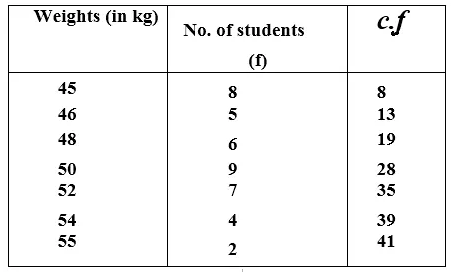
Here, number of terms (n) = 41, which is odd,
Median = 41+12 th term = 422 th term = 21st term = 50 (∵ 20th to 28th term = 50)
Hence median weight = 50 kg Ans.
Question 9.
Solution:
Arranging first in ascending order, we get:

Now preparing its cumulative frequency table
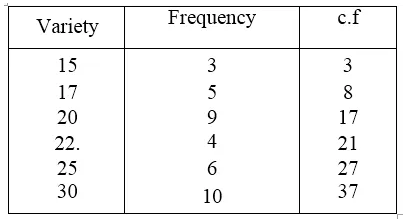
Here, number of terms is 37 which is odd.
Median = 37+12 th term = 382 th term = 19 th term = 22 (∵18th to 21st = 22)
Hence median – 22 Ans.
Question 10.
Solution:
first arranging in ascending order we get

Now preparing its cumulative frequency table,we find:
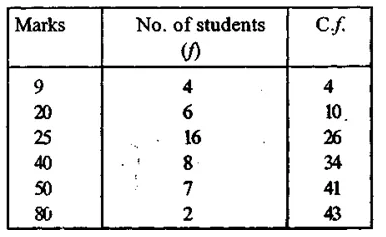
Here, number of terms is 43, which if odd.
Median = 43+12 th term = 442 th term = 22nd term = 25 25 (∵ 11th to 26th = 25)
Question 11.
Solution:
Arranging in ascending order,we get

Now preparing its cumulative frequency table, we find :
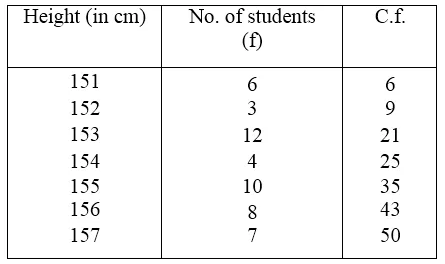
Here, number of terms = 50 which is even
∴Median = 12[502thterm+(502+1)thterm]
= 12 (154 + 155) = 12 (309) = 154.5 (∵ 22nd to 25th = 154, 26th to 34th= 155)
Question 12.
Solution:
Arranging in ascending order, we get:

Now, preparing its cumulative frequency table.
Here, number of terms is 60 which is even
∴Median = 12[602thterm+(602+1)thterm]
= 12 (30th term + 31st term)
= 12 (20 + 23) = 12 x 43 = 21.5 (∵ 18th to 30th term = 20, 31st term to 34th = 23)
Hence median = 21.5 Ans.
Ex 14H
Question 1.
Solution:
Arranging the given data in ascending order :
0, 0, 1, 2, 3, 4, 5, 5, 6, 6, 6, 6
We see that 6 occurs in maximum times.
Mode = 6 Ans.
Question 2.
Solution:
Arranging in ascending order, we get:
15, 20, 22, 23, 25, 25, 25, 27, 40
We see that 25 occurs in maximum times.
Mode = 25 Ans.
Question 3.
Solution:
Arranging in ascending order we get:
1, 1, 2, 3, 3, 4, 5, 5, 6, 6, 7, 8, 9, 9, 9, 9, 9
Here, we see that 9 occurs in maximum times.
Mode = 9 Ans.
Question 4.
Solution:
Arranging in ascending order, we get:
9, 19, 27, 28, 30, 32, 35, 50, 50, 50, 50, 60
Here, we see that 50 occurs in maximum times.
Modal score = 50 scores Ans.
Question 5.
Solution:
Arranging in ascending order, we get:
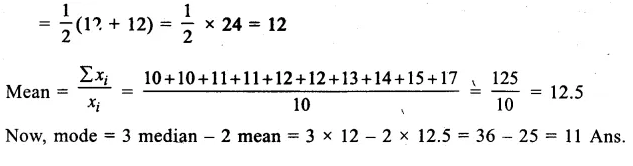
10, 10, 11, 11, 12, 12, 13, 14,15, 17
Here, number of terms is 10, which is even
∴ Median = 12[102thterm+(102+1)thterm]
= 12 (5th term + 6th term)
Question 6.
Solution:
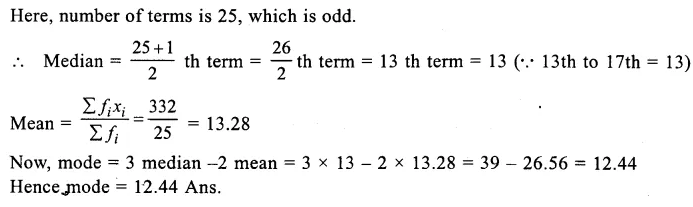
Question 7.
Solution:
Writing its cumulative frequency table
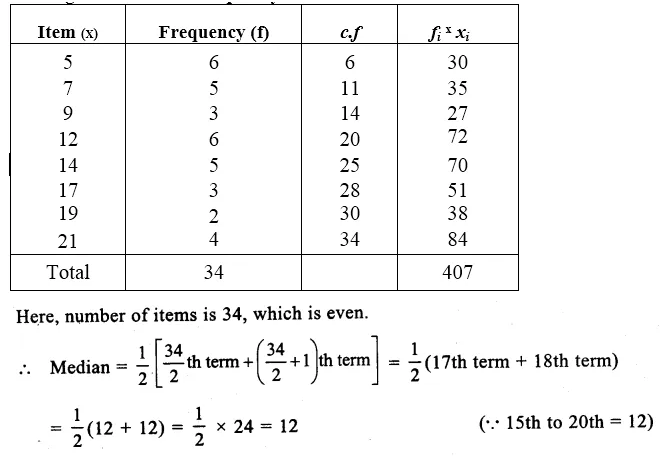

Question 8.
Solution:
Writing its cumulative frequency table
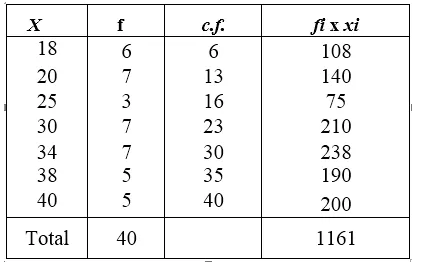
Here, number of items is 40 which is even.
∴ Median = 12[402thterm+(402+1)thterm]
= 12 (20th term + 21th term)
= 12 (30 + 30) = 12 x 60 = 30
Mean= ∑fixi∑fi = 116140 = 29.025
∴Mode = 3 median – 2 mean = 3 x 30 – 2 x 29.025 = 90 – 58.05 = 31.95
Question 9.
Solution:
Preparing its cumulative frequency table we get:
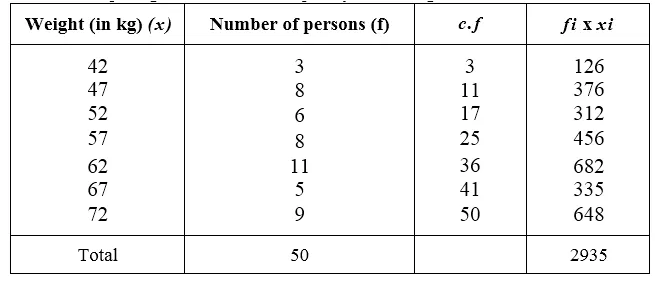
Here number of terms is 50, which is even
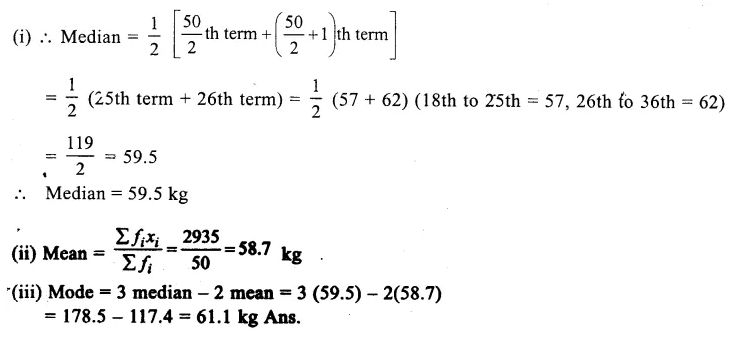
Question 10.
Solution:
Preparing its cumulative frequency table :
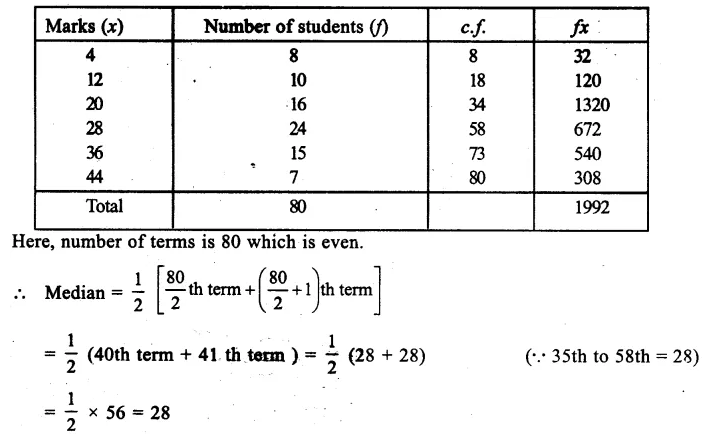
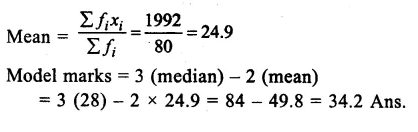
Question 11.
Solution:
Preparing its cumulative frequency table we have,
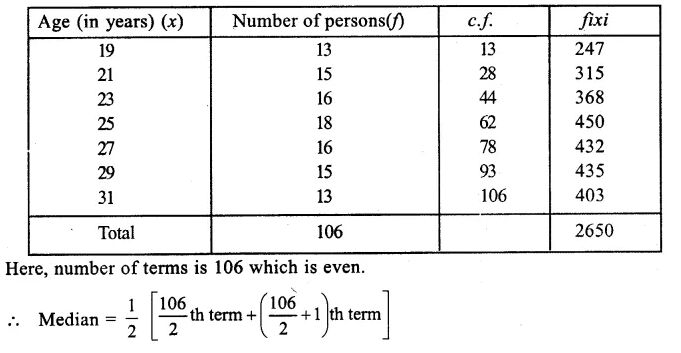
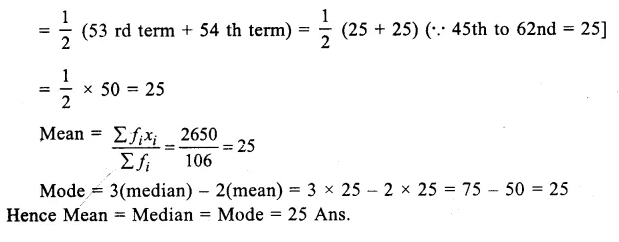
Question 12.
Solution:
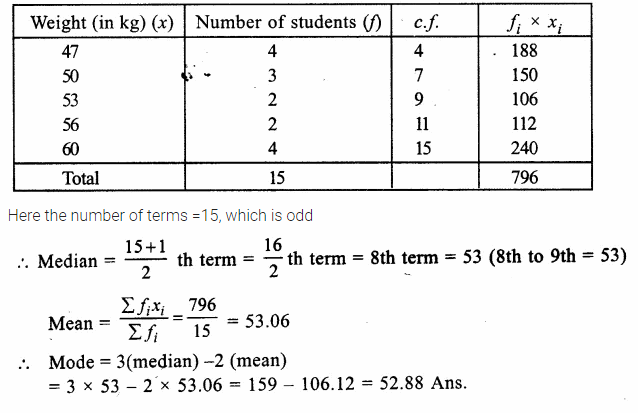
Preparing its cumulative frequency table we have,
RS Aggarwal Solutions for Class 9 Maths Chapter 14: Download PDF
RS Aggarwal Solutions for Class 9 Maths Chapter 14–Statistics
Download PDF: RS Aggarwal Solutions for Class 9 Maths Chapter 14–Statistics PDF
Chapterwise RS Aggarwal Solutions for Class 9 Maths :
- Chapter 1–Real Numbers
- Chapter 2–Polynomials
- Chapter 3–Introduction to Euclid’s Geometry
- Chapter 4–Lines and Triangles
- Chapter 5–Congruence of Triangles and Inequalities in a Triangle
- Chapter 6–Coordinate Geometry
- Chapter 7–Areas
- Chapter 8–Linear Equations in Two Variables
- Chapter 9–Quadrilaterals and Parallelograms
- Chapter 10–Area
- Chapter 11–Circle
- Chapter 12–Geometrical Constructions
- Chapter 13–Volume and Surface Area
- Chapter 14–Statistics
- Chapter 15–Probability
About RS Aggarwal Class 9 Book
Investing in an R.S. Aggarwal book will never be of waste since you can use the book to prepare for various competitive exams as well. RS Aggarwal is one of the most prominent books with an endless number of problems. R.S. Aggarwal's book very neatly explains every derivation, formula, and question in a very consolidated manner. It has tonnes of examples, practice questions, and solutions even for the NCERT questions.
He was born on January 2, 1946 in a village of Delhi. He graduated from Kirori Mal College, University of Delhi. After completing his M.Sc. in Mathematics in 1969, he joined N.A.S. College, Meerut, as a lecturer. In 1976, he was awarded a fellowship for 3 years and joined the University of Delhi for his Ph.D. Thereafter, he was promoted as a reader in N.A.S. College, Meerut. In 1999, he joined M.M.H. College, Ghaziabad, as a reader and took voluntary retirement in 2003. He has authored more than 75 titles ranging from Nursery to M. Sc. He has also written books for competitive examinations right from the clerical grade to the I.A.S. level.
FAQs
Why must I refer to the RS Aggarwal textbook?
RS Aggarwal is one of the most important reference books for high school grades and is recommended to every high school student. The book covers every single topic in detail. It goes in-depth and covers every single aspect of all the mathematics topics and covers both theory and problem-solving. The book is true of great help for every high school student. Solving a majority of the questions from the book can help a lot in understanding topics in detail and in a manner that is very simple to understand. Hence, as a high school student, you must definitely dwell your hands on RS Aggarwal!
Why should you refer to RS Aggarwal textbook solutions on Indcareer?
RS Aggarwal is a book that contains a few of the hardest questions of high school mathematics. Solving them and teaching students how to solve questions of such high difficulty is not the job of any neophyte. For solving such difficult questions and more importantly, teaching the problem-solving methodology to students, an expert teacher is mandatory!
Does IndCareer cover RS Aggarwal Textbook solutions for Class 6-12?
RS Aggarwal is available for grades 6 to 12 and hence our expert teachers have formulated detailed solutions for all the questions of each edition of the textbook. On our website, you'll be able to find solutions to the RS Aggarwal textbook right from Class 6 to Class 12. You can head to the website and download these solutions for free. All the solutions are available in PDF format and are free to download!