
Class 9: Maths Chapter 12 solutions. Complete Class 9 Maths Chapter 12 Notes.
RS Aggarwal Solutions for Class 9 Maths Chapter 12–Geometrical Constructions
RS Aggarwal 9th Maths Chapter 12, Class 9 Maths Chapter 12 solutions
Question 1.
Solution:
Steps of Constructions :
(i) Draw a line segment AB = 5cm.
(ii) With A as centre and a radius equal to more than half of AB, drawn two arcs one above and other below of AB.
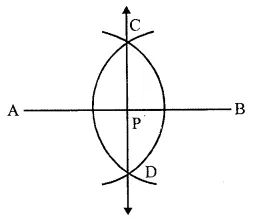
(iii) With centre B, and with same radius, draw two arcs intersecting the previously arcs at C and D respectively.
(iv) Join CD, intersecting AB at P.
Then CD is the perpendicular bisector of AB at the point P.
Question 2.
Solution:
Steps of constructions.
(i) Draw a line segment AB.
(ii) With A as centre and with small radius drawn arc cutting AB at P.
(iii) With P as centre and same radius draw another arc cutting the previous arc at Q and then R.
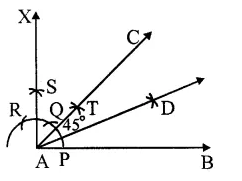
(iv) Bisect arc QR at S.
(v) Join AS and produce it to X such that ∠ BAX = 90°.
(vi) Now with centres P and S and with a suitable radius, draw two arcs intersecting each other at T.
(vii) Join AT and produced it to C Then ∠BAC = 45°.
(viii) Again with centres P and T and suitable radius draw two arcs intersecting each at D.
(ix) Join AD.
AD is the bisector of ∠ BAC
Question 3.
Solution:
Steps of construction.
(i) Draw a line segment AB.
(ii) With centre A and same radius draw an arc which meets AB at P.
(iii) With centre P and same radius, draw arcs first at Q and then at R.
(iv) With centres Q and R, draw arcs intersecting each other at C intersecting the first arc at T.
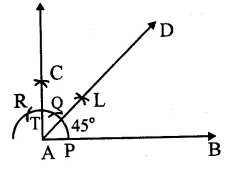
(v) Join AC
Then ∠BAC = 90°
(vi) Now with centres P and T and with some suitable radius, draw two arcs intersecting each other at L.
(vii) Join AL and produce it to D.
Then AD is the bisector of ∠ BAC.
Question 4.
Solution:
Steps of construction.
(i) Draw a line segment BC = 5cm.
(ii) With centres B and C and radius
5cm, draw two arcs intersecting each other at A.
(iii) Join AB and AC.
Then ∆ ABC is the required equilateral triangle.
Question 5.
Solution:
We know that altitudes of equilateral triangle are equal and each angle is 60°.
Steps of construction.
(i) Draw a line XY and take a point D on it.
(ii) At D, draw a perpendicular and cut off DA = 5.4cm.
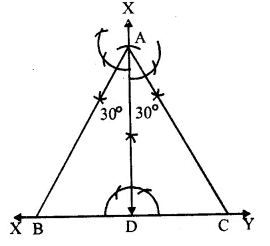
(iii) At A draw angles of 30° on each side of AD which meet XY at B and C respectively.
Then ∆ ABC is the required triangle.
Question 6.
Solution:
Steps of construction :
(i) Draw a line segment BC = 5cm
(ii) With centre B and radius 3.8 cm draw an arc.
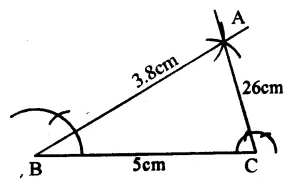
(iii) With centre C and radius 2.6 cm draw another arc intersecting the first arc at A.
(iv) Join AB and AC.
Then ∆ ABC is the required triangle.
Question 7.
Solution:
Steps of construction :
(i) Draw a line segment BC = 4.7cm.
(ii) At B, draw a ray BX making an angle of 60° with BC.
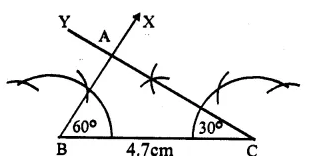
(iii) At C, draw another ray, CY making an angle of 30° which intersects the ray BX at A ,
Then ∆ ABC is the required triangle On measuring ∠ A, it is 90°.
Question 8.
Solution:
Steps of Construction :
(i) Draw a line segment QR * 5cm.
(ii) With centres Q and R and radius equal to 4.5cm, draw arcs intersecting eachother at P.
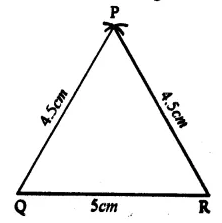
(iii) Join PQ and PR.
Then ∆ PQR is the required triangle.
Question 9.
Solution:
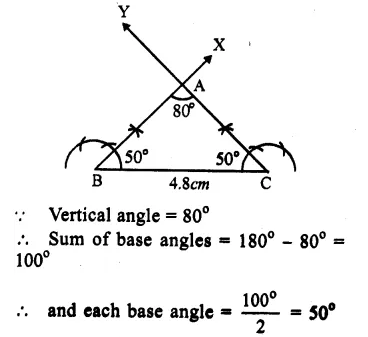
We know that in an isosceles triangle, two sides are equal and so their opposite angles are also equal.
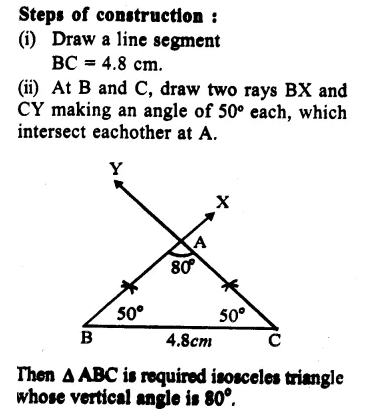
Question 10.
Solution:
Steps of constructions :
(i) Draw a line segment BC = 4.5cm.
(ii) At B, draw a ray BX making an angle of 90° with BC.
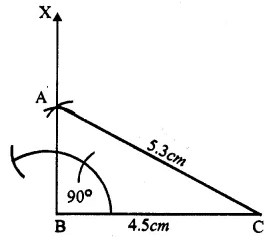
(iii) With centre C and radius 5.3 cm, draw an arc intersecting BX at A.
(iv) Join AC.
Then ∆ ABC is the required right angled triangle.
Question 11.
Solution:
Steps of constructions :
(i) Draw a line XY.
(ii) Take a point D on XY.
(iii) Draw a perpendicular at D and cut off DA = 4.8 cm
(iv) At A, draw a line LM parallel to XY.
(v) At A, draw an angle of 30° with LM on one side and an angle of 60° with LM on other side meeting XY at B and C respectively
Then ∆ ABC is the required triangle.
Question 12.
Solution:
Steps of constructions :
(i) Draw a line segment EF = 12cm.
(ii) At E, draw a ray EX making an acute angle with EF.
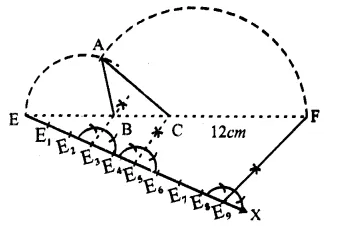
(iii)From EX,cut off 3+2+4=9 equal parts.
(iv) Join E9 F.
(v) From E5 and E3, draw lines parallel to E9 F meeting EF at C and B respectively.
(vi) With centre B and radius EB and with centre C and radius CF, draw arcs intersecting eachother at A.
(vii) Join AB and AC.
Then ∆ ABC is the required triangle.
Question 13.
Solution:
Steps of constructions :
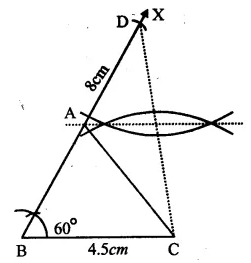
(i) Draw a line segment BC = 4.5cm.
(ii) At B, draw a ray BX making an angle of 60° and cut off BD = 8cm.
(iii) Join DC.
(iv) Draw the perpendicular bisector of BD which intersects BX at A.
(v) Join AC.
Then ∆ ABC is the required triangle.
Question 14.
Solution:
Steps of Constructions :
(i) Draw a line segment BC = 5.2 cm.
(ii) At B draw a ray BX making an angle of 30°.
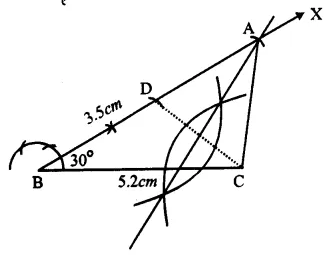
(iii) From BX, cut off BD = 3.5cm.
(iv) Join DC.
(v) Draw perpendicular bisector of DC which intersects BX at A.
(vi) Join AC.
Then ∆ ABC is the required triangle.
RS Aggarwal Solutions for Class 9 Maths Chapter 12: Download PDF
RS Aggarwal Solutions for Class 9 Maths Chapter 12–Geometrical Constructions
Download PDF: RS Aggarwal Solutions for Class 9 Maths Chapter 12–Geometrical Constructions PDF
Chapterwise RS Aggarwal Solutions for Class 9 Maths :
- Chapter 1–Real Numbers
- Chapter 2–Polynomials
- Chapter 3–Introduction to Euclid’s Geometry
- Chapter 4–Lines and Triangles
- Chapter 5–Congruence of Triangles and Inequalities in a Triangle
- Chapter 6–Coordinate Geometry
- Chapter 7–Areas
- Chapter 8–Linear Equations in Two Variables
- Chapter 9–Quadrilaterals and Parallelograms
- Chapter 10–Area
- Chapter 11–Circle
- Chapter 12–Geometrical Constructions
- Chapter 13–Volume and Surface Area
- Chapter 14–Statistics
- Chapter 15–Probability
About RS Aggarwal Class 9 Book
Investing in an R.S. Aggarwal book will never be of waste since you can use the book to prepare for various competitive exams as well. RS Aggarwal is one of the most prominent books with an endless number of problems. R.S. Aggarwal's book very neatly explains every derivation, formula, and question in a very consolidated manner. It has tonnes of examples, practice questions, and solutions even for the NCERT questions.
He was born on January 2, 1946 in a village of Delhi. He graduated from Kirori Mal College, University of Delhi. After completing his M.Sc. in Mathematics in 1969, he joined N.A.S. College, Meerut, as a lecturer. In 1976, he was awarded a fellowship for 3 years and joined the University of Delhi for his Ph.D. Thereafter, he was promoted as a reader in N.A.S. College, Meerut. In 1999, he joined M.M.H. College, Ghaziabad, as a reader and took voluntary retirement in 2003. He has authored more than 75 titles ranging from Nursery to M. Sc. He has also written books for competitive examinations right from the clerical grade to the I.A.S. level.
FAQs
Why must I refer to the RS Aggarwal textbook?
RS Aggarwal is one of the most important reference books for high school grades and is recommended to every high school student. The book covers every single topic in detail. It goes in-depth and covers every single aspect of all the mathematics topics and covers both theory and problem-solving. The book is true of great help for every high school student. Solving a majority of the questions from the book can help a lot in understanding topics in detail and in a manner that is very simple to understand. Hence, as a high school student, you must definitely dwell your hands on RS Aggarwal!
Why should you refer to RS Aggarwal textbook solutions on Indcareer?
RS Aggarwal is a book that contains a few of the hardest questions of high school mathematics. Solving them and teaching students how to solve questions of such high difficulty is not the job of any neophyte. For solving such difficult questions and more importantly, teaching the problem-solving methodology to students, an expert teacher is mandatory!
Does IndCareer cover RS Aggarwal Textbook solutions for Class 6-12?
RS Aggarwal is available for grades 6 to 12 and hence our expert teachers have formulated detailed solutions for all the questions of each edition of the textbook. On our website, you'll be able to find solutions to the RS Aggarwal textbook right from Class 6 to Class 12. You can head to the website and download these solutions for free. All the solutions are available in PDF format and are free to download!