
Class 6: Science Chapter 7 solutions. Complete Class 6 Science Chapter 7 Notes.
NCERT Solutions for 6th Class Science: Chapter 7-Getting to Know Plants
NCERT 6th Science Chapter 7, class 6 Science Chapter 7 solutions
Page No:64
Exercises
1. Correct the following statements and rewrite them in your notebook.
(a) Stem absorbs water and minerals from the soil.
(b) Leaves hold the plant upright.
(c) Roots conduct water to the leaves.
(d) The number of petals and sepals in a flower is always equal.
(e) If the sepals of a flower are joined together, its petals are also joined together.
(f) If the petals of a flower are joined together, then the pistil is joined to the petal.
Answer
(a) Root absorbs water and minerals from the soil.
(b) Stem holds the plants upright.
(c) Stem conducts water to the leaves.
(d) The number of petals and sepals in a flower may be equal or different.
(e) If the sepals of a flower are joined together, then its petals may or may not be joined together.
(f)If the petals of a flower are joined together, then the stamen may or may not be joined to the petal.
2. Draw (a) a leaf, (b) a taproot and (c) a flower, you have studied for Table 7.3.
Answer

(a) a leaf of rose plant

(b) Tap root of rose plant
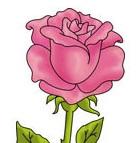
(c) Flower of rose plant
3. Can you find a plant in your house or in your neighborhood, which has a long but a weak stem? Write its name. In which category would you classify it?
Answer
Yes, i can find in my neighborhood which has a long but a weak stem.
Its name is cucumber or money plant or pea. It comes under the category of climber plants.
4. What is the function of a stem in a plant?
Answer
Functions of stem in a plant:
(i) It provides supports to the branches of plant.
(ii) It bears buds, flowers, leaves and fruits
(iii) It carries water and minerals from roots to different parts of the plant.
(iv) It also carries prepared food from leaves to the different parts of the plants.
5. Which of the following leaves have reticulate venation?
Wheat, tulsi, maize, grass, coriander (dhania), China rose
Answer
The arrangements of veins in lamina of the leaf is called venation.
The leaves of Tulsi, Coriander and China rose have reticulate venation.
6. If a plant has fibrous root, what type of venation do its leaves likely to have?
Answer
The plants having fibrous root more likely to have parallel venation.
7. If a plant has leaves with reticulate venation, what kind of roots will it have?
Answer
Plants with reticulate venation will have tap root.
8. Is it possible for you to recognize the leaves without seeing them? How?
Answer
Yes, it is possible for to recognize the leaves without seeing them by smelling or touching them. Leaves of some plants have aroma which can be recognized by smelling.
9. Write the names of the parts of a flower.
Answer
The parts of a flower are sepals, petals, stamens and pistil.
(i) Sepal: It is the small leaf-like structures which is the most prominent part in a bud.
(ii) Petals: It is the prominent parts of the open flower which is of different colours.
(iii) Stamens: It is the male reproductive part of the flower.
(iv) Pistil: It is the female reproductive part of the flower.
Answer
10. Which of the following plants have you seen? of those that you have seen, which one have flowers?
Grass, maize, wheat, chilli, tomato, tulsi, pipal, shisham, banyan, mango, jamun, guava, pomegranate, papaya, banana, lemon, sugarcane, potato, groundnut
The plants which have flowers are:
Grass, maize, wheat, chilli, tomato, tulsi, papal, shisham, banyan, mango, jamun, guava, pomegranate, papaya, banana, lemon, potato, groundnut.
11. Name the part of the plant which produces its food. Name this process.
Answer
Leaves produces the food of the plant. The process of making food in the presence of sunlight is called photosynthesis.
12. In which part of a flower, you are likely to find the ovary?
Answer
Ovary is present in the pistil of the flower.
13. Name two flowers, each with joined and separated sepals.
Answer
Two flowers with joined sepals: China rose and Cotton.
Two flowers with separated sepals: Rose and Jasmine.
NCERT Solutions for 6th Class Science: Chapter 7: Download PDF
NCERT Solutions for 6th Class Science: Chapter 7-Getting to Know Plants
Download PDF: NCERT Solutions for 6th Class Science: Chapter 7-Getting to Know Plants PDF
Chapterwise NCERT Solutions for Class 6 Science :
- Chapter 1 Food: Where Does It Come From?
- Chapter 2 Components of Food
- Chapter 3 Fibre to Fabric
- Chapter 4 Sorting Materials Into Groups
- Chapter 5 Separation of Substances
- Chapter 6 Changes Around Us
- Chapter 7 Getting to Know Plants
- Chapter 8 Body Movements
- Chapter 9 The Living Organisms and Their Surroundings
- Chapter 10 Motion and Measurement of Distances
- Chapter 11 Light, Shadows and Reflection
- Chapter 12 Electricity and Circuits
- Chapter 13 Fun with Magnets
- Chapter 14 Water
- Chapter 15 Air Around Us
- Chapter 16 Garbage In, Garbage Out
About NCERT
The National Council of Educational Research and Training is an autonomous organization of the Government of India which was established in 1961 as a literary, scientific, and charitable Society under the Societies Registration Act. Its headquarters are located at Sri Aurbindo Marg in New Delhi. Visit the Official NCERT website to learn more.