

Class 6: Science Chapter 12 solutions. Complete Class 6 Science Chapter 12 Notes.
Contents
NCERT Solutions for 6th Class Science: Chapter 12-Electricity and Circuits
NCERT 6th Science Chapter 12, class 6 Science Chapter 12 solutions
Page No: 123
Exercises
1. Fill in the blanks :
(a) A device that is used to break an electric circuit is called _______________.
(b) An electric cell has _______________ terminals.
Answer
(a) A device that is used to break an electric circuit is called electric switch.
(b) An electric cell has two terminals.
2. Mark ‘True’ or ‘False’ for following statements:
(a) Electric current can flow through metals.
(b) Instead of metal wires, a jute string can be used to make a circuit.
(c) Electric current can pass through a sheet of thermo col.
Answer
(a) True
(b) False
(c) False
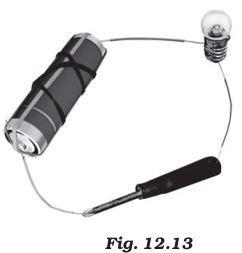
3. Explain why the bulb would not glow in the arrangement shown in Fig. 12.13.
Answer
Bulb will not glow in the arrangement because the holder of the tester used in the connection is made of plastic which is an insulator. Thus, current will not flow in the circuit.
Page No: 124
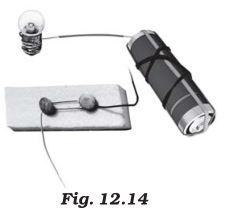
4. Complete the drawing shown in Fig 12.14 to indicate where the free ends of the two wires should be joined to make the bulb glow.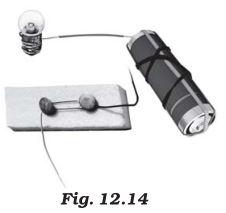
Answer
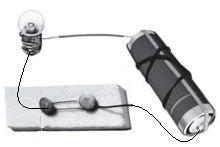
Earlier, the connection is not complete as one of the end of the cell is not connected to the switch and hence the bulb. Thus, there will be no flow of current in the circuit.
To complete the circuit, one of the end of the cell must be connected to the switch and then to the bulb. After this, bulb will start glowing as shown in the figure.
5. What is the purpose of using an electric switch? Name some electrical gadgets that have switches built into them.
Answer
An electric switch helps in making as well as breaking the circuit without removing the connection. When switch is ON, the current will flow and when switch is OFF, the current will not flow in the circuit. Thus, it also saves electricity and make the use of appliances easier.
Some electric gadgets are: Television, Iron, Washing Machine Refridgerator etc.
6. Would the bulb glow after completing the circuit shown in Fig. 12.14 if instead of safety pin we use an eraser?
Answer
No, the bulb will not glow when we will use an eraser instead of safety pin even after circuit is complete because rubber is an insulator and current will not flow through it.
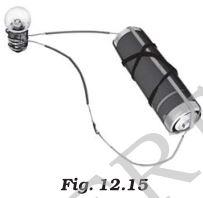
7. Would the bulb glow in the circuit shown in Fig. 12.15?
Answer
No, the bulb will not glow because the wires from both terminals of the battery are connected to the one terminal of the bulb. In order to make the bulb glow, wires should be connected to the both terminals of the bulb.
8. Using the “conduction tester” on an object it was found that the bulb begins to glow. Is that object a conductor or an insulator? Explain.
Answer
That object must be an insulator because it allows the current to flow through it and thus helped in the glowing of bulb.
9. Why should an electrician use rubber gloves while repairing an electric switch at your home? Explain.
Answer
Rubber gloves are insulator which do not allow the current to flow through it. Therefore, an electrician use rubber gloves while repairing an electric switch at your home because it protect them from the shock of electricity and for the safety purpose.
10. The handles of the tools like screwdrivers and pliers used by electricians for repair work usually have plastic or rubber covers on them. Can you explain why?
Answer
The handles of the tools like screwdrivers and pliers used by electricians for repair work usually have plastic or rubber covers on them as plastic is an insulator which protect the electricians from severe electric shocks and accidents.
NCERT Solutions for 6th Class Science: Chapter 12: Download PDF
NCERT Solutions for 6th Class Science: Chapter 12-Electricity and Circuits
Download PDF: NCERT Solutions for 6th Class Science: Chapter 12-Electricity and Circuits PDF
Chapterwise NCERT Solutions for Class 6 Science :
- Chapter 1 Food: Where Does It Come From?
- Chapter 2 Components of Food
- Chapter 3 Fibre to Fabric
- Chapter 4 Sorting Materials Into Groups
- Chapter 5 Separation of Substances
- Chapter 6 Changes Around Us
- Chapter 7 Getting to Know Plants
- Chapter 8 Body Movements
- Chapter 9 The Living Organisms and Their Surroundings
- Chapter 10 Motion and Measurement of Distances
- Chapter 11 Light, Shadows and Reflection
- Chapter 12 Electricity and Circuits
- Chapter 13 Fun with Magnets
- Chapter 14 Water
- Chapter 15 Air Around Us
- Chapter 16 Garbage In, Garbage Out
About NCERT
The National Council of Educational Research and Training is an autonomous organization of the Government of India which was established in 1961 as a literary, scientific, and charitable Society under the Societies Registration Act. Its headquarters are located at Sri Aurbindo Marg in New Delhi. Visit the Official NCERT website to learn more.