

Class 6: Science Chapter 13 solutions. Complete Class 6 Science Chapter 13 Notes.
Contents
Maharashtra Board Solutions Class 6-Science: Chapter 13- Sound
Maharashtra Board 6th Science Chapter 13, Class 6 Science Chapter 13 solutions
Questions and Answers
1. Fill in the blanks with the proper words.
Question a.
The propagation of sound does not occur through a ………….. .
Answer:
vacuum
Question b.
Noise pollution is a …………… issue.
Answer:
social/serious
Question c.
The sound which is disagreeable to our ears is called …………… .
Answer:
noise
Question d.
Noise has adverse effects on our …………….. .
Answer:
health
2. What should we do?
Question a.
The silencer of a motorcycle is broken.
Answer:
- If the silencer of a motorcycle is broken, vehicle should be immediately taken to the garage for repair.
- If silencer is not maintained properly, it will continue making loud noise on the road while in motion, resulting in increasing noise pollution.
Question b.
A factory in the surrounding is producing continuous loud noise.
Answer:
Factories should be located at a proper distance away from residential areas. Authorities should be contacted who will control the decibel level.
3. Write the answers in your own words.
Question a.
What is meant by vibration?
Answer:
Vibration of an object is necessary for the production of sound. As long as the object vibrates, the sound is heard. When the vibration stops, the sound also stops.
Question b.
Explain with the help of practical examples how sound is propagated through solids.
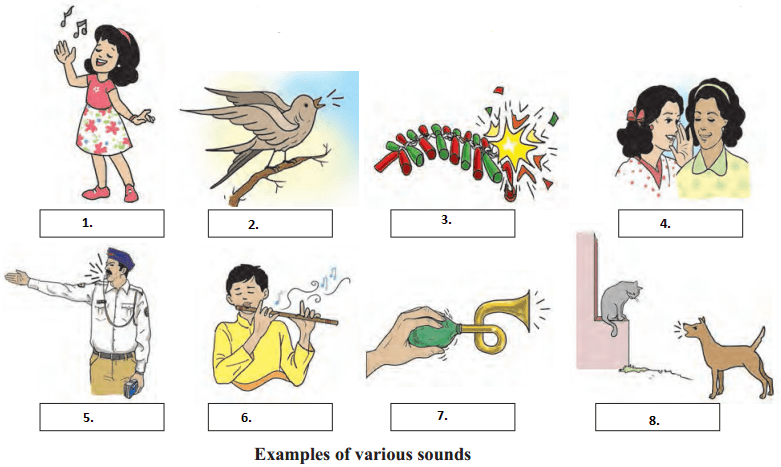
Answer:
- Singing
- Chirping of birds
- Bursting of crackers
- Whispering
- Whistling
- Flute
- Honking
- Dog barking
Question c.
What is meant by noise pollution?
Answer:
Continuous noise which has ill effects is called noise pollution.
Question d.
What measures will you take to control noise pollution?
Answer:
Measures for preventing noise pollution:
- As far as possible, we should avoid blowing horns.
- The volume of the TV or radio in the house should be restricted to those watching the programmes.
- Vehicles should be maintained properly to reduce the unnecessary sounds they produce.
- Factories, airports, railway stations and bus stands should be located at the proper distance away from residential area.
- Planting of trees helps reduce noise as trees act as a natural barrier.
4. Complete the table.
Question a.
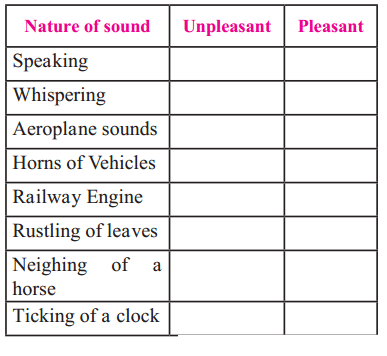
Answer:
| Nature of sound | Unpleasant | Pleasant |
| 1. Speaking | ✓ | |
| 2. Whispering | ✓ | |
| 3. Aeroplane Sounds | ✓ | |
| 4. Horns of Vehicles | ✓ | |
| 5. Railway Engine | ✓ | |
| 6. Rustling of leaves | ✓ | |
| 7. Neighing of a horse | ✓ | |
| 8. Ticking of a clock | ✓ |
Project:
Question 1.
Prepare a list of the harsh sounds mheard near your house. Write about those sounds which produce noise pollution.
Question 2.
Collect information about places where loud noise is prohibited and discuss why it is so.
Important Questions and Answers
Fill in the blanks:
Question 1.
Some sounds are ……………… and are heard easily.
Answer:
loud
Question 2.
Some sounds are very ……………… and cannot be heard unless we listen attentively.
Answer:
soft
Question 3.
As long as the object ……………… the sound is heard.
Answer:
vibrates
Question 4.
When the vibration ……………… the sound also stops.
Answer:
stops
Question 5.
The intensity of sound is measured in a unit called ……………… .
Answer:
decibels(dB)
Question 6.
The voice box is located in our ……………… .
Answer:
throat
Question 7.
Sound travels in the form of ……………… through air, water and ……………. .
Answer:
waves, solids
Question 8.
The sound is propagated more clearly through a ……………… than through air.
Answer:
solid
Question 9.
Transmission of sound occurs at a different ……………… through different mediums.
Answer:
speed
Question 10.
Continuous noise which may have ill effects, is called noise ……………… .
Answer:
pollution
Question 11.
Some of the sounds that we enjoy can be a ……………… for others.
Answer:
nuisance
Question 12.
The vibration of an object is necessary for the ……………… of sound.
Answer:
production
Answer in one sentence.
Question 1.
List characteristics of sound.
Answer:
Sounds are soft, loud, pleasant and unpleasant.
Question 2.
What do you mean by unpleasant sounds?
Answer:
The sounds by which we get annoyed are called unpleasant sounds.
Question 3.
What do you mean by loud and soft sounds?
Answer:
The sounds which are heard easily, are loud sounds and the sounds which cannot be heard unless we listen attentively, are soft sounds.
Question 4.
Which movement is exhibited by diaphragm of a speaker and a tabla?
Answer:
Diaphragm of a speaker and a tabla exhibit rapid oscillatory motion which gives rise to vibrations.
Question 6.
What is source of the sound?
Answer:
The object due to which sound is produced is called the source of the sound.
Question 7.
What is acoustics?
Answer:
The science of sound, resonance, production, propagation and effects of sound is called acoustics.
Question 8.
What produces sound in living beings?
Answer:
The vibration of the vocal chords in our larynx or voice box produces sound.
Question 9.
On what does quality of sound depend?
Answer:
Quality of sound produced in the larynx depends upon the tautness of the vocal chords.
Question 10.
How is sound propagated?
Answer:
The sound is propagated in the form of waves through air, water or through a solid.
Question 11.
Why is sound heard more clearly through solids?
Answer:
Transmission of sound occurs at a different speed through different mediums. Transmission of sound is faster through a solid than through a liquid and gas.
Question 12.
What is noise?
Answer:
A loud sound is harsh to ears. Such sounds produce noise.
Question 13.
List the effects of very loud or continuous noise on the people.
Answer:
- Very loud or continuous noise can cause hearing impairment.
- This can even lead to deafness.
- It also causes restlessness, irritability and mental exhaustion.
Question 14.
What is noise pollution?
Answer:
Continuous noise which has ill effects is called noise pollution.
Question 15.
How can we prevent noise pollution with respect to watching TV?
Answer:
The volume of the TV or radio in the house should be restricted to those watching the programmes.
Explain the terms.
Question 1.
Propagation of sound:
Answer:
Sound is said to be propagated when sound waves spread in all directions from a source of sound.
Question 2.
Medium of propagation of sound:
Answer:
The substance around a source of sound through which sound waves spread is called the medium of propagation of sound.
Question 3.
Which sounds do you hear during the recess in the school?
Answer:
During the recess in the school, we hear.
- laughing
- students running
- talking loudly
- ringing of the bell
- stamping on the staircase
- shouting
Question 4.
When there is silence in the classroom, close your eyes and sit quietly. Which sounds in your surroundings can you hear now?
Answer:
- Loud: Laughing, running, talking, horn of cars, marriage procession, school band, teacher’s voice in next classroom.
- Pleasant: P.T. teacher’s whistle, chirping of birds.
- Unpleasant: Shouting, bell ringing, stamping on staircase, dog barking, horns of vehicles.
Question 5.
When a song is being played on a radio or a music system in the house, place your hand on its speaker. What do you feel? Put off the music. What do you feel now?
Answer:
- When a hand is placed on the speakers of the music system, we feel vibrations on the hand.
- When music is put off, we don’t feel any vibrations on the hand.
Question 6.
When a metal dish falls on the floor; it makes a loud noise. What do we do to stop the noise? What is the effect of that action?
Answer:
To stop the noise of metal dish falling on the floor, quickly put hand on the dish. Vibrations of the metal dish are stopped and the noise stops.
Question 7.
What is it that vibrates when the sounds of sitar, bell, water tap, and breaking of a saucer, etc. are produced?
Answer:
Strings of the sitar, tongs of the bell, water drops hitting the floor of the basin, pieces of saucers that hit the ground vibrate to produce the sounds.
Question 8.
Take a pot full of water. Strike it lightly on the rim. What do you see? Why are waves formed on the water in the pot?
Answer:
- We see ripples on the water.
- When we strike the rim of the pot, our striking causes vibrations. These vibrations are transferred or moved from the pot to the water. Hence, water waves/ripples are seen on the water in the pot.
Question 9.
On rubbing balloon filled with water and another filled with air, of which balloon do we hear a clear or sound?
Answer:
We hear a clearer sound of the water balloon.
Question 10.
If a bell is rung in a vacuum container, will its sound be heard outside?
Answer:
Its sound will not be heard outside.
Observe and Discuss.
Observe the figure and answer the questions.
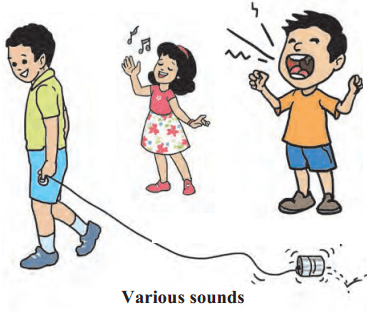
Question 1.
Which of these sounds is pleasant?
Answer:
The singing of the girl is a pleasant sound.
Question 2.
Which sound is a nuisance to people?
Answer:
- Boy shouting/screaming.
- Boy moving/ walking with a toy rattle.
Observe the figure and answer the following.
Question 1.
Make a list of all sounds implied in the picture.
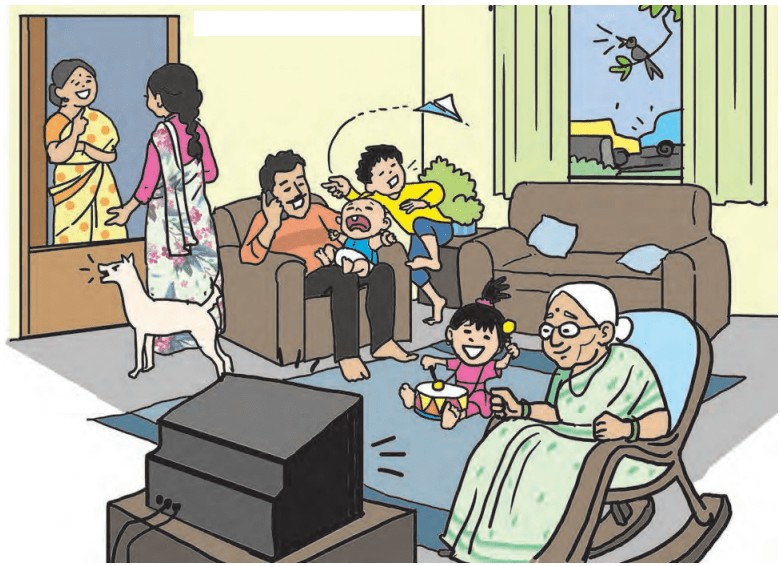
Answer:
- Chirping of bird outside the house on the tree.
- Collision of two vehicles – honking of the vehicles.
- Baby crying.
- Father talking on the phone.
- Brother playing in the house – jumping.
- Sister playing the drum – hitting the drum.
- Sound of TV.
- Dog barking.
- Mother talking to the neighbour.
Question 2.
How would this atmosphere affect a person who is not feeling well?
Answer:
This atmosphere is not convenient for a patient who is ill. He cannot take rest.
Question 3.
Would you be able to study in these conditions?
Answer:
No, students cannot study in this condition. They cannot concentrate on their study.
Download PDF
Maharashtra Board Solutions Class 6-Science: Chapter 13- Sound
Download PDF: Maharashtra Board Solutions Class 6-Science: Chapter 13- Sound PDF
Chapterwise Maharashtra Board Solutions Class 6 Science :
- Chapter 1- Natural Resources – Air, Water and Land
- Chapter 2- The Living World
- Chapter 3- Diversity in Living Things and their Classification
- Chapter 4- Disaster Management
- Chapter 5- Substances in the Surroundings – Their States and Properties
- Chapter 6- Substances in Daily Use
- Chapter 7- Nutrition and Diet
- Chapter 8- Our Skeletal System and the Skin
- Chapter 9- Motion and Types of Motion
- Chapter 10- Force and Types of Force
- Chapter 11- Work and Energy
- Chapter 12- Simple Machines
- Chapter 13- Sound
- Chapter 14- Light and the Formation of Shadows
- Chapter 15- Fun with Magnets
- Chapter 16- The Universe
FAQs
You can download the Maharashtra State Board Books from the eBalbharti official website, i.e. cart.ebalbharati.in or from this article.
Students can get the Maharashtra Books for primary, secondary, and senior secondary classes from here. You can view or download the Maharashtra State Board Books from this page or from the official website for free of cost. Students can follow the detailed steps below to visit the official website and download the e-books for all subjects or a specific subject in different mediums.
Step 1: Visit the official website ebalbharati.in
Step 2: On the top of the screen, select “Download PDF textbooks”
Step 3: From the “Classes” section, select your class.
Step 4: From “Medium”, select the medium suitable to you.
Step 5: All Maharashtra board books for your class will now be displayed on the right side.
Step 6: Click on the “Download” option to download the PDF book.
As of now, the MSCERT and Balbharti are responsible for the syllabus and textbooks of Classes 1 to 8, while Classes 9 and 10 are under the Maharashtra State Board of Secondary and Higher Secondary Education (MSBSHSE).
The Maharashtra State Board of Secondary & Higher Secondary Education, conducts the HSC and SSC Examinations in the state of Maharashtra through its nine Divisional Boards located at Pune, Mumbai, Aurangabad, Nasik, Kolhapur, Amravati, Latur, Nagpur and Ratnagiri.
About Maharashtra State Board (MSBSHSE)
The Maharashtra State Board of Secondary and Higher Secondary Education or MSBSHSE (Marathi: महाराष्ट्र राज्य माध्यमिक आणि उच्च माध्यमिक शिक्षण मंडळ), is an autonomous and statutory body established in 1965. The board was amended in the year 1977 under the provisions of the Maharashtra Act No. 41 of 1965.
The Maharashtra State Board of Secondary & Higher Secondary Education (MSBSHSE), Pune is an independent body of the Maharashtra Government. There are more than 1.4 million students that appear in the examination every year. The Maha State Board conducts the board examination twice a year. This board conducts the examination for SSC and HSC.
The Maharashtra government established the Maharashtra State Bureau of Textbook Production and Curriculum Research, also commonly referred to as Ebalbharati, in 1967 to take up the responsibility of providing quality textbooks to students from all classes studying under the Maharashtra State Board. MSBHSE prepares and updates the curriculum to provide holistic development for students. It is designed to tackle the difficulty in understanding the concepts with simple language with simple illustrations. Every year around 10 lakh students are enrolled in schools that are affiliated with the Maharashtra State Board.